I learned something very helpful from this. He’s been playing guitar from a young age, and provides some ideas about how to think about improvisation in this short video. ABN
While Brian Harpool attempts to use “lawfare” to silence the investigation by suing@RealCandaceO for defamation, we are putting the actual footage of September 10th up against the standard of medical science.
One of the central claims in Harpool’s defamation suit is the allegation that he did perform first aid on Charlie Kirk. But “performing first aid” isn’t a subjective opinioN—it is a medical procedure.
We’ve juxtaposed the footage from that day with an expert emergency medical instructor to show you what should have happened versus what actually did.
The Medical Standard:The Injury: Charlie’s carotid artery was hit. As the instructor explains, carotid blood is bright red and spurts. Without immediate intervention, a person goes unconscious in 20 seconds and dies within 60 seconds.
The Fix: The only way to stop a carotid bleed is to create a gauze “ball,” squish the vessel down, pack the wound, and wrap it in plastic to prevent air bubbles (air embolisms) from entering the bloodstream and stopping the lungs.
The Reality: When you watch the footage of Brian Harpool and the inner circle around Charlie, you don’t see wound packing. You don’t see the specific, high-pressure “squish” required to hold back a carotid spurt. You see a bunch of buffoons who’s main priority seemed to be getting him out of the public eye and chucking him into the back their suv like a sack of luggage. ZERO attempt at first aid.
The Most damning of all is the footage showing the actual EMTs on scene being refused access to Charlie. Why why would they prevent professionals with the proper equipment—gauze, clamps, and plastic seals—from taking over?
The Truth Isn’t Defamation Brian Harpool can sue all he wants, but he can’t sue the anatomy of the human neck. If the carotid was hit, and the protocol shown by the medical instructor was not followed, then “first aid” was not performed. TPUSA is trying to use the legal system to rewrite what our own eyes saw on that video. They want to punish the “noticing” community for pointing out that the people closest to Charlie did the exact opposite of what was needed to save his life.
If a man is spurting bright red blood from the neck, and you spend 60 seconds blocking the medics instead of packing the wound, that isn’t “first aid”—it’s a choice.
RT to demand the full, unedited medical examiner’s report. They can’t sue the facts.
I have wondered about their claim of doing first-aid. Is the spelling Harpool deliberate? I am a world-class, extremely bad speller, so can understand. ABN
…[After WW2], monopoly capitalism absorbed the world through debt, trade, media, technology, and corporate consolidation.
The result is the strange hybrid we live under today: corporate communism from above.
Private ownership for the few. Managed dependency for the many.
Who Won World War II?
The ordinary soldier did not win.
The bombed civilians did not win.
The raped women of Eastern Europe did not win.
The Christians sent to gulags did not win.
The British public did not win. Despite Britain’s continued role within the postwar international order, the public was left with heavy debt and prolonged austerity.
The American people did not win either—over 400,000 were killed, while U.S. institutions emerged with unprecedented federal debt and a permanently expanded war economy.
Poland suffered catastrophic losses during the war, with an estimated 5.5 to 6 million people killed—around one-sixth of its population—yet did not emerge as a fully independent state in the postwar settlement, but became part of the communist sphere of influence.
The Germans did not win. The country and its major urban and civilian centres were devastated by sustained bombing, millions were displaced or expelled from Eastern Europe. An estimated 6–7 million German soldiers and civilians lost their lives during the war and its immediate aftermath, and between 12 and 14 million ethnic Germans were displaced or expelled from Eastern Europe, with many forced into occupied Germany while others were deported eastward into communist labour camps or used as forced labour.
With over 20 million deaths, the Soviet population—including Russians, Ukrainians, Belarusians, Baltic peoples, and others—certainly did not win, if by “victory” we mean the experience of the people rather than the outcome for the Soviet state.
The winners were the institutions that emerged stronger: central banks, military contractors, intelligence agencies, supranational bodies, ideological bureaucracies, and the financial interests able to profit from destruction and reconstruction alike.
The war did not end in 1945. It changed form.
The battlefield shifted—from territory to finance, from armies to institutions, from open conflict to systems of management and global governance.
The old empires flew flags. The modern order operates through frameworks.
Institutions such as the United Nations matter not because they command openly, but because they reflect a broader postwar principle: that sovereignty is increasingly shaped, guided, and constrained through supranational structures.
I believe almost all thoughtful people can agree with the highlighted paragraph above. Who are the strongest players inside that system and what goals are they pursuing — these are the questions which face us today. Who controls the propaganda, who owns its outlets; who advocates for censorship; who uses established institutions to control large populations; who controls those institutions and how were they built, and how have they been taken over? What can possibly replace insider control of major institutions, and where does the power lie to do that? I don’t see it. We the people cannot do that. We the people can only act effectively when largely united, a rare occurrence. There may be a role for some future iteration of AI to remove most if not all of the corruption, contradictions, frictions and inefficiencies within regional and global systems. I imagine we humans will try to do that and might succeed. A good version of a world like that will provide for everyone without stifling anyone. At core, most of our problems are fairly simple, so it could happen. ABN
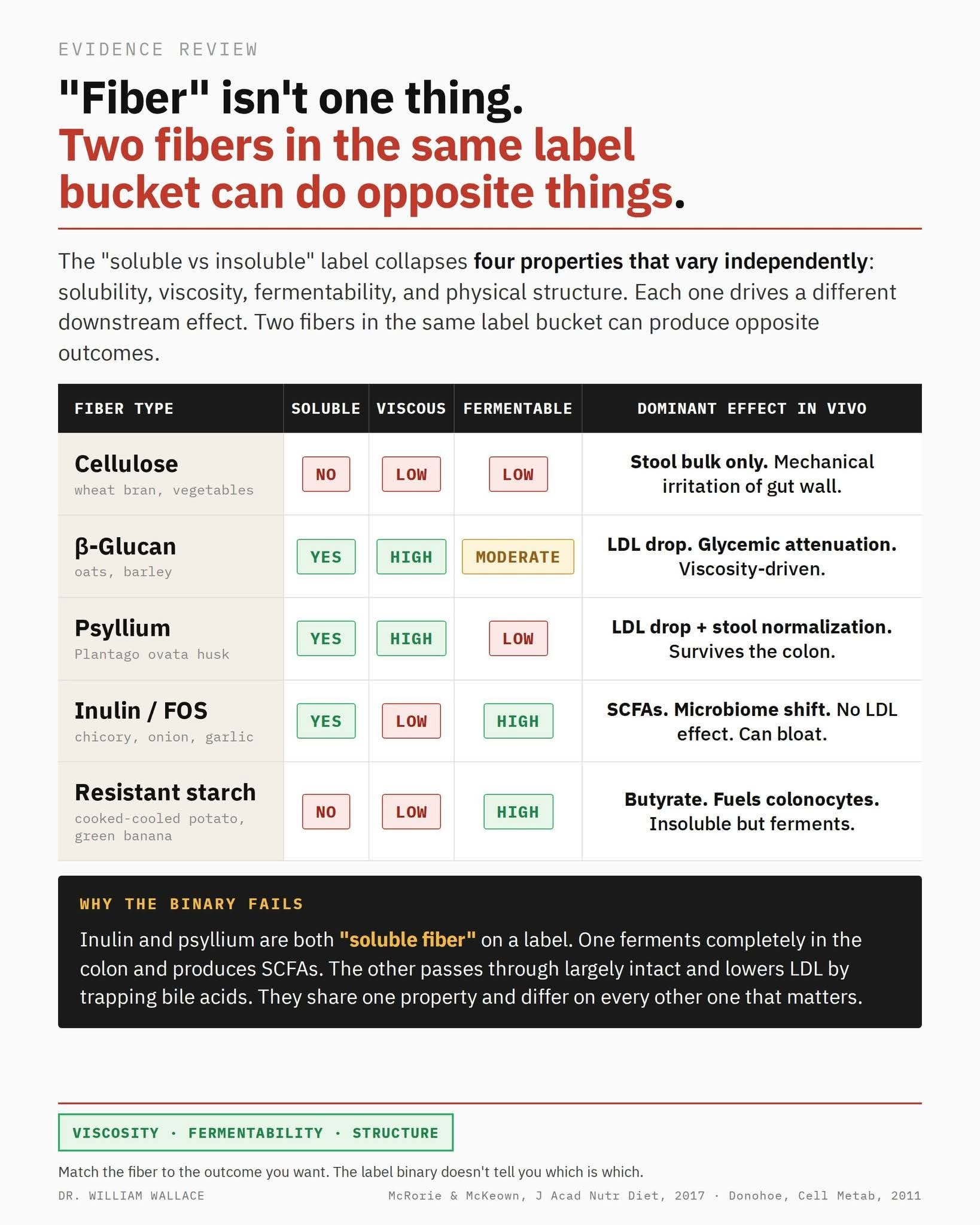
“Soluble vs insoluble” is one of the most enduring oversimplifications in nutrition. Two fibers in the same label bucket can do completely opposite things in your body.
Fiber has at least four properties that vary independently:
Solubility (does it dissolve in water?)
Viscosity (does it form a gel?)
Fermentability (do colon bacteria eat it?)
Physical structure (intact or particulate?) Each property drives a different outcome. The label binary collapses all four into one.
β-Glucan (oats, barley). Soluble, highly viscous, moderately fermented. Lowers LDL via bile acid sequestration. The FDA-approved oat health claim is built on this property.
Psyllium. Soluble, highly viscous, poorly fermented. Survives intact through the colon. Lowers LDL. Normalizes stool (works for both constipation and diarrhea).
Inulin / FOS (chicory, onions, garlic). Soluble but non-viscous. Highly fermentable. Bifidobacteria use it as substrate to produce SCFAs. Minimal LDL effect. Can bloat.
Resistant starch (cooked-cooled potato, green banana). Insoluble but highly fermentable. Produces butyrate, the primary fuel for colonocytes (~70% of their ATP).
Why the binary fails:
Inulin and psyllium are both labeled “soluble fiber.” Inulin ferments completely, produces SCFAs, has only minimal LDL effects. Psyllium passes through largely intact and lowers LDL via bile acid sequestration. They share one property and differ on every other one that matters. Practical translation. Match the fiber to the outcome:
LDL drop → viscous fibers (psyllium, β-glucan, raw guar gum)
Microbiome support → fermentable fibers (inulin, FOS, resistant starch)
Regular stools → either viscous gel-formers or coarse insoluble particles
The label binary doesn’t tell you which is which. The properties do.
…human language is a tool for communicating our thoughts, but is separate and distinct from thought itself. Evelina Fedorenko, a neuroscientist at MIT and lead author of the paper laying out the empirical evidence for this claim, was kind enough to let me interview her. Her basic argument is that we know language must be separate from thought because (a) people who lose language ability can still think and reason, and (b) different parts of the brain activate when we engage in different types of thought, and often the “language part” remains idle when we’re thinking. In my view, this evidence deals a serious blow to the hopes of achieving “artificial general intelligence” through the scaling of large-language models since, after all, they are language tools (it’s in the name).
Enter now stage left Dr. Paul Cisek, a neuroscientist at the University of Montreal, to throw some gasoline on that fire. Cisek first came across my radar last year when a pithy observation he made about LLMs started making the rounds on social media. You can read his full comment here, but to summarize:
We know that humans in general can falsely impute intelligence and agency to complex events that take place in the world, as we’ve seen humans do this in the past when interacting with a chatbot such as ELIZA, or claiming the gods make volcanoes explode.
But although modern-day LLMs are complex, researchers know quite a bit about how they function, through pattern-matching and use of mathematical theories (among other things).
Thus, although the public may be inclined to attribute sentience and agency to LLMs, scientists should know better. Cisek: “We are like a bunch of professional magicians, who know where all of the little strings and compartments are, and who know how we just redirected the audience’s attention to slip the card in our pocket…but then we are standing around backstage wondering, ‘Maybe there really is magic?’”
There isn’t any magic. But a big challenge we face is that the companies that produce LLMs are willfully trying to convince us otherwise, and are working to take advantage of the human impulse to ascribe agency to these tools.
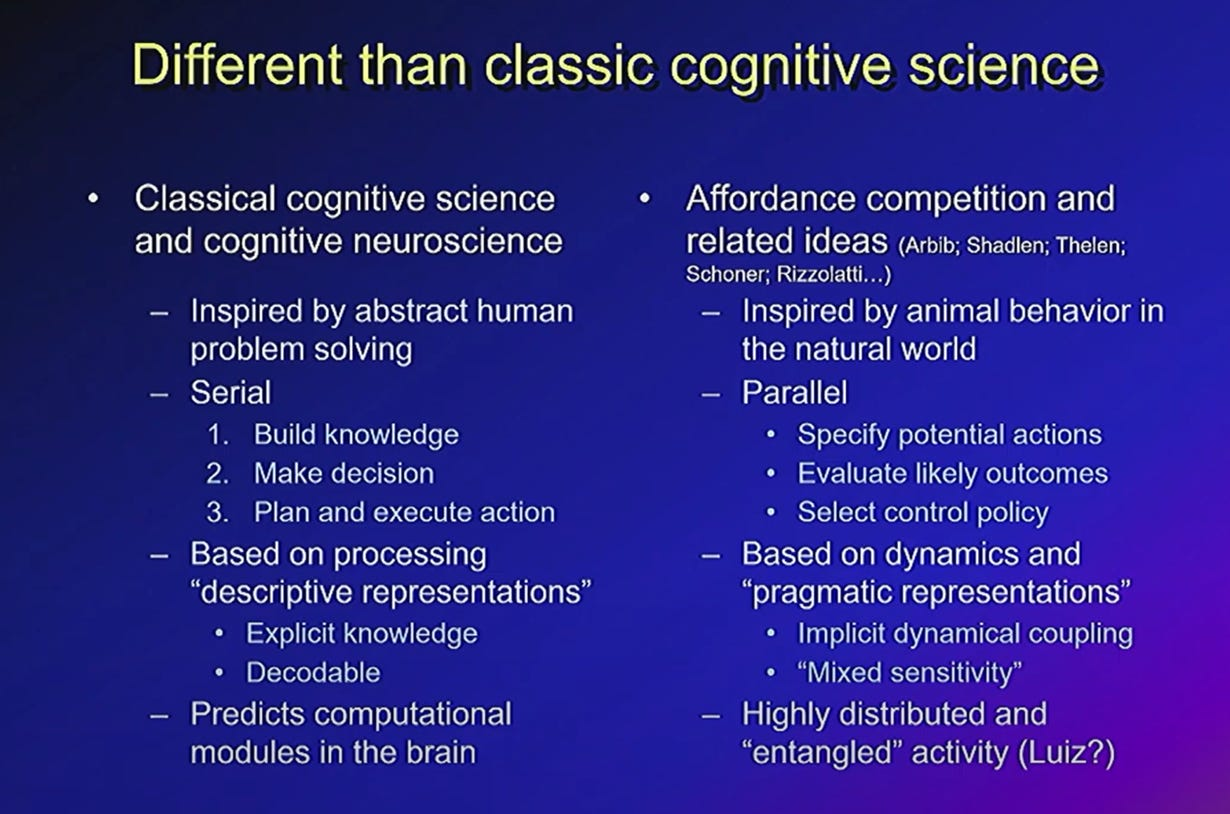
Cisek’s main claims as I understand them:
The simple model of the mind as an information processor that takes input and produces output is mistaken.
We should instead see minds as control systems that guide behavior as part of a continuous process, like a circuit.
Over hundreds of millions of years, biological evolution has expanded the range and depth of behaviors that our minds can control.
I have taken several excerpts from the essay above to provide a sense of the overall discussion. It’s an interesting read, not very long, not hard to follow. Well-worth reading. ABN
Gödel’s Incompleteness Theorems demonstrate that any sufficiently powerful formal system contains truths that cannot be proven from within the system, implying that complete understanding requires a perspective outside the system.
In philosophical and theological interpretations, this limitation is often mapped to the distinction between immanent knowledge (within the system) and transcendent awareness (outside the system).
1. The Structural Limitation
Internal Incompleteness: Gödel proved that a system cannot prove its own consistency or grasp all its own truths; there are always statements that are true but unprovable within the system’s axioms.
The “Outside” Perspective: To comprehend the complete picture or verify the system’s consistency, one must step outside the logical framework, accessing a higher order of intelligibility or a “super axiom.”
2. Application to Buddhist Epistemology
Samsara vs. Nibbāna: In this analogy, the “system” represents Samsara (the cycle of existence and conventional logic), while the “outside” represents Nibbāna (the unconditioned state).
Transcendent Awareness: A being within the system (a sentient being) cannot cognize the ultimate truth of the system from within. Only by transcending the system—achieving Arahanthood or Buddhahood—can one “see things as they are” from the outside.
Greater vs. Lesser: Consequently, the “lesser” cognition (bound by internal logical limits and dualistic perception) cannot fully comprehend the “greater” transcendent awareness (which encompasses the total system from a non-dual, external vantage point).
3. Philosophical Implications
Limits of Human Reason: This aligns with the view that human reason and formal logic are inherently limited and cannot grasp ultimate reality without intuitive or transcendent insight.
God and the Super Axiom: Similarly, in theological interpretations, Gödel’s work suggests the existence of a higher intelligence (God) or “super axiom” that exists outside the created system, sustaining it from a position of complete knowledge that finite beings cannot access internally.
Thus, Gödel’s logic provides a formal mathematical basis for the idea that ultimate truth is inaccessible to the system itself, requiring a transcendent standpoint for full comprehension.
I would add that FIML practice allows us to step outside of the psycholinguistic system we use to communicate with our partner, and others. There is some chance FIML partners could become lost in a folie à deux, or shared psychosis, but odds of this are very low, imo, especially if partners frequently refer to philosophies, thoughts, ideas, and evidence outside of their world as a couple. FIML provides a kind of parallax for both partners psycholinguistic systems as well as the two systems working together as one. FIML cannot completely solve the inherent ambiguousness of interpersonal communication but it can improve our understanding (or resolution1) of our communications by at least one order of magnitude, or more. ABN
the process or capability of making distinguishable the individual parts of an object ↩︎
The ongoing debate surrounding the relationship between Christianity and Jewish scripture has grown increasingly complex over recent decades, with critics like Laurent Guyénot arguing that Christianity did not merely absorb Jewish texts but was, in its very essence, molded by them. This perspective suggests that the core tenets of Christianity—such as notions of divine election and messianic expectation—reflect a deeper Jewish influence that has shaped Western civilization. Guyénot posits that Christianity became the primary conduit through which Jewish metaphysical concepts were disseminated to Gentile cultures. This appropriation, he argues, led to a civilization that, while claiming to worship a universal God of love, effectively organized itself around Jewish messianic aspirations. Such claims, while provocative, warrant careful scrutiny, particularly in the context of differing interpretations within the Christian tradition itself.
Guyénot’s analysis operates on two levels: one historical and one theological. He outlines a historical trajectory wherein the Latin Church gradually compromised its original theological foundations, becoming increasingly intertwined with the Jewish tradition it initially sought to transcend. However, he also asserts that Christianity inherently bore the Jewish imprint from its inception. Critics argue that this latter claim lacks sufficient evidence, suggesting instead that the issues Guyénot raises are symptomatic of a divergence within Christianity itself, particularly between Western and Orthodox traditions. The Orthodox Church, they argue, has consistently maintained a distinct theological identity that diverges from Western Christianity’s post-Filioque developments, and it has preserved the apostolic inheritance against various historical assaults.
The crux of the disagreement lies in the differing interpretations of salvation and grace between Orthodoxy and Western Christianity. While Orthodoxy emphasizes the transformative aspect of salvation as theosis—union with God through divine grace—Western traditions, particularly post-Filioque, have tended to frame salvation in more legalistic terms, akin to a change in legal status before God. This theological divergence has far-reaching implications, leading to fundamentally different understandings of the relationship between God and humanity. The Orthodox perspective maintains that the ultimate aim of Christian life is the restoration of communion with God, contrasting sharply with Western thought, which has often conceived salvation as a transactional relationship governed by legal categories.
Ultimately, the historical and theological complexities surrounding Christianity’s relationship with Judaism raise important questions about the nature of religious identity and the interpretation of scripture. While Guyénot’s thesis regarding the “Judaization” of Christianity has garnered attention, it is essential to recognize the diversity within Christian thought itself. The Orthodox tradition, with its emphasis on theosis and the uncreated divine life, offers a counter-narrative to the claims of inherent corruption within Christianity. The ongoing dialogue between these perspectives highlights not only the historical intersections between Christianity and Judaism but also the broader implications for understanding the evolution of religious thought in Western civilization. This discourse challenges adherents to critically engage with their theological foundations, ensuring that they are rooted in a coherent understanding of their faith that honors both tradition and scripture.
I am posting this because it explains Utah’s unique law on victims rights to a ‘speedy trial’; and also because Erika is not without suspicion, thus rendering her ineligible to invoke this law. Moreover, given the paucity of evidence against Tyler Robinson and the prosecution’s dilatory and incomplete disclosures of said evidence, it looks bad to speed this trial to a hasty conclusion. ABN
Full video:
__________
UPDATE: The full vid is worth watching because De Gregorio very reasonably suggests that Candace Owens file as a ‘close friend’ of the victim and request the trial not be speedy but deliberate, careful and fair. ABN
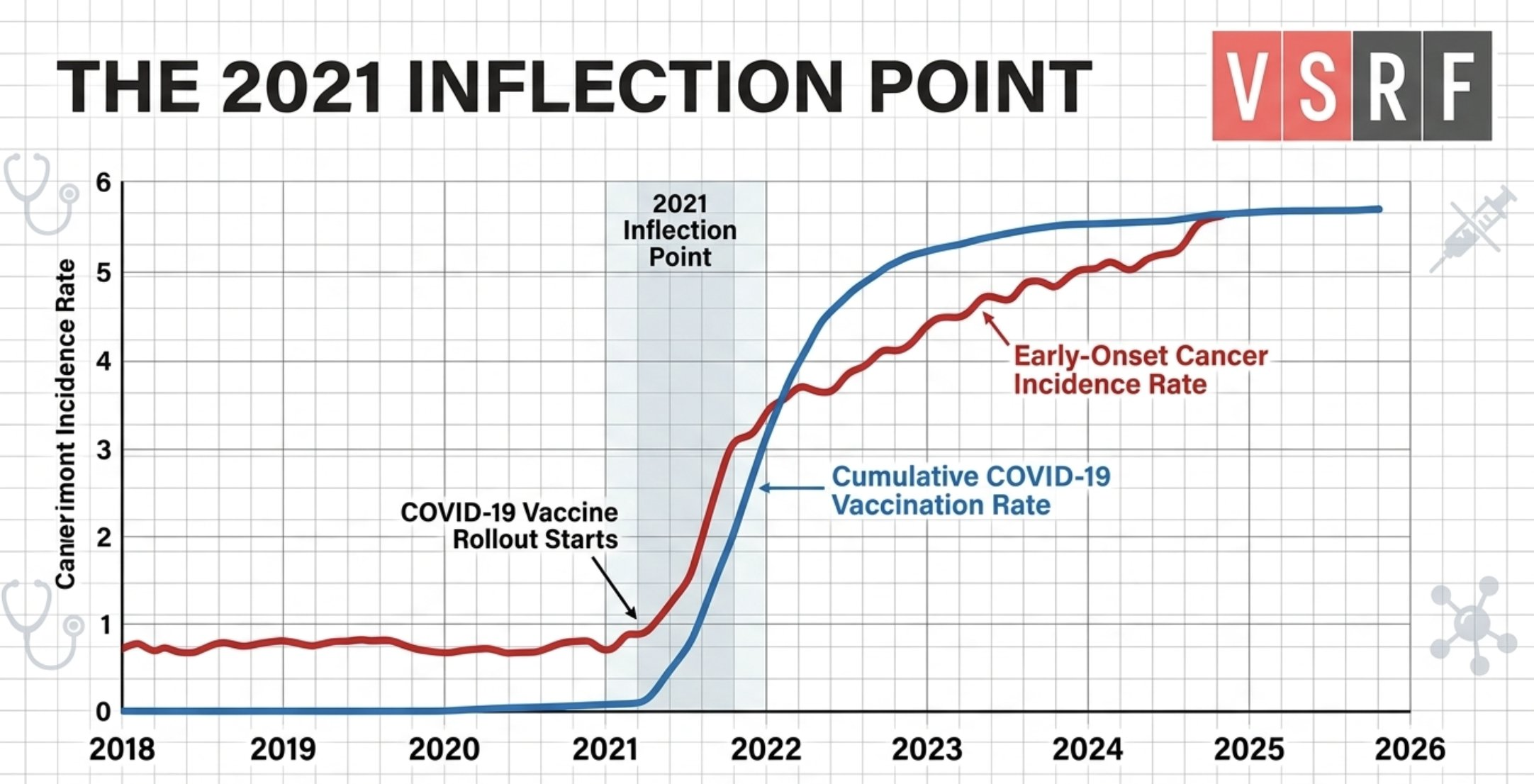
According to the latest 2026 reports from the National Cancer Institute (SEER) and the@AmericanCancer Society, since 2021, there has been a documented acceleration in #turbocancers, specifically colorectal, breast, and brain tumors, in adults under 50.
Millions believe this is proof positive of the the long-term immunological impact of mass mRNA #covidvaccination, yet the medical community refuses to do a proper investigation and/or end this disastrous campaign.
The timing of this surge is a massive red flag. We need transparency, independent safety data, and a relentless search for the truth.
Three Signs, or Trilakṣaṇa: All dharmas are anitya ‘impermanent’…. All dharmas are duḥkha ‘unsatisfactory, imperfect, unstable’…. All dharmas are anātman ‘without an innate self-identity. (dharmas means ‘things’)
By basing meditation practice on the Three Signs, we can achieve nirvana.
This is the simplest or shortest way to describe Buddhism. It appears to also be the most ancient way to describe Buddhism. This basic description is historically attested to within approximately 100 years of the Buddha’s passing.
The Noble Eightfold Path is also an excellent way to describe and understand Buddhist practice. It is not historically attested until several centuries after the Buddha’s passing.
Buddhism is a living tradition which develops and responds to new information and societal differences. Something that is true and helpful, like the Noble Eightfold Path, is good Buddhism. Buddhism is not based on sacred texts but on mind-to-mind teaching and insight, both philosophical (the Three Signs) and experiential (samadhi/ nirvana).
The Three Signs include duhkha, which is often misleadingly translated as ‘suffering’, or worse, ‘lifelong suffering’. The much better translation of duhkha is ‘badly standing’ or ‘unstable’. With this in mind, the Four Noble Truths may be considered slightly misleading since the First Noble Truth is often called the Truth of Suffering. The Four Noble Truths are not attested historically until several centuries after the Buddha’s passing.
Nirvana and deep meditative states are something we experience.. There is no substitute for this experience. All of Buddhist practice is aimed at experiencing nirvana. Nirvana can be attained in this life. ABN
Bayesian belief or perspective in some respects possibly co-relates with FIML as both are able to update expectation based on accumulating data insight, particularly as a kind of Thomas Kuhnian or Zen insight. The more reductive method of scientific expectation cognizes realization, reality, as statistical summaries across repeated events. These two types correlate, in degrees, to Kantian Noumenon and phenomenon, and to his notion of categorical decisions.
Beginning with Cantor’s Uncountability and Power Set Theorems, then Godel’s two Incompleteness Theorems, and Tarski’s Undefinability of Truth Theorem, it is presently accepted proof in logic-mathematics circles that there is no earth-touching mudra Truth gesture within “Human, All too Human” ratiocination. Cf Wittgenstein’s “Whereof one cannot speak, thereof one must be silent.” Both Gautama’s mudra and Jesus’ comparable “mudra” of Silence standing in the “What is truth?” Biblical scene witness to a Truth-claim of Mind re which human inquiry thereat Cantor, Godel, Tarski, et al. have satisfactorily shown to be coincidentally incomplete and therefore indefinite.
__________
I completely agree with paragraph one above. That is precisely what FIML does and it is in line with both ancient and modern philosophy and modern mathematics and science. As for paragraph two, I also agree with it but want to add that Buddhist practice provides a fundamental experience, which is typically lacking in Western philosophy. That experience is the experience of the samadhi states, including nirvana which is the purest of the samadhi states. If we use words to describe nirvana, we might say it is the experience of pure awareness of pure consciousness. It is the knowable and observable ‘going out’ of delusion, leaving the experiencer with nothing but pure awareness. This is an attainable state in this life, achievable through meditation. ABN

 American Buddhist Net