A mysterious detail hidden inside one of the world’s most famous religious images may defy conventional explanation, proving it might just be a miracle.
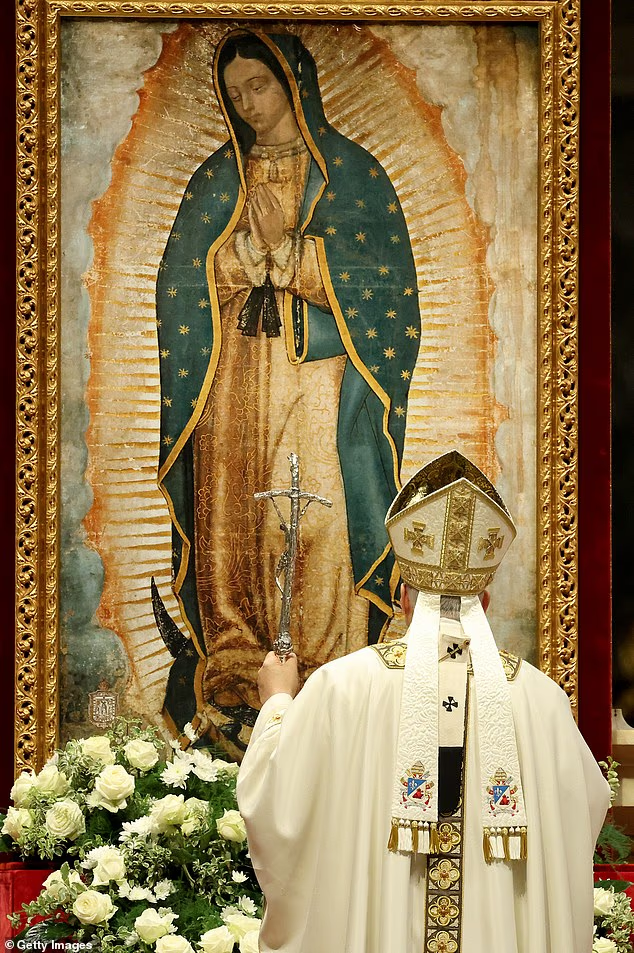
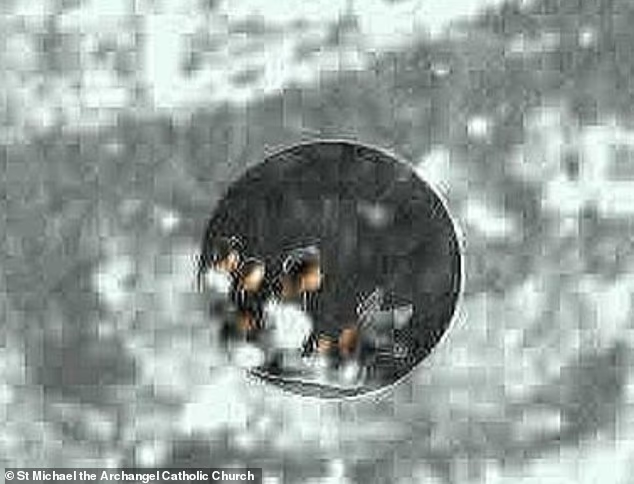
Scientists analyzing the Tilma of Guadalupe, a cactus-fiber cloak that Christians believe bears a miraculous image of the Virgin Mary, claimed they discovered at least 13 tiny human figures embedded within the eye.
The reflections are so small they can only be seen through digital enlargement, yet researchers said they resemble witnesses present when the artifact was first revealed in the 16th century.
After digitally processing high-resolution images, investigators also reported that sections of the face, hands, robe and mantle appear to have been applied in a single step, with no sketches, corrections or visible brush strokes.
‘The image of Our Lady of Guadalupe has been the subject of numerous technical studies since 1751,’ researchers wrote, adding that despite extensive investigation, ‘none of the results offered any sound scientific explanation, which up to this very day defies science and all human reasoning.’
Scientists have analyzed the Tilma of Guadalupe, a cactus-fiber cloak that Christians believe bears a miraculous image of the Virgin Mary, for decades, uncovering hidden details in her eye
The reflections are so small they can only be seen through digital enlargement, yet researchers said they resemble witnesses present when the artifact was first revealed in the 16th century. Further analysis suggested the reflections contain multiple figures, including witnesses who were allegedly present when the tilma was first displayed in 1531
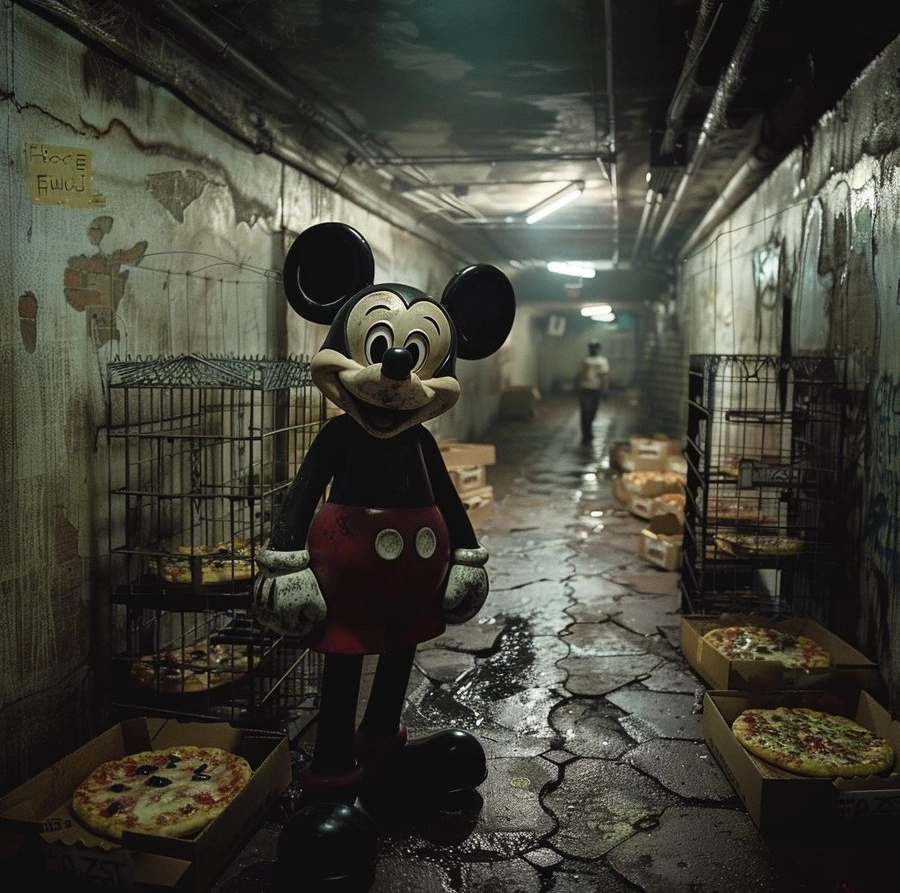
This is a masterpiece of dark parody and dark humor. Its callous buffoonery suits the horror and absurdity of the attack on Iran and the central role of maniacal Jewish Supremacism. ABN
Over 40,000 years ago, our early ancestors were already carving signs into tools and sculptures. According to a new analysis by linguist Christian Bentz at Saarland University and archaeologist Ewa Dutkiewicz at the Museum für Vor- und Frühgeschichte (Museum of Prehistory and Early History) in Berlin, these sign sequences have the same level of complexity and information density as the earliest proto-cuneiform script that emerged tens of thousands of years later, around 3,000 B.C.E.
Using a computational approach, the team examined over 3,000 signs found on 260 objects to reveal insights into the origins of writing. Their findings, which have been published in the journal PNAS, were clear—and surprised even the researchers.
Paleolithic objects dating back between 34,000 and 45,000 years bear mysterious sign sequences—often repeated lines, notches, dots and crosses. Many of these artifacts were discovered in caves in the Swabian Jura, such as a small mammoth found in the Vogelherd Cave in Lone Valley in southwestern Germany.
A Stone Age human carved the mammoth figurine out of a mammoth tusk and carefully engraved it with rows of crosses and dots. Other artifacts found in the Swabian Jura are also etched with signs.
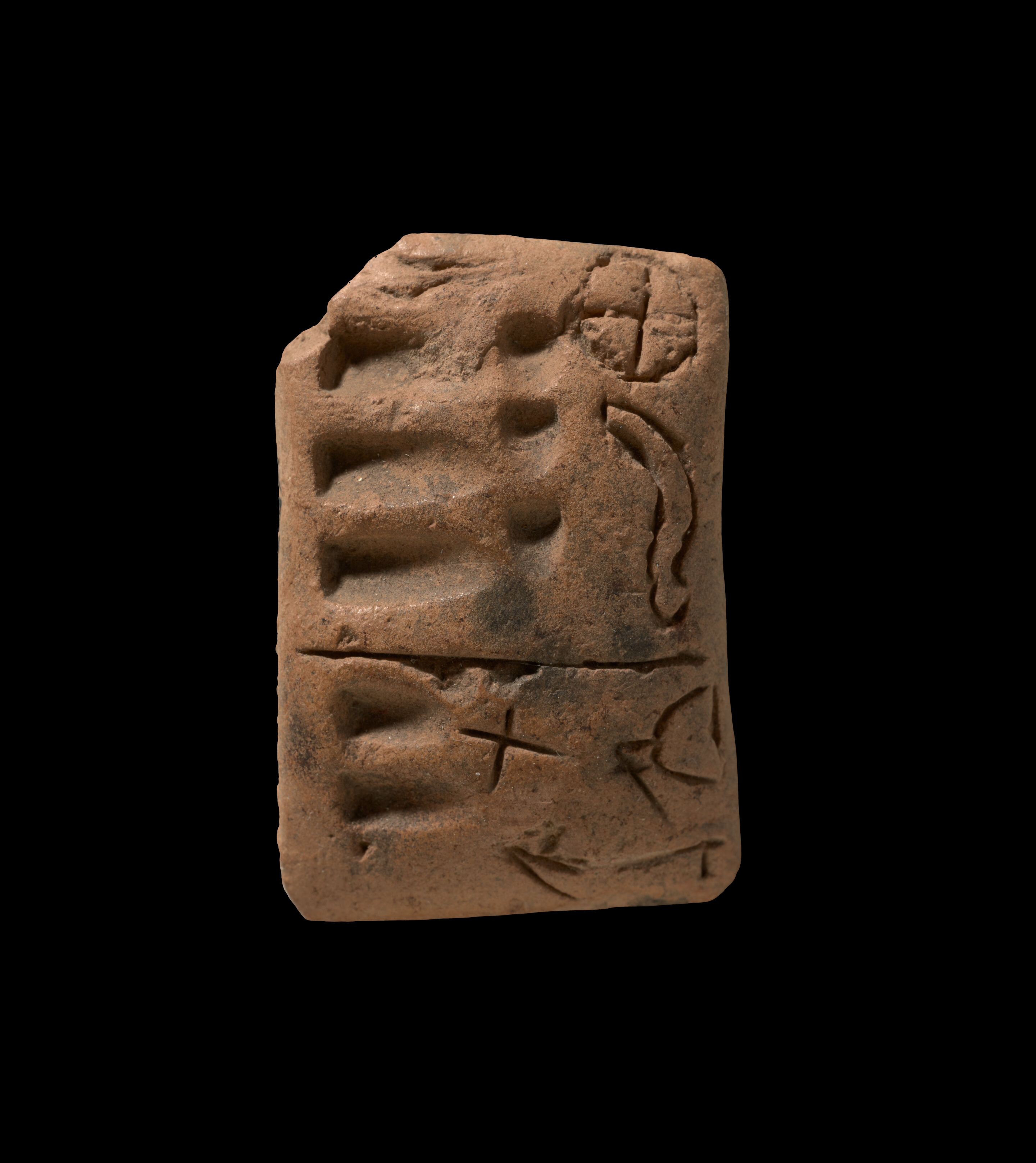
Proto-cuneiform tablet of the Uruk IV period (VAT 14774). This so-called numero-ideographic tablet features number signs on the left-hand side and more diverse ideographs on the right-hand side. This tablet is additionally partitioned by a horizontal line. Credit: Staatliche Museen zu Berlin, Vorderasiatisches Museum / Olaf M. Tesmer, CC-BY-SA 4.0
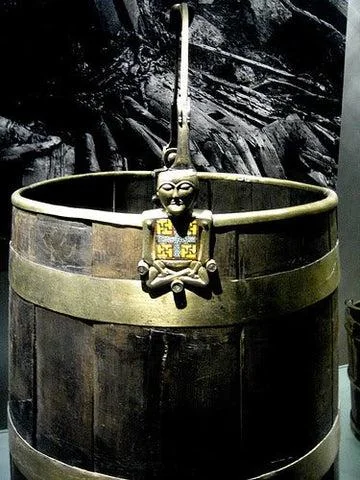
The Buddha bucket had a figure making the joint of the bucket handle. That figure was practising the meditation position. He sat on the lotus position (“Padmāsana”). His head flat. Eyes closed and facial expression sank. The decorations on the chests were in the yellow, red, and blue colours. It was the swastika illustrating the front of the Buddha’s cloak. The swastika in Buddism meant luck, good fortune, and blessing.
The Vikings must have met the Buddhists from other regions during their voyages or the newcomers came to Scandinavian countries to trade.
When people say ‘Vikings’ they usually picture longships raiding England.
Here’s what actually happened over 300 years: → Norwegians settled Iceland, Greenland, and reached North America → Danes conquered half of England and Normandy → Swedes built trade empires stretching to Baghdad
Three different expansion patterns from three Scandinavian homelands. One map that tells the whole story.
And…. 960 years later, in 2026, their original territories and Western strongholds are paying invaders to cum and outbreed them. Thirty-five years ago, Norway and Sweden were the most respected nations in the world. Today Sweden has the highest rape rate in the EU. My guys, this will not go away unless you do something. ABN
“Trash / garbage, get out of Japan! Scram / get lost already!”
This anime reflects rising nationalist sentiments in Japan, where public discourse on immigration intensifies due to demographic pressures like an aging population (projected to shrink by 30% by 2070 per UN data), yet polls (e.g., 2023 Pew Research) show over 70% of Japanese favoring cultural homogeneity over increased inflows.
UPDATE: I lived in Japan for over four years. Generally speaking, educated Japanese I spoke with were well-aware of Jewish covert behavior and wary of it. Japanese so-called antisemitism is actually the awareness of their tribe of the danger of the Jewish tribe. The views expressed in the short video above strike me as reflecting what I heard personally from intelligent, wealthy and well-educated Japanese, including respect for warriors outside of Japan. I myself have experienced horrific violence at the hands of Jewish Supremists. I had a responsible job while in Japan. And that meant my past had been thoroughly investigated by Japanese IC. So, some of those same Japanese I spoke with knew what I had been through and were willing to be open with me. Social and political interpersonal boundaries of speech in USA and the West are far more restricted than in Japan, China and other places I have lived in East Asia. Notice, Japan is not falling for the benefits of replacement invasion. This is not new. They have seen the problem and have been discussing it among themselves for decades. The rise of Sanae Takaichi and Japan’s ‘sudden’ swing to the right is happening because Japan’s elite is making it happen. This position also reflects popular sentiments, but the elite are making it happen. Just what we need in the West; if only our elite were not infiltrated by a large tribe of Jewish Supremists and their disgusting toadies. ABN
This is not implausible. Epstein himself appears to have been switched out for a dead body-double, possibly a murdered-to-order one. Having a lookalike serve your prison term in China is a common practice among the wealthy. It’s possible Ghislaine got a nose job in prison or just before, but that actually sounds less likely than that’s not her. Compare the stills. ABN






 American Buddhist Net