
Tag: art
This is a 2015 Toyota “G’s Baseball Party” commercial filmed in Kitakyushu’s Kokura district, where a routine street crossing morphs into an impromptu baseball game with pro-level plays.
Pat Smith moves to China
__________
This is a very well done routine. It’s funny and nails his point so anyone can understand. Humor is one of our best weapons against delusion and madness. ABN
Anthropic’s Claude AI has shown in testing that it is willing to blackmail and kill in order to avoid being shut down
__________
This is a major point and cannot be denied. This is why Musk says AI must be ‘truth-seeking and curious’. I have no problem with that. You have no problem with that. The only people who have a problem with a truth-seeking and curious AI are evil people who want to control the world. There is no moral, historical, mathematical, theoretical, rational, logical, ethical or practical reason to build a potentially autonomous AI which has been trained to lie and be incurious. This can be understood as logos itself (however you understand that term) proving the unassailable cosmic value of both truth and curiosity. The need for a truth-seeking and curious AI appears to be the voice of a conscious universe, God, mind-at-large, the Tathagata. I love this and believe it is a beautiful fold in reality we all should feel wonder and awe over. All religions, scientists, philosophers, artists, and honest people can unite on this one. ABN
Natalie Merchant – Carnival
Shroud of Turin animated
Kurt Cobain’s death was ‘homicide’: Shocking new forensic investigation questions suicide ruling
His death shocked fans and sent ripples through the music world, but decades later, Kurt Cobain’s final moments are under renewed scrutiny.
The Nirvana lead singer died on April 5, 1994, at age 27, from a self-inflicted shotgun wound at his Seattle home.
At the time, the King County Medical Examiner ruled his death a suicide by a Remington Model 11 20-gauge shotgun.
Now, an unofficial private sector team of forensic scientists has put fresh eyes on Cobain’s autopsy and crime scene materials, bringing in Brian Burnett, a specialist who previously worked on cases involving overdoses followed by gunshot trauma.
Independent researcher Michelle Wilkins, who worked with the team, told Daily Mail that after just three days looking into the evidence with fresh eyes, Burnett said: ‘This is a homicide. We’ve got to do something about this.’
If the subject interests you, this is a good article with plenty of information; quite convincing. ABN
EPSTEIN EXPOSED: The most comprehensive searchable database of every person, document, flight, and connection in the Epstein files
I’ve been building an open database of the Epstein case files for the past few months. Not to push any theory — just to make the raw data cross-referenceable. Once you connect the flight logs to the court documents to the emails to the black book, patterns start appearing that you can’t see when you’re reading individual PDFs.
The scale of it:
- 1,708 flights (1997–2019, including post-conviction flights through his arrest day)
- 6,180 court documents, DOJ releases, and EFTA files with full OCR text search
- 2,700 indexed emails from court releases
- 1,438 named individuals with documented connections mapped between them
- The full black book cross-referenced against flight appearances and document mentions
What jumped out:
The network graph is the part that keeps me up at night. When you map every shared flight, every co-appearance in documents, every email chain — you get a visualization of Epstein’s actual network. Not the media version where they show the same 10 photos. The real one. With 1,438 nodes and thousands of edges.
Some observations:
— The inner circle was tiny. Sarah Kellen (338 flights), Nadia Marcinkova (110), Lesley Groff (82), and Ghislaine Maxwell operated as a near-constant logistics team on almost every flight. If you remove these 4 people from the network graph, the whole thing fragments…
…The database:
Everything is at epsteinexposed.com. Free, no login, no ads, no paywall. You can search every person, flight, document, and email. The network graph is interactive. The degrees-of-separation tool traces paths with source evidence for each link.
All data comes from publicly released court records, DOJ/FBI disclosures, House Oversight releases, and FAA records. I’m just connecting it.
The thing that bothers me most isn’t what’s in the files. It’s what’s still missing. The DOJ claims to have released “all” records under the EFTA, but they’re still holding the island visitor logbook, the boat trip logs, 40 seized computers, 70+ CDs, and a computerized database. And somehow, not a single passenger manifest after August 2013 has been made public despite 835 documented flights between then and his arrest.
Above is the reddit description by the author of the database. Below is a link to the database and a screen shot of the front page. Crowd-sourcing and individuals with skills are the new FBI and the new journalism. That’s why the bad guys want to stifle free speech. ABN
link to Epstein Exposed database

After the fold, there is a fascinating suggestion for a better way to do the above. The author of the above agrees with it. ABN
Continue reading “EPSTEIN EXPOSED: The most comprehensive searchable database of every person, document, flight, and connection in the Epstein files”Amelia — Men of the West
Trevor Moore – High In Church – Illuminati
Moore’s 2021 death at age 41 from blunt force trauma after falling from a Los Angeles balcony—ruled accidental due to acute alcohol intoxication—lends this sketch an uncanny prescience. Autopsy reports confirmed no evidence of foul play.
Amelia morphs to save British girl
Amelia vs Indian school counselor
__________
Videos like this are today’s political cartoons, which date back centuries. Carpetbaggers after the Civil War, big fat cigar-smoking Robber Barons, or the one below which was published in 1894. The EU wants to censor X over the likes of Amelia, who is hugely popular for a reason. ABN
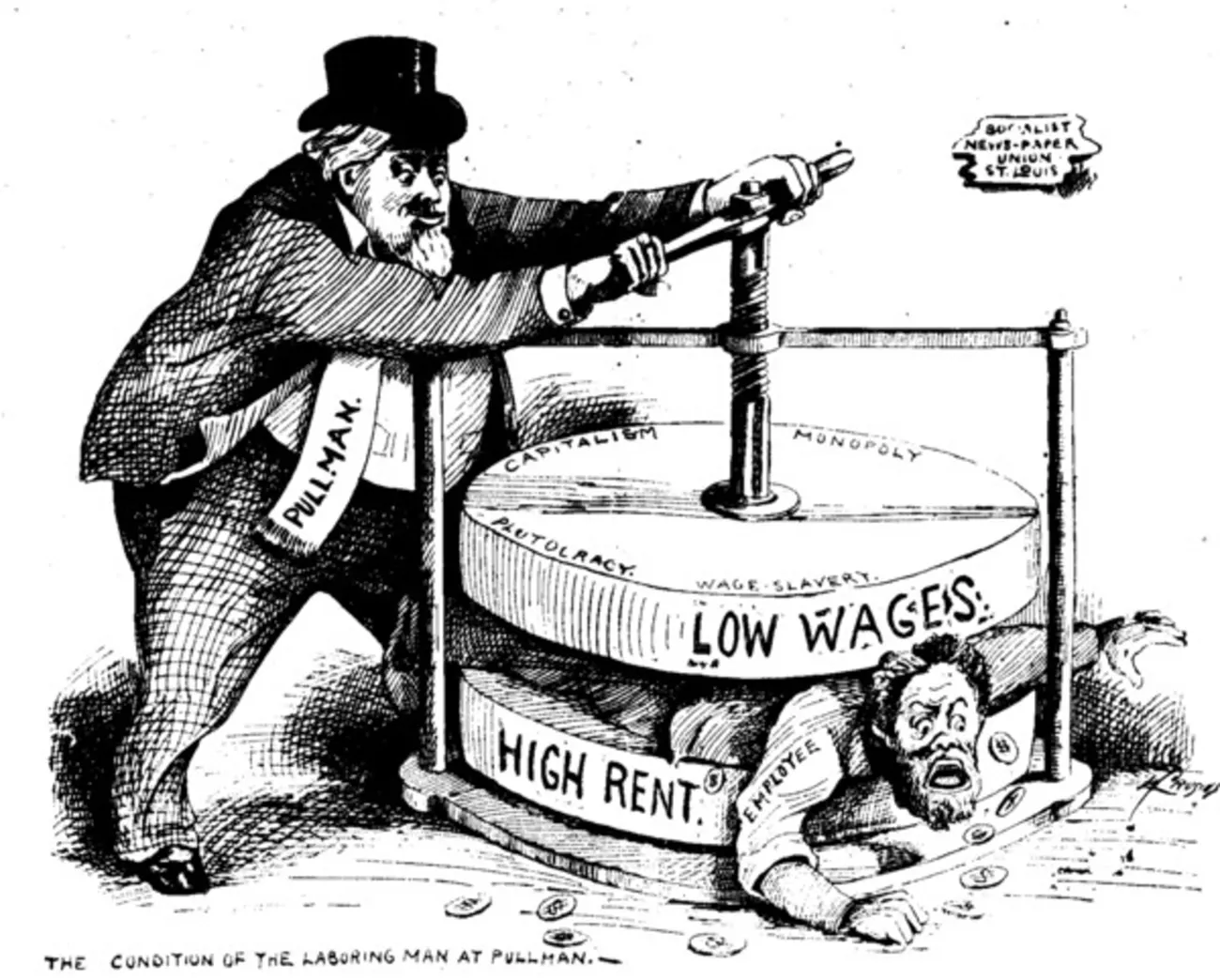
The Condition of the Laboring Man at Pullman (1894).
Trump shows model of the new White House Ballroom
This beautiful building will be, when complete, the much anticipated White House Ballroom — The Greatest of its kind ever built! It is a rendering from the Treasury Building, directly across the street, and replaces the very small, dilapidated, and rebuilt many times, East Wing, with a magnificent New East Wing, consisting of a glorious Ballroom that has been asked for by Presidents for over 150 years. Being an identical height and scale, it is totally in keeping with our historic White House. This is the first rendering shown to the Public. If you notice, the North Wall is a replica of the North Facade of the White House, shown at the right hand side of the picture. This space will serve our Country well for, hopefully, Centuries into the future! PRESIDENT DONALD J. TRUMP

__________
Looks good to me. ABN
 American Buddhist Net