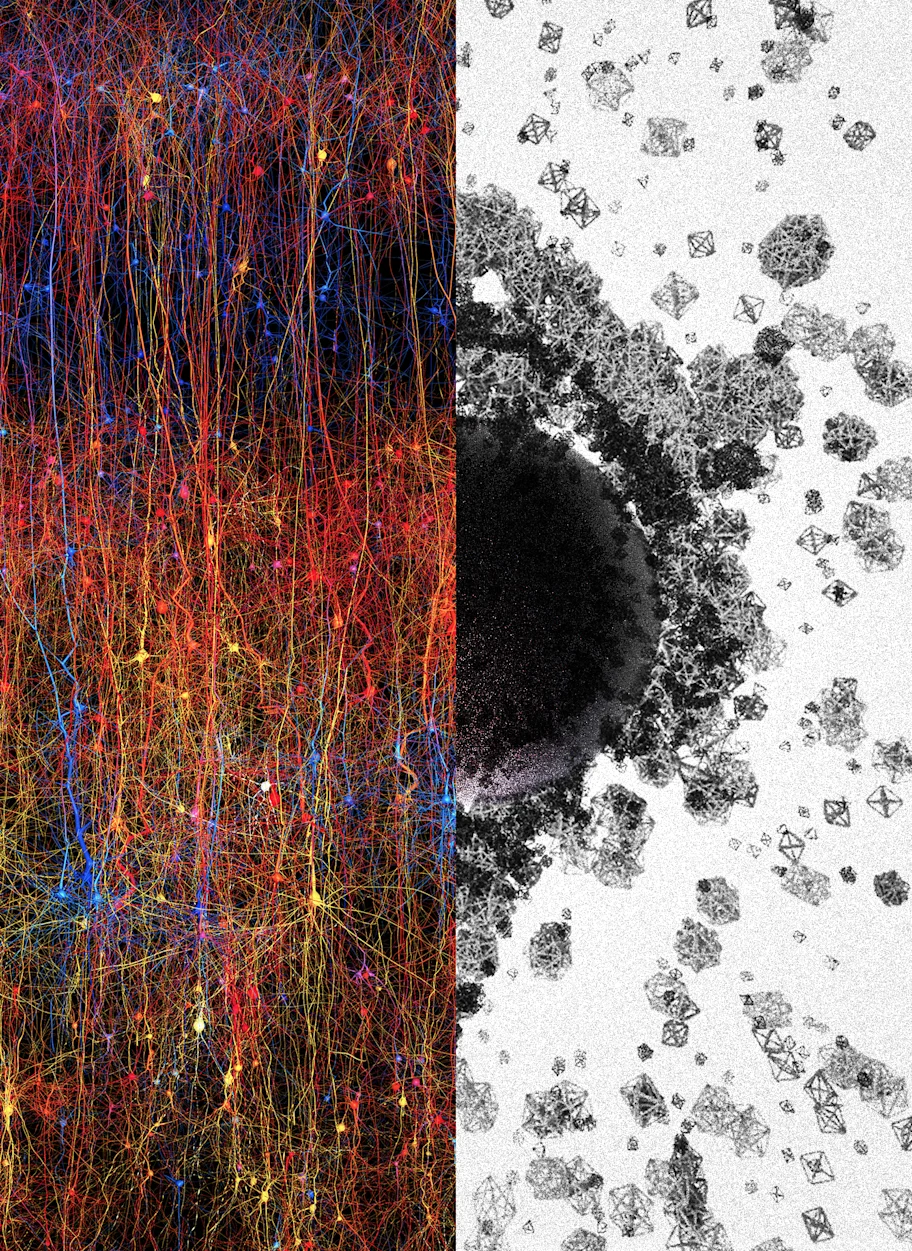
Using mathematics in a novel way in neuroscience, the Blue Brain Project shows that the brain operates on many dimensions, not just the three dimensions that we are accustomed to.
For most people, it is a stretch of the imagination to understand the world in four dimensions but a new study has discovered structures in the brain with up to eleven dimensions – ground-breaking work that is beginning to reveal the brain’s deepest architectural secrets.
Using algebraic topology in a way that it has never been used before in neuroscience, a team from the Blue Brain Project has uncovered a universe of multi-dimensional geometrical structures and spaces within the networks of the brain.
The research, published today in Frontiers in Computational Neuroscience__, shows that these structures arise when a group of neurons forms a clique: each neuron connects to every other neuron in the group in a very specific way that generates a precise geometric object. The more neurons there are in a clique, the higher the dimension of the geometric object.
Topology in neuroscience: The image attempts to illustrate something that can not be imaged – a universe of multi-dimensional structures and spaces. On the left is a digital copy of a part of the neocortex, the most evolved part of the brain. On the right are shapes of different sizes and geometries in an attempt to represent structures ranging from 1D to 7D and beyond. The “black-hole” in the middle is used to symbolise a complex x of multi-dimensional spaces, or cavities. Courtesy of the Blue Brain Project
When the researchers presented the virtual brain tissue with a stimulus, cliques of progressively higher dimensions assembled momentarily to enclose high-dimensional holes, that the researchers refer to as cavities. “The appearance of high-dimensional cavities when the brain is processing information means that the neurons in the network react to stimuli in an extremely organized manner,” says Levi. “It is as if the brain reacts to a stimulus by building then razing a tower of multi-dimensional blocks, starting with rods (1D), then planks (2D), then cubes (3D), and then more complex geometries with 4D, 5D, etc. The progression of activity through the brain resembles a multi-dimensional sandcastle that materializes out of the sand and then disintegrates.”
Sent by an alert reader. This describes what probably happens when a FIML query interrupts a stimulus, thus preventing an erroneous interpretation, either habitual or just arising, to flourish in the mind. If the querier’s interpretation is correct, a FIML query will confirm that to the benefit of both partners. If it is incorrect, the wrong interpretation can be corrected, also to the benefit of both partners. Hundreds of FIML queries increasingly establish a very secure ground for communication and mutual psychological understanding. There is not another way to get there but through FIML practice. FIML will completely change how you understand human psychology because the practice is based on real-world, real-time objective (agreed upon by both partners) data. ABN
This report — Brain oscillations reveal that our senses do not experience the world continuously — supports the core activity of FIML practice, which entails noticing the first instant(s) of the arising of an emotional sensation (that is typically tied to a much more involved “mistaken interpretation” within the brain). By interfering with the first instant(s) of arising, FIML practice forestalls the habitual wave of neurotic interpretation that normally follows. Instead, new information — better data obtained from the FIML partner — is used to replace the cue that led to the initial sensation, thus redefining that cue.
Professor Gregor Thut of the University of Glasgow, where the study was conducted, says of its results: “For perception, this means that despite experiencing the world as a continuum, we do not sample our world continuously but in discrete snapshots determined by the cycles of brain rhythms.”
I would further hypothesize that the same holds true for our “perceptions” of inner emotional states. In this context, recall the five skandhas of Buddhism — form, sensation, perception, activity, consciousness. A form can arise in the mind or outside of the mind. This form gives rise to a sensation (which is the first possible initiation point of a FIML query), which gives rise to perception, followed by activity (mental or physical), and lastly consciousness.
In Buddhist teachings, the five skandhas occur one after the other, very rapidly. They are not a continuous stream but rather a series of “discrete snapshots,” to use Thut’s words. In FIML practice, partners want to interfere with what has become a habitual “firing” of their five skandhas based on (neurotic) learned cues. FIML practice strives to prevent full-blown neurotic consciousness (the fifth skandha) from taking control of the mind by replacing the source of that consciousness with a more realistic interpretation of the neurotic cue. The cue corresponds to form in the five skandhas explanation while our emotional reaction to it begins with the second skandha, sensation. The more realistic interpretation of that cue is based on the true words of the partner.
The five skandhas can also help us understand how FIML is different from more or less normal psychological analysis. In normal, or traditional, analysis we use theories and schema to understand ourselves. In FIML we use a specific technique to interfere with habitual neurotic “firings” of the five skandhas. FIML partners are encouraged to theorize and speak about themselves in any way they like, and it is very helpful to do this, but the core FIML activity cannot be replaced by just theorizing or telling stories.
Here is a study that shows how quickly we distort our memories: Event completion: Event based inferences distort memory in a matter of seconds. The study concludes, in part, that “…results suggest that as people perceive events, they generate rapid conceptual interpretations that can have a powerful effect on how events are remembered.”
This study shows that our memories of events are dynamic and can become distorted very quickly. These findings well support FIMLpractice, which is based on quick interventions while we are speaking to capture sound, usable data that both partners can agree on.
Blogger Christian Jarrett writes about this study saying that “memory invention was specifically triggered by observing a consequence (e.g. a ball flying off into the distance) that implied an earlier causal action had happened and had been seen (Your memory of events is distorted within seconds).” Well-put.
From a FIML point of view, we generate or maintain neurotic interpretations (mistaken interpretations) by believing we are “observing a consequence…that implied an earlier causal action had happened.”
When we misinterpret an utterance during a conversation, we tend to do so in habitual ways; we tend to respond to that utterance as if it had meant something it did not; we tend to understand the “consequence” that happens in our minds as “implying” or being based on something that our partner actually had intended when they had not had any such intention.
This study illustrates very well why FIML practitioners want to develop their skills so that both partners are able to quickly disengage from their conversation while taking a meta-position that allows them to gather and agree upon good data that they can discuss objectively and rationally.
When your partner denies that they meant what you thought they meant, this study will help you believe them.
As the Buddha said: “The mind is everything. What you think you become.”
FIML is an acronym that stands for Functional Interpersonal Meta Linguistics.
FIML is a form of analytical psychotherapy done between two people, neither of whom needs any formal training in psychotherapy. It is designed to optimize communication and psychological well-being.
FIML is a technique that uses real-time, real-world communication data to clear up mistaken psychological interpretations that may have been held for many years or that may have just arisen.
By clearing up many small mistaken interpretations between partners, FIML gradually clears up the psychological bases of those misinterpretations. In this way, FIML optimizes the communication and psychologies of both partners.
For a basic description of how to do FIML see: How to do FIML.
For more information about the theory and practice of FIML, please see other posts on this site, most of which are concerned with FIML in one way or another.
Can you look at someone’s face and know what they’re feeling? Does everyone experience happiness, sadness and anxiety the same way? What are emotions anyway? For the past 25 years, psychology professor Lisa Feldman Barrett has mapped facial expressions, scanned brains and analyzed hundreds of physiology studies to understand what emotions really are. She shares the results of her exhaustive research — and explains how we may have more control over our emotions than we think.
_________
This talk is a very good background for FIML practice, which is based on acknowledging that interpersonal emotions and interpretations are fundamentally ambiguous and must be investigated often to achieve good communication. ABN
A simple test can reveal whether someone unknowingly lives with a hidden disability known as aphantasia – a condition that leaves people unable to form mental images in their mind.
Often undiagnosed and poorly understood, aphantasia affects the brain’s ability to visualise pictures, scenes or faces, even though eyesight itself is completely normal.
Although estimates suggest between two and five per cent of people have aphantasia, the vast majority are never formally diagnosed.
Because the condition is invisible and not routinely tested for, experts believe millions are unaware they have it and only discover it later in life by chance.
…Both groups – 42 people without aphantasia and 18 who reported having it – showed a normal pupil response when actually viewing the images, demonstrating that their eyes and visual pathways were functioning normally.
However, when both groups were then asked to visualise the same light and dark shapes in their mind, a clear difference emerged.
Participants without aphantasia showed the expected pupil response, with their pupils changing size depending on whether they were imagining light or dark objects.
By contrast, the pupils of those with aphantasia did not change at all when they attempted to visualise the images.
While visual aphantasia is the most common form, researchers say the condition can also affect the ability to imagine sounds, touch, smells, tastes and movement.
Mystical and religious experiences are hypothesized to be evoked by transient, electrical microseizures within deep structures of the temporal lobe. Although experiential details are affected by context and reinforcement history, basic themes reflect the inclusion of different amygdaloid-hippocampal structures and adjacent cortices. Whereas the unusual electrical coherence allows access to infantile memories of parents, a source of god expectations, specific stimulation evokes out-of-body experiences, space-time distortions, intense meaningfulness, and dreamy scenes. The species-specific similarities in temporal lobe properties enhance the homogeneity of cross-cultural experiences. They exist along a continuum that ranges from “early morning highs” to recurrent bouts of conversion and dominating religiosity. Predisposing factors include any biochemical or genetic factors that produce temporal lobe lability. A variety of precipitating stimuli provoke these experiences, but personal (life) crises and death bed conditions are optimal. These temporal lobe microseizures can be learned as responses to existential trauma because stimulation is of powerful intrinsic reward regions and reduction of death anxiety occurs. The implications of these transients as potent modifiers of human behavior are considered.
This article argues that the human brain saves energy by predicting or imagining “reality” more than actually perceiving it: Do Thrifty Brains Make Better Minds? The article argues that this way of using our brains allows us to work more efficiently with complex data or in complex situations.
I think this general premise is pretty well known and agreed on, but the linked article puts it in a new way. The following sentence caught my eye: This… underlines the surprising extent to which the structure of our expectations (both conscious and non-conscious) may quite literally be determining much of what we see, hear and feel.
The article uses visual perception as an example, but the idea applies just as well, and maybe more so, to what we hear in the speech of others. FIML practice works by inserting a new mental skill between the first arising of a (stored) interpretation and its full-blown acceptance as “reality”.
Most Buddhist practitioners will immediately understand and agree with the results of a study that shows that people feel better when they tell fewer lies. The study (Telling fewer lies linked to better health and relationships) is modest but worth considering.
Notice that the improvements found in the study come from refraining from lying.
“We found that the participants could purposefully and dramatically reduce their everyday lies, and that in turn was associated with significantly improved health,” says lead author Anita Kelly. (Same link as above.)
A good deal of Buddhist practice involves refraining from unwholesome thoughts and behaviors and ultimately eliminating them. Refraining from lying, or “false speech,” is the fourth of the Five Precepts, which are the basis of Buddhist morality. Lies cloud the mind and hinder clear thinking.
Buddhist mindfulness gets us to slow down and question how sure we are of our thoughts, feelings, and judgements. It helps us refrain from willfully lying, and it can help us refrain from unconsciously lying if we have the help of a trusted partner.
Another term for unconscious lying is self-deception. Self-deception may make us feel good for awhile in some circumstances, but in the long-run it is much the same as any other kind of lying. It’s not true. It constitutes inner false speech and causes serious intellectual and emotional contradictions that will almost certainly lead to wrong thoughts, behaviors, and interpretations.
Michael S. Gazzaniga in an online essay has this to say:
The view in neuroscience today is that consciousness does not constitute a single, generalized process. It involves a multitude of widely distributed specialized systems and disunited processes, the products of which are integrated by the interpreter module….Our conscious experience is assembled on the fly as our brains respond to constantly changing inputs, calculate potential courses of action, and execute responses like a streetwise kid. (source)
It is our “interpreter module,” to use Gazzaniga’s words, that can and does unconsciously lie to us or allow us to engage in self-deception.
In the same essay, Gazzaniga also says:
In truth, when we set out to explain our actions, they are all post hoc explanations using post hoc observations with no access to nonconscious processing….The reality is, listening to people’s explanations of their actions is interesting—and in the case of politicians, entertaining—but often a waste of time. (Source: same as above)
FIML practice may not be capable of giving us access to “nonconscious processing,” but it will give us access to what is/was in our working memories while showing us that what we said or heard may have been vague, ambiguous, muddled, or wrong.
With the aid of a trusted partner, FIML helps us catch our minds on the fly. Partners are encouraged to refrain from long explanations and just stick to what they remember having been in their minds during the few seconds in question. This forestalls long, self-deceiving explanations.
Beginning FIML partners will likely be amazed at how often their interpretation of what their partner said is completely wrong.
FIML emphasizes using trivial incidents because partners will be much less likely to self-deceive when the incident is minor. A minor mistake is easier to change than a major one. If partners keep working with minor mistakes and clear them up as soon as they arise, how can major misunderstandings even develop?
In the future, we may have brain scans that can help us separate fact from fiction in our minds, but for now, I know of no better way to do it than with a trusted partner in FIML practice. Your partner will help you see the minutiae of your mind as it actually works and impacts them. This leads to a large reduction in lying and self-deception and an increase in feelings of well-being and mutual understanding.
An autocatalytic system is a system that can “catalyze its own production”. Autocatalytic systems are usually called “autocatalytic sets”, but for our purposes using the word system may make the concept clearer.
FIML is an autocatalytic system that allows partners to reestablish the terms of their relationship, their psychologies, and their comprehension of the world around them. Strictly speaking, FIML is a non-autonomous autocatalytic set because FIML uses an abundance of language and ideas that come from outside of itself.
FIML is a small set of precise behaviors that allow partners to communicate with great clarity and without interpersonal ambiguity. Interpersonal ambiguity is the cause of much suffering. FIML does not tell partners what to think or what to believe. It simply provides them with a set of tools that gives them the means to develop in ways that seem best to them.
FIML is primarily a communication technique, but the discoveries it leads to will cause partners to remake their understandings of who they are and how they understand themselves. Once partners have learned the system, they will find that it autocatalyzes, causing them to remake themselves with a freedom that had not been possible before.
FIML differs greatly from mainstream psychology because mainstream psychology is not autocatalytic. It is analytical, theoretical, or medical. The individual sufferer seeks a professional who diagnoses their “problem” based on a static standard and then prescribes medication or some kind of therapy that will also be provided by an expert. In contrast, FIML teaches partners how to communicate with sufficient clarity to comprehend themselves. As it autocatalyzes, FIML quite naturally leads partners to make beneficial changes in themselves as they discover new meanings in each other and the world around them.
I am sure I have taken a few liberties with my application of this theory, but went ahead with these ideas anyway because one of the key features of FIML practice is it “auto-generates” or autocatalyzes itself. Once you get going and see how to do it, FIML practice almost runs by itself, allowing partners near infinite freedom to pursue whatever they want with it.
For some people, sleep brings a peculiar kind of wakefulness. Not a dream, but a quiet awareness with no content. This lesser-known state of consciousness may hold clues to one of science’s biggest mysteries: what it means to be conscious.
The state of conscious sleep has been widely described for centuries by different Eastern contemplative traditions. For instance, the Indian philosophical school of the Advaita Vedanta, grounded in the interpretation of the Vedas – one of the oldest texts in Hinduism – understands deep sleep or “sushupti” as a state of “just awareness” in which we merely remain conscious.
Similar interpretations of deep sleep are made by the Dzogchen lineage in Indo-Tibetan Buddhism. According to their teachings, different meditative practices can be followed during wakefulness and sleep to acknowledge the “essence” of consciousness. One of those meditative practices is that of dream yoga or luminosity yoga, which enables the practitioner to recognise the states of dream and sleep. This aims to bring them to a state of “pure awareness”, a state of being awake inside sleep without thoughts, images or even a sense of self.
For western science, this state poses a conundrum. How can you be aware without being aware of something? If these reports are accurate, they challenge mainstream theories that treat consciousness as always about an object. For example, my awareness of the laptop in front of me, or the blue sky rising above my window, or my own breathing. The existence of this state pushes us to reconsider what consciousness is.
In those studies, we found a spectrum of experiences we called “objectless sleep experiences” – conscious states that appear to lack an object of awareness. In all cases, participants who alluded to an objectless sleep experience reported having had an episode during sleep that lacked sensory content and that merely involved a feeling of knowing that they were aware.
This is an interesting article, sent by an alert reader.
From a Buddhist POV, these states are samadhi or dhyana states, which are essential to successful Buddhist practice.
The reason these states are essential is they provide the experience of pure awareness, pure consciousness with zero self and zero referent.
The Mind-Only Buddhist explanation of these states is they are touching on or engaging with the universal Tathagata, or enlightened mind.
In modern philosophical terms, these states are awareness of ‘mind at large’ or some version of ‘quantum consciousness’ or the fundamental ‘field of consciousness or thought’, which is posited as a primary component of the cosmos.
These states are extremely valuable and worth remembering and pursuing.
In higher levels of samadhi, enormous joy or bliss is experienced along with a total absence of self or referent.
The highest samadhi state is perfect equanimity coupled with deep awareness of the Tathagata.
Samadhi states eventually bump up against nirvana.
I love Western civilization, but the one thing it deeply lacks is a tradition of knowing about and using samadhi, which at the very least provides a marvelous and wonderful place to stand aside from all that is mundane.
Philosophically, Buddhism recognizes ‘relative truth or reality’ (mundane reality) and ‘ultimate truth or reality’, the full knowing of which constitutes Buddhist enlightenment.
In many Buddhist traditions, samadhi states are understood to be natural and attainable by anyone who tries diligently.
If you are fortunate enough to experience samadhi without trying, be thankful!
You have gained a deep realization.
One of the most difficult parts of Buddhism for non-Buddhists to understand is the experience of samadhi.
Also fundamental to Buddhism is the experience of a clear conscience, an honest and pure mind which is gained through wholesome moral and ethical thoughts and behaviors. ABN
Do reclusive and monastic religious practices foster wisdom about the human condition?
A new study indicates that they may.
Insights into social psychological phenomena have been thought of as solely attainable through empirical research. Our findings, however, indicate that some lay individuals can reliably judge established social psychological phenomena without any experience in social psychology. These results raise the striking possibility that certain individuals can predict the accuracy of unexplored social psychological phenomena better than others. (Social Psychological Skill and Its Correlates)
Short-term memory is where the rubber of human psychology meets the road.
It is the active part of human psychology as it functions in real-time.
New research indicates that the thalamus, which relays almost all sensory information, is central to the operation of short-term memory. Without the thalamus, short-term memory does not occur.
Short-term memory is a changeable “program” that deals with and responds to the world quickly. It is the main determinant of how “you” are in the moment.
Short-term memory maintains persistent activity (in the brain/body) by relaying its components through the thalamus in response to real-time conditions.
If we discover a mistake in our short-term memory, it is typically very easy to change. For example, if you realize you forgot to set your clocks ahead, your short-term memory will quickly adjust. You might feel a little dumb for a moment, but usually it is no big deal.
This example shows how our short-term memory is connected to long-term memories, to planning, expectation, and our general sense of the world around us and what we are doing in it.
FIML is an effective form of psychotherapy largely because it focuses on the short-term memory.
By targeting short-term memory loads, FIML helps partners discover how their psychologies are actually functioning in real-time during real-world situations.
Correcting mistakes in short-term memory immediately changes how we function.
Changing the same mistake several times very often removes it entirely from the long-term memory, from the overall functioning of the individual.
Buddhist mindfulness practice focuses a lot on short-term memory.
In this respect, FIML is a kind of shared mindfulness between two people, both keeping themselves and each other honest and on the same page.
FIML may feel intense for beginners because this kind of focus with this kind of intention has probably never been engaged in before.
With practice, FIML becomes relaxed and pleasant, creating an in-the-zone feeling like you are playing a fun game or doing something important and interesting together.
When done regularly, FIML generates a very sturdy kind of mutual self-respect. ABN
A physicist has proposed a radical new theory of consciousness – and it could finally explain what happens when you die.
Consciousness does not emerge from human brains, according to Professor Maria Strømme, a professor of nanotechnology at Uppsala University.
Instead, she claims that it exists as a fundamental field.
If this is correct, ‘mysterious’ phenomena such as telepathy, near–death experiences, and even life after death could finally be explained by science.
According to Professor Strømme’s theory, consciousness does not end when we die.
Instead, when a person passes away, their consciousness simply returns to the background field.
Speaking to the Daily Mail, Professor Strømme explained: ‘The possibility that consciousness is fundamental has been under–explored. But that is changing rapidly.
‘We are reaching a point where asking deeper questions about consciousness is not philosophy on the margins — it is becoming a scientific necessity.’
This is not a new theory in the modern world or the ancient.
This is what many thinkers are saying today and what Mind-Only Buddhism has always been saying.
The vocabularies available today—quantum fields, localization, non-local—allow us to make descriptions of consciousness sharper for the modern mind.
Buddhist samadhi states (meditative states) may be thought of as the realization of the underlying quantum field of universal consciousness, or immersion of individual consciousness in that field or fields.
I personally think something like this is the actual structure of reality and why it is so important to live morally and have clear and honest mind.
I hope more understanding of human life along these lines, whether they are called Buddhist or not, will end human tribalism and the absurd values and beliefs that support it. ABN
One important thing FIML practice has showed me is that people very often—more often than they realize—attribute specific, clear intentionality to the speech of others when that speech actually originated out of a muddled state and was not clear or specific at all to the speaker.
I think we do this because as speakers we have better knowledge of the rich ambiguity that is our mind, while as listeners we know, for the most part, only what the speaker has said, or rather what we think we heard them say.
In many other posts we have discussed hearing words incorrectly and the consequences that can follow from that. In this post, let’s confine ourselves to a listener’s attributing a more specific intentionality to the speaker than the speaker intended.
A crude example might be a drunk at a bar mumbling to himself. Another drunk walks by with his girl on his arm. Hearing the mumbling, he asks, “Did you say that to her?” In saying that, he is attributing intentionality where there was none.
Sometimes, the drunk at the bar will explain that he was just mumbling. And sometimes he will own the intentionality being attributed to him.
In that case, he might say, “Yes, I did. What are you going to do about it?”
Misconstrued intentionality surely leads to many fights.
But those of us who don’t get drunk in bars like that never do anything similar, right?
Not so. We do it all the time. We frequently hear the speech of others as having more specific intent than they meant.
Whenever we listen, we do so with the network of semiotics and language that subsumes our perceptions. Thus, whatever we hear will tend to confirm or be contextualized by that part of our subjective network that is most active at the time or that seems to apply best to what we are hearing.
Our use of that network for understanding the speech of others is hurried, quick, and often wrong. Our listening makes sense to us, but is almost never in full accord with what the speaker said, especially as so much speech initiates in vague or muddled states of mind. Speech is often groping while listening often is less so.
For example, if someone expresses a political view that we have recently been thinking about and that irritates us, our listening will very likely attribute a more specific or pointed intentionality to the speaker than is justified.
If we agree with what the speaker said under the circumstances described above, much the same thing will happen though our attribution of specific intentionality will be favorable rather than unfavorable.
These examples are the polite forms of the barroom brawl versus barroom camaraderie.
Notice also, the tendency we humans have to frame these sorts of errors as dichotomies. Either you are insulting my girl or we are all best friends.
Furthermore, notice that we also have a strong tendency to own the more specific intentionality being attributed to us by the listener. In the bar, you might decline the fight, but in another location you might lock horns with someone who attributed a specific intention to your muddled or idle expression of a vague political “view.”
Next time you think you heard a specific intent in the words of a friend, ask them if that was indeed their intent. Be careful when asking because if they are not experienced FIML practitioners, they may agree to own an intention they never had or that was far more muddled than it had seemed to you (or them in the moment of speaking).
My guess is a great deal of what we say is sloppier or more muddled than even we ourselves realize. This is simply how we are and how we really use language. You can’t make speech perfect.