
Psilocybin, the active compound in magic mushrooms, can ‘open up’ the brains of people with depression, helping patients to overcome rigid thought patterns and negative fixations, new research suggests.
A study led by the Imperial Centre for Psychedelic Research has shown that psilocybin therapy increases brain connectivity in people living with depression, even weeks after the treatment. The psychedelic acts in a way that conventional antidepressants do not, suggesting that psilocybin could be an effective, viable alternative to treating depression.
“These findings are important because for the first time we find that psilocybin works differently from conventional antidepressants, making the brain more flexible and fluid, and less entrenched in the negative thinking patterns associated with depression,” says Professor David Nutt, head of the Imperial Centre for Psychedelic Research.
link
Tag: brain science
Dual-Process Theories of the Mind as means to analyze real-world, real-time interpersonal data
…Despite their differences, dual-process theories share the common idea that thoughts, behaviors, and feelings result from the interaction between exogenous and endogenous forms of attention. Both types of attention can be applied to representations to increase or decrease their level of activation. As the activation level of a representation increases, so does its accessibility, which in turn increases the probability that it will influence behavior.
Individual Differences in Working Memory Capacity and Dual-Process Theories of the MindIn times of conflict[When a FIML query is initiated], accessibility can be managed (i.e., maintained or inhibited) during the stream of processing by the control of attention. In a sense, the “source” of attention (LaBerge, 2000), that is, whatever mechanism that applies the activation to the representation, can be thought of as the gateway of accessibility that is the essence of controlled processing.
FIML practice is a form of mindfulness training with the addition of controlled attention processing which enables rapid gathering of real-world data followed by analysis thereof. This controlled attention processing is a learned behavior shared by both partners. The general concept of this learned/trained behavior is explained in How to do FIML. Individual partners adapt this learned/trained behavior to their own lives. In this sense FIML itself has no content. It is wholly a technique that allows rapid analysis of agreed upon objective interpersonal data. ABN
Procedural and implicit memory described
- Is procedural memory implicit?
- Is implicit memory the same as procedural memory?
- What is an example of an implicit memory?
- Why is procedural memory considered a form of implicit memory?
- What are the two types of implicit memory?
- Does implicit memory decline with age?
- Is procedural memory affected by amnesia?
- What is the difference between episodic and procedural memory?
- What are the 2 types of implicit memory?
- What are the three types of implicit memory?
- Are habits procedural memories?
- What are the 3 stages of memory?
- What age does implicit memory develop?
- Does procedural memory decline with age?
- Is episodic memory long-term?
- Does semantic memory decline with age?
- What is the role of procedural memory?
- How do you test for procedural memory?
Visual working memory in aphantasia: Retained accuracy and capacity with a different strategy
Abstract
Visual working memory paradigms involve retaining and manipulating visual information in mind over a period of seconds. Evidence suggests that visual imagery (sensory recruitment) is a strategy used by many to retain visual information during such tasks, leading some researchers to propose that visual imagery and visual working memory may be one and the same. If visual imagery is essential to visual working memory task performance there should be large ramifications for a special population of individuals who do not experience visual imagery, aphantasia. Here we assessed visual working memory task performance in this population using a number of different lab and clinical working memory tasks. We found no differences in capacity limits for visual, general number or spatial working memory for aphantasic individuals compared to controls. Further, aphantasic individuals showed no significant differences in performance on visual components of clinical working memory tests as compared to verbal components. However, there were significant differences in the reported strategies used by aphantasic individuals across all memory tasks. Additionally, aphantasic individual’s visual memory accuracy did not demonstrate a significant oblique orientation effect, which is proposed to occur due to sensory recruitment, further supporting their non-visual imagery strategy reports. Taken together these data demonstrate that aphantasic individuals are not impaired on visual working memory tasks, suggesting visual imagery and working memory are not one and the same, with imagery (and sensory recruitment) being just one of the tools that can be used to solve visual working memory tasks.
link
Aphantasia means “the inability to form mental images of objects that are not present.” ABN
Neural noise indicates our working memory may encode Bayesian probabilities of its contents
The uncertainty in working memory may be linked to a surprising way that the brain monitors and uses ambiguity, according to a recent paper in Neuron from neuroscience researchers at New York University. Using machine learning to analyze brain scans of people engaged in a memory task, they found that signals encoded an estimate of what people thought they saw — and the statistical distribution of the noise in the signals encoded the uncertainty of the memory. The uncertainty of your perceptions may be part of what your brain is representing in its recollections. And this sense of the uncertainties may help the brain make better decisions about how to use its memories.
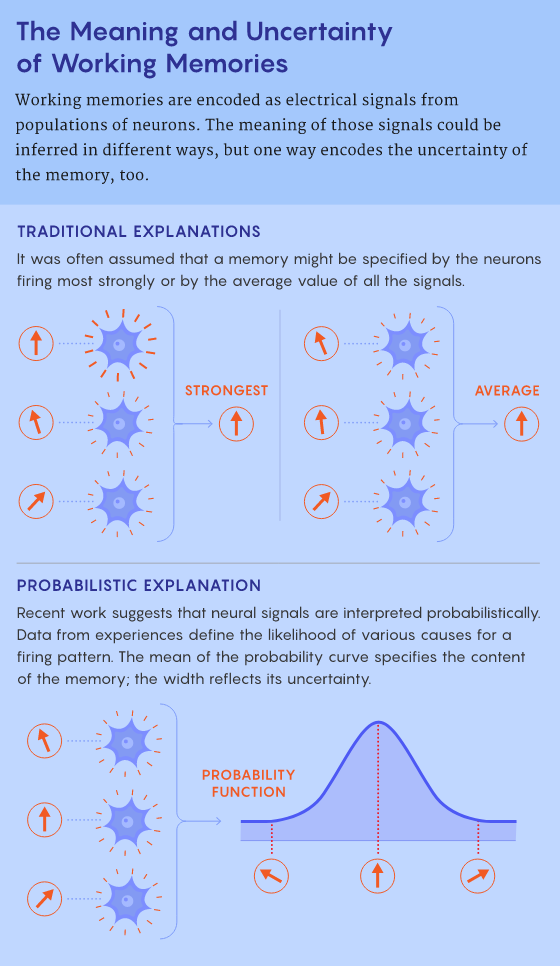
…the idea that we are walking around with probability distributions in our heads all the time has a certain beauty to it. And it is probably not just vision and working memory that are structured like this, according to Pouget. “This Bayesian theory is extremely general,” he said. “There’s a general computational factor that’s at work here,” whether the brain is making a decision, assessing whether you’re hungry or navigating a route.
link
FIML practice works precisely with the probabilistics of working memory. If the range of doubt in a perception is stronger than normal, it may prompt a query. If the range is stronger than normal and may indicate danger, a query is more likely. It would make sense that our assessments of these factors would be Bayesian. When perceptions are psychologically important, any Bayesian analysis will require assessing the subjective context into which the perception enters, which implies further Bayesian analyses. It would be wonderful if we had machines that could do this for us, but they will only be invented years from now if ever. For now, we can use our own minds to accomplish this through FIML practice. If you can understand the linked article, you should be able to see the value of FIML which collapses a Bayesian probability curve into the certainty of a single point. Psychologically, when this is done hundreds of times, the results are extremely satisfying. ABN
Researchers have gained a first insight into how the brain structures higher-level information. By extracting and analysing data from a neural network of grid cells, they found that the collective neural activity is shaped like the surface of a doughnut
Continue reading “Researchers have gained a first insight into how the brain structures higher-level information. By extracting and analysing data from a neural network of grid cells, they found that the collective neural activity is shaped like the surface of a doughnut”Spontaneous grid cell activity aligns to our external world
So, what is the significance of seeing that the network activity of grid cells is always unfolding on the surface of a doughnut?
“Only one theoretical model in neuroscience has predicted what the activity of grid cells should be like regardless of the animal’s state, the CAN theory. These findings tell us something about the way the network of neurons is connected. The doughnut exists in the connectivity between the cells,” Edvard Moser said.
CAN theory proposes that grid cells with similar functions, cells that are active at nearby places in space, are strongly connected, in a reinforcing way. Cells that are active at distant locations are weakly connected in a mutually inhibitory way. From this follows two premises: (1) If this theory is correct, the only way to get hexagonal grid cell patterns from single cells, is if the joint network activity moves along on the surface of a doughnut. (2) The activity structure is a result of the brain’s intrinsic wiring rules. Thus, the doughnut remains, regardless of where the animal is or what the animal is doing, whether it is using the grid cells to navigate its external environment or not.
The results show that the grid cell pattern is created internally by the connections between grid cells and is not created by the input from the sensory systems, from the outside.
link
Just 1.5% to 7% of the human genome is unique to Homo sapiens, free from signs of interbreeding or ancestral variants
Less than 10% of your genome is unique to modern humans, with the rest being shared with ancient human relatives such as Neanderthals, according to a new study.
The study researchers also found that the portion of DNA that’s unique to modern humans is enriched for genes involved with brain development and brain function. This finding suggests that genes for brain development and function are what really set us apart, genetically, from our ancestors.
As little as 1.5% of our genome is ‘uniquely human’
The study: An ancestral recombination graph of human, Neanderthal, and Denisovan genomes
Breakthrough “mind-reader” (neuroprosthesis) enables paralyzed man to communicate with words
The brain as a guessing machine
words 410
A new approach to the study of mental disorder—called computational psychiatry—uses Bayesian inference to explain where people with problems are going wrong.
Bayesian inference is a method of statistical reasoning used to understand the probability of a hypothesis and how to update it as conditions change.
The idea is that people with schizophrenia, for example, are doing a bad job at inferring the reasonableness of their hypotheses. This happens because schizophrenics seem to be less likely to put enough weight on prior experience (a factor in Bayesian reasoning).
Somewhat similarly, “sensory information takes priority [over previous experience] in people with autism.” (Bayesian reasoning implicated in some mental disorders)
Distorted calculations — and the altered versions of the world they create — may also play a role in depression and anxiety, some researchers think. While suffering from depression, people may hold on to distorted priors — believing that good things are out of reach, for instance. And people with high anxiety can have trouble making good choices in a volatile environment… (Ibid)
The key problem with autism and anxiety is people with these conditions have trouble updating their expectations—a major component of Bayesian reasoning—and thus make many mistakes.
These mistakes, of course, compound and further increase a sense of anxiety or alienation.
Like several of the researches quoted in the linked article, I find this computational approach exciting.
It speaks to me because it confirms a core hypothesis of FIML practice—that all people make many, significant inferential mistakes during virtually all acts of communication.
In this respect, I believe all people are mentally disordered, not just the ones who are suffering the most.
I think a Bayesian thought experiment can all but prove my point:
What are the odds that you will correctly infer the mental state(s) of anyone you speak with? What are the odds that they will correctly infer your mental state(s)?
In a formal setting, both of you will do well enough if the inferring is kept within whatever the formal boundaries are. But that is all you will be able to infer reasonably well.
In the far more important realm of intimate interpersonal communication, the odds that either party is making correct inferences go down significantly.
If we do not know someone’s mental state, we cannot know why they have communicated as they have. If our inferences about them are based on such questionable data, we are bound to make many more mistakes about them.
first posted MAY 15, 2016
A study that supports FIML
454 words
This study–Preventing the return of fear in humans using reconsolidation update mechanisms–supports FIML practice, which works by having partners volitionally interfere with neurotic responses as they occur, thus preventing reconsolidation of the neurotic memory (habitual response).
Truthful data supplied by a FIML partner provides much better (updated) information to the partner inquiring about their incipient neurotic reaction than that partner has had up to that point. This new non-neurotic information that is “provided during the reconsolidation window” results in neurotic responses “no longer [being] expressed”, often within just a few sessions.
The linked study is about fear, but I bet the findings will apply to all sorts of neurotic responses. In FIML practice, we have defined a neurotic response as a “mistaken response” or one not based on good data or evidence.
The technique used in the study produced “an effect that lasted at least a year and was selective only to reactivated memories without affecting others.”
Since most FIML partners will continue doing FIML practice for more than a year, the effects of FIML sessions and follow-up sessions dealing with neuroses should last as long or longer. If an old neurosis regains its power, skilled FIML partners should be able to deal with it rather quickly.
FIML posits that neuroses are very often the result of nothing more than mistakes in listening or speaking. This means that we can expect proto-neurotic mistakes to arise with great frequency (several per hour in most conversations). And this means that FIML partners will want to continue using basic FIML practices whenever they interact.
Another point: the linked study concludes that the effect of their technique is “selective only to reactivated memories without affecting others.” This seems to be the case with FIML practice as well. Memories are not being erased by drugs or other kinds of physical interference. Rather, they are being upgraded during the crucial “window of reconsolidation”. This upgrade does not directly change other memories, though in FIML practice since core neuroses are being confronted, effects will be widespread throughout the organism, causing beneficial changes in personality, behavioral strategies, autonomic responses, ancillary neuroses, and so forth.
I, for one, do not see any other way than FIML practice to deal with the plethora fundamental mistaken interpretations that occur in all human minds and with great frequency. Traditional talk therapy or the more common drug therapies used today can only deal with very general aspects of the fundamental cause of neurotic suffering–humans tend to make a great many mistakes when they speak and when they listen and these mistakes tend to compound and turn into ongoing mistaken interpretations (neuroses) of the self, the world, and people around us.
first posted APRIL 13, 2012
Future Science – The Wave Genome – Quantum Holography of DNA with Ulrike Granögger
UPDATE: This video is thought provoking and surely valid in many ways.
I am going to align two core ideas presented in the video and briefly explain how they relate to FIML practice:
DNA can be spoken to
and
while the chemical structure of DNA molecules will be almost the same in virtually all organisms, the electromagnetic informational signals or holographic images that travel upon these molecules can be vastly different
a language/semiotic signal occurs in a context. when we correct a language/semiotic signal through FIML we prevent an error from changing the context, which it is liable to do.
by doing this many times, we strengthen a healthy (mutual & individual) mind context; strengthen its coherence and efficiency while also strengthening the method for doing this
in a wider sense, “correcting” for good ends could also be “manipulating” for bad ends.* in a narrow context between two people playing the FIML game, manipulative correcting for bad ends could happen but would be difficult to maintain over a wide/large interpersonal context though this is possible. an evil FIML partner is possible. it is also possible for both partners to be evil
that said it is easier to be good and more satisfying to be good, so more FIML partners will tend toward the good than the bad. good FIML partners will strengthen their shared holographic context and expand it in good ways
*scams, propaganda, cheating, etc
How the brain processes new information
A new paper provides fascinating insight into how our brains amass information and organize and assess it in real-time.
The paper—Cliques of Neurons Bound into Cavities Provide a Missing Link between Structure and Function—proposes that “the brain processes stimuli by forming increasingly complex functional cliques and cavities.”
The full intro to the paper:
The lack of a formal link between neural network structure and its emergent function has hampered our understanding of how the brain processes information. We have now come closer to describing such a link by taking the direction of synaptic transmission into account, constructing graphs of a network that reflect the direction of information flow, and analyzing these directed graphs using algebraic topology. Applying this approach to a local network of neurons in the neocortex revealed a remarkably intricate and previously unseen topology of synaptic connectivity. The synaptic network contains an abundance of cliques of neurons bound into cavities that guide the emergence of correlated activity. In response to stimuli, correlated activity binds synaptically connected neurons into functional cliques and cavities that evolve in a stereotypical sequence toward peak complexity. We propose that the brain processes stimuli by forming increasingly complex functional cliques and cavities.
The cliques of neurons that grow and connect in real-time make up the transient “architecture” of awareness as it changes and responds to stimuli.
You can observe a process that seems to fit this description by simply turning your head and looking around. As your eye settles on something to consider in more detail, neuronic cliques will grow in your brain based on that stimulus.
Depending on the significance to you of what you are looking at, further associations drawn from memory and emotion will aggregate around it.
Interestingly, the concept of transient neuronal cliques that grow into larger structures fits very well with the Buddha’s Five Skandhas explanation of the path between perception and consciousness.
This paper also seems to explain why FIML practice works. FIML interrupts the (re)formation of mistaken neuronal cliques in real-time, thus preventing the (re)association of (mistaken) established mental states with new perceptions. If there was no mistake FIML affirms that truth.
By consciously interfering with habitual neuronal cliques, FIML eliminates the false and unwanted psychological structures that give rise to them.
FIML works because large (mistaken) psychological brain structures rely on reconsolidation through the continual processing of “new” information that falsely reconfirms them.
As such, human psychology to a large extent is an ongoing self-fulfilling prophesy.
Here is an article about the paper: Brain Architecture: Scientists Discover 11 Dimensional Structures That Could Help Us Understand How the Brain Works.
The science of psychedelics and religion
Very pleased to read about a study on psychedelics and religion: Religious leaders get high on magic mushrooms ingredient – for science.
I am not at all surprised that of the lucky people chosen for this study, “So far everyone incredibly values their experience. No one has been confused or upset or regrets doing it.”
I call them lucky because where else can you get medical-grade psilocybin?
If anyone hears of another study like this one, please let me know! I want to join.
More on Buddhism and psychedelics can be found here: Are We Misunderstanding the Fifth Precept?
Edit: 3:30 PM: Research Shows Magic Mushrooms Can Offer Real Benefits in Depression Therapy. Quote:
A review of the research on combining therapy with the psychoactive component from magic mushrooms has concluded it’s not only a safe and effective way to treat conditions related to anxiety, depression, and addiction, it could be better than many existing forms of treatment.
first posted JULY 9, 2017
How working memory works and doesn’t work
491 words
A new study on working memory has some intriguing insights into how working memory works and how it doesn’t work.
It’s widely known that when working memory is overtaxed, confusion results, skills decline, while feeling of frustration and anger may arise. The reason for this seems to be:
Feedback (top-down) coupling broke down when the number of objects exceeded cognitive capacity. Thus, impaired behavioral performance coincided with a break-down of Prediction signals. This provides new insights into the neuronal underpinnings of cognitive capacity and how coupling in a distributed working memory network is affected by memory load. (Working Memory Load Modulates Neuronal Coupling)
A well-written article about this study contains the following diagram and explanation:

This article—Overtaxed Working Memory Knocks the Brain Out of Sync—also contains the following passages and quote from one of the study’s authors:
Miller thinks the brain is juggling the items being held in working memory one at a time, in alternation. “That means all the information has to fit into one brain wave,” he said. “When you exceed the capacity of that one brain wave, you’ve reached the limit on working memory.”
…The prefrontal cortex seems to help construct an internal model of the world, sending so-called “top-down,” or feedback, signals that convey this model to lower-level brain areas. Meanwhile, the superficial frontal eye fields and lateral intraparietal area send raw sensory input to the deeper areas in the prefrontal cortex, in the form of bottom-up or feedforward signals. Differences between the top-down model and the bottom-up sensory information allow the brain to figure out what it’s experiencing, and to tweak its internal models accordingly. (Emphasis added)
Working memory works via connections between three brain regions that together form a coherent brain wave.
Notice that “an internal model of the world,” which is a “top-down signal” within the brain wave feedback loop, predicts or interprets “bottom-up” sensory input as it arrives in the brain.
I believe this “top-down signal” within working memory is the reason FIML practice has such enormous psychological value.
By analyzing minute emotional reactions in real-time during normal conversation, FIML practice disrupts the consolidation, or more often the reconsolidation, of “neurotic” responses. (Disruption of neurotic response in FIML practice)
FIML optimizes human psychology by helping partners intervene directly into their working memories to access real-world top-down signals as they are happening in real-time. Doing this repeatedly reliably alters the brain’s repository of top-down interpretations, making them much more accurate and up-to-date.
The model of working memory proposed in this study also explains why FIML can be a bit difficult to do. Partners must learn to allow a FIML meta-perspective or “super top-down” signal to quickly commandeer their working memories so that analysis of whatever just happened can proceed rationally and objectively. It does take some time to learn this skill, but it is no harder than many other “automated” skills such bicycling, typing, or playing a musical instrument.
first posted JUNE 7, 2018
CLIP (Contrastive Language–Image Pre-training)
We’re introducing a neural network called CLIP which efficiently learns visual concepts from natural language supervision. CLIP can be applied to any visual classification benchmark by simply providing the names of the visual categories to be recognized, similar to the “zero-shot” capabilities of GPT-2 and GPT-3.
…CLIP (Contrastive Language–Image Pre-training) builds on a large body of work on zero-shot transfer, natural language supervision, and multimodal learning. The idea of zero-data learning dates back over a decade8 but until recently was mostly studied in computer vision as a way of generalizing to unseen object categories.910 A critical insight was to leverage natural language as a flexible prediction space to enable generalization and transfer. In 2013, Richer Socher and co-authors at Stanford11 developed a proof of concept by training a model on CIFAR-10 to make predictions in a word vector embedding space and showed this model could predict two unseen classes. The same year DeVISE12 scaled this approach and demonstrated that it was possible to fine-tune an ImageNet model so that it could generalize to correctly predicting objects outside the original 1000 training set.
CLIP: Connecting Text and Images
 American Buddhist Net