Uncertainty in human social interactions

All human interactions entail some uncertainty and most entail a lot.

To deal with uncertainty, humans use heuristics (“rules of thumb”) that generally are based on what they perceive to be normal or required in the situation at hand. These heuristics come from experience, from role models, from organizational structures, beliefs and so on.

A recent study—Uncertainty about social interactions leads to the evolution of social heuristics—explores:

…an evolutionary simulation model, showing that even intermediate uncertainty leads to the evolution of simple cooperation strategies that disregard information about the social interaction (‘social heuristics’).

This study uses simulations to tease out how social heuristics and social cooperation evolve in very simple game scenarios.

If social games have rules, we can change how much uncertainty they contain and how best to cooperate within them.

This is essentially what FIML practice does. FIML greatly reduces interpersonal uncertainty between partners while increasing cooperation by having a few fairly simple rules.

When uncertainty is lowered and cooperation increased between partners, psychological well-being and understanding is proportionally enhanced. This happens because social interaction and communication are basic to human psychology.

The study linked above employs simulations to show a sort mathematically forced evolutionary outcome arising from initial settings. I believe FIML is similar in this respect, though the FIML game involves complex humans rather than simple sims.

I often wonder why no one has discovered the rules of FIML before. So many great thinkers, but not one found these key rules for optimal communication and psychological understanding. I believe there are two basics reasons for this: 1) FIML requires developing dynamic metacognition during real-time real-life communication events and this takes practice; and 2) most great thinkers that we know about today and hence could learn from also had great status, and this prevented them from noticing the deep flaws in interpersonal communication that FIML corrects.

first posted JUNE 1, 2018

Advanced FIML

FIML is a method for generating crystal clear communication between participating partners. Once this has been achieved partners will notice a profound reduction in neurotic feelings–anxiety, worry, fear, suspicion, depression, boredom, anomie, etc.

Following this, many FIML practitioners will also notice that the practice has given them insights into cultural semiotics that parallel changes in art and literature. In designing FIML, we were not originally looking for this outcome, but it is there. Let me explain.

The “semiotics” or vocabulary of all art forms have changed throughout history, but especially since the 19th century. For example, in music the notion of what is dissonant or harmonic has changed from simpler classical forms, which demanded greater conformity between scales and chords, to jazz and modern music that allow for much greater freedom. Similarly, in the visual arts, the modern sense of color, balance, and perspective has changed to allow for much greater freedom of expression than in the past. The same kinds of changes can be seen in literature, chess, math, architecture, design, and many other areas.

We even see these changes in society as many more concepts and ways of living are now allowed than in the past–a more open sense of gender and sexual orientation, for example, are generally considered normal or acceptable in many parts of the world when just a few decades ago they were not. We also have a much broader and deeper understanding of race, culture, history, religion, ethnicity, and so on.

All of this relates to FIML in this way: FIML gives partners the means to understand and reorganize any and all levels of cultural semiotics they can become aware of. By semiotics I mean all signs, symbols, mores, taboos, beliefs, roles, impressions, memories, feelings, etc. that are connected to language and that thereby influence our use of language. That basically means everything in your mind, including language. Semiotics is the water the fish of language and communication swim in. Your mind is filled with a multifaceted semiotics that affects everything you do, say, and hear. Normally, we are only sort of aware of this.

FIML practice will lead many partners to realize that the semiotics–whatever they may be–in which their lives are immersed are as fully open to interpretation and reorganization as the artistic and cultural traditions described above. How partners decide to interpret their shared semiotics is up to them. FIML says nothing about that. What FIML will do is show you in a most intimate and convincing way that your capacity to fully understand your partner can also free you from traditional strictures in how you think about psychology, society, politics, history, art, and so on. If you want to play classical tunes with that knowledge, that is fine. If you want to play jazz or something you make up, that is also fine.

FIML will free you to do whatever you like with the semiotics you share with your partner.

In this way, I think that FIML practice can greatly enhance traditional Buddhist practice. At the same time, FIML may make traditional Buddhist practice more accessible or relevant to people today. FIML shows partners the emptiness of their semiotics in a way that may be more engaging than traditional techniques.

(As a side note, one great concern I have about FIML is ethics. I am quite convinced the ethics required to successfully practice FIML will convince partners that high ethical standards are essential for good living, but I cannot prove that. It does not follow logically and we do not have enough examples of successful FIML practitioners to claim that based on the numbers. No social or intellectual system, not even a strict legal system, can ensure that all members will behave ethically. I hope that FIML will be so powerful and transformational to those who do it, though, that high ethical standards will be a nearly inevitable byproduct of the practice. Time will tell.)

first posted DECEMBER 24, 2011

UPDATE 09/18/22: I have long been convinced since first posting the above that honesty and good ethics all but “fall out” of FIML practice. Surely there will be some individuals who will misuse the practice but the majority will not. Within just a few weeks it will become evident to partners that lying or withholding are completely counterproductive and defeat everything good about FIML. Remember, FIML is not a tell-all game. Partners always have the option to decline to say. FIML is not about discovering personal secrets or using psychological techniques. It is all about becoming very clear about what you and your partner mean when you speak or act. It is an extremely wonderful, refreshing practice. ABN

Semiotics in game tech

Edit 2/26/15: The article linked below is an excellent example of how a single semiotic is functioning differently in different cultures. Well, there is more than one, but the examples are very clear and concrete. The contention that lies behind FIML practice is that all people all of the time hold many idiosyncratic semiotics and that when they communicate, these idiosyncratic semiotics can have a huge effect on how they listen and what they say. Idiosyncrasies may have cultural origins or they may arise from subjective states or simply be arbitrary. The idiosyncratic individual (all people everywhere at all times) is like a mini-culture. FIML practice is done between two idiosyncratic individuals who are close to each other, care about each other, and spend a significant amount of time together. It is designed to help partners understand how their idiosyncrasies can and do cause misunderstandings, some of which may snowball into serious conflicts when at heart there never was much of anything there save different views of the same semiotic.

If you have been studying or reading about FIML but still don’t quite see what is meant by semiotics or how they function in real-world settings, please be sure to read the article liked below and also here. The semiotics of controller design.

_______________________

A friend sent me an interesting article on The semiotics of controller design of the Sony PlayStation.

His comment on the article:

I thought you would find this interesting. The amount of consideration that goes into something so simple makes it practically impossible to experience anything directly without FIML and meditative insight.

The article discusses the meaning of a couple of signs on PlayStation controllers. It shows how cultural inculcation led Japanese and Americans to understand those signs very differently. So differently, in fact, Sony had to change the buttons (or “localize” them) for the American audience.

Most of us will find the linked article understandable and most of us will be able to appreciate how acculturation can and does lead us to perceive signs and symbols differently.

If you can see this it is but a short step to see that individuals do the same. Each of us perceives or understands signs and symbols in ways that are unique to us. As my friend says, it is “practically impossible to experience anything directly without FIML and meditative insight.”

How could it be otherwise? How can anyone expect to understand and be understood intimately without frequent and extensive discussion of what semiotics mean to them and their partner(s)?

Many people claim they don’t have time for discussions like that, and for some I think that is true. For the rest, I don’t agree.

In any case, before long we will have super-smart robots and brain-to-machine interfaces that will utterly change the way we perceive each other as well as “reality” itself.

When that day comes, we bio-humans will have the time and we will have the inclination to buckle down and do the work needed to really understand each other.

In the future, I expect something like FIML will be a major standard for human-to-human communication. When the machines are miles ahead of us, we will at last relent and really try to understand rather than just manage or control each other.

first posted FEBRUARY 25, 2015

How (intimate) interpersonal language functions

Parentheses around the word (intimate) indicate a spectrum from less to more intimate, less to more psychologically important.

1) If we study how (intimate) interpersonal language functions, we will discover that it is significantly both defined and impeded by errors in listening and speaking.

2) The more intimate interpersonal communication is the more idiosyncratic it is.

Since (intimate) interpersonal communication is psychologically more significant the more intimate it is, it follows that it is very important to analyze and understand this kind of communication. It also follows that (intimate) interpersonal communication is harder to analyze from the outside the more intimate it is.

It is essentially impossible for an expert to tell two lovers what their words mean or how to understand their acts of communication.

Therefore, the lovers must do it themselves. The expert can only show them how to do it themselves.

3) This is a fundamental truth that rests in the nexus between language and psychology: the more intimate the communication the more important it is psychologically and also the more important it is that the communicators be able to analyze their communication satisfactorily and correct errors that inevitably occur.

4) How to do that can be taught. This is a good job for psychologists. Doing the analyzing and correcting is the job of the intimate communicators.

5) If (intimate) interpersonal communications are not analyzed and corrected; if errors are not discovered and removed from the system, the psychologies of both communicators will be harmed.

6) Conversely, if (intimate) interpersonal communications are analyzed and corrected; if errors are discovered and removed from the system, the psychologies of both communicators will be benefited.

7) Indeed, removing error from an (intimate) interpersonal communication system will result in gradual optimization of both the system and the psychologies of the analyzers.


8) In sum:

  • communication error is inevitable in (intimate) interpersonal communication systems
  • it is very important to correct these errors
  • and to analyze them and the communication system itself in the light of these corrections
  • this optimizes both the communication system and the psychologies of both communicators

There is no other way to accomplish such sweeping improvement in both communication and individual psychology. There is no outside way for intimate communications to be analyzed and no one else to do it but the intimate communicators themselves.

This is a fundamental truth that applies both to intimate communication and psychology. And this makes perfect sense because psychology is determined by intimate communication and vice versa.

first posted JANUARY 6, 2019

UPDATE 09/17/22: FIML is by far the best way I know to accomplish this. In fact, I know of no other way. TBH, I know I am giving away something extremely wonderful for free. All you have to do is take it and use it. That’s all I want. ABN

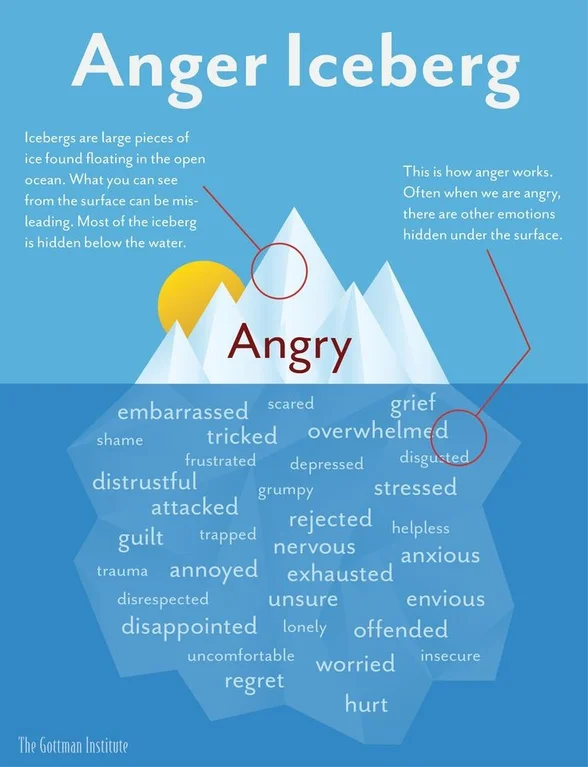
This image is profoundly misleading because it leaves out a major factor

A major cause of anger and all other emotional reactions during interpersonal communications is mistaken interpretations, either wrong or distorted. This can also include positive interpretations.

For Buddhists, the second skandha (sensation) is the proximate cause of how we perceive (third skandha) forms (first skandha). The fourth and fifth skandhas (mental activity and consciousness) are how we consolidate or more often reconsolidate the original mistaken or distorted sensation. For more on this see: The Five Skandhas.

For non-Buddhists, if you watch your mind closely you will notice there is a short delay between receiving an impression and reacting to it, interpreting it.

For everyone, if you can be mindful of the second skandha (sensation) as it occurs and then interrupt the habitual firing of the next three skandhas by doing a FIML query, you will begin to truly observe how your mind (and your partner’s mind) really works. Each interruption of this type improves your mental and emotional functioning because you will observe an objective bit of reality and correct toward it. For more information see: Disruption of neurotic response in FIML practice and How the brain processes new information. ABN

An image that illustrates the value of FIML practice

click on image for larger

FIML practice is like JWST compared to normal interpersonal speech, which is like Hale at best. Like the telescope, FIML is a technical advance that allows for much greater clarity and resolution. In Buddhist terms, FIML is partner-based mindfulness that provides an objective control on understanding in addition to much better clarity. ABN

Engineering Illusions of The Science

Much of what most people believe is science, is not science. A lot of people might agree with that sentiment, but there is a more important corollary that will make some scientists flip their lids, which is that most of what scientists believe is science, is not science.

We really are that far down the road of misunderstanding or totalitarianism or something.

The story I’m about to tell begins with a warm and fuzzy documentary, but spirals into threats made to a highly respected scientist who took his family into hiding. The tale begins with an essay I wrote many years ago (you can skip it…this is the better essay) that I believe displays something like the infection of science with a virus. This was a story for which I was particularly well suited to examine for reasons you will come to understand if you don’t know me already. Upon digging into this story, what I found was quite troubling as it points to the subtle presence of hard-to-identify corruption that is therefore likely more the norm in “The Science”™ than an outlier.

link

This morning my FIML partner told me an essay by Mathew Crawford (linked above) says exactly what I always say about FIML practice—that it just takes practice and that almost anyone can do it with not even that much effort. I am 100% certain Mathew could learn basic FIML in a few hours if he has a suitable partner or a good teacher. In fact, I hereby volunteer to teach him the “tricks” for free. You do not need to be really smart to do FIML. You do have to be willing to practice. Sadly, the hardest part of learning FIML is finding an honest partner who also wants to learn. While math tricks can get attention, FIML can open your mind to levels of conscious understanding you cannot even imagine today. I guarantee it. ABN

Our brains take time to update unless we are shown the update

A clever experiment has shown how our brains ignore change or incorporate it into our perceptions only slowly through a “continuity field,” as described below:

Like our social media feeds, our brains are constantly uploading rich, visual stimuli. But instead of seeing the latest image in real time, we actually see earlier versions because our brain’s refresh time is about 15 seconds, according to new UC Berkeley research.

The findings, appearing today, Jan. 12, in the journal Science Advances, add to a growing body of research about the mechanism behind the “continuity field,” a function of perception in which our brain merges what we see on a constant basis to give us a sense of visual stability.

“If our brains were always updating in real time, the world would be a jittery place with constant fluctuations in shadow, light and movement, and we’d feel like we were hallucinating all the time,” said study senior author David Whitney, a UC Berkeley professor of psychology, neuroscience and vision science.

link

The study itself—Illusion of visual stability through active perceptual serial dependence—focus more on the illusion of visual stability:

Despite a noisy and ever-changing visual world, our perceptual experience seems remarkably stable over time. How does our visual system achieve this apparent stability? Here, we introduce a previously unknown visual illusion that shows direct evidence for an online mechanism continuously smoothing our percepts over time. As a result, a continuously seen physically changing object can be misperceived as unchanging.

If you watch the videos in the first link above, you can notice two things: 1) the slowness and blurriness of our perceptual change as we watch the video, and 2) that we can and do accept that change the moment it is shown to us in comparative stills.

I believe it is fair for me to extrapolate from this that our psychologies or, more precisely, our psychological memories do something similar on both points. Though the medium of memory is vastly less crisp than that of visual perception in real-time, a fruitful comparison can be made.

Many old movies are based on the two points mentioned above. The protagonist thinks someone is either bad or good and acts accordingly and then at the climax is shown indisputable proof that the opposite has been true all along. This plot is very common in movies predating WW2 but is still an undercurrent in many movies since then.

Humans like this plot and resolution because it mirrors real life in an ideal way. If only we could resolve similar problems in our own lives so quickly and easily!

This can be done in FIML practice. In fact this is the goal of FIML practice—to update our psychologies or psychological memories (almost the same thing) quickly and in real-time. In FIML practice “real-time” means analysis should begin quickly while the initiating percept is remembered by both partners. Rather than allowing us to proceed with our normal “continuously smoothing our percepts over time,” FIML stops us and forces the update immediately.

I was intrigued to see that the authors of the study notice the time-span of 15 seconds:

We find that online object appearance is captured by past visual experience up to 15 seconds ago. 

This is roughly the “speed” of our working memories. FIML works most of all with the working memory because when we correct a mistake in our working memory or upgrade the data of our working memory while it is still present, we are able to make large changes in our psychologies almost effortlessly. FIML leverages the working memory to make large changes in our whole brain memories. It works well because changing your working memory to fit the obvious reality staring you in the face is easy.

In contrast changing whole brain memories and psychologies through rumination and recollection only entrenches them further and deeper.

While it is very easy to see how this happens visually as in the linked materials; and while it is also easy to see that many old movie plots exploit this feature of our consciousness, it can be hard to see how to do this in real time with our complex psychologies as they are functioning in real-life.

FIML completely solves this problem and yet is still hard for many to see how and why.

The why is psychologically analogous to correcting the illusions produced by our brains “continuously smoothing our percepts over time.” This “continuously smoothing over time” causes most of our psychological problems, often making our lives dingy self-fulfilling prophesies or uninterrupted narcissistic fantasies.

The how is done by pausing real-life in real-time so you can compare your own mind’s percept with your partner’s percept of the same thing and make corrections as warranted. Easy-peasy, right? Actually it is once you see the point.

Working memory is key to deep psychological transformation, Part 2

Part 1

Part 3

In science, working memory is generally thought of as either:

  • …the sketchpad of your mind; it’s the contents of your conscious thoughts.”   (Earl Miller, a professor of neuroscience at MIT’s Picower Institute for Learning and Memory)
  • Or “…a core component of higher cognitive functions like planning or language or intelligence.”   (Christos Constantinidis, a professor of neurobiology and anatomy at Wake Forest School of Medicine) [Source for both]

Obviously, both versions are valuable and probably both are roughly true. Some “contents” of working memory are indeed sketchpad-like—a crack in the sidewalk or a passing bird—while others clearly are “core components of higher cognitive functions” and, I would add, long-term memory including all psychological factors.

Our psychology—be it “natured” or nurtured—functions in real-life in real-time because we remember it. It bears on us because it is in our minds, because it colors our minds, shades our thoughts and actions.

Working memory is key to understanding human psychology because it shows us how we really are functioning, thinking, acting, feeling in real-time.

Working memory is also fleeting. If you want to use working memory to understand your real-life psychology, you have to be able to analyze it in real-time. This means you have to capture its contents and examine them as near to their appearance in working memory as possible.

You can do this alone with good effect, but when you do it alone you are prone to self-referential bias and other mistakes. When you do it with another person, they can help you avoid self-referential mistakes as well as other less serious ones.

This is how FIML practice works and why it is done the way it is. FIML analyzes data discovered in the working memory.

So how do you do that? You do that by immediately noticing when something significant about the other person’s speech or behavior enters in your mind or arises in your working memory. Generally, that something will have psychological impact on you, though you might just be curious or notice it for other reasons.

Whether working memory is an independent sketchpad or a component of higher functions, analyzing whatever you feel like analyzing in it is valuable. Sometimes even very little things can have great psychological import.

Analyses of working memory through FIML practice are most productive when they entail what I have called “psychological morphemes.”

Psychological morphemes are the smallest units of human psychology. Metaphorically, they are a word or a letter as compared to a phrase, a paragraph, or even a book. They are the building blocks of larger psychological structures and also may occur as unique isolates.

Whenever a psychological morpheme appears in working memory, it is always interesting. Psychological morphemes almost always signal the onset of a larger psychological interpretation, one either stored in long-term memory or one arising just now.

By working with any and all psychological morphemes as they appear in your and your partner’s working memories and by working with them repeatedly, both partners will come to understand that some of these psychological morphemes have deep roots in their cognitive systems while others do not.

For example, a fleeting expression or tone you observe in your partner may cause you to feel jealous or disrespected. Do FIML immediately and find out what it was.

It’s either true or false or in-between. If you have a good and honest relationship with your partner, most of the time you will find a negative psychological morpheme that appeared in your working memory was false and that it is part of a psychological habit of yours that has deep roots in other cognitive functions.

A great benefit of FIML is repeated analyses of mistaken psychological morphemes leads to their extirpation, sometimes quickly sometimes more gradually. A second benefit of FIML is it makes all communications between partners much clearer and more satisfying. A third advantage is most of these gains lead to better understanding and competency with all people.

Part 3

first posted NOVEMBER 14, 2018

Advanced FIML

It is of paramount importance that FIML partners learn to use the basic FIML technique described here: How to do FIML.

Even very advanced partners should be using the basic technique most of the time.

This is because most mix-ups are fundamentally simple and/or are based on something quite simple. And this happens because of how humans use and process language. Basically, our limbic system is too closely connected to our neocortex. Our emotional reactions have a strong tendency to overwhelm our capacities for good listening and rational analysis.

Mix-ups are 100% completely guaranteed for all people because all of us have learned to speak non-FIML languages. And even after we are able to do FIML, we will still readily slip back into non-FIML reactions.

It’s no one’s fault. We are primitive beings with poor control of both language and our emotional reactions to it.

That said, advanced FIML partners will find themselves regularly engaging in FIML discussions that may be continued for days and that will refer to factors that lie outside of the basic data described in the basic technique.

As partners progress, they will come to better understand the complexity of their interactions while noticing that some dynamic features between them tend to repeat. It’s good to keep a record in your minds of those features or routines that tend to recur. These are the idiosyncratic dynamics of your Functional Interpersonal Meta Linguistic reality.

Yes, some of these dynamic features can and will be generalizable to other couples, but the mixture of all of them together will largely be unique to the two of you.

FIML is not about telling you what to think or believe. It is, rather, a technique that will help you and your partner achieve optimum communication and mutual understanding with each other.

FIML partners must learn the basic technique and they must use it frequently because all other discussions will require it. That said, advanced FIML partners should also expect to engage in FIML discussions that go well beyond the basic technique in length, complexity, and the factors considered.

first posted DECEMBER 24, 2011

Random notes on FIML

Sometimes things become clearer when we have just a bit of information, or several small bits. A single detail can sometimes make us perceive the whole in ways we had not before; we may notice connections we had not noticed or recall pertinent memories that had been submerged. I hope the following short notes will be helpful in this way.

  • When we speak to someone, we speak to what we think is in their mind. FIML practice helps us know with much greater accuracy what is in the mind of the person we are speaking to.
  • FIML helps us avoid the worry of wondering if our partner is bothered by something we said (or did) because we know that if they are, they will bring it up.
  • FIML allows far more leeway in how we speak to our partner. It allows us to speak creatively and exploratorily with our partner. We can speak tentatively without the need for strongly expressed conclusions. We can share doubt, wonder, uncertainty with our partner.
  • Our minds are dynamic processes. FIML helps us access the dynamism of our minds in the moment with our partner. We can share and communicate dynamic states without clinging to static interpretations.
  • Interpretations of what others say or of what we think they are saying are all too often static interpretations based on things that happened in the past. With FIML practice, by simply asking, we avoid making harmful or mistaken interpretations. There is no need to guess at what our partner means, and every reason not to.
  • If you wonder what your partner means but don’t ask, you will still make some sort of interpretation. If you don’t ask them because you think it might feel awkward, you are still making an interpretation and limiting your understanding of yourself and your partner.
  • Neuroses (ongoing mistaken interpretations) are fed in the moment. Conversations move quickly and are dynamic. If we withhold a FIML query from our partner, we will almost certainly feed one of our ongoing mistaken interpretations of them, we will strengthen our own neurosis and miss a chance for mutual liberation from it.
  • When we speak or listen, we all tend to be self-centered, in a neutral sense of the term. I don’t mean selfish here, but simply self-centered. When we listen, we tend to listen first of all to how our partner’s speech impacts us. Did I do something wrong? Did I do something right? Will that cost me energy or money? Does that refer to me somehow? Our fundamental self-centeredness  is based on being in a body and having a mental autobiography. There is nothing wrong with that unless we use it mistakenly as an integral part of our interpretation of what our partner is saying. If you are wondering if their comments are being directed, subtly or not, at you, just ask them. If you don’t ask, you will either come to a conclusion based on insufficient information or you will continue to wonder about what they said. In either case you will be wasting both your own energy and your partner’s. It’s always “cheaper” (more energy efficient, more truth efficient) to do a FIML query than to avoid it.
  • It’s always “cheaper” (more energy efficient, more truth efficient) to do a FIML query than to avoid it.
first posted NOVEMBER 16, 2011

The elephant in the room of human communication

words 580

 …if a manager at work is grimacing because they are sitting in an uncomfortable chair, a person with increased oxytocin levels may think the manager is negatively reacting to what they are saying instead, which may potentially cause issues in the workplace.

Recent research at Concordia University in Canada has concluded that giving oxytocin to “healthy young adults” may not work. See High oxytocin levels ‘trigger oversensitivity to emotions of others’ for more as well as for the source of the quote above.

I don’t particularly doubt these research findings, but do believe that a much deeper problem—the elephant in the room—is lying right next to them.

And that problem is everyone is frequently faced with puzzles like the one cited above and no one has sufficient “emotional intelligence” or “social reasoning skills” to figure many of them out. All people frequently make mistakes in situations like these.

True, some do better than others and we probably can abstract a bell curve for this via some sort of test.

How do we define “oversensitivity?” Why would emotional sensitivity be a bad thing?

In the example linked above, it is true that most employees will never have an opportunity to ask their bosses why they are looking one way or another. But if they don’t even notice the possibility that their boss is reacting negatively, they are limiting their understanding of the world around them.

Language, facial expressions, and tone of voice in real-world communications are crude tools. There is no way around this fact. There is no “right sensitivity” or “right understanding” of any of these communicative signs that is out there somewhere. There is no stable standard for communication except in highly defined settings and contexts.

I tend to be against taking drugs for emotional “problems,” so I am not advocating supplementing your diet with oxytocin. My concern is how do you deal with communicative ambiguity? I guarantee that ambiguity is common in virtually all communicative acts.

If the ambiguity, such as the one cited above, occurs in an employment situation, should you be judged “emotionally sensitive” and in-touch with your “innate social reasoning skills” if you don’t notice it? Are you supposed to comprehend on the fly that your manager is sitting in an uncomfortable chair? How would you know that?

How could you possibly know for sure what your manager is thinking or feeling? It’s less likely but not inconceivable that your manager  is a nut who intends to attack you after work or fire you next week. There is no standard by which you can judge and be certain of what they feel or are thinking.

In intimate personal relations you can achieve certainty, or close to it, by practicing FIML with your partner.

If you and your partner do not do FIML or something like it, you will be more or less forced to cleave to some sort of “normal standard” for communication. But a “normal standard” for all communicative acts is not just elusive, it doesn’t exist.

This is the even bigger elephant in the room of psychological studies; indeed of all cultures everywhere. No standard for intimate communication exists outside of the one(s) you make for yourselves. If you leave too much to vague notions like “emotional sensitivity” or “emotional intelligence” without having the tools to actually comprehend communicative acts, you will consign yourself to many pointless misunderstandings, any one of which has the potential to snowball and disrupt your relationship.

first posted JANUARY 23, 2014

Why FIML queries need to be asked quickly

A fascinating Swedish study claims to show that:

…the sense of agency for speech has a strong inferential component, and that auditory feedback of one’s own voice acts as a pathway for semantic monitoring, potentially overriding other feedback loops.

The source of that quote can be found here: Speakers’ Acceptance of Real-Time Speech Exchange Indicates That We Use Auditory Feedback to Specify the Meaning of What We Say.

In an article about the study above—People Rely on What They Hear to Know What They’re Saying—lead author Andreas Lind says that he is aware that the conditions of their research did not allow for anything resembling real conversational dynamics and that he hopes to study “…situations that are more social and spontaneous — investigating, for example, how exchanged words might influence the way a… conversation develops.”

FIML partners will surely recognize that without the monitoring of their FIML practice many conversations would veer off into mutually discordant interpretations and that many of these veerings-off are due to nothing more than sloppy or ambiguous speech or listening.

If speakers have to listen to themselves to monitor what they are saying and still misspeak with surprising frequency, then instances of listeners mishearing must be even more frequent since listeners (normally) do not have any way to check what they are hearing or how they are interpreting it in real-time.

That is, listeners who do not do FIML. FIML practice is designed to correct mistakes of both speaking and listening in real-time. FIML queries must be asked quickly because speakers can only accurately remember what was in their mind when they spoke for a short period of time, usually just a few seconds.

The Swedish study showed that in a great many cases words that speakers had not spoken “were experienced as self-produced.” That is speakers can be fooled into thinking they said something they had not said. How much more does our intention for speaking get lost in the rickety dynamics of real conversation?

This study is small but I believe it is showing what happens when we speak (and listen). Most of the time, and even when we are being careful, we make a good many mistakes and base our interpretations of ourselves and others on those mistakes. I do not see another way to correct this very common problem except by doing FIML or something very much like it.

In future, I hope there will be brain scan technology that will be accurate enough to let us see how poorly our perceptions of what we are saying or hearing match reality and/or what others think we are saying or hearing.

It is amazing to me that human history has gone on for so many centuries with no one having offered a way to fix this problem which leads to so many disasters.

first posted APRIL 30, 2014

Retroactive Revision

words 331

Retroactive revision means changing what you said. Anyone can do it but retroactive revision is especially designed for FIML partners. Partners can use it whenever they feel a statement they have made has boxed them into a corner or is making the conversation take a turn they had wanted to avoid.

For example, you say “I like XYZ cars the best.” What you actually meant is I very much like XYZ cars. Your partner starts talking as if you really mean you like them the best. This is a very simple example, but sometimes it can be difficult to keep things on track even with a simple mix-up like this.

If you feel your partner is wasting time talking about the good points of other cars to show you that XYZ may not be the best, just say you want to retroactively revise what you first said. Say: “I want to retroactively revise what I said. I want to change my initial statement to I very much like XYZ cars. I didn’t actually mean I like them the best of all cars; I was exaggerating, I guess.” Your partner will understand that you were using words loosely and that they need not take your original statement literally. They will change their tack and your conversation will become more in keeping with what you really think and feel.

Once learned, that technique will give both partners a lot of freedom. It’s relaxing to know you can easily change what you have said to be more in line with the thinking that has evolved in your mind since you made your initial statement.

As with most FIML techniques, FIML partners should do retroactive revisions the moment they feel a jangle that their partner may have misunderstood them. If it turns out your partner did not misunderstand, there is still a major benefit for both partners because the mistaken impression you had about your partner will not cause any further confusion for either of you.

first posted MARCH 29, 2012