Nvidia (NVDA) is joining its mega-cap tech peers, becoming the fourth Magnificent 7 stock to split since 2022.
The chip giant’s 10-for-1 stock split, which will start trading on Monday, follows significant price growth, with shares up 212% in the past year. That massive rally pushed Nvidia into the $3 trillion club alongside Apple (AAPL) and Microsoft (MSFT), becoming just the third US company ever to reach that milestone.
“A stock split is a vote of confidence from management that the stock will hold its value, as the stock [price] typically increases,” S&P Dow Jones Indices senior analyst Howard Silverblatt says.
At this stage, European corporations have bought more land in Western Ukraine than the Russians have taken on the East side, while Ukrainians find themselves in a debt trap. pic.twitter.com/q7rPViQgK4
— Ignorance, the root and stem of all evil (@ivan_8848) June 8, 2024
The planned annihilation of Ukraine (note the 2021 changed land sale law and the 2014 color revolution) foreshadows the planned annihilation of Europe. ABN
If you’ve ever read a story in the news about elver fishing season, you’ve probably seen some variation of this line: “Maine’s the only state in the U.S. with a significant fishery for elvers.”
Maybe you thought that’s because elvers don’t exist in large numbers outside of Maine — that would be a reasonable assumption. But the real reason is somewhat more complicated.
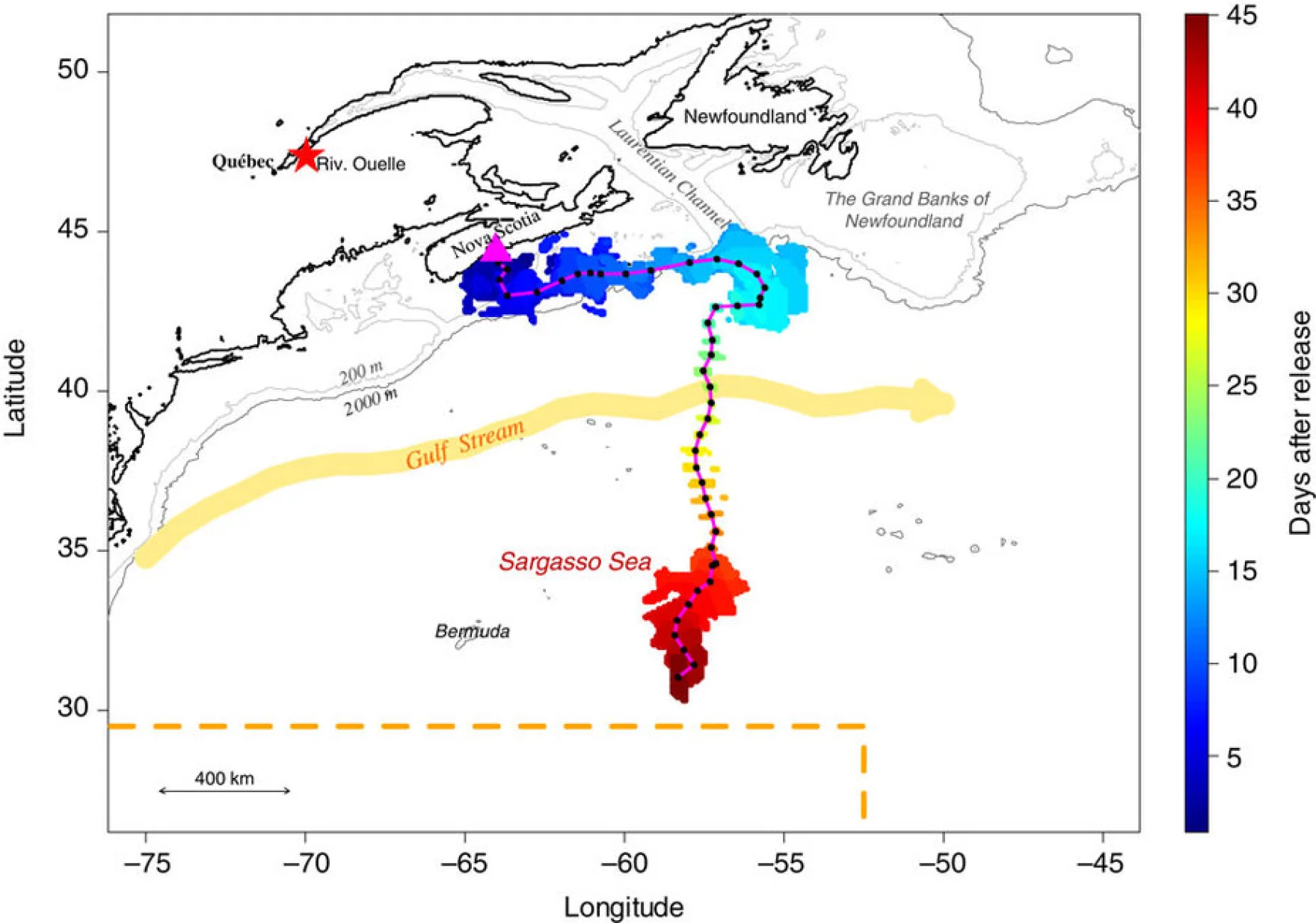
Let’s start at the beginning, in the Sargasso Sea. Although it sounds romantic, the Sargasso Sea is actually just an area of the North Atlantic that’s full of Sargassum, a kind of seaweed that floats in the ocean rather than existing close to land.
It’s a unique marine environment, and the Sargasso Sea provides a cozy place for many species to spawn or start out life, including baby turtles and some types of fish.
It’s also where the life cycle of the American eel both begins and ends. They’re born there, and after a few decades — eels are incredibly long-lived animals — they swim back in, spawn and die.
Outside of that, eels’ life cycle isn’t that well understood, but we know they start out there as tiny leptocephali, or larvae, which look like nothing more than a transparent willow leaf.
For the first few months of their lives, they float about with the ocean currents and are eventually carried by the Gulf Stream north along the continental shelf of the eastern U.S. Then, somehow — scientists don’t know quite how — they find their way out of the Gulf Stream and into coastal and fresh waters.
At this point, they’re about a year old and looking more eel-like, but still transparent. They’re now in the elver, or “glass eel,” stage, and as University of Maine marine biologist James McCleave puts it, they get “spit out everywhere” along the Atlantic Coast. Then they more or less stay put in estuaries, rivers and lakes near the coast for decades, getting bigger, fatter and more silvery.
This is a well-written article which explains why the price of Maine’s glass eels is typically over $1,000 per pound. The basic reason is Maine provides hard to get breed eels to Japan where eels are a popular dish. Be sure to read the whole story because it is interesting and much more complicated than that. ABN
Russian President Vladimir Putin‘s trip to China apparently failed last week to secure a project key to the hopes of Moscow’s struggling energy sector.
Putin’s state visit produced a joint statement heralding a “new era” for Beijing and Moscow’s “no limits partnership,” while the hug shared with Chinese counterpart Xi made headlines. But the long-ruling Russian leader walked away without a contract for a pipeline between his country and its largest export market.
Russia has offset some of the business it lost over its February 2022 invasion of Ukraine by rerouting natural gas and oil to China. This relationship continues to deepen with the first Power of Siberia pipeline expected to reach full capacity this year and pipe 38 billion cubic meters (bcm) into China annually.
However, the outsized importance of the Chinese market gives Beijing more control over the terms. Gas is flowing into China at a rate of $257 per 1,000 cubic meters, compared to the $320 for its remaining European markets, and this discount is set to increase to 28 percent next year.
The thing about trade wars is they really stop you from trading…
Reports have piled up about how Big Tech companies have turned on their money hoses to poach top AI talent from each other. They’ve also turned on the charm — both OpenAI’s Sam Altman and Meta CEO Mark Zuckerberg have reportedly been personally involved in courting candidates and offering lavish salaries. But a larger and more intractable talent war is brewing between the US and China.
U-S-A-I
China has had a habit of overtaking the US in technology, like EV adoption or 5G rollout. But when it comes to the hype-beast of generative AI, the US holds the reins. That’s partly because of how the tech industry is set up — Big Tech companies are developing AI in-house, but they’re also forging partnerships with startups like OpenAI, Anthropic, and France-based Mistral AI, because the cloud and computing infrastructure needed to run AI models is dominated by Microsoft, Amazon, and to a lesser extent, Google.
Meanwhile, the US wants to box China out of AI development, arguing that it might use it for military or otherwise nefarious purposes. Its ever-escalating chip trade war is aimed at depriving China of physical infrastructure, and the US is reportedly considering banning exports of AI models (although that seems a little nonsensical). The US is even fighting by proxy: The New York Timesreported in November that US officials were feverishly dissuading Dubai-based G42 to cut its AI links to Chinese businesses.
On the issue of crypto currency, watch the DC voices very closely.
They are about to take up legislation on the topic of crypto currency, regulation and overall ramifications therein. Keeping in mind that a dollar-based Central Bank Digital Currency (CBDC) cannot and will not coexist within a financial system that permits the transition (the exchange) of dollars into crypto and vice-versa.
Put simply, in the Western financial system, crypto currency cannot exist with a CBDC. Duality of currency is possible outside the West, but not feasible, viable or possible given the political motivations behind the creation of the dollar-based CBDC.
…The five major banks, all of whom gain maximum benefit from the CBDC as transfer brokers, will join Jamie Dimon (JPMorgan) and decry crypto as the planet harming, energy intense, earth polluting system that is currently melting the ice caps. Meanwhile Greta Thunberg and Taylor Swift will assemble their perpetually depressed Gen-Z forces against BitCoin et al.
Just watch, the seeds of the nonsense are already planted.
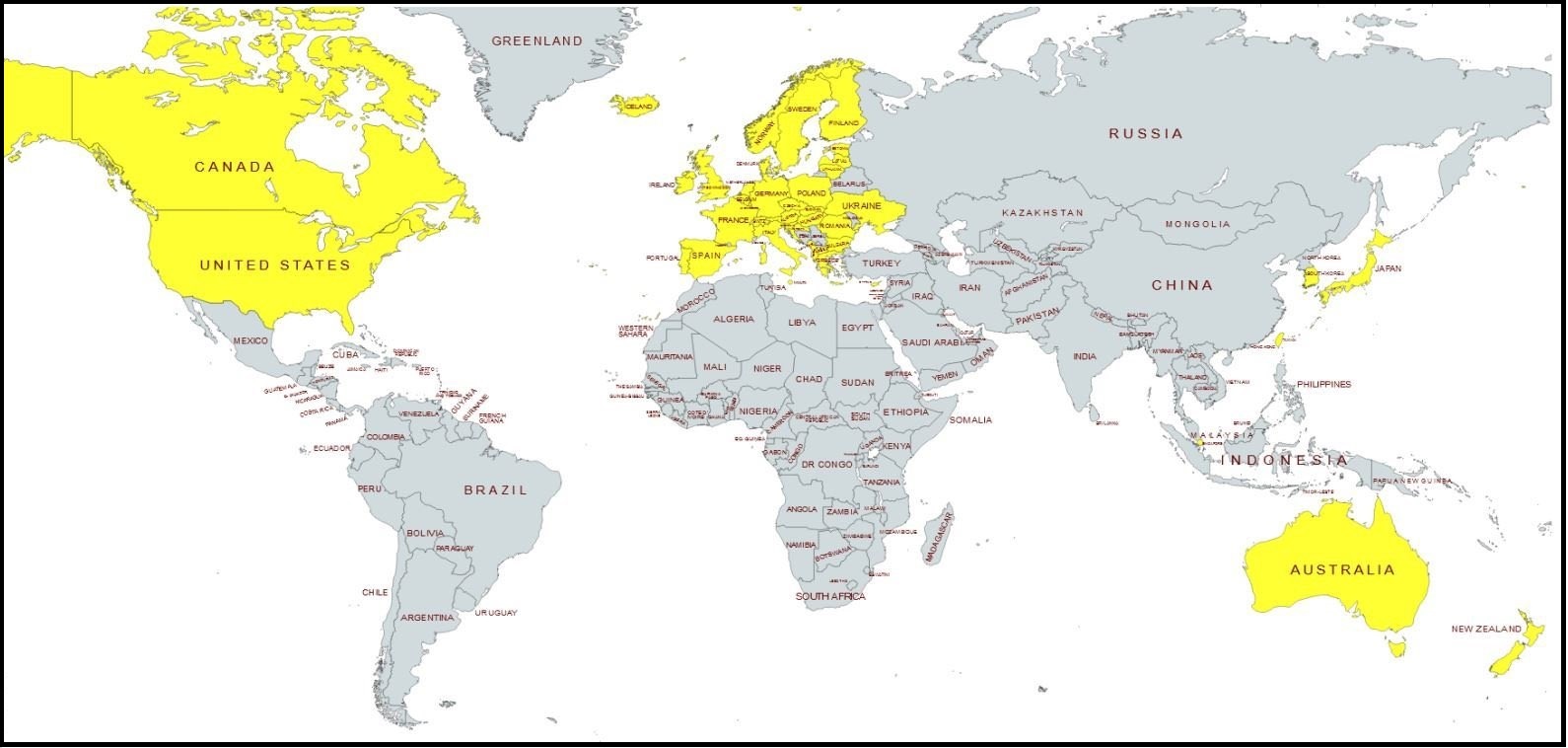
The Yellow Zone is specifically constructed to begin using a dollar-based CBDC likely sometime after the 2024 election, with open tests in 2025 depending on the election outcome. Even if Trump wins the ’24 U.S election, the bankers who control the rest of the yellow zone will continue implementation of the Dollar-Based Central Bank Digital Currency (DBCBDC) without direct USA participation (they will wait out Trump’s term).
Among adventure-touring bikes, it has seemed like most of the action in recent years has happened in the middleweight segment. The Aprilia Tuareg, the Yamaha Ténéré 700, and the Honda Transalp are just a few examples of excellent middleweights that have drawn new attention to the class. The stats back up that impression.
The MIC breaks down the adventure class into three displacement categories, and the 601-900 cc class is where the growth is happening, with sales up 13.1%. Meanwhile, sales were down 16.4% in the over 900 cc class and down 32.7% in the much smaller 600 cc and under class. Consumers really are migrating from the big adventure-touring motorcycles to the new middleweight entries that are lighter, less expensive, and still very versatile and capable. Sounds like a smart move to me.
U.S. motorcycle sales, which grew little in the decade between the financial crisis and COVID-19, and were then turned upside down by the disruptions of the pandemic, now appear to be returning to the stagnation and patterns we experienced before.
Highly disturbing even if you already know the story. Makes me think of all the young people I know whose parents resolutely followed doctors’ orders and vaccinated their babies who then manifested long-term serious bad effects. Thomas describes a deeply entrenched parasitic subculture which even he did not fully understand while he was an active practitioner. ABN
I’ve said it before, but I’ll repeat it: the concept of the energy transition is essentially a Western conceit. The U.S. and Western European countries are spending hundreds of billions of dollars on programs like the Inflation Reduction Act and the Energiewende to fund buildouts of solar, wind, batteries, and tutti-fruity-colored hydrogen, but that doesn’t mean the rest of the world will do the same. There is no evidence that China and India are going through an energy transition. Instead, the numbers show those two countries are building staggering amounts of new coal-fired capacity. That capacity is far greater than the amount of nuclear capacity they are building. This chart, which I first published last December, uses updated figures from the International Energy Agency and Global Energy Monitor.
…Understanding how Japan got here is simple: It had one of the world’s fastest-growing economies for much of the 20th century, and then it hit a slump that never abated.
The period after World War II was a full-on economic miracle. With massive investments in industrialization and legendary manufacturing acumen, Japan became the second-largest economy in the world, behind only the US — in some years during the 1960s, GDP grew by more than 10%.
Then came another kind of pop — the one that ends a bubble. But this was no typical bubble — it produced outlandish numbers like these:
Land values in Tokyo increased 10% in 1986, 57% in 1987, and 22% in 1988, more than doubling in three years. At one point, real estate economists estimated that the few acres of land under the city’s Imperial Palace were worth more than all of the real estate in Canada.
The real estate bubble coincided with a stock market boom, as firms were being valued with their massively appreciated real estate holdings in mind (uh-oh). The Nikkei Index rose every single year in the 1980s, culminating in speculator-fueled gains of 40% in 1988 and 29% in 1989.
Capital gains in Japan from land and stocks in 1987 comprised more than 40% of the gross national product.
To rein in speculation, the Bank of Japan raised inter-bank lending rates in 1989, which burst the bubble. Japan’s stock market crashed — equities fell 60% between 1989 and 1992 — and real estate values tumbled along with them. After averaging around 4% in the 1980s, Japan’s annual GDP growth rate from 1992 to 2007 was barely above 1.1%, according to OECD data.
…the direction of travel is unmistakable: once regarded among Western multinationals as the great business opportunity of this century, foreign businesses are pulling out of the country in growing numbers.
The danger for China is that what started as a trickle may quickly become a flood – if it hasn’t already. The list of major companies heading for the exit may be greater than those still operating in China.
A HOT POTATO: It’s no secret that certain types of jobs are more threatened by artificial intelligence than others. Call center workers fall into this category, and while we’ve already seen a few companies replace phone-based support staff with generative AI, there are warnings that the entire industry could be comprised mostly of chatbots in as soon as a year.
The grim prediction comes from K Krithivasan, head of Indian IT giant Tata Consultancy Services (TCS). The second-largest company in India by market cap, it has more than 616,000 employees worldwide.
Speaking to the Financial Times, Krithivasan said AI will result in a “minimal” need for call centers. The CEO added that while “we have not seen any job reduction” so far, that will change as multinational clients adopt generative AI. The technology is expected to have a massive impact on the customer help center industry, which, according to a Gartner report in 2022, employs about 17 million people.
this is it. we're moving to a new stage of the Endgame.
Japanese Yen ripping through barriers like paper, passing each level where the BoJ intervened before. The slow motion meltdown has finally begun to accelerate, and authorities are powerless to stop the decline, unless they… pic.twitter.com/LhX9AWExIo


 American Buddhist Net