If you’ve ever read a story in the news about elver fishing season, you’ve probably seen some variation of this line: “Maine’s the only state in the U.S. with a significant fishery for elvers.”
Maybe you thought that’s because elvers don’t exist in large numbers outside of Maine — that would be a reasonable assumption. But the real reason is somewhat more complicated.
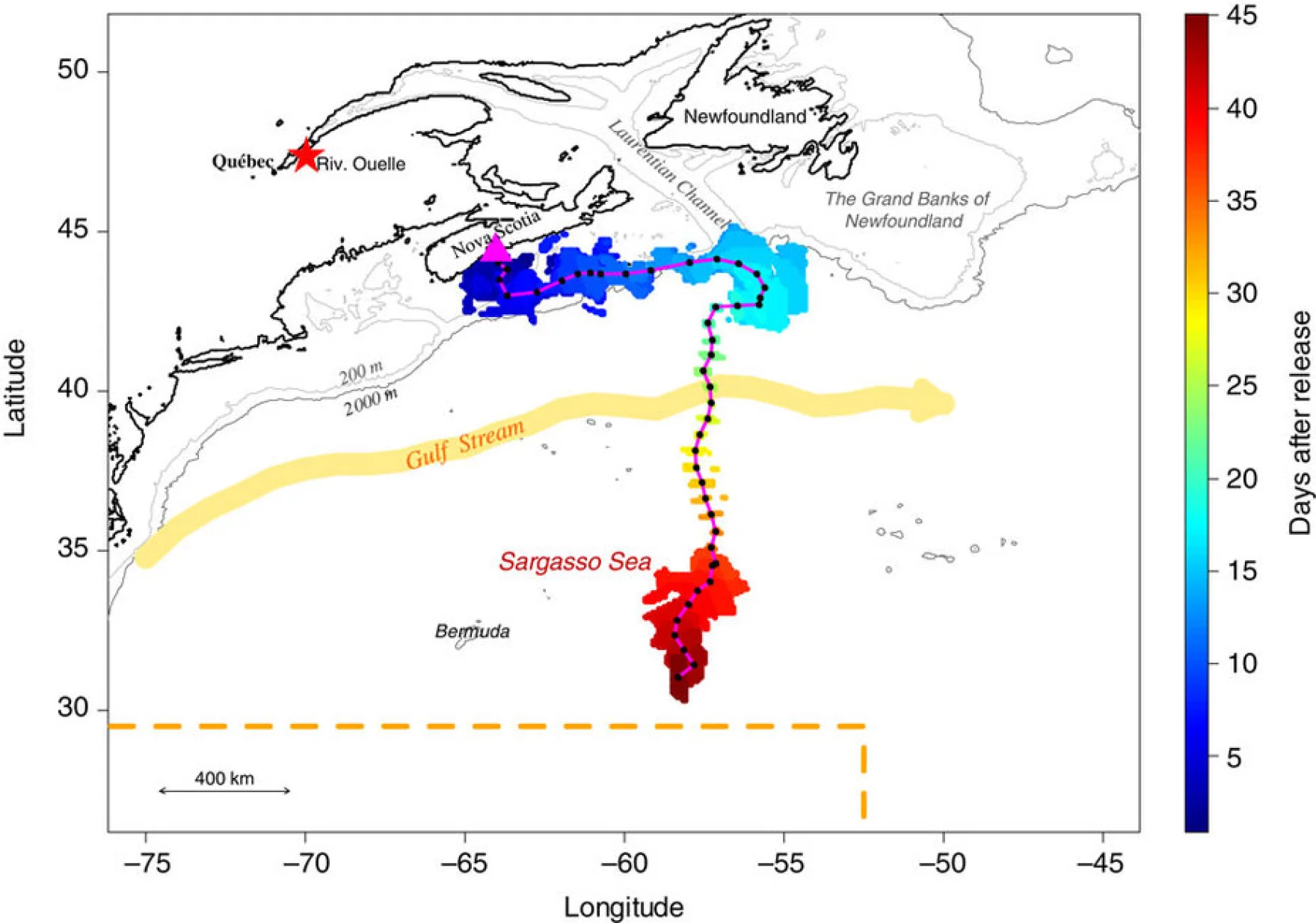
Let’s start at the beginning, in the Sargasso Sea. Although it sounds romantic, the Sargasso Sea is actually just an area of the North Atlantic that’s full of Sargassum, a kind of seaweed that floats in the ocean rather than existing close to land.
It’s a unique marine environment, and the Sargasso Sea provides a cozy place for many species to spawn or start out life, including baby turtles and some types of fish.
It’s also where the life cycle of the American eel both begins and ends. They’re born there, and after a few decades — eels are incredibly long-lived animals — they swim back in, spawn and die.
Outside of that, eels’ life cycle isn’t that well understood, but we know they start out there as tiny leptocephali, or larvae, which look like nothing more than a transparent willow leaf.
For the first few months of their lives, they float about with the ocean currents and are eventually carried by the Gulf Stream north along the continental shelf of the eastern U.S. Then, somehow — scientists don’t know quite how — they find their way out of the Gulf Stream and into coastal and fresh waters.
At this point, they’re about a year old and looking more eel-like, but still transparent. They’re now in the elver, or “glass eel,” stage, and as University of Maine marine biologist James McCleave puts it, they get “spit out everywhere” along the Atlantic Coast. Then they more or less stay put in estuaries, rivers and lakes near the coast for decades, getting bigger, fatter and more silvery.
This is a well-written article which explains why the price of Maine’s glass eels is typically over $1,000 per pound. The basic reason is Maine provides hard to get breed eels to Japan where eels are a popular dish. Be sure to read the whole story because it is interesting and much more complicated than that. ABN


 American Buddhist Net