About The New “Affordable Housing” Fees on Mortgages that Punish High Credit Borrowers

If you focus on the DC Potemkin Village, you view this move through the prism of Biden’s FHFA creating a policy to favor low-income (nonwhite) voters by punishing stable credit worthy borrowers.  That’s what the powers who control the levers, and create policy, want us to focus on.  That’s not what is going on.

Biden doesn’t control anything.  Biden is a puppet to the multinationals that control DC policy.  When Biden was installed, the people who control the money and wealth (Blackrock, WEF assembly etc.), the people behind the Potemkin Village, knew what the larger economic agenda would create.

link

Just another lending scam that will allow large investment funds to exit RE while prices are still high. Good short read. ABN

Lavrov in Caracas, Brasília talks SWIFT alternative amid sanctions

Russian Foreign Minister Sergey Lavrov, on his Latin America tour, urged countries facing similar challenges to “join forces” against  Western sanctions’ “blackmail”, explaining that countries like Venezuela, Cuba, and Nicaragua are also subjected to economic sanctions and embargoes but they continued to “choose their own path.” 

While in Caracas, Lavrov reviewed with his Venezuelan counterpart, Yván Gil, alongside their respective delegations, hundreds of accords that have been inked in the past between the two countries. The agreements covered issues in the financial, energy, agricultural, and other sectors. 

link

IMF launches new GLOBAL CURRENCY — The “Universal Monetary Unit” that is supposed to revolutionize the world economy

A new global currency just launched, but 99 percent of the global population has no idea what just happened.  The “Universal Monetary Unit”, also known as “Unicoin”, is an “international central bank digital currency” that has been designed to work in conjunction with all existing national currencies.  This should set off alarm bells for all of us, because the widespread adoption of a new “global currency” would be a giant step forward for the globalist agenda.  The IMF did not create this new currency, but it was unveiled at a major IMF gathering earlier this week

Universal Monetary Unit (UMU), symbolized as ANSI Character, Ü, is legally a money commodity, can transact in any legal tender settlement currency, and functions like a CBDC to enforce banking regulations and to protect the financial integrity of the international banking system.

Today, at the International Monetary Fund (IMF) Spring Meetings 2023, the Digital Currency Monetary Authority (DCMA) announced their official launch of an international central bank digital currency (CBDC) that strengthens the monetary sovereignty of participating central banks and complies with the recent crypto assets policy recommendations proposed by the IMF.

link

How Amazon made a turnaround in 2001

In 2001, Amazon’s stock fell 90%. In a hail-mary attempt, Bezos invited a book author to Amazon. Together, they created the foundation for trillions in market cap:

The author was Jim Collins, who published Built to Last in 1994. By 2001, Bezos had already adapted several of its concepts into Amazon’s principles:

· Tyranny Of Or → Avoid 1-Way Doors
· Homegrown Leadership → Hire & Develop the Best
· Good Enough Never Is → Insist on the Highest Standards

So, Bezos was intrigued when Jim said, in front of the whole executive team:

“In times like this you want to respond not by reacting to bad news, but by building a flywheel.”

Collins had in mind the 5,000 lb old-style flywheels. They took hours to turn at first. But at some point, WHOOSH! Their own momentum kept them going.

Collins had quite a bit of reason to believe in his statement. He had commissioned a large team of Harvard MBA researchers for his new book, Good to Great. They compared companies that had delivered sustainable, S&P 500-beating results to mediocre companies that had flailed.

What the team found is the great companies were spinning flywheels. It wasn’t the first, fifth, or one-hundredth rotation that got them spinning. It was their concentrated effort that led to the breakthrough momentum.

On the other hand, mediocre companies were constantly launching new initiatives. Instead of achieving breakthrough momentum on one flywheel, they tried to create many. But each never achieved breakthrough velocity. They had to keep manually cranking them.

Given the insight, Bezos and Collins began sketching out Amazon’s e-commerce flywheel. They identified that Amazon could generate self-reinforcing momentum in 2 ways:

  1. Lower cost structure leading to lower prices leading to more scale and back to lower costs.
  2. Greater selection leading to customer experience leading to traffic leading to more sellers and back to greater selection.

These two elements have been the backbone of Amazon’s e-commerce business for the 20+ years since the pair initially founded them.

To this date, the flywheel continues to extract market share for Amazon. Last year, Amazon reached a tremendous 57% of total US e-commerce sales. At $514B in revenue, it has left the competition – like Walmart – in the dust.

So, what can we learn from Amazon’s e-commerce flywheel? As product and business people, we are tempted to start new flywheels constantly. But, it usually pays to focus on spinning our main one with self-reinforcing momentum faster.

Sketch out your flywheel, and go get it.

link

As an observer, I have always believed Bezos also used Edward Deming’s Deming Cycle to grow and improve Amazon. Since Bezos departure as CEO, it seems Deming is being forgotten. Fees are higher, service is worse. ABN

Playing ‘Fool’s Mate’ on the Grand Eurasian Chessboard — Ron Unz

For at least a generation or more, America’s international policies have increasingly been governed by our Ministry of Propaganda, and the bill may finally be starting to come due.

Last Wednesday the Wall Street Journal reported that Saudi Arabia was joining China’s Shanghai Cooperative Organization, a decision that came just a few weeks after the announcement that it had reestablished diplomatic relations with arch-enemy Iran following negotiations held in Beijing under Chinese auspices. For three generations, the oil rich kingdom had been America’s most important Arab ally, and the lead sentence of the Journal article emphasized that this dramatic development reflected our waning influence in the Middle East.

That same day, Brazil declared that it was abandoning the use of dollars in its transactions with China, its largest trading partner, following an earlier statement that its president planned to meet with China’s leader in support of that country’s efforts to end the Russia-Ukraine war, a diplomatic initiative strongly opposed by our own government. Geopolitical dominoes seem to rapidly falling, taking down American influence with them.

link

Why are so many countries all of a sudden turning to the yuan to buy their essential commodities?

Why is the world de-dollarizing so quickly?

Simple — the Russian sanctions.

Russia is the biggest single commodity producer in the world — they have oil AND gas AND agro AND minerals AND anything else.

But because of the sanctions, Russia CANNOT take dollars (or euros) for sales of their commodities.

First, the sanctions disconnected Russia from SWIFT, meaning Russians can’t pay for things they would want to buy with dollars.

So why would Russia take dollars for their commodities — if they can’t buy stuff with those dollars.

Plus their dollar assets get confiscated in the West. So why hold dollars, and dollar assets to park them in, if they will be stolen?

So because of sanctions, Russia has been FORCED to de-dollarize.

Russia didn’t want to de-dollarize — they were obliged.

By the West.

Continue reading “Why are so many countries all of a sudden turning to the yuan to buy their essential commodities?”

‘These Numbers Look Horrific’: Work Absence Rates Are Off the Charts — And It’s Only Gotten Worse

“Something’s going on with our workforce that we’ve never seen before. And it’s gone so far above trend — it’s a health concern.”

The 2022 absence rate “makes absolutely no sense,” exclaimed former Blackrock portfolio manager Edward Dowd. “Something’s going on with our workforce that we’ve never seen before. And it’s gone so far above trend — it’s a health concern.”

“Absences are defined as instances when persons who usually work 35 or more hours a week worked less than 35 hours during the reference week for one of the following reasons: Own illness, injury, or medical problems; child-care problems; other family or personal obligations; civic or military duty; and maternity or paternity leave. Excluded are situations in which work was missed due to vacation or personal days, holiday, labor disputes, and other reasons. For multiple jobholders, absence data refer only to work missed at their main jobs. The absence rate is the ratio of workers with absences to total full-time wage and salary employment,” explained Mr. Dowd on his website.

He noted, “In relative terms, the deviation from trend in 2022, for the total (men+women) full-time workers was about 70%.”

“And that number [absence rates] went up three standard deviations off of trend (2003 to 2019)” in 2020, Mr. Dowd explained. In geek-speak, the chance of something three standard deviations above the mean is 0.3 percent.

link

Bombshell Vax Analysis Finds $147 Billion In Economic Damage, Tens Of Millions Injured Or Disabled

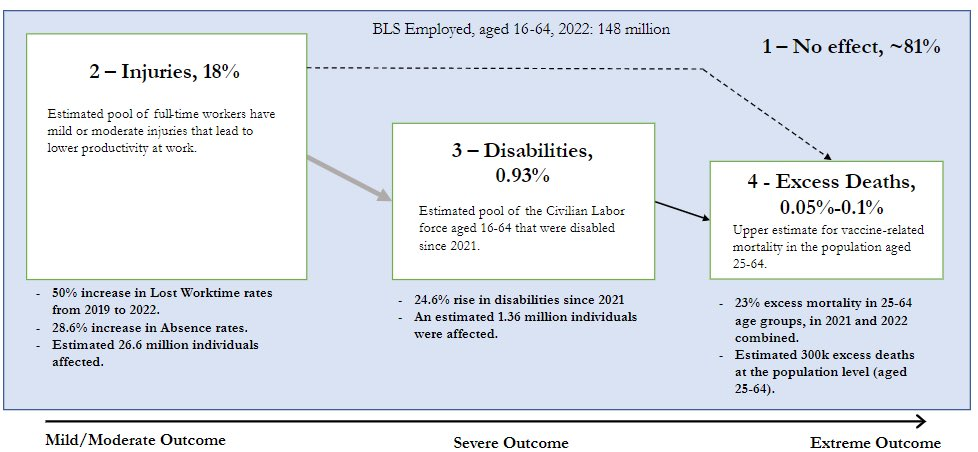
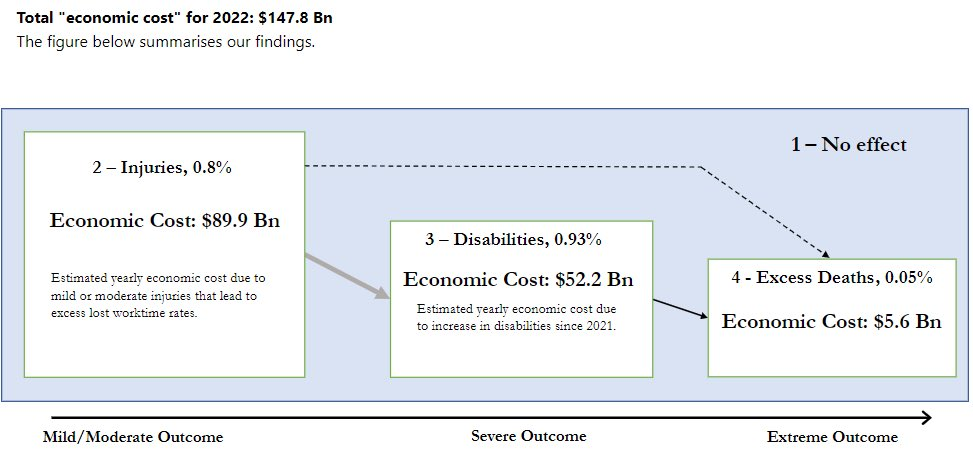
A new report estimates that 26.6 million people were injured, 1.36 million disabled, and 300,000 excess deaths can be attributed to COVID-19 vaccine damages in 2022 alone, which cost the economy nearly $150 billion.

Research firm Phinance Technologies, founded and operated by former Blackrock portfolio manager Ed Dowd, Yuri Nunes (PhD Physics, MSc Mathematics) and Carlos Alegria (PhD Physics, Finance), split the impact of the vaccines into four broad categories to estimate the human costs associated with the Covid-19 vaccine; no effect or asymptomatic, those who sustained injuries (mild-to-moderate outcome), those who became disabled (severe outcome), and death (extreme outcome). Data on vaccine disabilities and injuries comes directly from the Bureau of Labor Statistics (BLS), while the excess death figures are derived from official figures on deaths in the US via two different methods (methodology here).

It’s important to note that people in one category (injured, for example) can move into latter categories of severity – which this analysis does not take into consideration.

“We need to remember that not only are these groupings an attempt to characterize different levels of damage from the inoculations, they are not static and could interact with each other,” reads the report. “For instance, there might be individuals who had no visible effects after vaccination but nonetheless could still be impacted.”

Individuals with mild injuries from the inoculations could, over time, develop severe injuries to the extent of being disabled, or an extreme outcome such as death.”

link

The Phinance study and data can be found here just below. ABN

🚨🚨Estimated 2022 US Vaccine Damage Report

Estimated Human Cost:
✅26.6 million Injuries
✅1.36 million Disabilities
✅300k excess deaths

Estimated Economic Cost:
Total: $147.8 Billion
✅Injuries: $89.9 billion
✅Disabilities: $52.2 billion
✅Excess Deaths: $5.6 Billion

Pfizer & Moderna in 2022 had combined C-19 vaccine revenues in US of $11.5 billion so…

🚨🚨For every $1 dollar they made it cost the US economy $13 dollars.

Quite the negative societal ROI.

Largest crime scene in history. Multiply this across the globe.

Numbers…

https://twitter.com/i/web/status/1640735025498038273

Estimated Human cost report:

http://www.phinancetechnologies.com/HumanityProjects/The%20VDamage%20Project%20-%20Human%20%20Cost.htm

Estimated Economic cost report:

http://www.phinancetechnologies.com/HumanityProjects/The%20VDamage%20Project%20-%20Economic%20Impact.htm

Project Overview:

http://www.phinancetechnologies.com/HumanityProjects/The%20VDamage%20Project.htm

Our economic damage estimates are what we can measure. The knock effects such as lost productivity due to a worker being present but working at say 50%-75% of capacity is missed plus burn out from those picking up slack. Also supply chain delays are not captured etc and etc.…

https://twitter.com/i/web/status/1640735076110716928

Originally tweeted by Edward Dowd (@DowdEdward) on March 28, 2023.

End of unipolarity w/ Jeffrey Sachs, Alexander Mercouris and Glenn Diesen

Predictable surface generalities only. Mercouris joins Sachs in wondering why neocons simply cannot understand that a mutually cooperating multipolar world is what’s really best for them. I do not know enough about Sachs but suspect he is spending time cleaning up his reputation as he sees it appearing in history books sometime in the future. My sense is Mercouris knows there is more going on with neocons than insularity and failure to adapt. I encourage him to at least hint at the violent ideology that actually enlivens them. ABN