Titan’s Surface Organics Surpass Oil Reserves on Earth

Saturn’s orange moon Titan has hundreds of times more liquid hydrocarbons than all the known oil and natural gas reserves on Earth, according to new data from NASA’s Cassini spacecraft. The hydrocarbons rain from the sky, collecting in vast deposits that form lakes and dunes.

The new findings from the study led by Ralph Lorenz, Cassini radar team member from the Johns Hopkins University Applied Physics Laboratory, Laurel, Md., are reported in the Jan. 29 issue of the Geophysical Research Letters.

“Titan is just covered in carbon-bearing material — it’s a giant factory of organic chemicals,” said Lorenz. “This vast carbon inventory is an important window into the geology and climate history of Titan.”

link

Apparently not from buried algae and plankton. ABN

A Volcano Eruption Can Emit More CO2 Than All Humanity. Why Worry?

We should care about global warming and global cooling, no matter the cause.

But that does not mean we should make draconian changes in global economic, political and energy policies based upon the unproven hypothesis that human emissions of CO2 are leading to apocalyptic global warming. There simply is NO proof of this hypothesis.

It is complete supposition, despite what the CAGW alarmists, climate industry investors, globalists and radical environmentalists claim. Millions of individuals have already been severely harmed (or even killed) because of some of the irresponsible actions engaged in by governments “fighting” CO2 emissions. But billions could potentially be harmed if all of the more drastic measures proposed by alarmists are enacted.

link

Newry, Maine couple that discovered $1.5 billion lithium deposit fighting in court to mine it

A couple hoping to excavate what may be the world’s richest lithium deposit on their property in Newry has taken their case to Superior Court in an effort to clarify what is considered a metal under Maine’s 2017 mining law, one of the strictest in the nation.

Lithium is a highly sought mineral used in batteries, cell phones, stove tops and other goods. The lode, which could be worth as much as $1.5 billion, generated international headlines when it was discovered in 2021.

link

Mysterious shock wave CRACKS Earth’s magnetosphere that protects our planet from dangerous space radiation

A shock wave barreled toward Earth last night that cracked its magnetosphere, the region that shields our planet from harmful radiation.

The origin of the shockwave is unknown, but astronomers believe it came from an ejection of energetic and highly magnetized, superheated gas released from the sun – also known as a coronal mass ejection (CME).

The ejection may have been released from sunspot AR3165, which launched at least eight solar flares into space on December 14 that caused blackouts over the Atlantic Ocean, according to Space Weather.

While scientists are not sounding the alarm just yet, a crack can stay open for hours and let solar winds flow through.

link

Why the Net Zero Policy is painfully illogical

Start from a small number of statements that make up the Net Zero commitment.

  1. The Earth must actually be warming.
  2. The warming must pose a genuine and serious threat to life on Earth.
  3. The warming must be man-made. Specifically, it must be caused by excess carbon dioxide in the atmosphere arising from human activity.
  4. The U.K.’s [or anyone’s] NZC policy must bring about a meaningful global reduction of atmospheric carbon. That is, it must either make a significant reduction in its own right, or it must set an example that persuades other countries to reduce their own carbon emissions, to a degree sufficient to stop the warming.

For UK [or anywhere else] NZC to be effective, statements 1-4 must all be correct. If any one of them is false, the policy will fail, either because it doesn’t lead to sufficient carbon reduction, or because the policy wasn’t necessary in the first place.

link

Reliance on moose as prey led to rare coyote attack on human

Wildlife researchers have completed a study that may settle the question of why, in October 2009, a group of coyotes launched an unprovoked fatal attack on a young woman who was hiking in a Canadian park.

By analyzing coyote diets and their movement in Cape Breton Highlands National Park, where the attack occurred on a popular trail, the researchers concluded that the coyotes were forced to rely on moose instead of smaller mammals for the bulk of their diet – and as a result of adapting to that unusually large food source, perceived a lone hiker as potential prey. 

The findings essentially ruled out the possibility that overexposure to people or attraction to human food could have been a factor in the attack – instead, heavy snowfall, high winds and extreme temperatures created conditions inhospitable to the small mammals that would normally make up most of their diet. 

“The lines of evidence suggest that this was a resource-poor area with really extreme environments that forced these very adaptable animals to expand their behavior,” said lead author Stan Gehrt, a wildlife ecologist at The Ohio State University. 

“We’re describing these animals expanding their niche to basically rely on moose. And we’re also taking a step forward and saying it’s not just scavenging that they were doing, but they were actually killing moose when they could. It’s hard for them to do that, but because they had very little if anything else to eat, that was their prey,” he said. “And that leads to conflicts with people that you wouldn’t normally see.” 

link

Good article with sufficient relevant detail. The attack was rare and generally coyotes do not pose a danger to humans. ABN

Study here: Severe environmental conditions create severe conflicts: A novel ecological pathway to extreme coyote attacks on humans

Two ‘alien’ minerals never before seen on Earth are discovered in a 14-ton meteorite that crashed in Somalia two years ago

The meteorite landed outside the town and was first discovered by camel herders who alerted experts. 

The space rock is about twice as dense as a regular Earth rock and is so magnetic – nothing like this has been observed on our planet.

As Herd was analyzing the meteorite to classify it, he saw something that caught his attention. 

He contacted Andrew Locock, head of the U of A’s Electron Microprobe Laboratory, who has been involved in other new mineral descriptions, including Heamanite-(Ce).

‘The very first day he did some analyses, he said, ‘You’ve got at least two new minerals in there,’ says Herd. ‘That was phenomenal. 

link

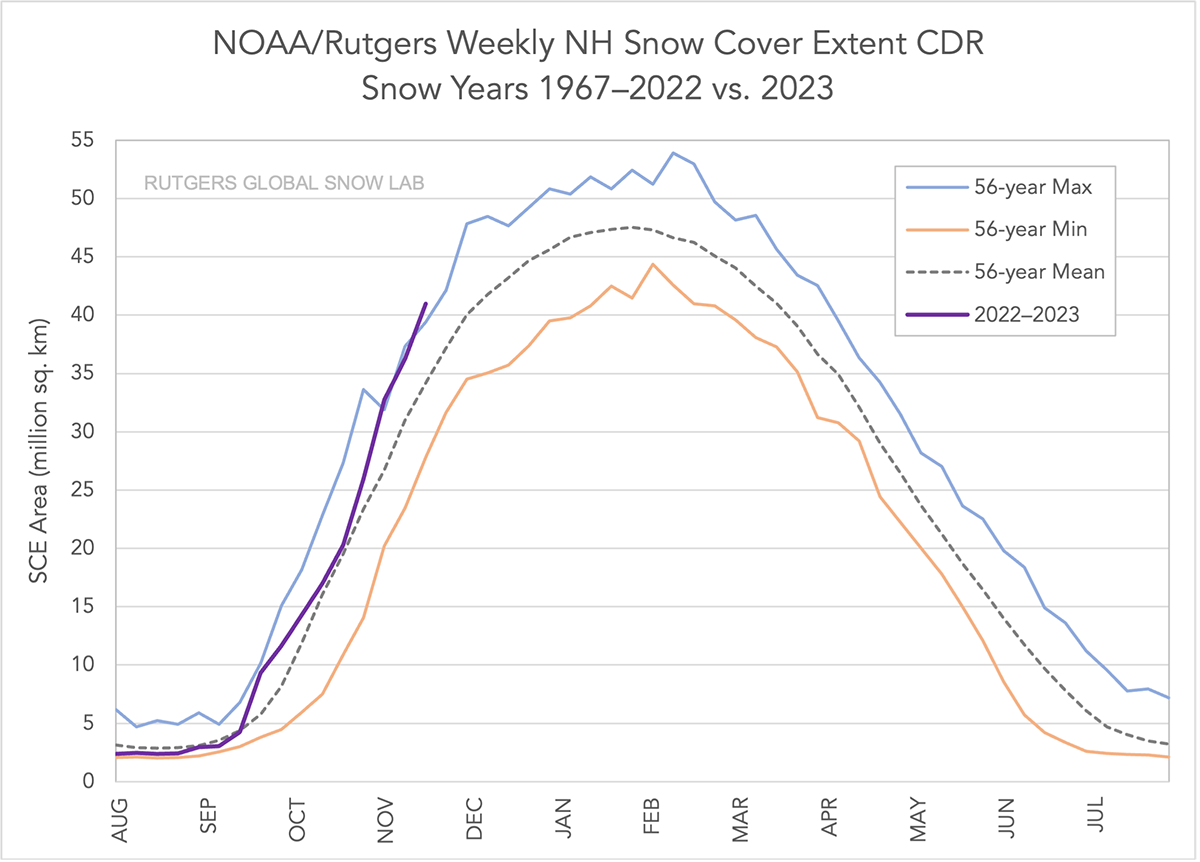
Snow Extent in the Northern Hemisphere now Among the Highest in 56 years Increases the Likelihood of Cold Early Winter Forecast both in North America and Europe

Snow extent in the Northern Hemisphere at the end of November represents an important parameter for the early winter forecast. This year snow extent is running much higher than average and according to existing global estimates, it is now beyond the highest ever observed so far. Winter forecast, especially in its early phase and in Europe, might be strongly influenced by such a large snow extent, although many other factors need attention.

link

Ancient DNA Reveals the First Known Neanderthal Family

For the first time, researchers have identified a Neanderthal family: a father and his teenage daughter, as well as several others who were close relatives. They lived in Siberian caves around 54,000 years ago.

The researchers extracted ancient DNA from bones and teeth that once belonged to 11 Neanderthals living together at the Chagyrskaya Cave, as well as 2 others from a second cave nearby. Of the 13, eight were adults and five were children. Alongside these remains, the team also found stone tools and animal bones.

The researchers say that the individuals found at Chagyrskaya likely lived at the same time—an unusual finding at sites this old, where discoveries often span vast timelines.

“The fact that they were living at the same time is very exciting. This means that they likely came from the same social community.”

link