The Arabian wolf (Canis lupus arabs) is a subspecies of gray wolf native to the Arabian Peninsula. It is not a threat by any means to humans and is the apex predator of Wadi Rum. It doesn’t happen everyday, though, to meet one and quench its thirst.
Air conditioner settings – closed, fresh air, and vent – refer to the different modes or positions of the air vent on your air conditioner unit. Here’s a breakdown of what each setting means:
Closed: This setting means the air vent is fully closed, and the air conditioner is not drawing in outside air. This setting is typically used for maximum cooling or heating, as it allows the unit to focus on circulating conditioned air within the room or space.
Fresh Air: This setting means the air vent is partially open, allowing a small amount of outside air to enter the room or space. This setting is useful for introducing fresh air into the space, which can be beneficial for air quality and odor control.
Vent: This setting means the air vent is fully open, allowing a significant amount of outside air to enter the room or space. This setting is typically used when you want to bring in cooler outside air to supplement the air conditioner’s cooling or heating capabilities.
It’s worth noting that some air conditioner units may have additional settings or modes, such as a “fan only” mode that allows the unit to circulate air without cooling or heating.
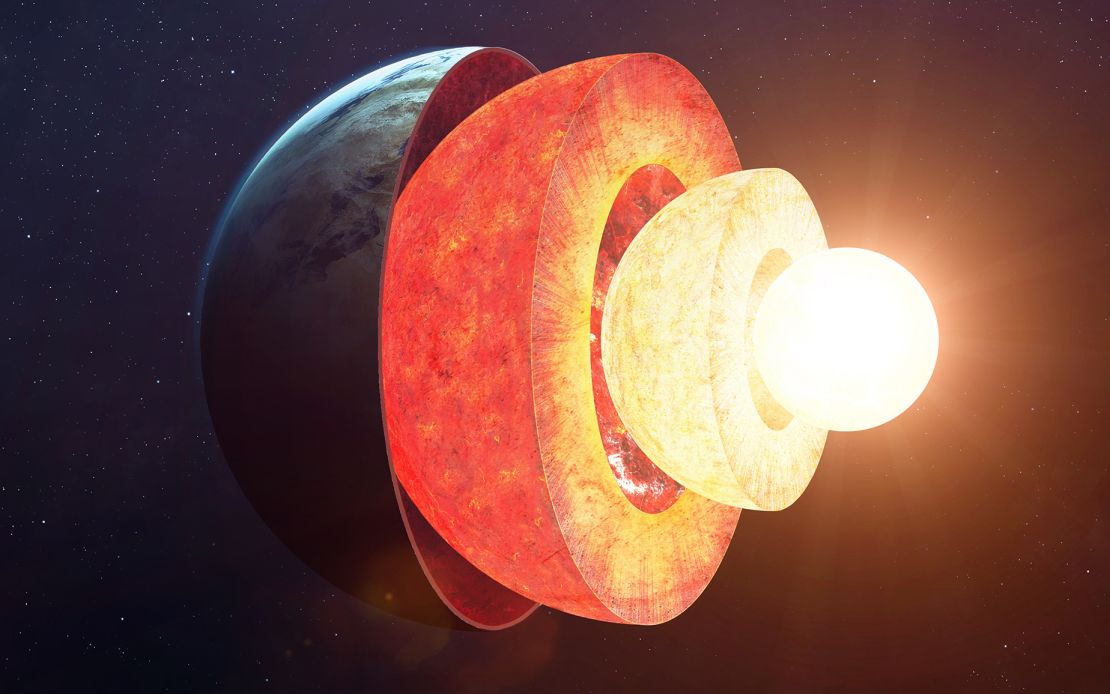
…One promising model proposed in 2023 described an inner core that in the past had spun faster than Earth itself, but was now spinning slower. For a while, the scientists reported, the core’s rotation matched Earth’s spin. Then it slowed even more, until the core was moving backward relative to the fluid layers around it.
At the time, some experts cautioned that more data was needed to bolster this conclusion, and now another team of scientists has delivered compelling new evidence for this hypothesis about the inner core’s rotation rate. Research published June 12 in the journal Nature not only confirms the core slowdown, it supports the 2023 proposal that this core deceleration is part of a decades-long pattern of slowing down and speeding up.
Scientists study the inner core to learn how Earth’s deep interior formed and how activity connects across all the planet’s subsurface layers. forplayday/iStockphoto/Getty Images
The new findings also confirm that the changes in rotational speed follow a 70-year cycle, said study coauthor Dr. John Vidale, Dean’s Professor of Earth Sciences at the University of Southern California’s Dornsife College of Letters, Arts and Sciences.
“We’ve been arguing about this for 20 years, and I think this nails it,” Vidale said. “I think we’ve ended the debate on whether the inner core moves, and what’s been its pattern for the last couple of decades.”
But not all are convinced that the matter is settled, and how a slowdown of the inner core might affect our planet is still an open question — though some experts say Earth’s magnetic field could come into play.
The argument that global warming is coming from heat transfer in the core-mantle region is illuminated by this section from the article: The mysterious region where the liquid outer core envelops the solid inner core is especially interesting, Vidale said. As a place where liquid and solid meet, this boundary is “filled with potential for activity,” as are the core-mantle boundary and the boundary between mantle and crust.
“We might have volcanoes on the inner core boundary, for example, where solid and fluid are meeting and moving,” he said.ABN
Most mornings, Wolf Ruck walks the mown paths in his yard in Mississauga, Ontario, watching for insects landing on the goldenrod, birds feeding on native seed heads, and chipmunk kits playing in the tall grass.
The septuagenarian artist, film-maker and former Olympic canoeist began rewilding his garden with native plants three years ago, as part of a growing movement across Canada towards replacing water-thirsty lawns with “naturalised gardens”.
Letting nature take its course has been a blessing to observe, Ruck says. But to city officials, his garden violates the city’s nuisance weed and tall grass control bylaw. Twice, officers responding to anonymous neighbour complaints have brought workers to forcibly cut Ruck’s garden, billing him later for the work.
“My property is not abandoned. It’s not a blight on the community. It simply seems to offend some neighbours who don’t like the look of it,” Ruck says.
A growing number of Canadian gardeners are facing legal action for their efforts to rewild their gardens, a movement that took off during the coronavirus pandemic, as people confined to their homes reconsidered their relationship with their lawn. Proponents of rewilding cite greater biodiversity, drought resistance, and lower upkeep as advantages.
Beyond sidewalk gardens overflowing with black-eyed susan, hairy beardtongue and white turtlehead, signs of the growing movement can be seen in the proliferation of community initiatives, such as wildflower seed libraries and butterfly ranger programs. In recent years big-box retailers and garden centres have started carrying native plants alongside Kentucky bluegrass seed and hybrid tea roses.
If you’ve ever read a story in the news about elver fishing season, you’ve probably seen some variation of this line: “Maine’s the only state in the U.S. with a significant fishery for elvers.”
Maybe you thought that’s because elvers don’t exist in large numbers outside of Maine — that would be a reasonable assumption. But the real reason is somewhat more complicated.
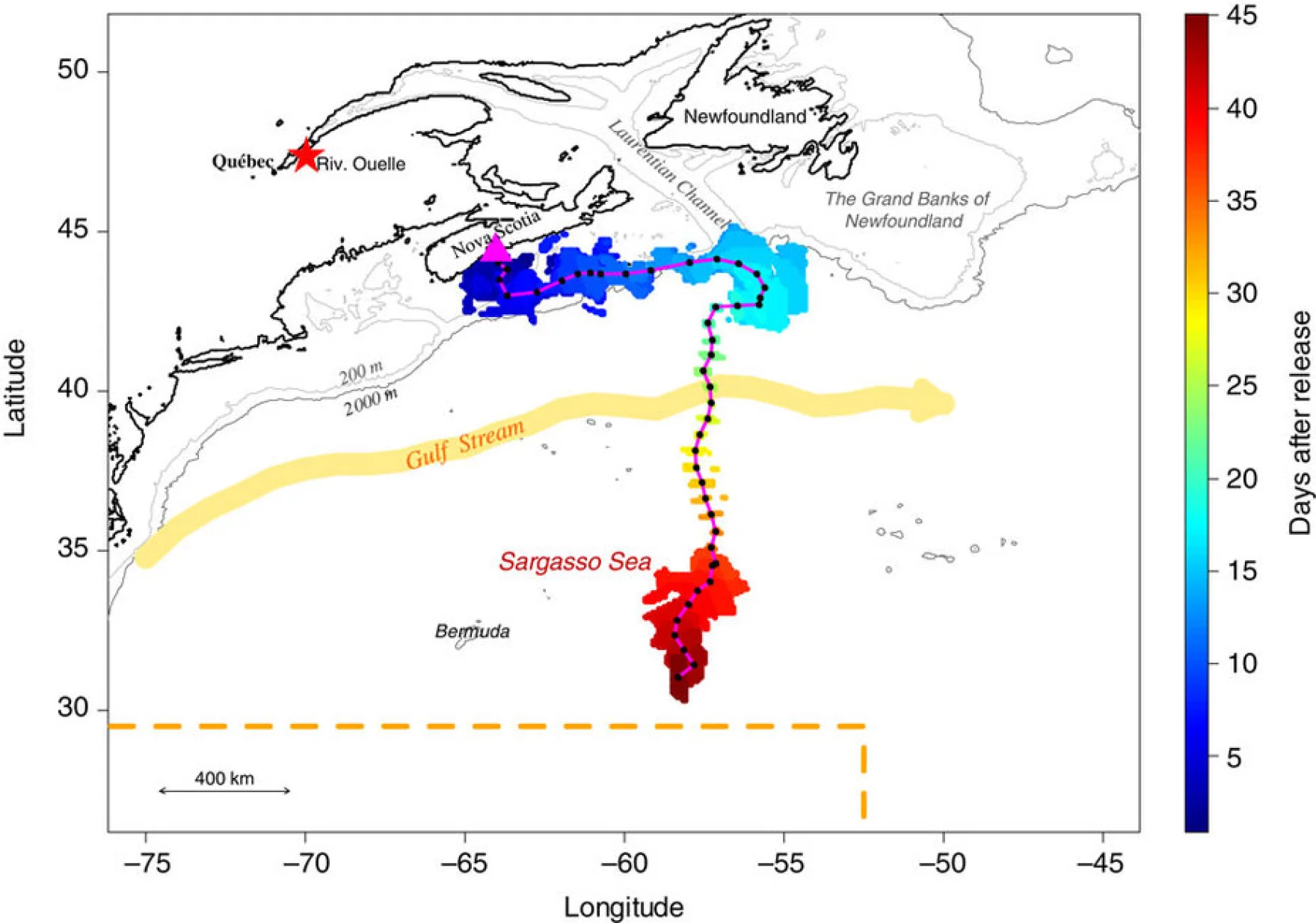
Let’s start at the beginning, in the Sargasso Sea. Although it sounds romantic, the Sargasso Sea is actually just an area of the North Atlantic that’s full of Sargassum, a kind of seaweed that floats in the ocean rather than existing close to land.
It’s a unique marine environment, and the Sargasso Sea provides a cozy place for many species to spawn or start out life, including baby turtles and some types of fish.
It’s also where the life cycle of the American eel both begins and ends. They’re born there, and after a few decades — eels are incredibly long-lived animals — they swim back in, spawn and die.
Outside of that, eels’ life cycle isn’t that well understood, but we know they start out there as tiny leptocephali, or larvae, which look like nothing more than a transparent willow leaf.
For the first few months of their lives, they float about with the ocean currents and are eventually carried by the Gulf Stream north along the continental shelf of the eastern U.S. Then, somehow — scientists don’t know quite how — they find their way out of the Gulf Stream and into coastal and fresh waters.
At this point, they’re about a year old and looking more eel-like, but still transparent. They’re now in the elver, or “glass eel,” stage, and as University of Maine marine biologist James McCleave puts it, they get “spit out everywhere” along the Atlantic Coast. Then they more or less stay put in estuaries, rivers and lakes near the coast for decades, getting bigger, fatter and more silvery.
This is a well-written article which explains why the price of Maine’s glass eels is typically over $1,000 per pound. The basic reason is Maine provides hard to get breed eels to Japan where eels are a popular dish. Be sure to read the whole story because it is interesting and much more complicated than that. ABN
The article “Exothermic Core-Mantle Decoupling – Dzhanibekov Oscillation Theory” explores a hypothesis that links changes in Earth’s core and mantle to significant shifts in Earth’s climate and rotational dynamics. Here is a simpler breakdown of its main points:
@EthicalSkeptic 2/5 A process called exothermic core-mantle decoupling is taking place, where the Earth’s core transfers heat to the mantle. This process, previously misinterpreted as solely due to human activities, could be significantly affecting Earth’s climate.
3/5 Following the heat transfer, a phenomenon similar to the Dzhanibekov effect observed in space physics, where a body flips unexpectedly while rotating. In Earth’s case, this could mean a dramatic shift in the position of the geographic North Pole due to changes in the density and rotation of the mantle.
4/5 The theory introduces two critical points:
The Indigo Point is the beginning phase of these changes, where actions set in motion are not easily noticed but lead to significant outcomes.
The Tau Point marks a crucial tipping point where these changes become irreversible and clearly observable.
5/5 A link between the Earth’s core-mantle, large-scale environmental and rotational changes challenges scientific understanding. Catastrophic changes could be underway. New ways to understand geological & environmental data are urgently needed before reaching the critical Tau Point.
The longer article from which AI extracted the summary above: Exothermic Core-Mantle Decoupling – Dzhanibekov Oscillation (ECDO) Theory. TES has been a saint during covid and beyond. He is also very interesting on how heat from the earth’s core is affecting earth’s climate by warming our oceans. I am using the AI extract above in the hope that it will prompt more readers to delve into TES’s work on climate change. Most of us know the oceans have suddenly heated up at a (modern) unprecedented rate. Since there is nothing new enough happening in the atmosphere, it seems highly likely that something is happening in the deep ocean. When that much water gets that much hotter fast, obviously the atmosphere will also heat up. ABN
Earth could suffer the worst solar storm in 165 years as six streams of plasma that erupted from the sun this week are set to make crash into our atmosphere tonight.
The National Oceanic and Atmospheric Administration (NOAA) revealed today that the worst-case scenario would be what happened during the 1859 Carrington event, which set telegraph stations on fire, cutting communications worldwide.
In our modern-day society, a geomagnetic storm of that magnitude could cause widespread electrical disruptions, blackouts and damage to critical infrastructure.
The event could also trigger magnificent nighttime auroras, or the northern lights, which will be visible in the US starting around 11pm ET and lasting through Saturday.
Scientists will know how severe the storm will be at around around 8 pm ET when the explosions of plasma racing through space will be nearly one million miles from our planet – and NOAA plans to issue alerts immediately.
Ocean waves crashing on the world’s shores emit more PFAS into the air than the world’s industrial polluters, new research has found, raising concerns about environmental contamination and human exposure along coastlines.
The study measured levels of PFAS released from the bubbles that burst when waves crash, spraying aerosols into the air. It found sea spray levels were hundreds of thousands times higher than levels in the water.
The contaminated spray likely affects groundwater, surface water, vegetation, and agricultural products near coastlines that are far from industrial sources of PFAS, said Ian Cousins, a Stockholm University researcher and the study’s lead author.
“There is evidence that the ocean can be an important source [of PFAS air emissions],” Cousins said. “It is definitely impacting the coastline.”



 American Buddhist Net