Study supports FIML practice

This study—Neural Correlates of People’s Hypercorrection of Their False Beliefs—supports the contention that FIML practice can produce deep, wide-ranging, and enduring changes within the brain/mind of practitioners.

The basic finding of the study is:

Despite the intuition that strongly held beliefs are particularly difficult to change, the data on error correction indicate that general information errors that people commit with a high degree of belief are especially easy to correct. (Emphasis added.)

According to the study, this happens due to:

…enhanced attention and encoding that results from a metacognitive mismatch between the person’s confidence in their responses and the true answer.

This is exactly what happens when a FIML query shows the questioner that his/her assumptions about what their partner’s thoughts or intentions were wrong.

Initially, FIML partners may experience some embarrassment or disbelief at being wrong. But since FIML queries are generally based on negative impressions, after some practice being shown to be wrong will typically produce feelings of relief and even delight.

A FIML query will generally arise out of a state of “enhanced attention” and usually further increase it by being spoken about. Incidentally, this is probably the most difficult aspect of FIML practice—controlling the emotions that accompany enhanced attention, especially when that attention concerns our own emotional reactions.

With continued practice of FIML, however, even strongly held erroneous interpersonal beliefs will be fairly easily corrected whenever they are discovered during a FIML discussion. Correcting core false beliefs (mistaken interpretations) has a wide-ranging, beneficial effect on all aspects of a person’s life.

Since the hypercorrection effect discussed in the linked study only occurs during moments of enhanced attention, the FIML technique of focusing quickly on good data agreed upon by both partners can be seen as a way of inducing states of enhanced attention that will lead to deep changes in both partners. This technique (using good data) also turns the discussion from one about feelings to one about “information,” which the study finds makes errors “especially easy to correct.”

Furthermore, since FIML practice tends to deal with very small incidents, the enhanced attention FIML induces works like a laser that quickly and painlessly excises erroneous thoughts and feelings while they are still small and have not been allowed to grow into full-blown emotional reactions.

first posted OCTOBER 31, 2015

There is no unified self

 …Concern shifts, then, from care of the person, or care of the other, to care for the relational process. From what forms of relationship do we flourish? Here again is a pragmatic question for conversations now in progress.

link

The pragmatic answer is do FIML. ABN

Philosophical psychology

Are your thought patterns valid? Are your premises true? Is your mind sound?

Buddhism further asks are your mental states wholesome? Are they conducive to enlightenment, wisdom, freedom from delusion?

There are many things we can do while alone to clean up our thought processes. And there are some things we can only do with the help of another person.

Only another person can tell us if our premises, thoughts, and conclusions (however tentative) about them are true, valid, and sound.

Buddhism has a concept of a “spiritual friend,” a “good friend,” a noble friend,” or an “admirable friend.” All of these terms are translations of the Pali Kalyāṇa-mittatā, which is well-explained at that link. (Chinese 善知識). That link is well-worth reading in full.

From the link above and from many years of working with Buddhist literature and people, my sense is that a Buddhist “good friend” is someone who is to be admired and emulated. They are similar to what we mean today by mentors or “good role models.”

I deeply respect the concept of a Buddhist good friend, but find it lacks what I consider the preeminent virtue of philosophical psychology—real-time honesty based on a teachable technique.

Indeed, I cannot find anything anywhere in world philosophy, religion, or literature that provides a teachable technique for attaining real-time honesty with another person.

I also do not quite understand how this could be.

For many centuries human beings have thought about life but no one has come up with a technique like FIML?

How can that be?

I do not see a technique like FIML anywhere in the history of human philosophy nor anywhere in modern psychology.

The importance of a “good friend” who does FIML with you cannot be overemphasized because it is only through such a friend that you can discover where your premises about them are right or wrong, where your thoughts about them are valid or not, and through those discoveries where your mind itself is arranged soundly or not.

first posted MAY 30, 2017

UPDATE 12/14/23: Buddhists can and should make Buddhist practice their own, update or improve the practice with new ideas that are sound, valid, and true. This is a very positive and excellent side of Buddhism, which itself is not written in stone. Buddhism is preeminently a mind-to-mind teaching. It does not depend on ancient texts or the absolute interpretation of words. It depends on fulsome understanding of the deep truths at the core of all Buddhist thinking—impermanence, emptiness, and nirvana. Anything that is consonant with those three truths and conforms to Buddhist morals is good Buddhism. Anything that contradicts those three truths and/or Buddhist morals is not Buddhism.

The Buddha encouraged teaching the Dharma in people’s native languages. He discouraged writing his teachings down because he did not want them to become sacred texts that people worship rather than understand. FIML practice is an efficient, detailed, sound, and accurate way for “good friends” to deeply share mind-to-mind communion/communication with each other. In this sense, it is excellent Buddhist practice. FIML has no other teaching than how to communicate really well with a good friend. FIML does not tell you what to think or believe. Anyone can do it. ABN

What is the Problem of the Criterion? The Buddhist origin of Skepticism

The problem of the criterion is a fundamental issue in epistemology, which is concerned with the nature and scope of knowledge. It is a problem that arises when trying to determine the extent of knowledge and formulate the criteria for epistemic values, such as truth, justification, and evidence.

The problem can be phrased as a pair of questions: “What do we know?” and “What is the extent of our knowledge?” However, these questions seem to be circular, as it appears that we cannot answer the first question without already having an answer to the second, and vice versa.

This problem has been discussed by philosophers for centuries, with ancient roots dating back to the works of Pyrrho and Sextus Empiricus.

The problem of the criterion is closely related to the issue of justification, as it is difficult to determine what criteria should be used to justify our beliefs and knowledge claims. This problem has been addressed in various ways, including the development of different epistemological theories and the exploration of the nature of truth and evidence.

In essence, the problem of the criterion highlights the difficulty of determining the starting point of knowledge and the criteria for evaluating knowledge claims. It is a problem that has puzzled philosophers for centuries and continues to be a topic of ongoing debate and inquiry.

the above was AI generated in Brave browser

Pyrrho’s tripartite statement is completely unprecedented and unparalleled in Greek thought. Yet it is not merely similar to Buddhism, it corresponds closely to a famous statement of the Buddha preserved in canonical texts. The statement is known as the Trilakṣaṇa, the ‘Three Characteristics’ of all dharmas ‘ethical distinctions, factors, constituents, etc.’ Greek pragmata ‘(ethical) things’ corresponds closely to Indic dharma ∼ dhamma ‘(ethical) things’ and seems to be Pyrrho’s equivalent of it. The Buddha says, “All dharmas are anitya ‘impermanent’…. All dharmas are duḥkha ‘unsatisfactory, imperfect, unstable’…. All dharmas are anātman ‘without an innate self-identity’.”

~Beckwith, Christopher I.. Greek Buddha: Pyrrho’s Encounter with Early Buddhism in Central Asia

The quote from Beckwith just above highlights how Beckwith has very convincingly connected Pyrrho’s skepticism with early Buddhism. The Trilaksana or Three Characteristics are the foundation of the Four Dharma Seals, belonging to the very earliest (attested) teachings of the Buddha. They are the heart of virtually all Buddhist philosophy and practice. They also define the Problem of the Criterion in Buddhist terms. The Fourth Seal is nirvana or freedom from the anxiety and suffering of not fully understanding the the first Three Dharma Seals.

I am making this point to encourage Buddhists, Skeptics and Stoics to read Beckwith’s Greek Buddha: Pyrrho’s Encounter with Early Buddhism in Central Asia.

I am also making this point because the Problem of the Criterion, or the Four Dharma Seals, are very real and impact our daily lives at every level all the time. And this is not just an abstract philosophical problem. It affects all of our relationships and everything we say and hear. In this vein I want to say that FIML (without my specifically knowing it at the time) is designed to address the Problem of the Criterion as it arises between two people in a close relationship.

I have said more than a few times over the years that it is hard for me to understand why ancient philosophers, including the Buddha, did not discover FIML or teach it. I believe it is possible Buddhist monks in the Buddha’s day were given instructions that amounted to some form of FIML, but there exists no evidence of this.

Whatever the case, FIML is designed to deal with interpersonal conundrums that arise out of the Problem of the Criterion, our inability to solidly nail what we know to the wall. FIML cannot completely fix the problem. It does not solve the Problem of the Criterion but it does make everything much clearer and better by at least an order of magnitude and probably more. By fully recognizing this inherent problem within all communication FIML partners can cooperatively work to solve it for the most part between themselves. ABN

A useful guide to understanding what FIML is

The Ethical Skeptic (TES) has written a very good essay: The Distinction Between Comprehension and Understanding. I want to use a schema presented in his essay to describe what FIML is, how to see it and understand it. Comprehending it requires doing it and reaping its benefits.

TES provides this illustration of the layers of thought and psychology that culminate in comprehension:

I might not use a hammer to represent comprehension but since we have a hammer, it would represent FIML’s ability to smash through the dogma of psychology, our ordinary understanding of psycholinguistics, the simplicity with which we view real-time speech, and our ignorance that there exists anything profound in being able to analyze real-time, real-world speech as it is happening.

FIML is a method, a technique. It has no content save what you bring to it. FIML works with and reveals the profound subjectivity of the individual. Since basic FIML cannot be done alone but only with a partner, it also reveals the profound subjectivity of your partner. In doing this, it smashes the dogmas of psychology and virtually all public/common notions about what the human mind even is.

The difficulties of FIML are fundamentally two: 1) seeing it at all and 2) doing it. FIML is not something people normally ever do. I have been writing, reading, and thinking about FIML for many years and have never seen any reference to anything like it anywhere in the history of the world. If you know of one, please tell me. I will be delighted.

FIML is probably hard to see because all languages everywhere contain a very strong proscription against questioning anyone in the moment in order to begin a sober analysis. People just don’t do that. Getting that close and personal about something someone has just said (or did) is instinctively perceived as disrespect, argumentativeness, stupidity, rocking-the-boat, etc. FIML 100% is not that, but since no one has cultivated the habit or acquired the training to do it, no one can even see it let alone do it.

Most of us can see moments of speech and change our minds quickly if we are ordered, instructed, or want to curry favor. I guess that is a starting point, but none of that is FIML. FIML begins with a subjectively felt (or comprehended) need to find out if you have interpreted something correctly. Very ordinary, right? Yes, it is in “slow-time,” but not in real-time.

When done in real-time, the emphasis is on the one asking the question because this one has noticed an interpretation arising in their mind that may be wrong. The interpretation could be completely new or more likely habitual. By frequently noticing these interpretations and then asking your FIML partner about them (using FIML rules) and listening to their reply, you will gradually begin to see a true picture of your actual profound and marvelous subjective mind as it moves through and responds to its living existence.

FIML is no more difficult to learn than playing a musical instrument, riding a motorcycle, or cooking. Once both you and your partner understand what FIML basically is and why it is so necessary, you will progress quickly and gain many insights into your behaviors and thinking processes. At some point, you will achieve a kind of mutual comprehension of each other that is very clear and beautiful and cannot be gained in any other way.

Ethics, morality, and signaling

If we consider our minds to be networks of signals, then we can say that it is better that the signals be more efficient and contain fewer errors.

This might be a good definition of a sound ethical position—to reduce signal error and increase signal efficiency.

In many ways, the two are the same. When we reduce signal error, we increase the efficiency of the entire system.

Thus, for any one system, such that there is a such a thing, the best ethical position would be to reduce signal error while increasing signal efficiency. That one system might stand for one human being.

But what if there are two or more systems that interact with each other?

In one sense we might say they are the “same” system, especially if interaction is imperative. In another sense, we can treat them as different systems.

If they are seen as the “same,” then reducing error and increasing efficiency will benefit the whole system (of two or more).

If they are seen as separate and not the same, there are two possibilities. Separate systems within the whole may decide to lie or cheat or they may decide not to lie or cheat.

If none of the separate systems within the network ever lies or cheats, efficiency will be increased and error will be reduced.

If one or more of the separate systems within the network decides to lie or cheat, efficiency will decrease and errors will multiply.

The separate systems can be understood to be people while the large network can be understood to be human groups. Lying and cheating or refraining from lying or cheating must be conscious acts.

Errors that just happen non-consciously (misspeaking, mishearing, misunderstanding, data mistakes, etc.) are not moral errors unless they could be or could have been avoided by a reliable method.

No network without lying or cheating has ever been achieved by large numbers of human beings. Even very small groups, as few as two people, rarely are able to achieve an ideal ethical state of no lying and no cheating. And even if they do get pretty good at that, it is very difficult for even just two people to remove non-conscious errors from their interactions.

FIML practice can greatly reduce non-conscious error between partners while at the same time providing a robust basis for increased moral awareness and increased understanding that both partners are benefiting greatly from the honesty (or ethical practice) of both of them.

My honesty with you greatly improves my understanding of and honesty within my own network and also gives me much better information about your network. And the same is true for you. Together we form an autocatalytic set that continually upgrades our mutual network and individual systems.

Clarity, honesty, and efficiency in interpersonal communication is satisfying in itself and also it improves efficiency between partners as it upgrades the self-awareness of each.

One partner could lie and cheat while doing FIML practice, but since FIML is fairly involved and somewhat difficult to learn, it is likely that most partners will do their best by each other and that most individuals will come to realize that honesty benefits them much more than lying.

I think it is fair to conclude that the best ethical or moral position to take is one that increases efficiency of signalling (talking, doing, etc.) while also reducing signalling error. The problem with doing that is people can and will lie and cheat and we do not (yet) have a reliable way to tell when they are lying and cheating.

A good way to tell if someone is being honest will be an accurate lie-detector, but even that may not be efficient or work well with the dynamics of real-time human communication.

Thus some other technique is needed. FIML can be that technique and I know of no other one that works as well. Thus a sound ethical position in today’s world would be having the aim of reducing signal error while increasing signal efficiency through the practice of FIML.

Without FIML, interpersonal communications is at least an order of magnitude cruder and thus much less efficient. FIML is not perfect, but it is much better than what we ordinarily do. If you can increase resolution and detail at will within any system, it will improve that system. If you can do that with interpersonal communication, it will improve all aspects of that system.

UPDATE: Notice that the fear people have about AI destroying the world is based on its learning how to deceive us. How to lie to us. When I introduced this idea to my partner this morning, she very convincingly argued that DARPA already has a much more powerful AI that is able to control the GPT programs we are now seeing and that our overlords will use the excuse that AI has gone rogue to further enslave us. That went right onto my Bayesian probability pie-chart as a big slice. ABN

An analogy using photography that illuminates human interpersonal communication

image source

Psycholinguistics: our normal interpersonal communication system inevitably produces significant error

Our normal interpersonal communication system inevitably produces significant error; thus leading to misery, personality disorder, mental illness. In spiritual terms, the normal ways we talk and listen carry toxic seeds of ignorance (and evil) that scatter everywhere. Even the sciences are affected.

Without the FIML corrective, nothing will change.

I have done FIML long enough that I feel deeply sorry for everyone who does not do it.

It’s not super easy to do FIML, to correct the mistakes that cause so much suffering, but it can be done with no more effort than learning to cook well or play the piano passably well. And like those skills, it’s fun to do once you get going with it.

Societies collapse because ignorance, greed, and madness accumulate and rot them out from inside. It happens to all of them. It is happening to us very seriously right now.

Marriages, friendships, and individual lives collapse for similar reasons. Errors build on errors, minds overwhelmed; suffering ensues.

I beg of you. Give it a shot. Learn FIML.

Within a short time you will see what it does, how it does it, and why it is so necessary for a good life.

The importance of the Readiness Period for speech, listening, and decision making

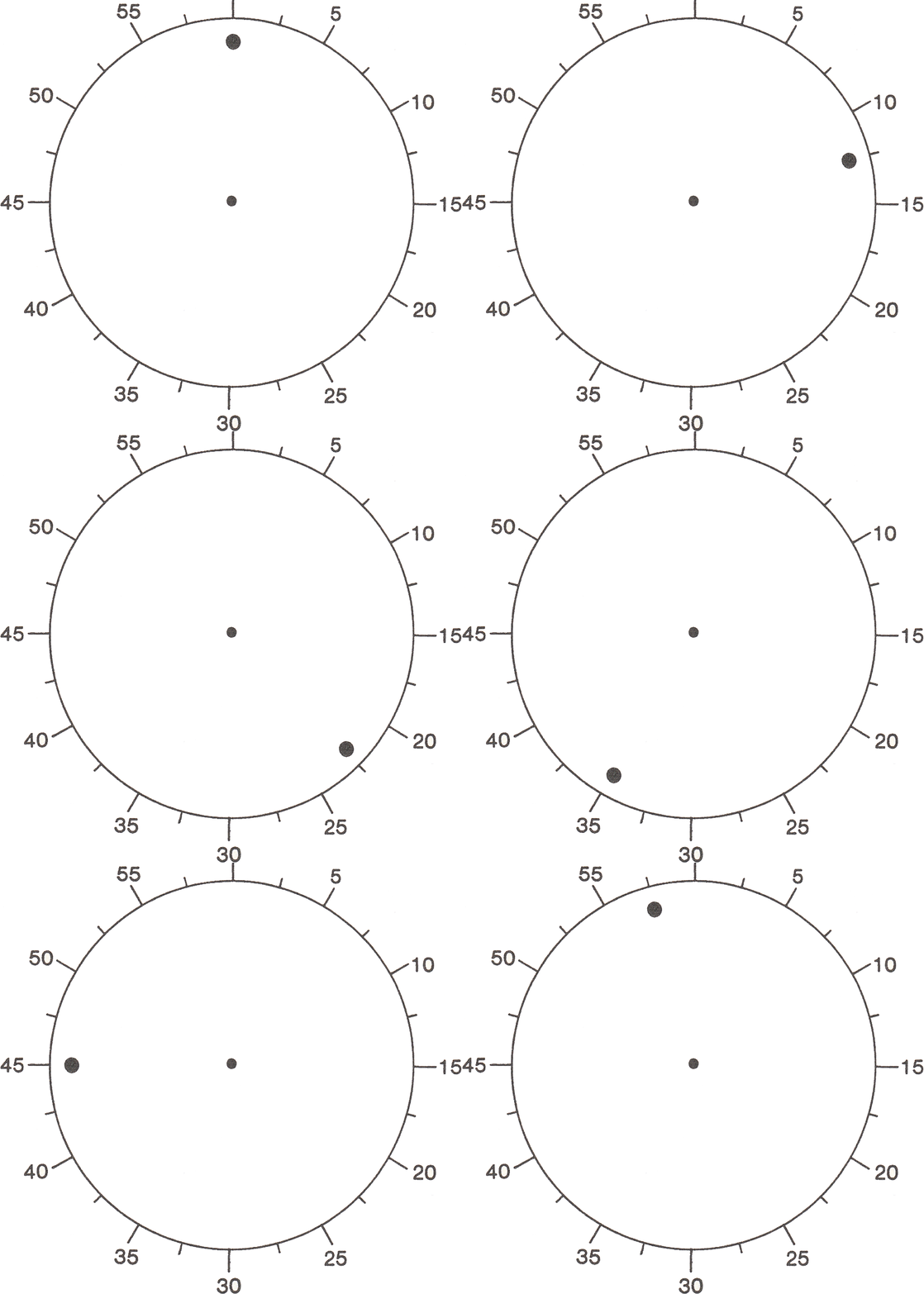
Libet gave participants of his experiments a simple task, while measuring their brain activity: they had to decide to flex a finger whenever they wished, and note the position on a fast-moving clock at the precise moment they took the decision.

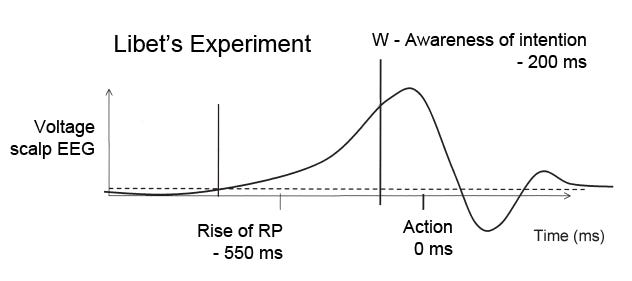
The result was that the brain showed activity at least 400ms before the participants became aware of their “decision making.”

Here’s a diagram showing what’s going on:1

“RP” stands for “Readiness Potential,” that is, the supposed build-up in brain activity before the decision to act and the subsequent action. What we see is that this brain activity starts before the participants became aware of their intention to flex the finger.

The results have led the no-Free-Will crowd to [falsely] exclaim, “see, everything is driven by your brain, and you taking decisions is just an illusion!”

However, this seems to be a typical case of taking something very specific and isolated out of context and then drawing conclusions based on existing biases.

link

The exercise of free will in basic FIML is done during the “Readiness Potential” period described above. FIML done with a partner is an exquisite exercise of free will that completely changes how we speak and listen for the better. FIML is somewhat difficult because it requires being aware of the Readiness Potential period close to its onset. But this can be learned with practice. Buddhists or others who practice mindfulness may find this part of FIML to be rather easy. From this point of view, FIML can be described as mindfulness shared by two people, or pair-work mindfulness. FIML mostly focuses on interpersonal speech and listening but also includes all other interpersonal semiotics. More posts related to FIML and brain science can be found here. ABN

Google and FIML

Google has helped all of us upgrade our info about the world around us, whatever we are interested in, etc.

In the past, people had brains as complex as ours and a love of good information as great as ours, but they had to make do with less.

Somewhat resembling Google, FIML practice upgrades interpersonal information shared by (usually) two people.

Rather than guess and fill our minds with superstitions about the people we care about most, FIML allows us to “look up” the info we need when we need it.

This has a dramatic and beneficial effect on both the self and other(s). The foundations of human psychology are exposed in FIML practice.

Once you see how FIML works and what it does, you will be doing it as often as you jump on the computer to look up something you want to know.

FIML is advanced interpersonal technology that makes first-rate psychological information as readily available as a computer search. It does take some practice, but is emotionally even more valuable than Google.

first posted SEPTEMBER 9, 2016

Eight years ago when this was first posted, I was still naive about Google, which is a beast at both gathering and curating information. The analogy posed above belongs to a different time. Properly done, FIML practice does not curate information or selfishly gather information and hide it as Google now does. ABN

The Five Skandhas

The Buddha’s explanation of the five skandhas is intended to help us understand the emptiness of the self. It is a short explanation aimed at his most intelligent students.

The Sanskrit word skandha means “heap” or “aggregate” in English. Sometimes the Buddha compared the skandhas to heaps of rice. They are the “heaps” of psycho-perceptual data that comprise the “contents” of our minds. The five skandhas are conditioned dharmas (literally, “conditioned things”), which is to say that they are impermanent and empty, and when improperly understood lead to delusive attachments characterized by greed, anger, and ignorance. The purpose of the Buddha’s five skandha explanation is to help us see through the skandhas, or disentangle ourselves from them. In some Buddhist texts the five skandhas are called the “five covers” because they cover our minds and prevent us from seeing deep levels of reality. In others they are called the “five yin (versus yang)” because they cloud the mind and hide the truth from us. I will discuss each of the five skandhas in the sections below.

1) The first skandha is form. Form, in this case, means anything that leads to, or is capable of leading to, the next skandha. Forms can be visual, auditory, or sensory. They can be dreams, memories, feelings, or moods. Forms are often described as being “obstructions” because, though they may lead to complex thought and activity, they are also hindrances to mental clarity since the activity they lead to is essentially delusive. It is important to remember that the five skandha explanation is an explanation of the deluded mind and its thought processes.

The Abhidharma-mahavibhasa Shastra categorizes the skandha of form into three types:

a) Visible forms with a referent in the outer world such as color, size, length, position, shape, and so on.

b) Invisible forms with a referent in the outer world that are associated with the other sensory organs such as sounds, smells, tastes, and the sensations arising from physical contact.

c) Invisible forms with no referent in the outer world such as dreams, memories, thoughts, feelings, and so on. Though a dream may be “visible” to the dreamer, it is called “invisible” here because no one else can see it. This last category of forms is associated with what the Buddha called “mental dharmas.”

2) The second skandha is sensation. Following the appearance of a form, the mind reacts to it with a sensation that is either positive, negative, or neutral. We either like it, don’t like it, or are neutral about it. Though it is possible to become conscious of this skandha, most of us most of the time are not.

Sensations are generally categorized into two types:

a) Sensations of the body coming from the outside world through any of the sensory organs, such as sights, sounds, smells, tastes, and so on.

b) Sensations of the mind which may or may not come from the outside world. These include moods, feelings, memories, dreams, thoughts, ideas, and so on.

Both kinds of sensation are, of course, based on the prior appearance of a form. Greed and anger have their roots in the skandha of sensation, for if we enjoy a positive sensation we are liable to become greedy about it, while if we do not enjoy it, we are liable to become “angry” or irritable concerning it. The deep meaning of greed is “excessive attraction” to a sensation that we deem to be agreeable or positive, while the deep meaning of anger (or hatred) is “excessive aversion” to a sensation that we deem disagreeable or negative. Neutral sensations often are the result of our ignorance or lack of understanding, though as we progress in Buddhist practice they may be the result of wisdom.

Positive and negative sensations associated with the body are generally considered to be weaker than those associated with the mind, though both types of sensations often are interrelated. An example of this mixture and distinction might be a light slap in the face. While the physical sensation is only mildly unpleasant, the mental sensation will be quite strong in most cases. And yet both are interrelated.

3) The third skandha is perception. This skandha refers to the deepening of a sensation. It is the point where the mind begins to latch onto its sensations. At this point conscious recognition of form and sensation normally begins. It is possible to become conscious of the first and second skandhas as they are occurring, but most of us generally are not. During the skandha of perception we begin making conscious distinctions among things.

4) The fourth skandha is mental activity. This skandha refers to the complex mental activity that often follows upon the skandha of perception. Once we have identified (perceived) something, long trains of mental associations become active. Our bodies may also begin to move and behave during this skandha. For example, the simple perception of a travel poster may set in motion a great deal of mental activity. We may begin recalling an old trip or begin fantasizing about a new one. If we are photographers, we may admire the composition of the photo, step closer to it, make an effort to remember it, and so on. All of these behaviors belong to the skandha of mental activity.

5) The fifth skandha is individual consciousness. It is a product of the first four skandhas and is completely conditioned by them. This is what we normally, more or less, think of as being our “self.” The Buddha taught the five skandhas primarily to help us understand that this “self” or consciousness is empty since it is entirely based on the conditions found in the first four skandhas.

The Ekkotarika-agama explains this point very well. It says, “The Buddha said that the skandha of form is like foam, the skandha of sensation is like a bubble, the skandha of perception is like a wild horse, the skandha of mental activity is like a banana tree, and thus the skandha of individual consciousness is nothing more than an illusion.” The trunk of a banana tree is made of leaves curled together. From the outside, it may look substantial, but if we examine it closely we will find that one leaf pulls away from the next, leaving ultimately nothing behind. The trunk looks substantial, but in truth it is “empty.” In just this way, our individual consciousness may look substantial to us, but if we peel it apart, we find that there is no self within—it is empty.

How to Understand the Five Skandhas

Though most of us are not normally aware of the first two skandhas it is possible to become aware of them through meditation and mindfulness practices. Though it is easier to begin understanding the five skandhas by thinking of them as being separate and distinct, it is important to realize that any of the last four skandhas can give rise to the skandha of form. Mental activity itself, for example, can generate whole new trains of forms, sensations, and perceptions.

Another important thing to understand about the five skandhas is that our minds move very quickly from one to the next. The five skandhas produce a snow storm of impressions and mentation, upon which rests our unstable conscious world. When we become overly attached to this snow storm or to the consciousness built upon it, we generate the karma that ultimately fuels the five skandhas in the first place.

The Explanation of Mahayana Terms (en 1212) says that the skandhas can be understood as being either good, bad, or neutral. The goodness mentioned in this explanation should be understood as being a relative goodness that arises within the phenomenal world—though it is “good,” it is not the same as an enlightened vision that completely sees through the five skandhas. For this reason, we will use the word “positive” in place of “goodness” in this discussion. The Explanation says that positive activation of the five skandhas can be of three types: activation by a positive form, such as a Buddhist image; activation by skillful means, such as a desire to help someone; and activation within a pure-minded person. The Explanation says that the three bad or negative types of activation of the five skandhas result from: simple badness within them, as may have derived from low motives or moodiness; contaminations within them, such as selfishness during an act of kindness; and negativity that is simply the result of bad karma. The Explanation says that the three neutral types of activation are: formal activations that result from the performance of rituals; activations resulting from the practice of a skill; and neutral changes among the skandhas themselves.

How to Contemplate the Five Skandhas

The second noble truth of Buddhism is the cause of suffering. Generally, this cause is explained as clinging to a false self. By contemplating the five skandhas, we learn to understand both that the self is empty and why it is empty. This contemplation appeals to the rational mind for it allows us to use reason to convince ourselves that the “self” we call our own is, in truth, an illusion.

In contemplating the five skandhas we should be mindful that we begin to generate karma during the skandha of perception. At the same time, it is important to realize that the very forms we see and the sensations that result from them are heavily conditioned by our past actions, by the accumulation of karmic “seeds” or influences that are already stored in our minds. Two people may see exactly the same form, but have very different responses to it because their karma is not the same. Since their karma is different, their sensations and perceptions, and especially their mental activity and consciousness will be very different.

The Numerical Teachings of Great Ming Dynasty Tripitaka says (en 1213) that the most important way to understand the five skandhas is to realize that each of them is empty. As we become familiar with the five skandhas, we will find it easier to identify each one and contemplate its emptiness. We can think about them from first to last or from last to first.

If we choose to think of them from last to first, our contemplation will consist of a series of questions, whose answers should be considered deeply. We begin by asking ourselves what the skandha of individual consciousness is based upon. The answer is the roiling mentation of the skandha of mental activity. The skandha of mental activity becomes apparent as soon as we sit down to meditate. Having identified this skandha and appreciated its fundamental emptiness, we can ask ourselves what it is based upon. The answer is the skandha of perception. First the mind seizes one of its impressions (the skandha of perception), then a long train of thought and emotion follows (the skandha of mental activity). Having appreciated this process, we then ask ourselves what the skandha of perception is based upon. The answer is sensation—of the many forms and feelings passing through our minds, one of them gave rise to either a positive or negative sensation (neutral sensations are usually ignored by the mind). It is this sensation that led to the skandha of perception. If we can appreciate this, then we can ask what the skandha of sensation is based upon. The answer is form—either an outer or inner form. Were it not for this form, none of the other skandhas would have arisen.

If we choose to contemplate from the first skandha to the last, we may choose a form and then carefully watch how our minds process it. We will see that form leads to sensation, then to perception, then to mental activity, and lastly to individual consciousness—a state of mind deeply colored by the skandhas below it. Bear in mind that when the five skandhas are simply happening of themselves and no one is watching them, we are normally unconscious of the activity of the first two skandhas. Before most of us are even aware of what we are perceiving, we have begun to react to it. It requires some skill to see that forms give rise to positive, negative, or neutral sensations before they give rise to the skandha of perception, but this is the case in a normally active mind.

The quotation cited previously from the Ekkotarika-agama can also be used as a very fine contemplation. The agama said, “The Buddha said that the skandha of form is like foam, the skandha of sensation is like a bubble, the skandha of perception is like a wild horse, the skandha of mental activity is like a banana tree, and thus the skandha of individual consciousness is nothing more than an illusion.” The skandha of form is like foam in a stream—at any moment scores of forms contend for our attention. The skandha of sensation is like a bubble—suddenly we react to a single bubble within the foam. The skandha of perception is like a wild horse—we can never be sure which way our mind will turn at this point. The skandha of mental activity is like a banana tree—it consists of many things wrapped together. And thus, the skandha individual consciousness is empty, an illusion.

ABN

UPDATE: FIML practice can be understood in terms of the five skandhas in this way: A FIML query begins at or interrupts the skandha of mental activity. Through training and prior agreement, partners learn to identify a fraught psychological response at the third skandha–perception–and thereby shift away from habitual mental activity to FIML mental activity. The FIML query at this points implicitly asks is my habitual perception based on fact? The FIML query should be made in as neutral a tone as possible to avoid influencing your partner. Your partner’s reply will either confirm or refute your habitual perception. FIML is a dynamic and very powerful form of mindfulness that allows partners to be much more objective about the granular workings of their minds. After hundreds of FIML queries, partners will establish a database of objective insight into their own (and each other’s) psychology that is much more accurate than what can be done alone or through general discussion with anyone. ABN

Buddhism and modern psychology

I put up a post yesterday about the ‘erasure’ of dysfunctional psychological schema and how to achieve that. The article that post is based on, How the Science of Memory Reconsolidation Advances the Effectiveness and Unification of Psychotherapy is good and well-worth reading.

Today, I want to explain how that take on modern psychology fits very well with Buddhist practice.

Buddhist practice is best understood by understanding the Noble Eightfold Path:

Right View, Right Intention, Right Speech, Right Action, Right Livelihood, Right Effort, Right Mindfulness, and Right Samadhi.

If the Noble Eightfold Path is followed diligently, it will erase all dysfunctional schema from the mind. The complete erasure occurs in the eighth element of the path, Right Samadhi.

Right Samadhi is an elixir of the mind. It bathes and cleanses the mind like nothing else. Right Samadhi erases all delusion, all suffering, all dysfunctional schema. Right Samadhi is one part of the Noble Eightfold Path and also it can be understood as a culmination of the Path, the ultimate or penultimate reward of Buddhist practice.

On this site, I add something to the Noble Eightfold Path that, in my opinion, makes it even better. What I have added is FIML practice. FIML can be understood to be an addition to Right Speech and Right Mindfulness. FIML works by getting us to pay close attention to what we hear as well as what we say. When we do that using the tools FIML provides we also greatly improve our Right Mindfulness.

I deeply hope readers of this site will improve their understanding of Buddhism and learn how to do FIML.

The hardest thing about FIML practice is finding a Right Partner, someone who is able to understand the practice and willing to do it with you. The second hardest thing is overcoming a very deep-seated, instinctive human speech prohibition which prevents us from quickly shifting from talking to talking calmly and wisely about the minutia of the talking and listening that just occurred.

If you have a suitable partner, learning how to do FIML is much easier and more fun than finding a suitable therapist. Like Buddhism itself, FIML works directly with the unique reality of the lives of you and your partner.

How the Science of Memory Reconsolidation Advances the Effectiveness and Unification of Psychotherapy

Abstract

Memory reconsolidation research by neuroscientists has demonstrated the erasure of emotional learnings. This article reviews these historic findings and how they translate directly into therapeutic application to provide the clinical field with an empirically confirmed process of transformational change. Psychotherapists’ early use of this new, transtheoretical knowledge indicates a strong potential for significant advances in both the effectiveness of psychotherapy and the unification of its many diverse systems. The erasure process consists of the creation of certain critical experiences required by the brain, and it neither dictates nor limits the experiential methods that therapists can use to facilitate the needed experiences. This article explains memory reconsolidation, delineates the empirically confirmed process, illustrates it in a case example of long-term depression, indicates the evidence supporting the hypothesis that this process is responsible for transformational change in any therapy sessions, describes the differing mechanisms underlying transformational change versus incremental change, and reports extensive clinical evidence that the basis and cause of most of the problems and symptoms presented by therapy clients are emotional learnings, that is, emotionally laden mental models, or schemas, in semantic memory.

link

FIML practice works most of all because it focuses directly on memory formation and reconsolidation, thus allowing beneficial changes to be made quickly in real-time. Discussions of how this is done can be found here: Memory reconsolidation as key to psychological transformation and here: Disruption of neurotic response in FIML practice.

Below is an excerpt that explains how memory reconsolidation works. FIML does precisely what is described below in real-time, real-world situations as they arise between partners or when they are together and something else arises. ABN

The Erasure of an Emotional Learning

MR research by neuroscientists has demonstrated that an emotional learning is nullified by the following set of three experiences, which have therefore been termed the empirically confirmed process of erasure (ECPE) (Ecker 2018). Hundreds of MR research studies have used a vast range of different procedures and protocols to produce these experiences (reviewed by Ecker 20152018), which means that what the brain requires for erasure of an emotional learning is not any particular external procedure, but rather the internal occurrence of these three subjective experiences, whatever may be the external procedures that create them. Therefore the ECPE does not dictate or favor the use of any particular therapeutic techniques, and psychotherapists are free to facilitate these critical experiences using any of the therapy field’s vast array of experiential methods.

  1. 1.Reactivated, Symptom-Generating Target Learning Experienced in AwarenessThis is the deliberate use of salient cues or contexts that reactivate the target emotional learning or schema underlying the client’s presenting symptom or problem. For example, a woman in therapy for depression and absence of motivation was cued into reactivation of her lifelong schema that had newly come into awareness and was verbalized as, “Mom sees and knows everything I ever care about or do, and then takes over and takes away everything I ever care about or do, which feels devastating for me, and my only way to be safe from her pillaging is for me to care about nothing and do nothing.” To assure that the schema is being directly accessed at its roots in the emotional learning and memory system and is not merely a cognitive insight, it is critically important that the emotions accompanying the reactivated schema are fully felt affectively and somatically while the schema also is cognized verbally and conceptually. Note that the schema is at core a mental model, from which are generated particular emotions, which in the example above would include helplessness, hopelessness, fear, desperation, despair, aloneness, and the deep pain of feeling used, pillaged and eclipsed in this way by her own mother. How that schema was found, brought into awareness, and then disconfirmed and unlearned is described in the case vignette in the next section.
  2. 2.Experience of Mismatch/Prediction Error Destabilizes the Target Learning’s Neural EncodingWhile the target schema is reactivated in awareness as described above, this is an additional, concurrent experience or knowing that contradicts what the client knows and expects according to the schema. This is termed a memory mismatch or prediction error experience by memory researchers. In response to this experience of the world differing from the target learning’s expectations, the client’s brain rapidly transforms the neural encoding of the target learning from its stable, consolidated state in long-term memory into a destabilized, de-consolidated, labile state, which is susceptible to being updated and re-encoded by any relevant new learning that may occur next. This destabilization, which requires and is triggered by the mismatch/prediction error experience, begins the reconsolidation process.Footnote2 The labile, destabilized condition persists for about 5 h, widely termed the reconsolidation window, after which the neural encoding automatically reconsolidates, that is, it returns to a stable state in long-term memory. The case vignette below describes how a contradictory knowing was found for the schema of the depressed woman, creating the needed mismatch experience.
  3. 3.Experience of Counter-Learning Drives Unlearning, Nullification, Re-encoding and Replacement of Target LearningThis experience consists of just a few repetitions, during the rest of the therapy session, of the same mismatch experience created in the previous step. Each mismatch is a juxtaposition experience, in the sense that the client experiences both reality according to the target learning and a contradictory perception or knowing, with both in the same single field of awareness. Two or three repetitions of that juxtaposition experience serve as counter-learning that functions as an experiential disconfirmation of the target learning. Because the counter-learning is occurring while the encoding of the target learning is labile, the counter-learning rewrites and replaces the encoding of the target schema in memory. As a result, the target learning no longer exists in memory, so it cannot be reactivated and cause a relapse. The target learning is a model of the world in semantic memory, not an episodic memory of specific events and experiences; the latter is not erased. The unlearning of the target learning’s version of reality is the profound resolution of a core emotional issue in the client’s life, as noted earlier.Footnote3 Successful erasure of the target learning is then verified by observing the markers of transformational change beginning to appear immediately: the symptom(s) driven by the target learning cease to occur; the target learning itself, which previously was felt as a potent and horrible truth of the world, no longer feels true or real and is not reactivated by situations that formerly did so, eliminating a problematic, distressed ego state; and those changes persist effortlessly and permanently. If the same counter-learning occurs without first finding, reactivating and destabilizing the target learning (steps 1 and 2 above), the counter-learning only creates its own encoding separate from that of the target learning. In that case, the two learnings compete for control of behavior and state of mind, producing at best only incremental change that is prone to relapse when the emotionally more intense target learning becomes newly retriggered by current circumstances.
ibid

An advantage of FIML as therapy for unwholesome or unwanted schema is FIML is mostly done in real-time, real-world situations so the schema is right there in front of you clear as a bell in your own mind. You can see it and see very clearly how it is distorting reality.

Therapies that work by recalling unwholesome schema in a professional settings have the advantage of: 1) relying on a professional; 2) avoiding doing this work with your spouse or best friend; and 3) aiming for wholesale erasure of the schema once and for all.

FIML practitioners could use a schema method to do this but generally FIML works by focusing on the unwholesome schema the moment it arises and whenever it arises in the real-world (conditions permitting). This method erases or extirpates the unwholesome schema by observing its maladaptive dysfunction as many times as needed.

FIML is also able to deal with more than one maladaptive schema, and in real-life there are many, without causing confusion because when unwholesome schemas are encounter in real-world, real-time, their structure and origins are generally easily seen for what they are.

Many unwanted schema can be extirpated with just a few FIML exchanges. Some are more stubborn and may require more time and multiple occurrences.

Another advantage FIML has is it prevents new schemas from arising and taking hold. Unwholesome schemas do not all come from the deep past or from childhood. Schemas also arise later in life and often are based on serious misinterpretations. FIML is very effective at stopping schemas of this sort immediately, before they can consolidate and cause harm.

I would add that unwholesome schemas exist in virtually everyone and often we are dealing not with our own schemas but those of others. FIML partners can eliminate problem schemas between themselves, but often do no more than recognize them in others. However, understanding ourselves through FIML practice does help us understand others much better, and how deal with them more compassionately due to that understanding. ABN

Non-FIML sociology and Buddhism

Non-FIML sociology cannot but be based on and imbued with vagueness and uncertainty. Individuals make their ways in this foggy social environment according to their upbringing, experiences, and the different ways they have learned to negotiate ambiguity. Each non-FIML individual cannot but conform to or accept a position somewhere on the spectrum of private neurosis-public semiotics.

This is so because non-FIML individuals cannot attain interpersonal certainty; they can only attain a semblance of interpersonal certainty that is necessarily made up of many erroneous interpretations of the world around them, their loved ones, and themselves. Their understanding of themselves and of others will necessarily be made up of either private interpretations (that are sure to be largely false and thus neurotic) or public/cultural interpretations that are similarly just as false and/or too narrow or generalized (science, mainstream psychology, professional societies, religious or ethnic allegiances, etc.) to be fully satisfying to the profound needs of the individual. This is not to say that many individuals living in conditions like that are not happy, but rather that their sense of who they are and what they are doing is false, utilitarian, exploitative, slavish, or otherwise limited in one way or another. Individuals in conditions like that cannot but offend their deep-seated needs for interpersonal honesty/certainty by compromising their individual understanding of what the world around them means by accepting either prepackaged public explanations (public semiotics) or making up their own (private neurosis).

Most individuals in the world are, thus, contorted in some way. Some are deeply unhappy because they can sense something is wrong but have no way to grapple with it. Others decide to make their way in the world as it is, fully accepting, even enjoying, their perceived “need” to deceive themselves and others, to manipulate others, to take advantage of them, etc.

I think the above roughly describes a big part of what is meant by delusion and suffering in Buddhism. Delusion and suffering constitute the first two of the Four Noble Truths. The First Noble Truth says unenlightened life is characterized by suffering or dissatisfaction. The second explains the first by saying, briefly, that people suffer because they become attached to delusions. Delusions can be egocentric, sociocentric, or both. They can be a private neuroses or the very public madness of a whole society, or both. However you look at it, individual human beings will suffer and experience discontent under these conditions because their core sense of what is true is almost constantly being violated.

In the Buddha’s day, you fixed this problem by becoming a monk. You can still do that today, or you can practice Buddhism as a lay person. My feeling is that if you only practice Buddhism and do not do FIML practice, you will make a lot of progress but remain unsatisfied. Societies today are so large and complex, it is nearly impossible not to be influenced constantly by them. If you can join a monastery or build a cabin in the woods, lucky for you. Most of us, though, will continue to live among unenlightened people and will continue to have deep needs for highly satisfying interpersonal communication with our loved ones and close friends. FIML practice fits in right there. Since so many monasteries today are burdened with the weight of their own semiotics, FIML practice probably would be a very good practice even for monks, if it can be arranged.

In the Chinese Buddhist tradition, there is a story about heaven and hell. In hell people sit at a dinner table to eat but are forced to use chopsticks that are so long they cannot put any food in their mouths, and so they go hungry and feel miserable. In heaven, conditions are exactly the same, but people there use their long chopsticks to feed each other, so everyone if well-fed and very happy.

FIML practice is like heaven. By doing it we feed each other and grow more satisfied as we come to understand what the real conditions of this world are.

Incidentally, I am of the opinion, and many share this opinion, that Buddhists can and should work with the basics of the tradition to make it speak to them. I am fully convinced that FIML practice will open a very large door for almost anyone who tries it. Non-Buddhists can do FIML, but so can Buddhists. I do not see any contradictions between FIML and Buddhist practices. And I do see many advantages to augmenting Buddhist practice with FIML.

first posted FEBRUARY 18, 2012

Meaningfulness or emotional valence of semiotic cues

A new study on post traumatic stress disorder shows that PTSD sufferers actually perceive meaning or emotional valence within fractions of a second.

This study bolsters the FIML claim that “psychological morphemes” (the smallest psychological unit) arise at discrete moments and that they affect whatever is perceived or thought about afterward.

The study has profound implications for all people (and I am sure animals, too) because all of us to some degree have experienced many small and some large traumas. These traumas induce a wide variety idiosyncratic “meaning and emotional valence” that affects how we perceive events happening around us, how we react to them, and how we think about them.

The study in question—Soldiers with Posttraumatic Stress Disorder See a World Full of Threat: Magnetoencephalography Reveals Enhanced Tuning to Combat-Related Cues—is especially interesting because it compares combat veterans without PTSD to combat veterans with PTSD.

It is thus based on a clearly defined pool of people with “similar” extreme experiences and finds that:

…attentional biases in PTSD are [suggestively] linked to deficits in very rapid regulatory activation observed in healthy control subjects. Thus, sufferers with PTSD may literally see a world more populated by traumatic cues, contributing to a positive feedback loop that perpetuates the effects of trauma.

Of course all people are “traumatized” to some degree. And thus all people see “a world populated by traumatic cues, contributing to a positive feedback loop that perpetuates the effects of trauma.”

If we expand the word trauma to include “conditioned responses,” “learned responses,”  “idiosyncratic responses,” or simply “training” or “experience” and then consider the aggregate all of those responses in any particular individual, we will have a fairly good picture of what an idiosyncratic individual (all of us are that) looks like, and how an idiosyncratic individual actually functions and responds to the world.

FIML theory claims that idiosyncratic responses happen very quickly (less than a second) and that these responses can be observed, analyzed, and extirpated (if they are detrimental) by doing FIML practice. Observing and analyzing idiosyncratic responses whether they are detrimental or not serves to optimize communication between partners by greatly enhancing partners’ ranges of emotion and understanding.

In an article about the linked study (whose main author is Rebecca Todd), Alva Noë says:

…Todd’s work shows that soldiers with PTSD “process” cues associated with their combat experience differently even than other combat veterans. But what seems to be driving the process that Todd and team uncovered is the meaningfulness or emotional valence of the cues themselves. Whether they are presented in very rapid serial display or in some other way, what matters is that those who have been badly traumatized think and feel. And surely we can modify how we think and feel through conversation?

Indeed, what makes this work so significant is the way it shows that we can only really make sense of the neural phenomena by setting them in the context of the perceptual-cognitive situation of the animal and, vice-versa, that the full-import of what perceivers say and do depends on what is going on in their heads. (Source)

I fully agree with the general sense of Noë’s words, but want to ask what is your technique for “modifying how we think and feel through conversation?” And does your technique comport well with your claim, which I also agree with, that “we can only really make sense of the neural phenomena by setting them in the context of the perceptual-cognitive situation of the animal”?

I would contend that you cannot make very good “sense of neural phenomena” by just talking about them in general ways or analyzing them based on general formulas. Some progress can be made, but it is slow and not so reliable because general ways of talking always fail to capture the idiosyncrasy of the “neural phenomenon” as it is actually functioning in real-time during a real “perceptual-cognitive situation of the animal.”

The FIML technique can capture “neural phenomena” in real-time and it can capture them during real “perceptual-cognitive situations.” It is precisely this that allows FIML practice to quickly extirpate unwholesome responses, both small and large, if desired.

Since all of us are complex individuals with a multitude of interconnected sensibilities, perceptions, and responses, FIML practice does not seek to “just” remove a single post traumatic response but rather to extirpate all unwholesome responses.

Since our complex responses and perceptions can be observed most clearly as they manifest in semiotics, the FIML “conversational” technique focuses on the signs and symbols of communication, the semiotics that comprise psychological morphemes.

FIML practice is not suited for everyone and a good partner must be found for it to work. But I would expect that combat veterans with PTSD who are able to do FIML and who do it regularly with a good partner will experience a gradual reduction in PTSD symptoms leading to eventual extirpation.

The same can be said for the rest of us with our myriad and various traumas and experiences. FIML done with a good partner will find and extirpate what you don’t want knocking around in your head anymore.

first posted JULY 9, 2015

UPDATE: This essay is very important for anyone who wants to better understand human communication. I hope readers of this site will avail themselves of the opportunity to learn FIML. FIML is a major discovery in interpersonal psychology and communication. If you try it and have difficulties, feel free to email me and/or post a comment addressing your issues. If you think you already do FIML and understand it, you don’t. There is nothing like it in any literature I have seen.

For readers today who have become aware of the great extent of government and media sponsored mind-control, the linked study as well as FIML can help explain how mind-control works at very basic levels. In this context, I highly recommend: The Rape of the Mind: The Psychology of Thought Control, Menticide, and Brainwashing. The Kindle version is just $.99 today. This book explains how humans are controlled by totalitarian regimes, a phenomenon we are surely experiencing today.

I bring the book up today because Meerloo delves deeply into how mind control techniques work at the individual level. In some ways, what he describes is 180 degrees opposite of FIML practice. FIML frees us from all forms of bad training and conditioned psychological responding, both idiosyncratic and totalitarian. Additionally, FIML helps us identify bad training at the most granular level of real-time, real-world activity. This is the opposite of mind-control. ABN