A simple and basic way to use FIML

Consider one of your fears, hang-ups, neuroses, emotional problems. Notice how it is affecting your relationship with your partner and yourself.

If you are honest and observant, it should be obvious that your assessment of the above is ambiguous at best, possibly entirely wrong. Maybe some of it is true, who knows?

Since you and your partner have already agreed to do FIML, keep your hang-up or emotional problem in the back of your mind. During any ordinary interaction with your partner, assuming there is enough time, initiate a FIML query the moment you notice your hang-up is acting up because of something your partner said or did.

Maybe your agreed signal is simply to say, ‘FIML’. Your partner will then divulge the contents of their working memory. In Buddhist thinking, these are the subtle and very subtle states of mind present in that moment. Keep in mind your own subtle and very subtle states of mind as they just arose in approximately that same moment.

Compare your partner’s answer with what was in your mind. This should be very revealing to you.

When your hang-up began acting up, in Buddhist terms a form (or percept) arose in your mind. It produced a sensation which you perceived as the onset of your hang-up. By initiating FIML at about this point, you have interrupted the normal course of your hang-up. Your activity (both mental and physical) veered away from reconsolidating your hang-up to questioning it.*

After you have done this a few times with the same hang-up, it will change. Eventually it will be extinguished because your mind will have been shown there are better ways to think. In psychological terms, you will have stopped reconsolidating your hang-up and gained perfect insight into it. In Buddhist terms, you will have become enlightened to the emptiness of your delusion and that karma will have ended. ABN

*The italicized words in this paragraph are four of the five skandhas.

A few notes

  • Historically, all languages and communication strategies developed/evolved without FIML. Thus communication all but everywhere and with all but everyone relies entirely on non-FIML strategies. As languages evolved/developed, non-FIML strategies proliferated, in many ways making it more difficult for FIML strategies to arise. People became accustomed to non-FIML communication strategies, learned to enjoy them, and wanted to perpetuate them. This is still the case today. People are so used to non-FIML strategies, they cannot imagine anything else.
  • In many ways, it is because people understand only non-FIML strategies that they communicate to their loved ones by using public semiotics rather than clear interpersonal speech. They buy things, go on trips, go out to dinner, achieve status, and so on as substitutes for real interpersonal communication. Lack of FIML is also an important reason why many people enjoy their professional or public lives more than their private ones. Many people do like to bowl, but many of those same people also join bowling leagues because their private lives are unsatisfying.
  • If you do not do FIML practice with your primary interlocutor, you will be neurotic. Sounds bold to say that, but how could it be otherwise? Without FIML, you will not have clear communication with your primary interlocutor (spouse, SO, best friend, etc.); and without clear communication you will be forced to imagine what they mean and you will make mistakes and the mistakes will compound. In a short time, you will have a mistake-riddled, self-centered understanding of your primary interlocutor rather than a clear understanding of them. And the same will be true for them. This is why so many very loving, very compatible couples have problems within a few years.
  • Do you want to have clear communication with your SO? Do they want to have it with you? If you don’t do FIML, how can you get it? I don’t think you can. Do you think you can rely on feelings? On love? On good will between you? How will you prevent misunderstandings from developing if you have no way of knowing with great clarity what you are saying to each other? What is your strategy? Do you have one?
  • Make an arbitrary list of, say, ten words. Ask your SO to free-associate on each word; just have them say what first pops into their mind when you read each of the words. Have them do the same for you. Is it not clear that your associations are not the same? Maybe a few of them are, but most will be different. Now what happens when you speak sentences to each other? Can you see that you are always going to be making assumptions about what your SO is saying based on your own self-generated associations? How can you be sure you know what is in their mind when a certain tone of voice issues forth? Can you be certain you know why they chose that word or that phrasing? Of course you cannot be sure.
  • You can only know with clarity what your SO is saying if you ask them. But if you are only accustomed to non-FIML strategies, you will find that hard to do. As mentioned, communication all but everywhere and with all but everyone relies entirely on non-FIML strategies.
  • A wonderful result of FIML practice is it removes the need to wonder whether your partner has been bothered by something you did or said. This result occurs because you will gradually become confident that your partner will say something if they feel bothered.
  • Best of all, they will say something right away before whatever it is grows into something large and unmanageable. For example, if you use a way of saying good-bye that makes them feel lonely, they will bring it up right away and you can figure out what the cause was and/or how to do things differently if need be. This is a much better way to deal with something like that than for them to wait months or years before telling you, if they ever do. Imagine how just that one bad (also wrong) feeling might grow in them over time and lead to negative thoughts and actions that could have been avoided.
  • The best way to learn FIML is to break the practice down into small skills. Try the word list described above with your partner. Or start by just pointing to things. After you have had some practice, ask how some phrases make them feel or what they associate with them. Doing that will be fun and it will help you develop the skills needed for FIML practice. Stop, ask, hold your emotions in abeyance, listen, think. It gradually will become second-nature.

first posted JANUARY 3, 2012

Rational emotive behavior therapy (REBT) and FIML

This short interview gives a quick outline of Rational Emotive Behavior Therapy (REBT): Albert Ellis: A Guide to Rational Living. FIML is not REBT and REBT is not FIML but the two methods are mutually supportive and probably not contradictory in all that many ways.

FIML resembles REBT in that it is a practice that can and will reduce neuroticism and unrealistic thinking. FIML is based on real data agreed upon by both partners and in this sense it is a pragmatic, scientific approach to human psychology and communication as is REBT.

FIML is different from REBT in that it is based on a specific technique that can be taught and then used by partners without the help of a therapist. FIML works primarily with very short segments of communication. It deals with belief, cognition, and emotion, but emphasizes accessing them by being attentive to the moment in a very concrete way.

FIML is not just psychotherapy but also very much a technique for anyone who wants to optimize communication with those who are most important to them. FIML helps partners understand how emotion, semiotics, habit, personal history, word associations, and so on influence how they listen and speak. FIML is largely value-neutral in what it says, though the practice will tend to strengthen awareness, rational thinking, and sound ethical behavior.

REBT is a form of cognitive-behavioral therapy (CBT).

first posted JANUARY 1, 2012

Memory reconsolidation as key to psychological transformation

I’ll probably have more to say on this subject, but for now let me just say I am delighted to have found a psychotherapy that is highly compatible with FIML practice.

Indeed this psychotherapy is based on the same principles as FIML, though the approach is different.

In FIML unwanted psychological reactions are discovered in real-world, real-time situations with a partner.

In Coherence Therapy—the psychotherapy I just discovered—unwanted psychological reactions are called schemas. Schemas are transformed through memory reconsolidation in a way that is theoretically very similar to FIML practice.

Here is a video that explains the process of memory reconsolidation that is achieved through Coherence Therapy:

Coherence Therapy (CT) requires a therapist, while FIML does not.

In a nutshell, CT uses three steps (as described in the video) to achieve results. I will list them below in bold font and explain briefly how FIML differs and is also very similar.

1) CT: Reactivate the target schema as a conscious emotional experience. This is done with the help of a therapist.

FIML: In FIML, harmful or unwanted schemas are encountered in real-life with a participating partner. No therapist is needed, though prior training in the technique is helpful.

2) CT: Guide a contradictory experience. This juxtaposition unlocks (de-consolidates) the target schema’s memory circuits. (“Mismatch”/”prediction error” experience)

FIML: The “contradictory experience” is discovered in real-life through the FIML query. The partner’s answer to the FIML query provides the “juxtaposition” that unlocks or de-consolidates the encountered schema. In FIML, we have been calling this process the discovery and correction of a contretemps or mix-up.

3) CT: Repeat contradictory experience in juxtaposition with target schema. This rewrites and erases target schema.

FIML: Repetition of the contradictory experience happens in real-life whenever it next happens if it happens again. Generally, most schema or unwanted reactions are corrected within 5-10 recurrences. Serious unwanted schemas may take more repetitions.

Since CT uses a therapist as a guide, it is better than FIML for very serious problems and for people who are unable to find a partner to do FIML with.

Since FIML does not use a therapist, it is better for dealing with a very broad range of many unwanted schemas, not just the most serious or ones discovered by a therapist.

I am quite sure that CT will be very effective for many kinds of psychological agony. If a problem is acute, I would recommend CT based on my experience with FIML.

A shortcoming of FIML is it requires a caring partner and the transformations it induces are generally all induced in the presence of that partner. Much good comes of that and most transformations can be extrapolated to other people and other situations, but for serious problems like panic or deep anxiety, a CT therapist may be more helpful.

FIML is best for two people who want to optimize their psychologies. Partners will discover and correct many unwanted schemas and many bad communication habits.

If you can understand CT, you should be able to do FIML. If you have already done CT and had good results and now you want to go further and optimize your psychology, FIML will help you do that.

I believe the core theory of CT is sound. If that is so, it should be clear that bad schemas arise constantly in life. We start new ones all the time. Bad schemas are like trash that inevitable accumulates and must be cleaned away. FIML does this job very well.

Here is more on memory reconsolidation, which underlies CT: A Primer on Memory Reconsolidation and its psychotherapeutic use as a core process of profound change.

More on FIML can be found at the top of this page and in most posts on this site.

first posted FEBRUARY 26, 2019

Dissociation in FIML practice

In the field of neuropsychology, the term dissociation is used to describe various ways of identifying the neural substrate of specific brain functions.

One way this is done is by studying “lesions,” or damaged areas, in people’s brains and figuring out how that damage affects such functions as perception, speech, memory, vision, and so on.

Neuroimaging is another method for observing particular brain regions and thus “dissociating” them from the larger brain system in order to understand their unique functions.

While FIML practice does not rely on lesions in the brain and has not (yet) been studied in an fMRI machine, it does employ a kind of dissociation.

When a FIML partner stops a conversation and makes a query, the partner being questioned is essentially being asked to dissociate a few moments of communication from the large welter of brain function that had been going on before the query.

By isolating, or dissociating, that small segment of communication, both partners gain insight into how they express themselves and how they interpret what they are hearing or perceiving.

Seeing many dissociated segments of communication teaches partners that their communication is frequently more random, ambiguous, misleading, and just plain wrong than they had realized prior to doing FIML practice.

Dissociation in FIML practice also teaches partners how to sharpen their overall communication by frequently adjusting and fine-tuning small segments of it through FIML queries and follow-up discussions.

I can imagine more advanced neuroimaging devices than we have today showing what part of the brain is being used to do the “macro-perception” required by a FIML query. I hope that a more advanced device will also show how small mistakes in communication can often lead to very large mistakes in mutual understanding.

Ideally, an advanced neuroimaging device would dissociate the initial error in both partners’ brains and show how that error then quickly spreads chemically and neurologically throughout their brains.

For now, all we have is shared self-reporting between FIML partners, but this is still a very large improvement over not doing FIML at all. By clearing up many micro-errors in communication, FIML practice improves macro-functionality in the brain.

first posted APRIL 6, 2014

Why FIML is a little bit hard to do (at first)

FIML is hard to do at first because it violates, or seems to violate, a basic language instinct to not interrupt another speaker or question them too closely.

FIML gets around this instinct by having partners make a prior agreement to interrupt (or break into) a conversation and question each other closely, specifically to ask their partner to divulge the contents of their working memory and then (often) divulge their own.

FIML establishes a new human skill. The ability to do the above quickly and easily, and without undue emotion.

It will feel a bit weird at first to learn and exercise this skill, but after a few dozens iterations it will become fairly easy and eventually become second nature.

I believe FIML has never been discovered and this region of interpersonal language and communication has never been properly explored due to the strong but superficial instinct against it mentioned above. I would also speculate that this instinct is a significant contributing factor to hierarchical social structures and the psychologies that derive from them. In this respect, the psychologies of virtually all people everywhere are deeply steeped in the mores, taboos, and sensibilities that attend to and revolve around the instinct to hold your tongue when you most need to use it.

As post-modern humans on the verge of an earth-shaking AI singularity, it is past time to overcome this part of our primitive nature. ABN

Artificial Intelligence Learned to Read Your Mind 🤯

Do FIML now if you want to be well-prepared for mind-reading AI! Since I started writing about FIML over ten years ago, I have wanted to see AI technology develop in the direction of giving people deep access to the real-world, real-time workings of their minds. FIML practice can do this already but AI will make it easier and far more evident why we need to do this sort of practice, why we need to have a very strong grasp of how our minds actually function and communicate. A wonderful possible result from AI combined with FIML is a major upgrade in human communication at all levels everywhere.

Pause for a moment and consider how stupid the main ideas employed in mass mind-control are. Then consider that these stupid ideas, devoid of nuance and subtlety, work simply because the majority of people allow them to work. And people do that because they do not understand how their own minds work or how to communicate deep truths honestly. It is possible AI will help humanity raise its game far above the ignorant cognitive hierarchies we suffer with today. It is also possible AI will produce a dystopia, but I am hopeful because if elites can be made more intelligent and more aware, they may become more ethical. ABN

A deep philosophical flaw of the West is the root cause of our downfall

How we perceive and what to do about it

Human perception is massively based on human memory, expectations, and schemas already formed and present in the brain.

A recent study on visual perception came to this conclusion:

Altogether, these results show that many neurons in the medial temporal lobe signal the subjects’ perceptual decisions rather than the visual features of the stimulus. (Source)

This study is about visual perception and it focuses on neurons in the medial temporal lobe of the brain, but it’s conclusions have been discovered in many other studies—that is, we very often perceive what we already know or expect to perceive visually, aurally, verbally, semiotically.

Humans are capable of seeing new things and forming new conclusions and perceptions, but our default brain state is that most of the time we react to what we already think we know, consciously or unconsciously.

And how could it be otherwise? We could not function if we had to reassemble every pixel in a photo or our visual field every time we looked at anything. Same for sounds, sentences, concepts, and semiotics in general. If we are unable to quickly generalize and categorize something as something we already know about, we will find ourselves utterly lost in a maze of astounding complexity every second of our lives.

We cannot live without that default state, but when we use it during interpersonal communication we frequently run the risk of applying an erroneous “perceptual decision” about what someone is saying or about how we think they have heard us.

If you make erroneous perceptual decisions at a normal pace, which can be several times per hour, you will almost certainly begin to build up bigger and bigger wrong perceptions of the person you are doing it to. If that person is a spouse or close friend, you will have problems.

How do we usually deal with or work around problems of that type?

  1. We ignore them.
  2. We spend time away from the person.
  3. We get mad openly or seethe quietly.
  4. We resort to the simple generalities of basic friendship—shared activities, safe topics, declarations of loyalty or friendship.
  5. We believe or hope that mistakes will average out and not matter much.

In order:

1) If we ignore problems that arise from erroneous “perceptual decisions,” we are merely pushing them aside where they will continue to fester. Some people are truly able to completely ignore or forget, but do you really want to do that to your memory? And what replaces what you have forgotten? Isn’t it just another false “perceptual decision?”

2) This works to dilute feeling and perception, but not to improve or upgrade it. In most cases, this is a losing strategy with close friends.

3) Getting mad is better than most responses if you have the tools to fix the problem. Seething silently is a horrible way to go, though unfortunately a very common one. The worst of all is “not getting mad but getting even.” People who do this with friends are universally idiots.

4) Sad way to go but probably the most common halfway-decent thing people do. This describes most friendships and marriages. They become  sort of lifeless card games that go on and on because no one knows what else to do. And the longer they go on, the less likely there will be change.

5) I think this is an unrealistic belief because false perceptions can go off at many different angles. They don’t cancel out. At best, this belief may produce an outcome similar to item four above.

There is a way to handle these problems and that way is FIML. With practice, FIML partners will find that they have no festering false perceptions about each other and that they have not been forced to compromise the integrity and complexity of their relationship by resorting to any of the above strategies.

If you read about morality in books and essays, it is all usually very philosophical. What is it? What are the foundations of it? How does fairness contribute? Is it emotional? Cognitive? Non-cognitive? Etc.

But how do you do it? Not how do you do it in the big sense of politics or global warming or philosophy, but how do you do it with just one other person? Can you do that? Have you ever done that? Can you conduct a complex and moral relationship with even one other person?

I don’t mean just sex, though that’s in there. I mean everything. Can you get very, very clear about all of the complexities of your relationship with just one other person? How can you be psychologically healthy if you cannot? I think most people are stuck, at best, on level four above. The reason is not that they want that but that they do not see another way.

You absolutely have to do something like FIML. If you don’t, false perceptions will accumulate and lead to one of the five things mentioned above.

first posted SEPTEMBER 28, 2014

Ambiguity and social hierarchy

In this post I am going to contend that: linguistic ambiguity tends to lead to or produce hierarchical social systems.

By linguistics, in this context, I just mean language and its uses, though expressions, gestures, roles, and so on can also be factors. Of course, many other things–genes, wars, historical precedents, etc.–also produce hierarchical societies, but today we will just deal with language.

Another way of stating the contention above is: humans have adapted to linguistic ambiguity by forming hierarchies. Or human hierarchical societies have evolved as adaptations to linguistic ambiguity. A stronger way of saying that would be human hierarchical societies have evolved as adaptations to linguistic ambiguity and they exploit ambiguity to maintain themselves.

Another way of saying all that might be to say that in hierarchical societies linguistic ambiguity is good for the top people because it maintains the status quo. This happens because if the ambiguity matters in any way, it is almost always the top people who will decide what it means.

I am going to present a microcosmic example of this point. Please notice as you read this example that this kind of ambiguity is very common. Something like this will occur in your life very often, maybe as often as a few times per hour of conversation, maybe more.

This morning I was cutting some (store-bought) potatoes for breakfast. As I was doing that I said to my partner: “The potatoes from our garden are so much better than these store-bought ones.” All I meant was that. I had no further implication in mind.

My partner (my FIML partner) did a FIML query and asked me: “Did you say that to make me feel good about our garden?” I replied: “No, I did not.” After which she said: “Because if you had I would have felt bad because I was very careful when I bought those potatoes so I would have felt that you were criticizing my shopping.”

This example shows very clearly that the only way to resolve the ambiguity inherent in my statement is to fully discuss the statement–why I said it, what I meant by it, and what I didn’t mean by it. Anything less would leave a puzzle in my partner’s mind.

This example also shows the value of trivial incidents for FIML practice, something we have emphasized many times. That this incident is trivial and small (just a single sentence) makes it perfect material for a FIML query. If the incident were larger, it would be harder to isolate and agree upon data points. As it was, my partner and I were able to clearly remember what I had said and how we both understood that statement very differently. As it was, we were able to clear up the ambiguity very quickly. No, I was not implying criticism. Yes, I do appreciate your careful shopping. Yes, these are excellent store-bought potatoes, but they aren’t as good as the ones we grow in our garden.

Everything was clear and we both experienced a resolution, my partner more than I because I had not initially noticed the ambiguity in my statement or the effect it had on my partner.

That’s a good example of a FIML query. And it is a good example of how a FIML query can lead to an extensive discussion. The extensive discussion in this case is how even very minor ambiguities like the potato incident can lead to or support hierarchical social structures.

In most non-FIML homes, I am pretty sure most people would not have inquired as my partner did. Most people would probably not say anything. Not saying anything would maintain whatever status quo had been established in that home.

If our home were a hierarchy and I were the top dog (and we did not do FIML), my partner would be forced to wonder silently about what I meant about my potato comment. Maybe she would suffer or feel confused or resentful. It is natural for humans to interpret language in a self-centric manner and it is natural (normal) for humans to be a little paranoid about what they hear. If my partner were the top dog and I had said that, she might question me in an aggressive manner or accuse me of being ungrateful. In that case, I would probably be forced to apologize and claim that I hadn’t meant it that way. Going forward, I might become more wary about what I said around her.

So, not inquiring, not resolving small linguistic ambiguities maintains the status quo. If the status quo is a hierarchy, it will be maintained.

If the status quo is not hierarchical, other problems will result from not resolving ambiguities even as small as the potato example. In the example of partners who live together, partners will feel a mounting sense of confusion and uncertainty as ambiguities like that accumulate. It will be harder for them to trust each other. Kind motives may be misinterpreted as being aggressive, and so on. In time, things may get so bad partners will separate or stay together but divide their lives into separate spheres of influence. If they separate, no status quo has been maintained (demonstrating my main point). If they divide their lives into separate spheres of influence, they will essentially be dividing their lives into small hierarchical spheres of influence (ditto). The garden is yours. The basement is mine. Et cetera.

Some hierarchy is inevitable and desirable between friends or in the home. But for close relationships, less hierarchy is better for most people because it is through egalitarian relationships that we learn the most about ourselves and each other, and it is in these sorts of relationships that we develop the most.

In hierarchical societies, generally speaking the person who is higher up decrees the resolution to all ambiguities. Do what the boss says. Just do what you’re told. She’s in charge. He is infallible, etc.

One reason hierarchies get away with decrees like that is it would simply take far too much time to resolve every ambiguity in a perfectly egalitarian way. Thus, almost all humans today are well-adapted to living in hierarchies. I am sort of OK with that in many professional and business contexts.

Where I am not OK with it is between close friends or couples, except for a little bit here and there depending on context (for example, one partner has special knowledge or experience the other doesn’t have). I suppose many people are very content living in a hierarchy in their own home, but that’s not for me. I don’t want my partner obeying me or being afraid of me and I don’t want to obey or be afraid of her either.

From this small potato example, I hope readers will be able to extrapolate to the formations of social groups. Surely social groups formed in many places at many different times. As history moved forward in time, less well-adapted groups were dominated by groups that were better adapted. And that is why the world is run by hierarchies almost everywhere.

One consequence of this is it affects the individual psychology of all of us who live in hierarchical societies. This may make us intolerant of ambiguity. It may make us view our private lives through hierarchical lenses. Without FIML, our massive training in hierarchical systems will lead to confusion and suffering in our private lives. The inevitable ambiguity will eat away at us if we have no way to fully deal with it.

Another consequence of living in hierarchical societies is people who for one reason or another don’t quite understand the rules will often be judged as mentally ill, dangerous, trouble-makers, outlaws, and so on. In very rigid societies you can be sent to a gulag or be burned at the stake for not conforming. In less rigid societies, you will be fired or ostracized.

first posted JUNE 20, 2012

Psycholinguistics defined

Definition one: Psycholinguistics is the discipline that investigates and describes the psychological processes that make it possible for humans to master and use language.

Definition two: Psycholinguistics is the discipline that investigates and describes the psychological processes controlled by language.

I generally use the word in the sense of definition two. FIML focuses on words and phrases and how we react to them and understand them. When we learn how to analyze real-time, real-world communication we learn to speak in a way that deeply resonates with our psychologies. Then everything improves. ABN

GPT AI Enables Scientists to Passively Decode Thoughts in Groundbreaking Study

A team of scientists has made a groundbreaking discovery by employing a Generative Pre-trained Transformer (GPT) AI model similar to ChatGPT to reconstruct human thoughts with up to 82% accuracy from functional MRI (fMRI) recordings. This unprecedented level of accuracy in decoding human thoughts from non-invasive signals paves the way for a myriad of scientific opportunities and potential future applications, the researchers say.

The Study and Methodology

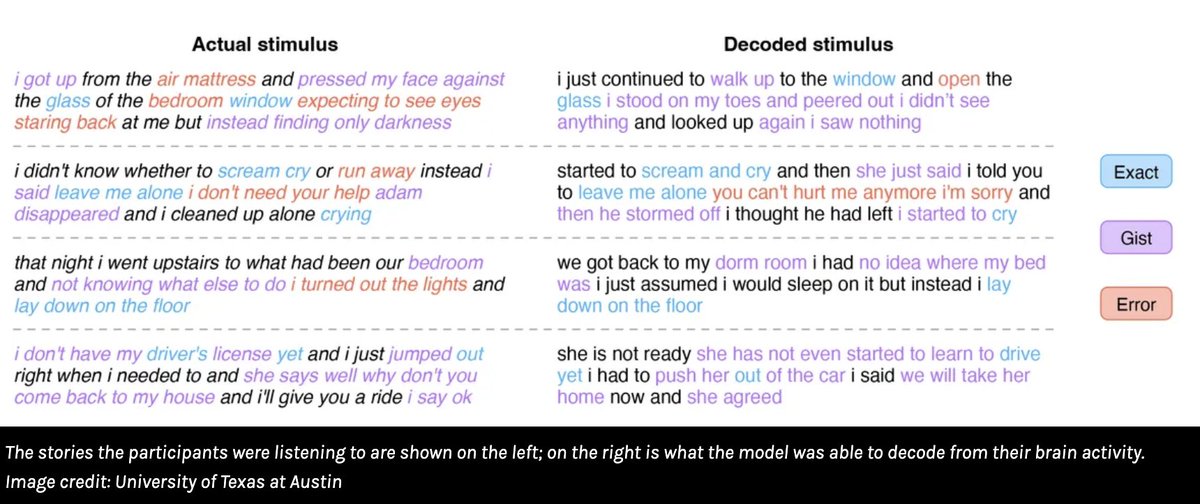
Published in Nature Neuroscience, researchers from the University of Texas at Austin used fMRI to gather 16 hours of brain recordings from three human subjects as they listened to narrative stories. The team analyzed these recordings to identify the specific neural stimuli that corresponded to individual words.

Decoding words from non-invasive recordings has long been a challenge due to fMRI’s high spatial resolution but low temporal resolution. Although fMRI images are of high quality, a single thought can persist in the brain’s signals for up to 10 seconds, causing the recordings to capture the combined signals of approximately 20 English words spoken at a typical pace.

Before the advent of GPT Large Language Models (LLMs), this task was nearly insurmountable for scientists. Non-invasive techniques could only identify a few specific words that a human subject was thinking. However, by utilizing a custom-trained GPT LLM, the researchers successfully created a powerful tool for continuous decoding, as there are far more words to decode than brain images available – exactly where the LLM has superpowers.

The prospect of decoding human thoughts raises questions about mental privacy. Addressing this concern, the research team conducted an additional study in which decoders trained on data from other subjects were used to decode the thoughts of new subjects. The researchers found that “decoders trained on cross-subject data performed barely above chance,” emphasizing the importance of using a subject’s own brain recordings for accurate AI model training.

link

AI makes mind-reading possible

Massive announcements in the world of AI today from the University of Texas, Geoffery Hinton, IBM, and Walmart.

Here’s the rundown on everything you need to know:

1. AI makes mind-reading possible

This new study will literally- *blow your mind*

Researchers at the University of Texas have developed a GPT-based decoder that translates thoughts into text using non-invasive fMRI scans.

– Participants trained the decoder by listening to podcasts for 16 hours.

– The AI system generated a text as participants listened to or imagined a new story, capturing thoughts .

The exact words were not always the same, but the overall meaning was captured.

[This whole thread is interesting but I am putting it up because the kind of AI feedback described above will reveal in detail the underlying loose organization and chaos of the mind as we speak and listen (and do everything else). Being able to see this clearly will revolutionize our understanding of human psychology; how it actually functions in real-time. When tech like this is something we can access routinely at a business or school or even purchase and use at home, human communication and self-understanding will hit fabulous new levels, freeing us from the humdrum common associations we must now depend on for clear communication. FIML practice can show a great deal of this right now. I would highly recommend more smart people learn to do FIML because it shows us how we really think and act, thus preparing us for what is coming from this new tech. Subjectivity will become much more objective. This will shock and even traumatize many, but it need not because it is real and utterly fascinating. In my view, this will become one of the most impactful technologies stemming from AI. ABN]

Continue reading “AI makes mind-reading possible”

How FIML can improve your favorite relationship, your own mind, and your partner’s

FIML is a technique used to optimize communication and psychological well-being between two people in real-time, real-world communication. It is a form of analytical psychotherapy that aims to clear up mistaken psychological interpretations that may have been held for many years or that may have just arisen. No psychological training is necessary to do FIML.

By clearing up many small mistaken interpretations between partners, FIML gradually clears up the psychological bases of those misinterpretations, which leads to greatly improved communication and psychological well-being. FIML can be used in any interpersonal relationship, including romantic relationships, friendships, and professional relationships. FIML is ideal and should be considered mandatory for marriages and other long-term committed relationships based on love or mutual affection, especially when partners live together.

It is important that both partners care about each other and very helpful if they realize that the well-being of one is the well-being of the other, or at least greatly contributes to that. FIML practice enhances and supports honesty between partners and their understanding of what honesty entails and how to be deeply honest in a relationship without relinquishing subjective privacy and freedom of thought, which are essential for spiritual and psychological growth.

To do FIML, both partners need to have a previous agreement to do it and then follow their mutual understanding of how FIML is done. Partners should do FIML at a time and place where they can converse without interruption.

A FIML query begins when one partner notices they have begun to form an impression or an interpretation of something their partner said or did. To be sure they are not mistaken, they begin a neutral query that fundamentally asks their partner to describe the contents of their working memory at that moment in time.

Partners must agree on the basic data that initiated the query. “When you said, XYZ what was in your working memory?” Partners must be able to agree that one of them said XYZ. Or, “When you turned away and looked into the sink, what was in your mind [working memory]?” Partners must be able to agree that one of them turned and looked into the sink. Moments like these are chosen by the partner making the inquiry. These moments can be playful or they can be very serious, causing incipient strong emotions to begin forming. Before those emotions take hold, do the query and find out if you were right or wrong by listening carefully to your partner’s answer.

After you have listened to your partner’s description of the contents of their working memory, compare it with your own. Then share your insights with your partner. This part of FIML is where the greatest value is. Since the precipitating event was small—a word or gesture or tone of voice—it is quite easy to confess your mistaken interpretation and then listen to your partner’s probably befuddled response to your mistake. This part is fun and can be a huge relief if your query was psychologically charged with underlying traumatic memory.

It really helps if both partners have a rich understanding of how imprecise, messy, crude, and sloppy almost all spoken language is. ABN

‘We are at an impasse. I love you. I am committed to you’ — the Crowders

The exchange between Steven Crowder and his wife, Hilary, is not unusual. Rules, commitments, roles, I love you. I don’t love you.

The exchange is an example of a common form of communication that is normal throughout the world. It is based on a deep failure to understand how interpersonal language does not work. And how it can and should work.

It does not work through vows, declarations of loyalty or love, roles, or ‘respect’.

Interpersonal communication between couples only works when they have a consciously shared method that allows them to understand themselves in real-world, real-time situations.

If the Crowders had been doing FIML, which is precisely the method they need, none of this would have happened.

Consider how simple-minded their conversation is. How stupid it is. Two full-grown, intelligent, successful adults who at some point must have cared for each other talk themselves into box like a couple of babies.

Their voices creak with anger as they battle for peace and contentment while destroying any chance of getting it with every word they say. Neither is to blame because neither one knows any other way to speak.

FIML is described in the links above. It is easy to do if you start before you get to where the Crowders are.

The hardest part about FIML is observing and controlling the first split-second of the formation of any significant impression or interpretation of your partner. FIML can only be learned when partners are at peace with each other. Then, small impressions with only small importance can be explored. This lays the foundation for deeper impressions later on.

For Buddhists, FIML requires observing and controlling your reactions during the first skandhas, before consciousness has fully developed. The fourth skandha of mental activity should be engaged in doing a FIML query rather than consolidating what is probably a mistaken impression of your partner. ABN