Here’s a question I know many are wondering about: why did China wait until now to use rare earths as leverage against the US? Why not in the first Trump administration when the US started the trade hostilities? Or when the Biden administration unleashed the chips export controls 3 years ago?
I just watched a fascinating explanation by a Chinese analyst and, unexpectedly, a big part of the explanation is… helium.
Helium isn’t just a party balloons gas: it has plenty of industrial applications for things such as quantum computing, rocket technology, MRI machines, as a coolant for chip lithography equipment, etc.
In a nutshell what he’s explaining is that with helium the US had an even stronger card to play if China ever used the rare earths card.
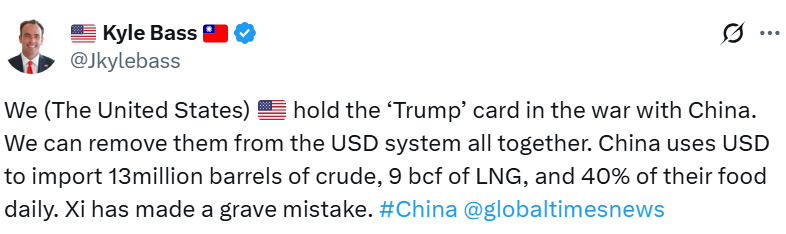
Also Kyle Bass: ‘The path forward certainly feels like an inevitability of war.’
Bass is fairly reliable and does not have stars in his eyes vis-a-vis China, which is a very good thing.
I would hope USA has other ways to get rare earth minerals.
This move by China has been brewing for a long time and it has been a well-known option all along.
As for BRICS becoming stronger if USA responds vigorously, Bass has this to say:
‘The BRICS are akin to 5 garbage trucks backing into each other. Reserve managers won’t go there and China will collapse in the meantime.’
For decades I have watched Westerners being overly intimidated and/or impressed by China. This is a natural form of what might be called ‘culture shock’.
Everyone who studies Chinese starts out this way, super-enamored. It takes years of study to see their weaknesses and faults; their real humanity.
The best thing China has going for them is ethnic/ racial cohesion.
Sun Yat-sen taught this over one hundred years ago and it has become gospel in all Chinese communities everywhere.
It is a foundational part of Chinese education everywhere.
In the West, we have mistakenly gone the other way and are fast destroying ourselves with endless self-criticism and resignation.
The ‘culture shock’ aspect of this is societies affected by it typically feel despondent, even hopeless because the confronting culture is new and seems indominable.
Japan and China both reacted this way when first confronted by the West.
Japan figured things out more quickly than any other society in the world and succeeded in modernizing without losing their Japanese identity.
China today is still reeling from its self-perceived ‘Century of Humiliation’.
The West today is akin to Japan in, maybe, 1885 in our understanding of the ‘culture shocks’ we are experiencing.
Another big factor in the West is we are infested with powerful and hostile parasitic subcultures, literally high-end gangs, who are actively seeking to destroy us as they feed on us. ABN
It has just been learned that China has taken an extraordinarily aggressive position on Trade in sending an extremely hostile letter to the World, stating that they were going to, effective November 1st, 2025, impose large scale Export Controls on virtually every product they make, and some not even made by them. This affects ALL Countries, without exception, and was obviously a plan devised by them years ago. It is absolutely unheard of in International Trade, and a moral disgrace in dealing with other Nations.
Based on the fact that China has taken this unprecedented position, and speaking only for the U.S.A., and not other Nations who were similarly threatened, starting November 1st, 2025 (or sooner, depending on any further actions or changes taken by China), the United States of America will impose a Tariff of 100% on China, over and above any Tariff that they are currently paying. Also on November 1st, we will impose Export Controls on any and all critical software.
It is impossible to believe that China would have taken such an action, but they have, and the rest is History. Thank you for your attention to this matter!
DONALD J. TRUMP PRESIDENT OF THE UNITED STATES OF AMERICA
I said on the day of the Qatari strike that the attack will be great for Palestine. Since then we’ve seen an aggressive systematic overturn on Israel’s interests.
This is a great article. Everyone should read it.
I’ve copy pasted here as its behind a paywall;
Two weeks before he went to the US to discuss a Donald Trump-backed plan to end the war in Gaza, Prime Minister Benjamin Netanyahu stood in front of his far-right followers in an Israeli settlement in the occupied West Bank and made a vow. “There will be no Palestinian state,” he said. “This place is ours.” Now, sitting in a hotel room in New York with his closest advisers and US interlocutors, he was looking at a draft document for a peace plan that ended with the exact opposite: a “credible pathway”, however vague, to a future Palestinian state. “The sting was in the tail,” said a person briefed on the meeting, which took place in late September. “It felt like a final betrayal.”
It wasn’t the only sting. Trump’s draft document was the result of a frantic round of lobbying by Qatar, Saudi Arabia and other influential Arab and Muslim countries, that also tapped into the president’s anger over Israel’s September 9 strike targeting Hamas’s political negotiators in Doha. The diplomatic push was also aided by the renewed influence of Trump’s son-in-law and former Middle East envoy, Jared Kushner. Their goal, said people involved in the process, was to deliver for the US president twin political and personal ambitions. Trump wanted to secure the release of the 48 Israeli hostages held by Hamas, end the war in Gaza and also keep alive his dream of brokering a grand rapprochement between Israel and Saudi Arabia. The timing was not arbitrary, said two Israeli officials involved in the talks. Trump made clear that he wanted the war to end by the second anniversary of Hamas’s October 7 2023 attack on Israel, which triggered the conflict. The Nobel Peace Prize, which Trump covets, will also be announced this month.
“From very early on, Trump understood that the hostages are the keys that open all doors in the Middle East,” said a former Israeli diplomat who liaised with Washington on behalf of the captives’ families.
Trump had met with released hostages, knew some by name, and followed their recovery from months in captivity — a personal connection far surpassing that of Netanyahu. Trump’s envoy, Steve Witkoff, texts regularly with the families waiting for their loved ones. But to get all the hostages out at once, and set his grand plan for the Middle East in motion, Trump needed Netanyahu to make concessions and a postwar plan. This was necessary not just to convince Hamas — for whom the hostages are the only real source of leverage — but also to appease Washington’s Gulf allies, who Netanyahu had alienated with Israel’s belligerence across the Middle East.
Among the most influential was Qatar, which hosts Hamas’s political office and has been central to two years of mediation efforts, said people involved in the negotiations. Israel’s attack on Doha, a US ally, just as Hamas was studying a ceasefire proposal from Witkoff, infuriated Trump. Indeed, when Netanyahu finally made it to the White House on September 29 — days after Trump had already presented his peace plan to Arab leaders — the president handed him a phone receiver and listened in as Netanyahu humbly apologised to Qatar’s prime minister. The strike on Qatar “actually opened the door for all of this,” said a former US official who maintains contact with leaders in the Middle East. The strike was humiliating for Trump, but “it allowed him to say, ‘you guys fucked up, and I’m bailing you out here, and I’m done,’” the official said, satirically characterising Netanyahu’s subsequent Oval Office apology to Qatar as “a hostage video”.
While Netanyahu and his team tried watering down some elements of what became Trump’s 20-point peace plan — especially the reference to a Palestinian state — a Qatari technical team sat not far away in the White House, said a person familiar with the events.
“It was impossible to change more than a few words here and there,” said a second person who read drafts of the plan. For instance, Netanyahu and his negotiators had sought one major concession — an opportunity to return to fighting if Israel decided Hamas had broken some clause of the agreement. The team was told, in no uncertain terms, “to stop looking for loopholes”. “Trump himself had guaranteed [to the Arabs] that Israel would not start the war again,” the person said. This pledge was verified by a second person familiar with conversations between the White House and Arab officials. And so nestled between the dry legalese of the peace plan were proposals that would be anathema to the far-right and messianic parties that prop up Netanyahu’s coalition, and who have vowed to expel Palestinians from Gaza and resettle it with Jews. Now, the document ruled out forced displacement and said Gazans would be free to leave the besieged enclave, and to return when they wanted. Hamas fighters could be granted amnesty if they gave up their weapons and agreed to “peaceful coexistence”, instead of being hunted to death. Not only would Israel not be allowed to occupy or annex Gaza, it could not build settlements there. The UN, reviled by Netanyahu, would be allowed back to feed Palestinians starved by Israel’s blockade. Still, there was enough in the document for Netanyahu to save face. Hamas would be barred from Palestinian governance. Its fighters would be disarmed and the strip demilitarised.
A committee of Palestinian technocrats and an international supervisory body chaired by Trump would run Gaza temporarily, not the Palestinian Authority, which administers parts of the West Bank. An international force would provide security. But most important, said two Israeli officials, was the language Trump used when announcing it — if Hamas rejected the deal, he said, “Israel would have my full backing to finish the job of destroying the threat of Hamas”. Standing next to him, Netanyahu looked subdued. He had grappled with and outmanoeuvred three American presidents — Bill Clinton, Barack Obama and Joe Biden. Now he faced intense pressure from the president he had confidently declared to be “the greatest friend that Israel has ever had in the White House”. Though Trump has long unnerved US allies with his transactional approach to politics and mercurial decision-making, Netanyahu had seen the US leader and his fervently pro-Israel political base as reliable sources of support. But earlier this year Trump surprised him with the announcement that the US had been holding indirect talks with Iran, then embarrassed him by reminding him that Israel was propped up by billions of dollars in US aid. “The rule of thumb is Donald Trump’s interests come first,” said Michael Oren, a former Israeli ambassador to the US. Before Trump, Netanyahu expanded settlements over Obama’s objections, and slow-rolled peace talks under Clinton. Referring to demands from Biden on the conduct of the Gaza war, Oren added: “And with president Biden who famously said don’t, don’t, don’t — and Israel did.” “But with Donald Trump, when he says don’t, then you don’t,” said Oren. “And now that’s the rule [even for] Israel.” He pointed out the expletive-laden public scolding the president administered when Israel bombed eastern Iran after Trump declared a ceasefire that ended a 12-day war between the regional enemies in June.
Days after his White House visit, where Netanyahu stood alongside Trump and said he supported the plan, the mood turned sour for the Israeli prime minister again. Back home, he had sold the Trump proposals as a victory for Israel — a “take it or leave it” option for Hamas, with US blessing for Israel to annihilate the militant group as the cost of rejection.
But on Friday, when Hamas cherry-picked the part of the deal that appealed the most to Trump — the release within 72 hours of all the remaining captives, alive and dead — while sidestepping the more contentious elements, Netanyahu found himself cornered. “Suddenly, there was a fundamental change in the situation. Earlier, Hamas had three choices — it could surrender, it could abjure terror, or it could die,” said Oren. “Now, it has a fourth choice — to negotiate. And while they negotiate, Israel has a red light.” Shortly after Hamas’s statement, Trump ordered Israel to “immediately” cease military operations in Gaza while talks continued. In a phone call with Trump, first reported by Axios and confirmed by an Israeli official, Netanyahu tried to convince Trump that Hamas’s qualified acceptance was a delaying tactic. Trump snapped back: “Why are you so fucking negative?” Axios reported. Days later, Trump publicly hammered the point home, telling an Israeli reporter that it did not take much to convince Netanyahu to accept the situation. “He was fine with it. He’s got to be fine with it. He has no choice,” Trump told Israel’s Channel 12 news. “With me, you got to be fine.”
If this account is true, Israel does not control Trump. Great read. ABN
Larry Ellison previously said he “would never let Elon Musk fail.” Ellison is Musk’s financial backstop.
Musk will never stake a position against Oracle, Google or Thiel’s interests.
Ellison then began moving toward TikTok. K-Street funded to assist with lobbying. Trump circle directly part of the assist (Sacks, Lutnick, Musk).
David Ellison simultaneously begins moving toward Paramount (CBS). There is no distance between father and son. Trump circle then assists (Hollywood tariffs).
Ideologically social media and boomer media target operations complete. Now watch what happens with CNN.
At the end of this construct, AI enmeshed with govt., and Social Media data, via national security and Palantir.
L Ellison wins. D Ellison wins. Musk wins. Thiel wins. Sacks wins. Ackman wins. Alex Karp wins. Bibi wins.
The Kentucky Derby is won by horses, but it’s the owners who get the prize money.
When Hamas came back with a “yes, but” to President Trump’s Gaza peace proposal on Friday, Trump called Israeli Prime Minister Benjamin Netanyahu to discuss what he saw as good news.
Netanyahu felt differently. “Bibi told Trump this is nothing to celebrate, and that it doesn’t mean anything,” a U.S. official with knowledge of the call told Axios.
Trump fired back: “I don’t know why you’re always so f***ing negative. This is a win. Take it.”
Define a game as “a set of rules that focuses and directs thought, feeling, intention.”
Most human games are overwhelmingly involved with human semiotics. Human feeling, thought, and intention overwhelmingly operate within and are defined by human semiotics.
Humans are semiotic animals who live within semiologies as much or more than their natural environments. Few of us can even comprehend our natural environments save through a semiotic system.
A semiology is a signal system, a system of signals. Humans need and want their signal systems to be organized; from this arises culture and psychology.
From this arises the many games of human semiotic organization. Humans crave meaning—a synonym for semiotic organization and focus—and thus play games (as defined above) with their intentions, thoughts, emotions, behaviors, instincts, perceptions, desires, and so on. Without meaning, focus, purposive semiotic organization, life is dismal and many humans destroy themselves and others for this alone.
Human semiotic organization can be beneficially reorganized in two basic ways:
Through general thought, which mainly changes how we focus and what we focus on. This region of organization includes all culture and science, including mainstream psychology and its treatments.
Through analysis of the most basic elements of semiotic organization, individual semiotics and semiologies. To do this at the individual level, two individuals are needed because you cannot successfully analyze your own semiotics by yourself. This is so because a great number of human semiotics are fundamental to both psychology and communication. They do not exist independently.
The goal of reorganizing individual semiologies is to optimize them. As individual semiologies optimize, individual psychologies inevitably optimize apace. Much is possible at this level that is not possible at the general level of psychological theory.
Reorganization at this level is done through individual semiotics, the actual signals of individual communication and psychology alike. To play this game—the game of semio-psychological reorganization and optimization—you have to have rules. Herethey are.
The White House budget office indicated Wednesday that mass firings could be on the table in the event of a government shutdown as Congress faces a stalemate on negotiations in the days leading up to the government funding deadline.
A memo from the Office of Management and Budget (OMB) reviewed by The Hill indicates agencies are directed to “use this opportunity to consider reduction in force (RIF) notices for all employees in programs, projects, or activities” under three conditions.
The conditions include discretionary funding lapses Oct. 1, if another source of funding isn’t available and if the programs, projects, or activities are not “consistent with the president’s priorities.” In order to consider firing, all conditions must be met.
Agencies were also directed to revise RIFs once a shutdown ends to retain the “minimal number” of employees needed to function, according to the memo, and a plan must be submitted to the OMB.
The memo essentially directs agencies to permanently fire some federal employees that otherwise would be furloughed during a shutdown but then return to work once Congress reopens the government.
Trump has been setting this table for the entire year. He’s pursued a very clear agenda that has confounded his critics because so few of them are as smart or wise as they think they are.
He’s put the neocons into their corner, rattle in hand, stripping them of much of their political capital, even while, at times, looking like he played their game.
The best way to invalidate your opponent’s leverage is to expose who they really are….
That’s Trump’s superpower. It always has been. Now Europe has no choice but to fight a war they cannot win with weapons they can’t afford with soldiers who don’t have any desire to fight for heir leaders.
This is a recipe for the most epic failure in modern history.
And all he has to do is sit back and shake his head.
Trump has presented his first U.S. plan to end the Gaza “war” during a meeting with Arab and Muslim leaders. The outline includes:
➤ Release of all hostages
➤ Permanent ceasefire
➤ Gradual Israeli withdrawal from Gaza
➤ A post-war governing body without Hamxs
➤ Security forces with Arab/Muslim troops
➤ Arab funding for reconstruction and governance
Arab leaders welcomed the plan but demanded:
➤ No Israeli annexation or occupation of Gaza/West Bank
➤ No new settlements
➤ Protection of Al-Aqsa’s status quo
➤ Immediate increase in humanitarian aid
According to sources, Trump emphasized the urgency of ending the war, warning Israel is becoming increasingly isolated. Arab leaders expressed cautious support, calling it the first serious U.S. proposal since the war began. A follow-up meeting with Arab foreign ministers was held today, with a more detailed plan expected before Trump’s talks with Netanyahu on Monday.
After getting to know and fully understand the Ukraine/Russia Military and Economic situation and, after seeing the Economic trouble it is causing Russia, I think Ukraine, with the support of the European Union, is in a position to fight and WIN all of Ukraine back in its original form. With time, patience, and the financial support of Europe and, in particular, NATO, the original Borders from where this War started, is very much an option. Why not? Russia has been fighting aimlessly for three and a half years a War that should have taken a Real Military Power less than a week to win. This is not distinguishing Russia. In fact, it is very much making them look like “a paper tiger.” When the people living in Moscow, and all of the Great Cities, Towns, and Districts all throughout Russia, find out what is really going on with this War, the fact that it’s almost impossible for them to get Gasoline through the long lines that are being formed, and all of the other things that are taking place in their War Economy, where most of their money is being spent on fighting Ukraine, which has Great Spirit, and only getting better, Ukraine would be able to take back their Country in its original form and, who knows, maybe even go further than that! Putin and Russia are in BIG Economic trouble, and this is the time for Ukraine to act. In any event, I wish both Countries well. We will continue to supply weapons to NATO for NATO to do what they want with them. Good luck to all!
DONALD J. TRUMP, PRESIDENT OF THE UNITED STATES OF AMERICA
To understand how Israel has gained a near-total control over the American ruling class today, we must understand Israel of course, but we must also study the principles by which any ruling class operates. The perfect book for that is The Ruling Class, by Italian political scientist Gaetano Mosca (1858–1941). Mosca begins by establishing the following law (p. 50):
In all societies, from societies that are very meagerly developed and have barely attained the dawnings of civilization, down to the most advanced and powerful societies, two classes of people appear: a class that rules and a class that is ruled. The first class, always the less numerous, performs all political functions, monopolizes power and enjoys the advantages that power brings, whereas the second, the more numerous class, is directed and controlled by the first…
No matter what their internal divergences are, the ruling class is bonded by a high degree of solidarity: “the minority is organized for the very reason that it is a minority” (p. 54).
It follows that the main object of political science must be the study of various types of ruling classes. Mosca, p. 336: “We must patiently seek out the constant traits that various ruling classes possess and the variable traits with which the remote causes of their integration and dissolution, which contemporaries almost always fail to notice, are bound up.” Historians and journalists remain at the surface of historical events when they ascribe them to the decisions of heads of states, who are only, as a rule, the public faces of a ruling class, and sometimes not the main decision-makers.
A ruling class can be overthrown, either by a foreign conquest, by a coup d’état, by a revolution, or in more subtle ways that are not always immediately perceptible by the ruled. But any change of regime, even if provoked by popular uprising, leads to the formation of a new ruling class.
All this may seem quite obvious, but reading Mosca and pursuing this line of thought has modified my perspective on political regimes, on the illusion of Democracy, and on what Israel is up to.









 American Buddhist Net