Doha used the strike as a permission structure to pivot away from the hosting model.
It wasn’t a “soft-power failure”.
It was a structural pivot.
Qatar treated “hosting Hamas” as a proxy-asset whose position turned negative.
For a decade, the asset had positive utility. The US got a reliable conduit, Israel tolerated Qatari cashflow management into Gaza, and Doha monetised access into mediator prestige.
That setup existed because the US originally wanted a reachable Hamas channel in a US-aligned host (Al Udeid as the ultimate security umbrella).
So until now, that channel still priced in that utility.
But now it’s over.
Qatar’s “mediator” brand only worked while those conditions held.
There’s a reason why these conditions no longer remain useful. And i’ve explained this before.
Proxies are time-sensitive assets.
They remain useful during stalemated negotiations. Once they obstruct normalization or capital flows, sponsors reroute;
budgets thin, access tightens, and the proxy gets integrated, contained, or abandoned.
There’s PLENTY of signals we’re at the end of this curve.
Maintaining mediator role is just a toxic position now.
Stop looking at the past to determine what the future should be. That’s not how statesmen think. They evolve all the time.
What Qatar needs to do now, is exit the hosting role, and keep the convening brand. It should facilitate talks without residency.
There’s several reasons why it needs to accelerate this pivot.
The Hamas/Israel deadlock has became a liability.
The mediation channel has stalled.
When a channel stops producing swaps/ceasefire increments, it stops buying Qatar influence and starts costing it.
In other words, reading between the lines: The night before Kirk’s talk at UVU, rabbi Wolicki asked to have a one-hour Zoom conversation with him, to go through his pro-Israel “talking points”, because many of his fans “were turning on Israel” and “there were prominent people … actively working to [get him to] drop his support for Israel on a daily basis.” (In other words, Kirk was pushed in an anti-Israel direction by his followers and by people like Carlson and Owens, and needed strong opposite pressure to stay in line.) Kirk was “in a combative mood”, “playing the role of devil’s advocate.” (In other words, the conversation turned into an argument.) Kirk was assassinated the next day.
Another point I have not seen brought up is the timing of the shot is said to have been .23 seconds, which comes from an audio measurement of the shot from firing to hitting Kirk.
How do we know the audio has not been doctored?
That would be an easy thing to do. That .23 seconds yields a distance of 143 yards, precisely the distance the sniper is said to have been away from Kirk.
But that ‘sniper’ ran off with no apparent gun in hand.
Also, no bullet has been recovered and there appear to be no signs of it exiting, which should have been conspicuous.
Why did Kirk’s security immediately clean up the scene? And why did Zinn act like a decoy immediately after the shot?
There are numerous anomalies like these in the so-far official story of what happened. ABN
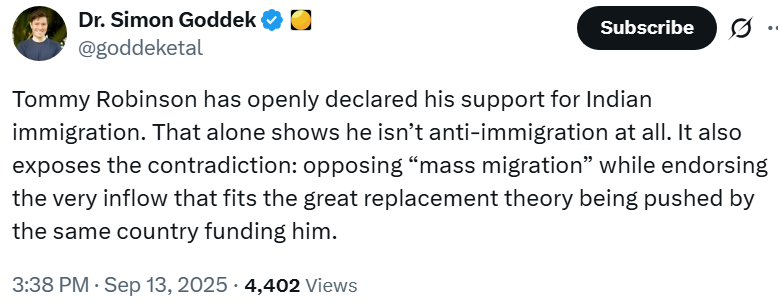
Simon makes a decent point, but don’t throw the crowd out with the bathwater. Nothing is perfect. Millions of Brits needed a reason to show their mettle. Who organized it is not the main feature. We have to work with percentages. A huge crowd like this inspires tens of millions, perhaps hundreds of millions. Don’t make perfect be the enemy of pragmatics. ABN
The West clings to its delusion of supremacy like a fading empire hoarding tarnished trophies.
It’s the same old playbook for them.
They spin a narrative, call it truth, and expect the world to bow.
They do this with everything. From marketing product sales, to politics.
To grasp the Middle East’s geopolitics, you have to understand this Western narrative framework.
“Terrorism” is always the villain, and the West, the gallant hero, swoops in to save the day.
There’s no reality where the resistance topples Israel and “wins” the Middle East.
That’s not how the script works.
The West demands its victory lap, claiming it tamed the savages and gifted the region peace.
The reality however, is that their grand experiment failed to become a hegemony so they need to wrap this up, and demote Israel to just another player integrated into the region’s control.
That’s the reality. That’s the outcome.
The Gulf states get this. They ditch the ego and pride and see the board for what it is. And they couldn’t care less what the region thinks of them.
Outcomes over optics.
Many on here don’t understand this. Frankly, they should not be involving themselves with geopolitics.
Just pay attention over your timeline. Anyone saying the Gulf states are an embarrassment or a humiliation over this Doha strike,
are the ones being played by the Western narrative. They care about the narrative of optics over the reality outcomes.
They care about shit like honor, integrity, glory when the stakes are far more substantial.
These people are like naive children.
They don’t just fall short when it comes to geopolitics. They often conduct themselves poorly in other domains within their life.
I see it in corporate very often.
Very easy to manipulate.
They become part of the means for people who shape outcomes.
Decentralization will be the new strategy for Hamas.
The Doha strike proved that no single location is safe, accelerating Hamas’s move toward a dispersed leadership model.
From what I am gathering from the region, the group has already established a political office in Baghdad and maintains a significant presence in Istanbul.
This swift readjustment just proves once again, just how coordinated all this is.
This shift to a multi-node network across several friendly nations is a logical evolution to maintain survival and slow integration. Intelligence collection will be forced to pivot from monitoring a single headquarters to mapping this distributed and more elusive network.
This will naturally mitigate the risk while significantly raising the cost of Israel attempting further strikes in the absence of undeniable proof that Hamas is still strong and active.
To understand and make sense of all this, you need to walk the western narrative framework.
As I said,
the Israeli strike in Doha marks the end of the “safe haven” era for Hamas’s political bureau.
From here, I think Hamas will survive as an organization, its role in regional diplomacy will contract sharply,
with Arab states and TPS [Transnational Private Sector] actors seizing the initiative to reshape Palestinian governance.
Poland’s Prime Minister today warned ‘we are closer to war than any time since World War Two’ after his country was forced to shoot down Russian drones that violated its airspace.
Polish media is now reporting that Donald Tusk has requested the triggering of NATO’s Article 4, where member countries can bring an issue to the attention of the North Atlantic Council. Poland’s security council will also meet to discuss an ‘appropriate response’.
More than eight million Poles were ordered to hide in their homes as the drones flew overhead, with debris from one shot-down device crashing into a house. The full force of NATO’s fighter planes was unleashed to shoot down the drones.
After the organisation’s patriot defence systems detected the drones with their radars, Polish F-16 fighter jets, Dutch F-35, Italian surveillance aircraft, and NATO’s MRTT mid-air refuelling aircraft all came together to counter the drones.
The downing of Russia’s unmanned aerial vehicles marked the first-ever direct engagement between Moscow and NATO. It has long insisted it wants no confrontation with Putin. Kyiv has accused Russia of deliberately invading Poland’s airspace with 24 UAVs to test the West’s defences.
Multiple Russian drones leaving Ukraine airspace into Poland’s
On Wednesday, Tusk held an extraordinary meeting with top officials after Russia’s actions. Senior army officials are present at the gathering.
He said a number of drones that posed direct threats to Russia were shot down in a joint effort with NATO allies, and warned that Poland is ready to react. The prime minister added that he was in communication with allies.
Tusk also spoke in parliament and said some of the drones flew in from neighbouring Belarus, a staunch ally of Russia. He also confirmed that three or four of the nineteen drones were shot down.
UPDATE: The reasons for this are decidedly ambiguous. Could be to provoke NATO, to test Poland’s defenses, to prepare for negotiations or just to flex. How we interpret it is a psychosemiotic challenge. I doubt Putin wants war and also I doubt he would back down from war if provoked. It is very possible Poland or NATO has provoked Russia in some way we do not know about. Navrotsky said yesterday: ‘I’m not going to give my consent to send the Polish military to Ukraine’. I wonder if his views on that will change now. Another possibility is Zelensky sent doctored drones from Ukraine to provoke Poland against Russia. ABN
‘I’m not going to give my consent to send the Polish military to Ukraine,” Navrotsky said.
‘I declare and say this in all conversations with partners so that everything is clear.
We are ready to help the coalition of the willing, but from my point of view, the participation of the Polish army in Ukraine is excluded — there is no need for this.
As for the statements of Western European countries. As for the participation of these troops in Ukraine, so far, as far as I know, there are no clear declarations from Western states about which military contingent could go to Ukraine.”
Following confirmation of the planned deployment of U.S. Air Force F-35A fighter aircraft to Puerto Rico to support ongoing operations near Venezuela, questions have increasingly been raised regarding how the fighters may be utilised to support an American offensive against its southern neighbour as tensions continue to escalate.
The deployment of F-35s was announced hours after an overflight by two Venezuelan Air Force F-16 fighters over the U.S. Navy Arleigh Burke Class destroyer USS Jason Dunham in the Caribbean Sea, and at a time when the United States is actively considering options to escalate hostilities to launch attacks on Venezuelan soil.
As part this escalation, the United States government has placed a higher bounty on the head of Venezuelan President Nicolas Maduro, following years of sustained efforts to oust him from power including a failed kidnapping attempt in 2020.
The F-35 is the only fifth generation fighter class in production anywhere in the Western world, and is considered unrivalled in its sophistication by any non-Chinese fighter class.
The aircraft is heavily optimised for operations against advanced air defence networks, making it an ideal fighter to neutralise the S-300VM, BuK-M2 and S-125 systems guarding Venezuelan airspace, all of which are deployed in only relatively limited numbers.
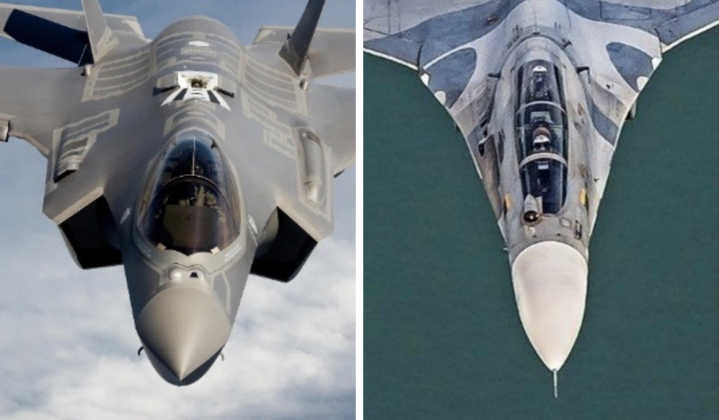
F-35 (left) and Venezuelan Su-30MK2
With Venezuela’s F-16s being among the oldest and least capable in the world, the greatest challenge to any attempts to attack the country by air will come from its fleet of 22 Su-30MK2 fighter aircraft, which considered by far the most capable in Latin America.
A comparison of the capabilities of the rival fighter classes could thus provide valuable insight into how a potential engagement could play out.








 American Buddhist Net