It’s too destabilizing for Egypt, Jordan, GCC [Gulf Cooperation Council], and the TPS [Transnational Private Sector].
So Israel resorts to incremental displacement; making areas unlivable so populations slowly filter out.
That’s Israel’s current state calculus.
In parallel to that, yes, flattening urban space creates a blank slate for reconstruction contracts.
Cycles of destruction/rebuilding feed into TPS projects tied to donor funds.
This ensures that while Israel secures its “security” objective, the TPS still gets entry points for capital deployment.
But the TPS doesn’t want total ethnic cleansing, because it risks blowing up the very donor funds from the GCC and sabotages Israel normalization with them.
So the TPS tolerates destruction as long as it leads to managed rebuilding under conditional frameworks.
Everyone thinks Palestinians will be exterminated / totally displaced.
It’s already a foregone conclusion that this will not happen.
The United States has significantly increased its military presence near Venezuela in late August and early September 2025, deploying naval assets to combat drug trafficking and counter alleged narco-terrorism under President Donald Trump’s directives On August 18, three U.S. Navy warships—USS Gravely, USS Jason Dunham, and USS Sampson—along with approximately 4,000 military personnel, were sent to the Caribbean and waters off Venezuela’s coast This force has since expanded to include additional warships, P-8 surveillance aircraft, an attack submarine, and three amphibious assault ships carrying over 4,000 sailors and Marines
The U.S. government claims these deployments are part of a broader campaign to disrupt drug cartels, particularly the Venezuelan-linked Tren de Aragua, which was designated a foreign terrorist organization in February 2025 The Trump administration has also doubled the reward for information leading to the arrest of President Nicolás Maduro from $25 million to $50 million, accusing him of leading a “narco-terror cartel” Attorney General Pam Bondi announced the seizure of $700 million in assets linked to Maduro, including luxury goods and private jets
While the U.S. has not signaled plans for a land invasion, White House Press Secretary Karoline Leavitt stated that President Trump is “prepared to use every element of American power to stop drugs from flooding into our country and to bring those responsible to justice,” declining to rule out military strikes On September 3, two Venezuelan F-16 fighter jets conducted a flyover near a U.S. destroyer, which the Pentagon condemned as “highly provocative,” warning against interference with counter-narcotics missions
In response, Venezuela has declared “maximum preparedness” for defense President Maduro announced the activation of over 4.5 million members of the Bolivarian Militia—a civilian defense force established in 2005—to guard factories, workplaces, and national territory He characterized the U.S. naval deployment as an “extravagant, unjustifiable, immoral and absolutely criminal and bloody threat” and warned that military action would “stain Trump’s hands with blood” Maduro also stated he would declare a “republic in arms” if Venezuela were attacked, though he did not elaborate on what that would entail
Venezuela has deployed more than 15,000 troops along its coast and border with Colombia and temporarily banned drone operations in its airspace, citing past assassination attempts The Venezuelan government rejects U.S. allegations, calling them a “false narrative” designed to justify regime change, and insists that most cocaine trafficking from Colombia occurs via the Pacific, not Venezuela
Analysts and officials note that while tensions are high, there is no indication of an imminent U.S. invasion, and the current operations remain focused on interdiction and deterrence within international waters and airspace
Donald Trump greenlit a daring mission to send Navy SEALs into North Korea to bug Jim Jong Un before the operation unraveled after the soldiers killed several fishermen and fled, a bombshell new report reveals.
The audacious plot unfolded in early 2019 as Trump was locked in high-stakes nuclear talks with Kim to limit the hostile nation’s nuclear program.
With negotiations moving forward, Trump was set for the first of two face-to-face meetings with Kim in Vietnam, and military officials presented a plan to have a SEAL team covertly move in.
The mission was given to SEAL Team 6, the same unit that took out Osama Bin Laden in Pakistan in May 2011.
But despite months of rehearsals to sneak to the North Korean coast in submarines and plant the device before leaving undetected the operation quickly went sideways, a new report from The New York Times claims.
According to military officials who spoke with the outlet, the SEALs only got onto the beach for a short time before they were spotted by a sailing vessel.
Fearing that the vessel was North Korean military, the SEALs opened fire and killed around three people on board before puncturing their lungs to ensure their bodies would sink to the ocean floor.
If even one European country sends troops to Ukraine, we’ll declare war on them immediately. No other way about it. It won’t be easy, but this time we’ll end the Patriotic War in London.
While we’re at it, we’ll clear out all illegal migrants from our mandated territory—grooming gangs? Shot on sight, no fuss. Every last one. And British girls will flock to greet our moral, slightly grumpy Russian soldiers. You’re free, Brits. Do whatever you want now.
Show your true colors!
Also with the French, but Cossacks on Montmartre is already déjà vu. Pick out a couple of lampposts for Macron and that wrinkled Neanderthal.
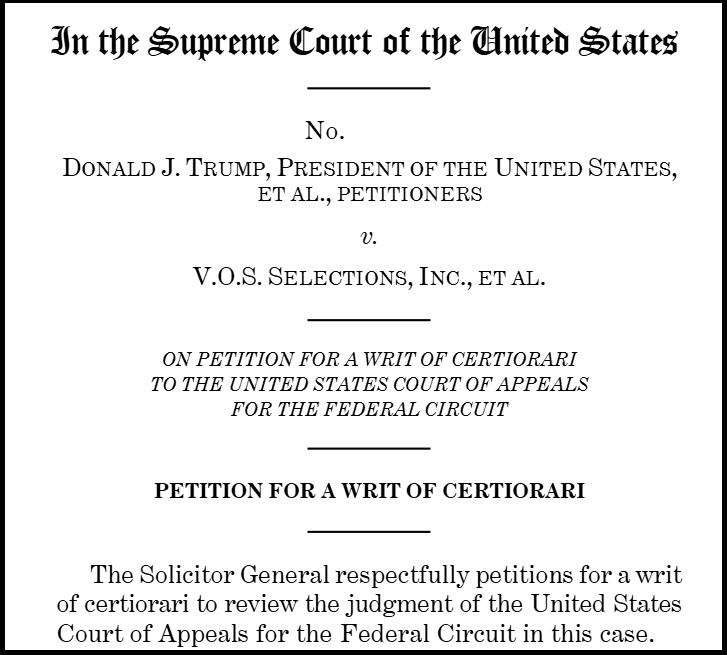
U.S. Solicitor General D. John Sauer has asked the Supreme Court to accept the case by next week, hear arguments in early November and “expedite” its ultimate ruling “to the maximum extent feasible.” [Appeal Here] with [Expedited Review Request Here]
At issue is the president’s authority under the International Economic Emergency Powers Act (IEEPA), a 1977 law Trump used to impose baseline tariffs between 10 and 50 percent on goods from countries who do not have Free Trade Agreements with the U.S.
President Trump also declared fentanyl drug shipments a national emergency, providing the administration’s justification for imposing tariffs on Canada, China and Mexico.
From the request for expedited consideration, “The en banc Federal Circuit’s erroneous decision has disrupted highly impactful, sensitive, ongoing diplomatic trade negotiations, and cast a pall of legal uncertainty over the President’s efforts to protect our country by preventing an unprecedented economic and foreign-policy crisis,” Sauer notes.
Adding comments from Treasury Secretary Scott Bessent, “The recent decision by the Federal Circuit is already adversely affecting ongoing negotiations. World leaders are questioning the Presi-dent’s authority to impose tariffs, walking away from or delaying negotiations, and/or imposing a different calculus on their negotiating positions.”
Moreover, “[t]he frameworks for trade agreements already in place contain additional provisions whereby the trade partners agree to significant purchases from and/or in-vestments in the United States.” … “If these agreed upon frameworks were unwound and the investments and purchases had to be repaid, the economic consequences would be catastrophic.” (more)
Happening in Japan as well. Prepare for the worst. The sooner this comes out big-time, the better. Corrupt elites are working to destroy any and all opposition to their lust for power. Citizens have more power than them when we are united. Elites can and do rig elections but they cannot overcome strong and widespread resistance from the citizenry. ABN
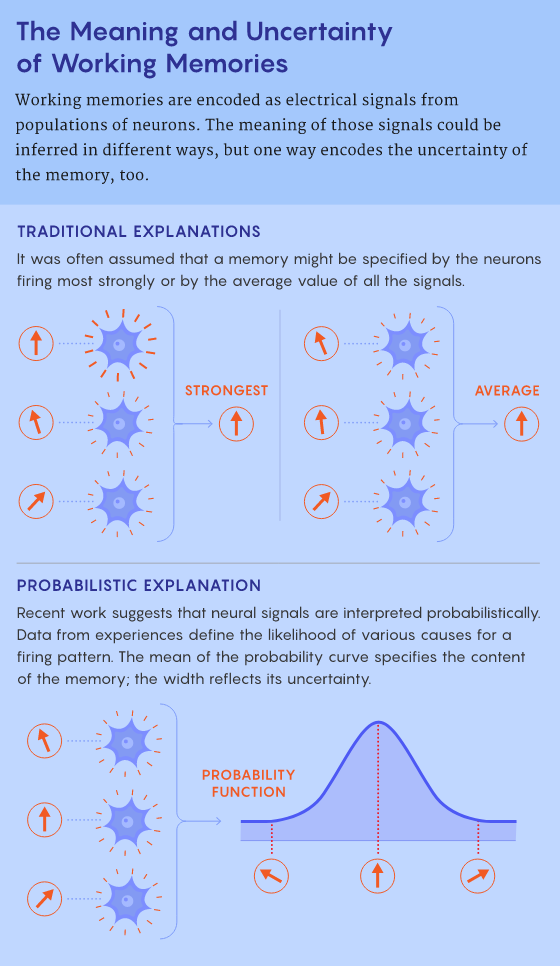
The uncertainty in working memory may be linked to a surprising way that the brain monitors and uses ambiguity, according to a recent paper in Neuron from neuroscience researchers at New York University. Using machine learning to analyze brain scans of people engaged in a memory task, they found that signals encoded an estimate of what people thought they saw — and the statistical distribution of the noise in the signals encoded the uncertainty of the memory. The uncertainty of your perceptions may be part of what your brain is representing in its recollections. And this sense of the uncertainties may help the brain make better decisions about how to use its memories.
…the idea that we are walking around with probability distributions in our heads all the time has a certain beauty to it. And it is probably not just vision and working memory that are structured like this, according to Pouget. “This Bayesian theory is extremely general,” he said. “There’s a general computational factor that’s at work here,” whether the brain is making a decision, assessing whether you’re hungry or navigating a route.
FIML practice works precisely with the probabilistics of working memory. If the range of doubt in a perception is stronger than normal, it may prompt a query. If the range is stronger than normal and may indicate danger, a query is more likely. It would make sense that our assessments of these factors would be Bayesian. When perceptions are psychologically important, any Bayesian analysis will require assessing the subjective context into which the perception enters, which implies further Bayesian analyses. It would be wonderful if we had machines that could do this for us, but they will only be invented years from now if ever. For now, we can use our own minds to accomplish this through FIML practice. If you can understand the linked article, you should be able to see the value of FIML which collapses a Bayesian probability curve into the certainty of a single point. Psychologically, when this is done hundreds of times, the results are extremely satisfying. ABN
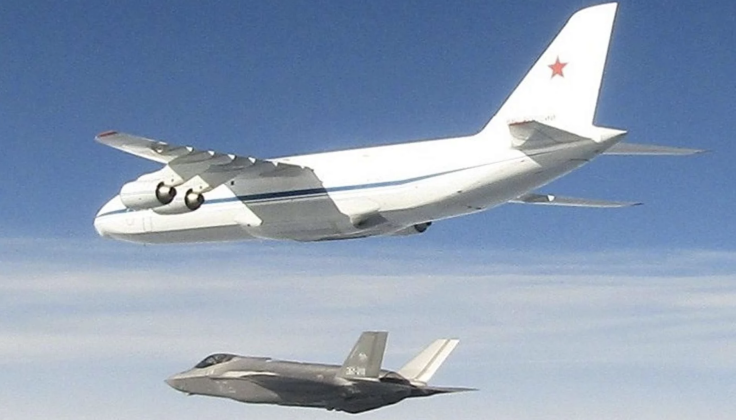
Apair of Italian Air Force F-35 fighters forward deployed to Amari Air Base in Estonia were reported on August 28 to have intercepted one of the Russian Aerospace Forces’ small number of An-124 strategic transports, which are by far the largest transport aircraft fielded outside the United States.
The 32nd and 6th Wings at Amari Air Base are currently operating as part of NATO’s Baltic Air Policing mission, as the South European state has played a disproportionate role in bolstering Western Bloc air power both in Eastern Europe and in the Pacific.
The interception highlights the sustained tensions surrounding the Russian enclave of Kaliningrad, which is geographically surrounded by NATO territories placing any air, sea or land traffic between it and the Russian mainland at risk of being targeted by Western Bloc forces.
The incident follows an encounter two weeks prior between an Italian F-35 and Russian Su-27 and Su-24M fighters in the region.
I don’t want to keep talking about crypto because it’s not my area of expertise.
But I want to respond to the post below because I’ve seen too many of these “feel good” assertions, as if we are on the verge of breaking away from a “dying” system and about to “earn our freedoms”.
These are luxury beliefs with no grounding in reality.
Bitcoin doesn’t dissolve the old frame. It proves how the TPS [Transnational Private Sector] rewrites frames.
Gold worked not because people “believed” in it,
but because a handful of people within states and empires enforced it with armies, trade routes, regulation and convertibility rules.
The masses just did as they’re told.
There’s a whole power structure mandate that you’re completely neglecting.
The dollar works NOT because of “habit,” but because the FIC transacts in it and the MIC enforces it globally.
Saddam shared a very similar philosophy on the dollar. That it was a fiat worth nothing based on false belief.
He quickly found out that it was much more than that.
So did Gaddafi.
Ok.
So it’s NOT just “belief” that adds value to a currency.
It’s enforcement of the power structure that punishes anyone who deviates from it.
Lot of people think companies like Apple, NVIDIA, Microsoft are sovereign giants calling the shots because of their multi-trillion dollar valuations.
That’s not how it works.
At all.
It’s the financiers that call the shot.
Through proxy voting and board control, they set policy on dividends, ESG, executive pay, even mergers.
Apple, NVIDIA etc may look powerful, but they’re ultimately operators inside an index fund empire. They are constrained by semiconductor subsidies, export controls, and defense-linked AI/Chip contracts.
These CEO’s rely on JPMorgan, Goldman Sachs, Citi, etc, for credit lines, bond issuance, and stock buybacks. This level of capital availability is political.
Tied to TPS interests.
Defense firms like Raytheon are structurally embedded in the MIC. Their demand is guaranteed by Pentagon budgets, not free markets.
Energy firms like Chevron are tied to FIC-MIC loops (petrodollar, US security guarantees).
The regulatory chokepoints that Trump loves to slap on US companies like export controls, antitrust threats, sanctions frameworks, making it look like he’s working for the people, is just a facade.
It’s all to simply remind firms that they’re licensed to operate within TPS rules.
The fact is that these companies are powerful at the operational level (deciding products, engineering, marketing) but subordinate at the strategic level (capital flows, bloc alignment, geopolitics).
Once a firm is swallowed by the TPS, it means financiers drive the decisions.
What people thought America could be – a beacon of democracy – was the last thing it became. In reality, it’s a corporate machine that has given rise to the Transnational Private Sector (TPS).
The TPS is a coalition of corporate giants, led by the Financial-Industrial Complex (FIC) with firms like JPMorgan, Goldman, and BlackRock, alongside the Military-Industrial Complex (MIC), Consumer-Industrial Complex (CIC), and Techno-Industrial Complex (TIC).
This collective force operates beyond borders, transcends nationality, and prioritizes profit over public welfare.
When Jamie Dimon, JPMorgan’s CEO, warned in October 2024 that wars in Ukraine and the Middle East could destabilize the global economy, he wasn’t just forecasting. He was asserting the TPS’s dominance over policy.
To understand this power, you have to examine the game theory driving the TPS’s clash with nations.
This concept that I have developed deliberately sets aside the idea of good, evil, right, or wrong. Geopolitical dynamics are examined through the lens of incentives, power, and measurable outcomes, not moral judgments. The focus is the strategic interplay of actors, stripped of ethical narratives.
___
Game theory provides a framework for understanding geopolitical strategies by analyzing the incentives that drive actors’ decisions.
There are two distinct game types: finite and infinite. Both these games shape global interactions. Finite games are zero-sum with defined endpoints, and clear winners and losers. It’s akin to a corporate quarter where profit maximization is the sole objective.
One player wins, the other loses.
Infinite games, conversely, lack a conclusion, have no end, prioritizing sustained participation through long-term stability, akin to a nation’s multi-generational survival strategy.
States operate within infinite games.
They do not expire. They do not tap out.
Their permanence compels them to prioritize enduring stability over immediate gains. For instance, China’s $1 trillion Belt and Road Initiative, spanning decades, secures global trade networks to ensure long-term economic influence. BRICS nations, through $10 billion in yuan-based trade, foster mutual economic resilience for mutual prosperity.
This cooperative approach engenders a form of morality rooted in reciprocity: mutual support today ensures mutual survival tomorrow. Such strategies reflect a commitment to societal development and stability, as states must maintain legitimacy and resources for their populations over time.
The TPS operates as a corporate entity, fundamentally detached from societal obligations. Unlike states, the TPS bears no responsibility to citizens, public welfare, or long-term development. Its imperative is profit maximization within finite time horizons, driven by shareholder demands and market cycles.




 American Buddhist Net