Protests in Iran continue for a second consecutive night on 10 January 2026, despite a nationwide internet blackout and escalating government crackdowns, with demonstrators defying threats of severe punishment The unrest, which began on 28 December 2025 over a currency crisis and soaring inflation, has now spread to at least 190 cities and entered its third week, marking one of the most significant challenges to the Islamic Republic in decades
Iranian authorities have imposed a near-total internet shutdown since 8 January, confirmed by NetBlocks, in an effort to suppress information and disrupt protest coordination—a move described by experts as a “digital kill switch”
Security forces have used live ammunition against protesters, with human rights groups reporting at least 48 deaths, while the US-based Human Rights Activists News Agency claims 116 killed, including seven under 18, and over 2,600 arrested
Iran’s Supreme Leader Ayatollah Ali Khamenei dismissed protesters as “vandals” and vowed the regime “will not back down,” while also warning U.S. President Donald Trump that he would be “brought down” for interfering
Trump has repeatedly threatened Iran, stating the U.S. would “start shooting” if protesters are killed and declaring “Make Iran Great Again,” signaling strong support for the demonstrators
The UN-mandated fact-finding mission on Iran has urged the government to halt violence and restore internet access, expressing alarm over reports of unrestrained crackdowns
Exiled opposition figure Reza Pahlavi has called for continued protests and nationwide strikes by energy and transport workers, amplifying pressure on the regime
International condemnation has grown, with the leaders of the UK, Germany, and France condemning the killings, and UK Foreign Secretary Yvette Cooper praising the protesters’ courage
Iran is experiencing one of the most serious challenges to its theocratic rule since the 1979 revolution, with widespread protests and economic collapse placing the regime under unprecedented pressure The unrest, which began in late December 2025 with a merchants’ strike in Tehran’s Grand Bazaar over soaring prices and currency devaluation, has evolved into a nationwide political revolt spanning over 145 cities across 28 of Iran’s 31 provinces The Iranian rial has plummeted to around 1.4 million per US dollar, inflation has exceeded 50%, and food prices have surged more than 70% year-on-year, eroding public trust in the government’s ability to manage the economy
Protesters are no longer demanding reforms but are explicitly calling for regime change, chanting “Death to the dictator” and “This is the year of blood – Khamenei will be overthrown” The regime has responded with live fire, internet blackouts in major cities, and mass arrests, resulting in at least 30 deaths, mostly of young people, and hundreds injured Despite this, the intensity of the protests has not diminished, and demonstrations have spread to previously quiet towns and religious centers like Qom, signaling deepening societal unrest
The regime’s ideological foundation is also crumbling. The narrative that sacrifices in the form of economic hardship and military spending were necessary to challenge Israel and the West has been undermined by Israel’s decisive 12-day war in June 2025, which severely damaged Iran’s nuclear and missile programs and exposed its military weakness This has led to a crisis of legitimacy, with even President Masoud Pezeshkian admitting that failure to address economic grievances could lead the country “to hell”
A critical factor in the regime’s survival has been the loyalty of the military, particularly the regular armed forces (Artesh), which have historically refrained from political involvement while the Islamic Revolutionary Guard Corps (IRGC) handled internal repression However, there are growing signs that the Artesh may no longer remain neutral. Officers, many of whom come from families suffering under the economic crisis, may begin to question their allegiance, especially if they perceive the regime as doomed Historical precedents, such as Romania in 1989 and Egypt in 2011, show that regime collapse often occurs when the military withdraws support
Analysts warn that while regime collapse is possible, it is not guaranteed The opposition remains fragmented and lacks centralized leadership, which could prevent a coordinated transition The regime still possesses coercive power, and hardliners may resist any move toward negotiation However, the combination of economic collapse, loss of ideological legitimacy, and potential military defection suggests that Iran may be approaching a tipping point
International rhetoric, including U.S. President Donald Trump’s statement that the United States is “locked and loaded” to protect Iranian protesters, may further influence the calculations of Iranian military leaders, signaling potential external support for a break with the regime While such statements do not guarantee intervention, they contribute to the perception that the current regime is increasingly isolated and vulnerable
In sum, while the Iranian regime has not yet fallen, it is facing its most precarious moment in decades, with structural weaknesses, mass unrest, and potential fractures within the security establishment making collapse a real possibility
This is a huge issue if fully exposed and arrests happen. It’s also tied to massive NGO, Somali and immigration scams linked to Dems and global leftists. Trump has promised 2026 will be a strong year. We can already see the direction he is moving in. This will likely involve similar scams in Europe being exposed and causing public outcry. ABN
Add to this the total failure of the Chinese defense weaponry and the Chinese troops who manned it in Venezuela when USA swooped in and arrested Maduro without losing a single soldier. This was a very strong message to China and they know it. ABN
The video captures the sequence of events on January 3, 2026, when a Chinese delegation led by envoy Qiu Xiaoqi met Venezuelan President Nicolás Maduro to reaffirm bilateral ties on energy and trade, only for U.S. forces to launch airstrikes and capture Maduro hours later, as announced by President Trump.
The video footage depicts a cordial exchange between Maduro and the envoy, including zodiac sign banter (Maduro as a Tiger, referencing a 2006 meeting with Hu Jintao) and discussions of “unbreakable brotherhood” against U.S. influence, highlighting Venezuela’s strategic pivot toward China for economic support.
Trump’s operation, conducted with Maduro facing U.S. charges on drugs and weapons, serves as a geopolitical statement amid escalating U.S.-China rivalry in Latin America, potentially stalling hundreds of Sino-Venezuelan deals valued at billions in oil and infrastructure investments.
Donald Trump has hailed his ‘brilliant’ operation to capture Venezuelan President Nicolas Maduro, as Maduro’s deputy demanded proof the leader is still alive.
Speaking to The New York Times at 4:30am on Saturday morning, nine minutes after announcing the raid on his TruthSocial website, Trump said: ‘A lot of good planning and lot of great, great troops and great people.
‘It was a brilliant operation, actually.’ Asked if he had consulted Congress prior to authorizing the strike, Trump said: ‘We’ll discuss that.’
He then told the paper he’d give more details during a press conference scheduled for 11:30 ET from his Mar-a-Lago country club in Palm Beach, Florida.
US military officials are growing increasingly concerned about China‘s expeditions in the Arctic after the country’s research submarines traversed thousands of feet beneath the ice for the first time over the summer.
Such expeditions could yield valuable data about the natural resources underneath the melting ice caps, significantly reduce travel time for commercial shipping and position nuclear-armed submarines closer to potential targets – including the US, national security officials told the Wall Street Journal.
Chinese vessels on research missions are also often used to give cover to the military, noted US Air Force Gen. Alexus Grynkewich, the top military leader for the North Atlantic Treaty Organization.
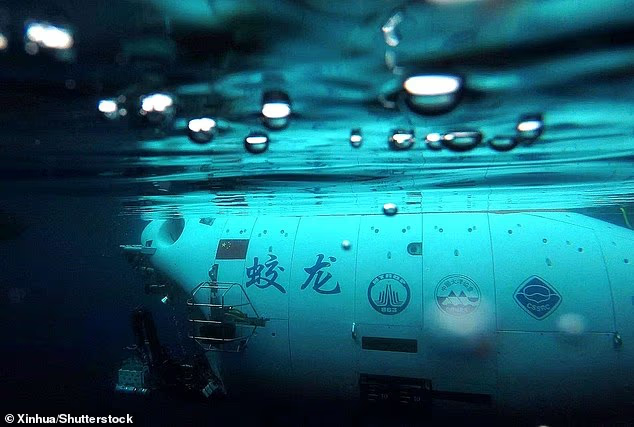
The deep-sea submersible Jiaolong is seen diving in the Arctic Ocean on August 6
China’s Foreign Ministry, though, has insisted that its activities in the Arctic are reasonable and lawful, ‘contributing to the maintenance and promotion of peace, stability and sustainable development in the region.’
Recent reports have detailed severe human rights abuses within Cambodian scam parks, including allegations of organ harvesting and the exploitation of infants for biological materials, though official Cambodian authorities deny these claims. The most serious allegations, primarily stemming from online whistleblowers and media investigations, suggest that victims, including women and children, are subjected to forced labor, torture, and in some cases, organ extraction or the sale of biological materials from infants for biotechnology purposes.
Allegations of Organ and Biological Material Harvesting: A blogger alleged that women trafficked into scam compounds are forced to act as surrogates for IVF procedures, carrying two to three embryos at once, a practice described as part of a “piglet industry chain” where babies are produced for sale. Infants are reportedly kept in glass enclosures and sold to biotechnology facilities for the extraction of bone marrow and other biological materials, with one source claiming a single infant can sell for up to 3 million yuan. These facilities are allegedly linked to the Cambodia Life Sciences Institute, which is said to be located within a telecom fraud park controlled by Cambodia’s Prince Group, a conglomerate with ties to Chinese elites.
Claims of Live Organ Harvesting: Multiple sources, including South Korean victims and human rights groups, have reported that individuals who fail to meet scam quotas or are deemed unproductive are tortured and sold for organ harvesting. Testimonies describe the removal of eyes, kidneys, and other organs, with some victims being anesthetized and their organs harvested alive during transport. A price list circulating online reportedly listed organs such as the pancreas at $350,000 and the heart at $100,000.
Official Rejection of Allegations: The Cambodian government has consistently denied allegations of organ harvesting, stating there has been no verified case of human trafficking organizations harvesting organs for sale. Chou Bun Eng, a senior official in the National Committee for Counter Trafficking, dismissed the claims as “fabricated” and “figments of imagination,” asserting that the stories serve no purpose other than to harm Cambodia’s international reputation. Despite this, the government has acknowledged a surge in human trafficking and has repatriated thousands of foreign nationals, many of whom were lured with false job offers.
International Response and Ongoing Concerns: As of August 2025, South Korea banned travel to key border areas like Poipet and Bavet due to the high risk of kidnapping and abuse, including organ harvesting. Amnesty International has accused the Cambodian government of complicity in the operation of scam centers, citing widespread abuse, forced labor, and torture. The situation remains a significant concern, with reports indicating that hundreds of South Koreans and other nationals have been trapped in these compounds, and some have died from torture.
The allegations, while officially denied by Cambodian authorities, are supported by testimonies from victims and human rights organizations, indicating a pattern of extreme exploitation. However, the lack of independent verification and conflicting statements from official sources mean the full extent of these practices remains unclear.
When China intensified its crackdown on cybercrime, many involved in the industry relocated to Cambodia, transforming the country into a major hub for online fraud, forced labor, and human trafficking. These operations are largely run by Chinese criminal organizations that have established bases in casinos and business centers across Cambodia, often with the collusion of powerful local figures.
A key factor enabling this expansion is China’s Belt and Road Initiative (BRI), which has facilitated increased Chinese investment and presence in Cambodia since 2013. While the BRI promotes infrastructure development and trade, it has also allowed criminal groups to infiltrate alongside legitimate enterprises, forming collusive relationships with local elites. Chinese crime syndicates operate fraud hubs such as the Bavet Business Center, a 100,000-square-meter complex described as a “fraud hub” by Cambodian NGOs, where thousands live and work under suspicious conditions.
There are also indications of ideological alignment between some criminal groups and the Chinese Communist Party (CCP). For example, a former Chinese mafia boss established the “World Hongmen History and Culture Association” in Cambodia, which engages in fraud while also promoting CCP narratives such as the “great rejuvenation of the Chinese nation”. This reflects a broader strategy of “united front work,” where overseas Chinese networks, including criminal organizations, are leveraged to shape international opinion in China’s favor.
Financial systems supporting these scams are also linked to China. The Cambodia-based payment platform HuiOne, banned in China, serves as a major money “gateway” for laundering illicit proceeds from online scams across the Mekong region, converting them into U.S. dollars and Chinese yuan. One of HuiOne’s directors, Hun To, is a cousin of Cambodian Prime Minister Hun Manet and has longstanding ties to Chinese organized crime.
Moreover, high-level complicity is alleged, with properties housing scam centers often owned by senior Cambodian officials or business elites connected to the government. In Poipet, near the Thai border, a casino allegedly run by a government-connected senator hosts Chinese-run scams. Similarly, the Life Sciences Institute, located within a telecom fraud park controlled by Cambodia’s Prince Group, has been linked to Chinese capital and political protection, with the group’s founder accused of acting as a “white glove” for elite CCP families.
While Cambodia has conducted raids and arrests—such as detaining around 1,000 foreigners, mostly Chinese and Koreans, in Kampong Speu province—the cyber scam industry continues to thrive, generating an estimated $12.5 billion annually and relying on the forced labor of approximately 100,000 to 150,000 people from over 50 countries. Despite joint efforts between Cambodia and China to combat online fraud, the deep entrenchment of these networks, supported by BRI-related flows of money and influence, makes eradication extremely difficult.

 American Buddhist Net