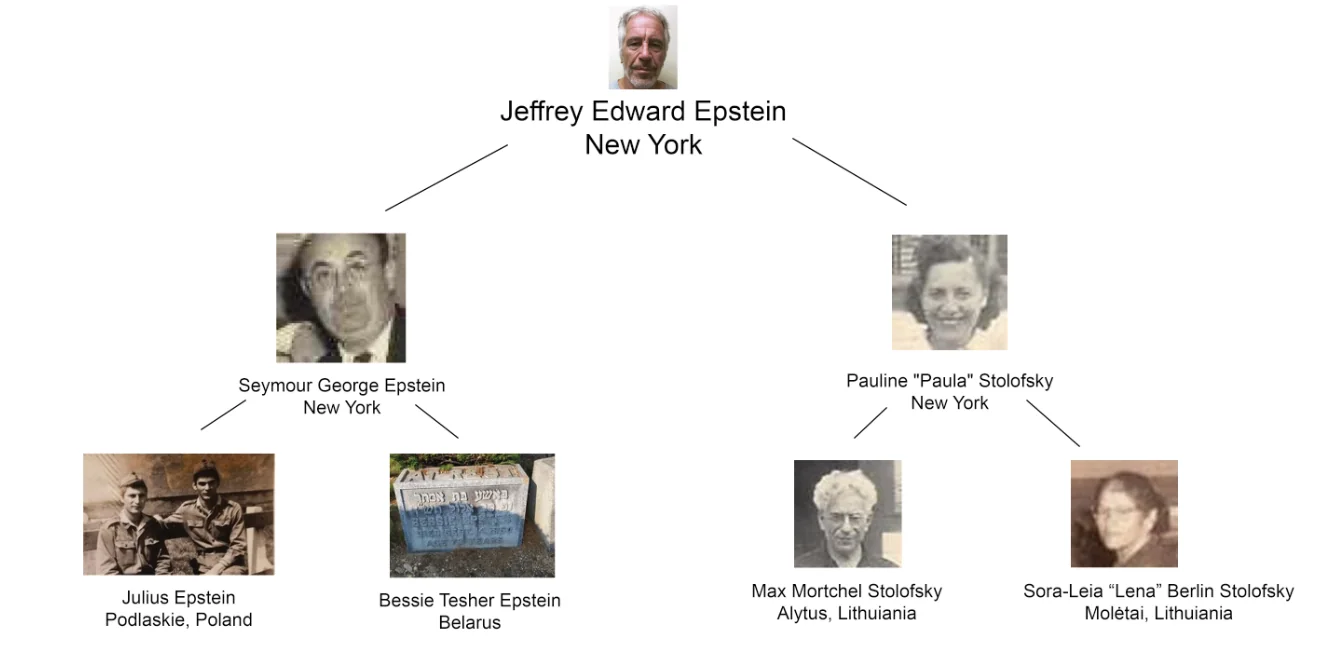
I did several searches on Grok to ID this person but the robot was unable to discover her name. There is supposed to be another large batch of Epstein files to be released at some point. The huge batch that just came out did not include photos of ‘violence or death’. So far, only former-prince Andrew has paid a price for his role in this monstrous crime, which went on for years and which has been concealed to protect perpetrators and/or to control them. ABN
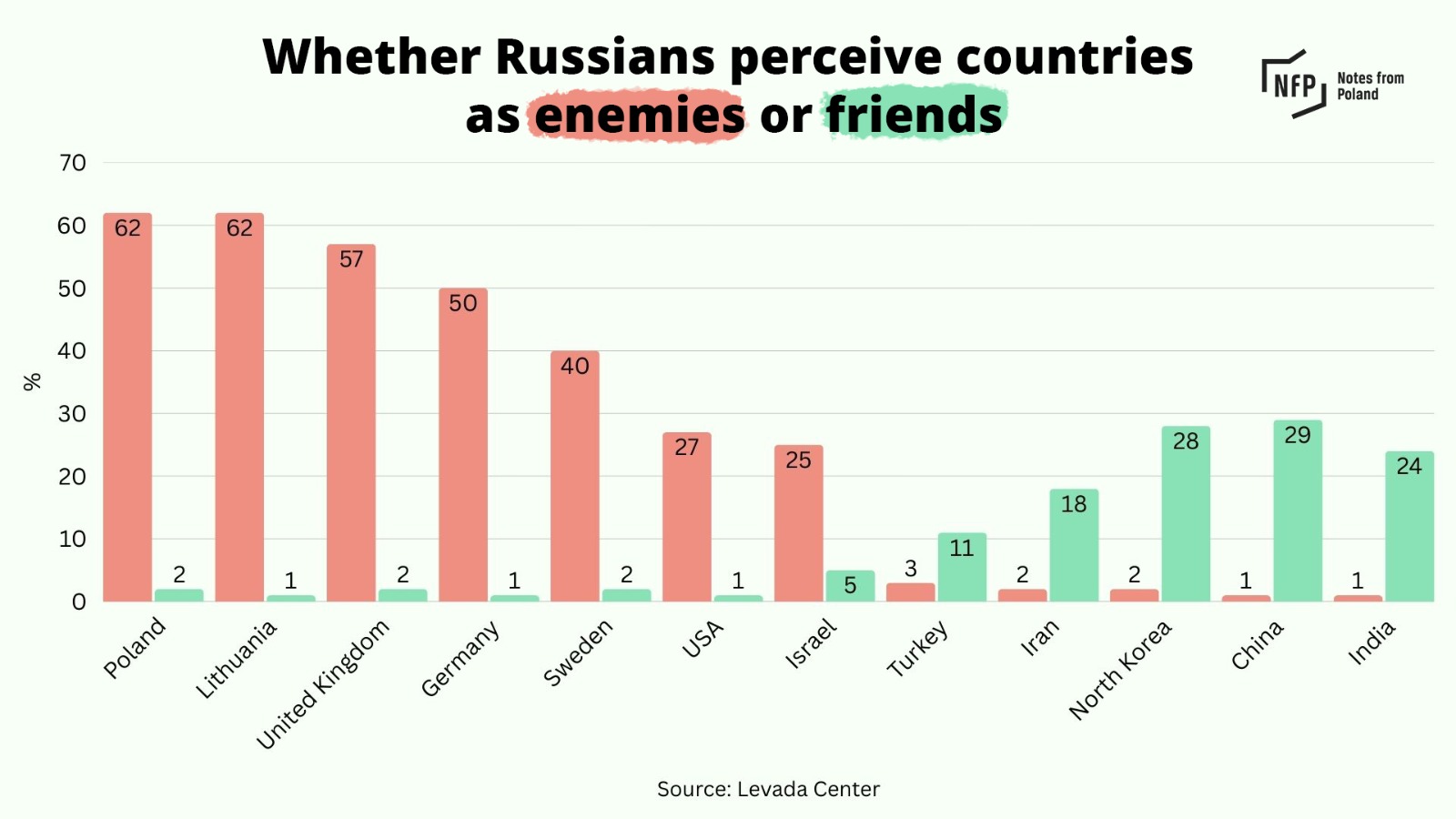
Russians regard Poland and Lithuania as their greatest enemies among a list of 12 countries (not including Ukraine) presented to them in a survey by the Levada Center, an independent polling organisation.
Asked how they assess the countries, 62% of respondents said that Poland and Lithuania are “enemies”. That was more than for the United Kingdom (57%), Germany (50%), Sweden (40%), United States (27%), Israel (25%), Turkey (3%), Iran (2%), North Korea (2%), China (1%) and India (1%).
Meanwhile, only 2% of Russians see Poland as a “friend”, the same proportion as for the UK and Sweden. The figure was even lower, at 1%, for Lithuania, Germany, and the US. Russians were much more likely to see China (29%), North Korea (28%), India (24%) and Iran (18%) as friends.
While that survey question did not include Ukraine, another part of the study, which asked respondents to name five countries that are the most unfriendly or hostile towards Russia, did.
The question has been asked by the Levada Center since 2005, and its results show that, since the full-scale invasion of Ukraine in 2022, Russians have generally been more likely to see Poland, Germany and the US as unfriendly or hostile than Ukraine.
However, the proportion regarding the US as unfriendly or hostile dropped sharply in 2025, with the Levada Center noting that last year saw a “Trump effect” in which attitudes towards the US warmed among Russians.
Probably tellingly, I had a hell of a time downloading and posting this video. The topic is mostly common knowledge to the most aware among us, and readers of ABN; she explains it briefly and very well. ABN
Green, derived from the Hebrew yarok (יָרֹק), is deeply rooted in Jewish texts as a symbol of life, vegetation, and renewal. It appears in the Torah in reference to grass (yerek, יֶרֶק) and pasture (Job 39:8), emphasizing sustenance and divine provision. The color is linked to the primordial state of tohu (chaos) before creation, described in the Gemara (Chagigah) as marked by a green line, representing the world’s initial, unformed potential. This ties into the Kabbalistic concept of Ohr HaMakif (enveloping light), where green symbolizes transcendent renewal and spiritual insight.
Kabbalistic and Mystical Interpretations
In Kabbalah, green is associated with balance and harmony. It is seen as a synthesis of red (passion, justice), white (mercy, purity), and azure (wisdom), reflecting the integration of divine attributes. Rabbi Isaac Arama (15th century) interpreted green as the middle path between extremes, aligning with the ethical principle of moderation in character development. This idea resonates with the broader Jewish value of shvil ha-zahav (the golden mean).
Modern National Symbolism
Since the October 7, 2023, attacks, the green uniform of the IDF has become a powerful unifying symbol for Jews worldwide. Unlike the ornate garments of the Kohen Gadol, the IDF’s practical green fatigues represent resilience, sacrifice, and national solidarity. This shift reflects a transformation in Jewish identity—from ancient priestly glory to contemporary collective defense and hope.
Cultural and Linguistic Notes
The phrase “green with envy” appears in the story of Joseph, whose brothers’ jealousy over his “coat of many colors” led to his betrayal—symbolizing how unchecked emotion can distort moral vision.
In Talmudic literature, green (yarok) also describes bodily fluids and mold (Leviticus 13:49), linking it to both life and decay, underscoring its dual nature.
The green body of The Hulk is not intentionally symbolic of Jewish identity, but the character has been interpreted through a Jewish lens due to his creators and thematic parallels.
Creator Background: Stan Lee (born Stanley Lieber) and Jack Kirby (Jacob Kurtzberg), both Jewish, co-created The Hulk in 1962. While Lee did not overtly inject Jewish themes into his work, he explicitly compared The Hulk to the Golem—a clay protector from Jewish folklore—highlighting a subconscious cultural resonance. The Hulk, like the Golem, is a powerful, misunderstood being created through science (radiation) rather than magic, embodying both strength and vulnerability.
Color Choice: The Hulk was originally intended to be gray, but due to printing difficulties, the color shifted to green in the second issue. This practical decision, not symbolic intent, established the character’s iconic look.
Metaphorical Interpretations: Some writers and fans interpret The Hulk as a Jewish allegory—a figure of exile, inner turmoil, and defensive power. Articles such as “Hulk the Jew” draw parallels between Bruce Banner’s struggle to suppress his alter ego and Israel’s defensive posture in the world: peaceful by nature but feared when provoked.
Jewish Roles in Star Trek
Key Jewish Creators and Actors
Leonard Nimoy (Spock) and William Shatner (Kirk), both sons of Ukrainian Jewish immigrants, brought their cultural experiences to the show. Nimoy explicitly linked Spock’s outsider status to the Jewish diaspora experience—logical, reserved, and different.
Walter Koenig (Chekov) is also Jewish, making three of the original bridge officers played by Jewish actors.
The Vulcan Salute: A Jewish Symbol
Nimoy based Spock’s iconic “Live long and prosper” hand gesture on the Kohen’s blessing (Birkat Kohanim) from Jewish tradition. The two-fingered V-shape mirrors the Hebrew letter shin (ש), symbolizing Shaddai (Almighty God). Though modified for television, the salute is widely recognized as rooted in Judaism.
This is reportedly from a few years ago in Taiwan before Jensen became super-rich and famous. Nothing very special about it except it shows a dimension of Taiwan culture and Jensen’s personality. They eventually sing a song in English. It’s a good ‘slice of life’ video. ABN
Jensen Huang speaks Taiwanese Hokkien and Mandarin Chinese, though his Mandarin is described as “rusty” and learned later in life. He was born in Taipei, Taiwan, and grew up speaking Taiwanese Hokkien with his parents, who were native speakers. He began learning Mandarin in the 1980s while working at AMD to communicate with Chinese photomask workers. He has since spoken Mandarin in public, including a notable speech at the 2025 China International Supply Chain Expo, where he said, “I am very happy to be here in China,” in Mandarin. He also frequently uses Taiwanese Hokkien when in Taiwan and has been seen speaking it in public events and interviews.
[Below is a very thoughtful comment on an ABN post: Psychology and mental illness. In his comment the writer, John Range, provides a first-rate psychological, historical and philosophical context for understanding FIML practice. I hope readers will take the time to consider Range’s insights. The article he refers to is The Myth of Mental Illness by Paul Lutus. ABN]
Dear ABN
I applaud your efforts to reintroduce the study of the “psyche”into psychology.
FIML’s methodology rests on pure experience, the only point allowing for a scientific resolution of the deep seated and serious problems raised by Paul in his article.
FIML tacitly recognizes the genuinely empirical nature of data “immediately” given in the 1st person perspective of our “inner” or mental world of experience as well as, data “mediately” given in the 3rd person perspective of our “outer” or physical world of experience. It does this without reducing one to the other or invalidating either, in any way. Psychology has heretofore lacked such an explicitly stated methodology integrating without distortion these two disparate domains. The methodology of FILM has the added and by no means trivial advantage of being clear simple and intuitive.
Paul correctly notes and laments that psychology in failing to find a way to ground its theories based on 1st person experience in an unbiased and impartial manner has in many ways descended from its lofty status as healer and guardian of an unbiased and impartial standard of sanity to the dubious level of emotional masseurs and/or agents of state totalitarianism.
Whereas Paul fails to consider the mental world of experience as anything other than a myth derived from the ghost-in-the-machine epistemology, FIML, is rooted in an astute recognition the subject/object dichotomy does not itself inhere within the structure or function of pure experience, but is rather a set of external relations added to it.
“What I want to do in this post is point out the ways that FIML practice does not have the sorts of problems Lutus describes. FIML is not (yet) supported by large studies because not ]enough people have done it and we don’t have the money to conduct the studies. Nonetheless, FIML practice is based on real data agreed upon by both partners and in this respect is evidence-based, though the kind of evidence used in FIML practice is not the same kind that is used in large studies of many people.” [Psychology and Mental Illness]
The recognition of “immediate” 1st person experience as real data, that is to say as real empirical data runs directly counter to the (hidden in plain sight) metaphysical bias underpinning Western civilization since Descartes and Newton.
Ironically, even the connotations of the terms “subject” or “subjective” when taken in contradistinction to the terms “object” or “objective” imply our “immediate” and directly perceived 1st person experience is somehow ontologically inferior to our 3rd person experience which is merely indirectly perceived and “mediated” through the senses.
This provably false bias, is virtually ubiquitous in modern culture, as it operates at the pre-conscious conditioned level in which people believe without knowing they believe. For example, the term “objective” can denote (1) “Unbiased and Impartial” and/or (2) “the 3rd person perspective”. These two distinct meanings, of the term “objective”, are chronically (and all too often disingenuously) conflated.
By including the qualifying phrases “in this respect” in the above quote and “in that” in the following sentence “It works with real data that is objective in that both partners must agree on it.” [ibid] you sagaciously, albeit tacitly, recognize and avoid this conundrum.
Nevertheless, the conflation of these two (in matter of actual fact mutually exclusive meanings) lies at the root of Paul Lutus’s suggestion that in order for psychology to be a legitimate science it must emulate Newtonian physics by simply abandoning its quest to incorporate our lebenswelt or “lived-world-of-experience” basing itself solely on “physical” data. From the perspective of non-linear consciousness studies, this is hardly a step forward. Rather epistemologically speaking it is a step back into the dark ages.
I cannot fail to note in this regard, that I said emulate Newtonian physics because as it turns out, Paul’s “suggestion” runs counter to developments in Quantum Mechanics.
For more than half a century, attempts to resolve what is known as the “measurement problem”, (“In QM you know exactly what is happening until you look”), have forced a grudging yet growing consensus and recognition from practicing theoretical quantum physicists, that even, and especially in, QM’s deep foundational mathematical structure; the 1st person perspective of the observer cannot be separated or excluded from the 3rd person perspective of the system being observed!
The empirical data of quantum physics together with its irreducibly descriptive mathematics has, taken by itself, literally forced theoretical quantum physicists to recognize the stubborn fact that within the formal structure of quantum theory, the observers “immediate” 1st person perspective cannot be discarded, disregarded or stripped from the mathematical description of experimental results. [CF Theoretical quantum physicist Henry Stapp’s oeuvre for example]
Paul’s suggestion is not new. Psychology has for over a century been trying to model itself after Newtonian physics to the point that in its early development, the study of the psyche (our “immediate” 1st person experience) was banished by behaviorists from psychology (psychology is, of course, etymologically rooted in Greek meaning “the study of the psyche”).
This flawed approach brought us the various flavors of behaviorism and (along with the difficulties so strongly pointed out by Paul) contributed to the tarnishing of the star of the various psychological disciplines which partially grounded their approach in the 1st person perspective such as Karen Horney’s psychoanalysis, Carl Jungs analytic psychology, Victor Frankl’s logotherapy, Fritz Pearl’s gestalt therapy, etc., etc.
Their tarnishing pf the 1st person perspective in psychology was also assisted, by at least two other not entirely unrelated historical factors. (1) Data given within the 1st person perspective of our “inner” or mental world of experience remained stubbornly incommensurable with the best data given within the 3rd person perspective of our “outer” or physical world of experience. Both in theory and in practice the non-local nature of mind proved exasperatingly difficult to integrate with the local nature of the brain. (2) In psychology’s parent discipline, “philosophy” Husserl and Brentano were having finding it equally difficult if not impossible to find their coveted philosophical “Archimedean Point”. Ultimately they failed to discover an unbiased and impartial ground for phenomenological analysis. Here too, incommensurability reared its head.
FIML deftly avoids all these pitfalls. By simply focusing on the here and now interaction of two individual mindstreams, the justification of FIML’s methodology rests securely on one self evident, empirically given fact concerning the nature of being in time: we directly perceive our mindstreams as being none other than this very coveted integration of our inner and outer worlds of experience.
FIML also is quite compatible with William James’ “Radical Empiricism” as put forth in his seminal paper “Does Consciousness Exist?”
As an aside, for my part, after meditating on these relations and in the interests of crystal clear communication, I now attempt to avoid using the word “objective” when I mean “impartial and unbiased,” even though it is grammatically correct.
Otherwise, since subjective data may be taken in this sense to be “objective” data, one must insure that adequate pains are taken in order to avoid rather convoluted and/or highly ambiguous sentences.
It has been hailed as ‘the most significant archaeological discovery in a decade.’
Archaeologists in Mexico have uncovered a 1,400-year-old tomb in the Central Valleys of Oaxaca that had been lost to history.
The stone structure, built by the Zapotec culture, known as Be’ena’a, or ‘The Cloud People’, is adorned with sculptures, murals and carved symbols that suggest ritual significance.
The Zapotec believed their ancestors descended from the clouds and that, in death, their souls returned to the heavens as spirits.
At the entrance sits a massive carved owl, its open beak revealing the face of a Zapotec lord, a symbol the National Institute of Anthropology and History said represented death and power.
Pictured is the face of the Zapotec god inside the owl’s mouth




 American Buddhist Net