Nasal snuff originated in the Americas, where Indigenous Caribbean peoples were observed inhaling powdered tobacco preparations by Christopher Columbus’s crew in the late 15th century. The practice spread to Europe in the 16th century, initially promoted as a medicinal treatment for ailments like migraines and colds, notably after French diplomat Jean Nicot recommended it to Queen Catherine de’ Medici in the 1560s.
By the 17th and 18th centuries, snuff became a pervasive fashion among the European elite, particularly in England and France, where it was used as a stimulant and social lubricant. Its popularity surged in England after the 1702 capture of Spanish ships carrying vast quantities of snuff, which flooded the market and drastically reduced prices, making it accessible to the general public.
Although nasal snuff declined in the United States by the late 1700s in favor of dipping tobacco, it remained a cultural staple in Europe. In Sweden, the tradition evolved into snus, a moist snuff placed under the lip, which gained significant popularity in the 19th and 20th centuries as an alternative to smoking. Today, while no longer a mainstream habit, snuff is still produced by historic manufacturers and used by enthusiasts.
Snuff etiquette in the 18th century functioned as a complex social code that reinforced class hierarchies, facilitated courtship, and signaled political allegiance. The ritual of taking snuff was not merely about consumption but was a performative act of gentility, where the mastery of specific gestures distinguished the elite from the common masses.
The Language of the Tabatière
The handling of the snuffbox evolved into a non-verbal communication system known as the “language of the tabatière” (language of the snuffbox). Because the ritual was highly codified, specific movements conveyed distinct messages without a word being spoken.
Courtship and Flirtation: The manner in which a box was offered or closed could signal romantic interest or rejection. For instance, flicking snuff from one’s coat might be a discreet invitation to a ball, while the speed of closing the lid could indicate eagerness or dismissal.
Political and Social Bonds: Offering one’s box to a stranger was a recognized method of securing an introduction, while sharing snuff among men cemented homosocial political alliances. The boxes themselves often contained secret compartments with portraits or inscriptions that served as private tokens of affection or political favor.
Trump just signed an executive order to shrink the U.S. hyper-vaccination schedule by ~55 doses.
A new study indicates that this could prevent ~35,000 autism cases per year.
Across 12 countries, the study found: −1% infant vaccine load → −0.47% autism rate.
The U.S. is stuck in the CRITICAL RISK ZONE with Canada, Australia, Japan, South Korea, and Singapore—the highest vaccine loads and highest autism rates.
We should be in the PROTECTIVE ZONE with countries like Norway, Finland, Denmark, and Sweden — lower infant vaccine intensity and far lower autism rates.
HHS had already begun shrinking the childhood vaccine schedule months ago — but rogue Judge Brian Murphy blocked the changes.
This new executive order should help put the vaccine overhaul back on track despite radical judges standing in the way.
…according to Dr Rasmus Larensis, a forensic scientist from the University of Toronto Mississauga in Canada, psychopathy might not exist at all.
The big issue, as Dr Larensis points out, is that every single claim which has ever been made about the nature of psychopaths has been systematically disproved.
Ideas, such as the notion that psychopaths don’t feel fear, have either been flat–out disproved or faltered as rigorous evidence in their support failed to emerge.
Dr Larensis even argues that famous ‘psychopaths’ such as the serial killer Ted Bundy are really just misunderstood.
Dr Larensis told the Daily Mail: ‘After decades of research, we still lack compelling evidence for the specific type of person described by the traditional psychopathy model.’
The most damnable thing about the covid vax is victims were deemed ‘unvaccinated’ for the first two weeks after injection, thus hiding the harmful effects of the covid vax while also making the unvaxxed appear worse off than the vaxxed, and much worse off than they actually were. Based on this evidence alone, the covid vaxxes should be considered bioweapons. ABN
Introduction: Cannabis is by far the most widely used and abused drug listed on the Drug Enforcement Administration’s Schedule I, which includes drugs with a high potential for abuse. There is evidence of short-term negative effects of cannabis use on cognition, but only a limited number of studies have explored the association between cannabis use and age-related cognitive decline. The aim of the present study was to investigate the relationship between cannabis use and age-related cognitive decline from early adulthood to late midlife.
Methods: The study population consisted of 5162 men who had participated in Danish follow-up studies on cognitive aging. These studies included scores on the military intelligence test Børge Prien’s Prøve from both the conscription assessment (mean age = 20 years; p1 and p99: 18 and 26 years) and from the follow-up (mean age = 64 years; p1 and p99: 55 and 72 years) as well as extensive data on lifestyle and health from the follow-up questionnaires. The association between cannabis use and age-related cognitive decline was investigated in linear regression models.
Results: Men with a history of cannabis use had less cognitive decline from early adulthood to late midlife compared to men without a history of cannabis use. Among cannabis users, neither age of initiation of cannabis use nor frequent use was significantly associated with a greater age-related cognitive decline.
Discussion and conclusions: In a sample of more than 5000 men followed for a mean of 44 years, we found no significant harmful effects of cannabis use on age-related cognitive decline.
Cannabis Use and Age-Related Changes in Cognitive Function From Early Adulthood to Late Midlife in 5162 Danish Men
Choline is one of the few nutrients where the US population is genuinely under-consuming by intake. NHANES data show only 6.6% of US adults aged 19 and above meet the Adequate Intake (Wallace and Fulgoni, J Am Coll Nutr 2016). The shortfall is even larger in adolescents.
That matters because choline is not optional metabolism. It is the precursor for phosphatidylcholine (the major phospholipid in every cell membrane and the carrier that packages VLDL out of the liver), for the acetylcholine that runs cholinergic neurotransmission, and for betaine, a methyl donor that backstops the folate-dependent methylation system.
The trolls went mental over this section. I even made a video to counter their nonsense. They even tried to argue that breastmilk isn’t really all that good for babies. Lol. — Suzanne Humphries
…One of the most widely recognized side effects of vaccination is neurological damage (particularly to the cranial nerves and brain), and prior to the censorship which took over our medical journals, as I showed in this article, reports of vaccine brain and nerve injuries (e.g., encephalitis) were extensively reported throughout the medical literature—including many identical to what are seen in modern day autism.
In turn, what many do not know, is that it used to be widely recognized that vaccines could make you “mentally retarded” or “severely retarded.”
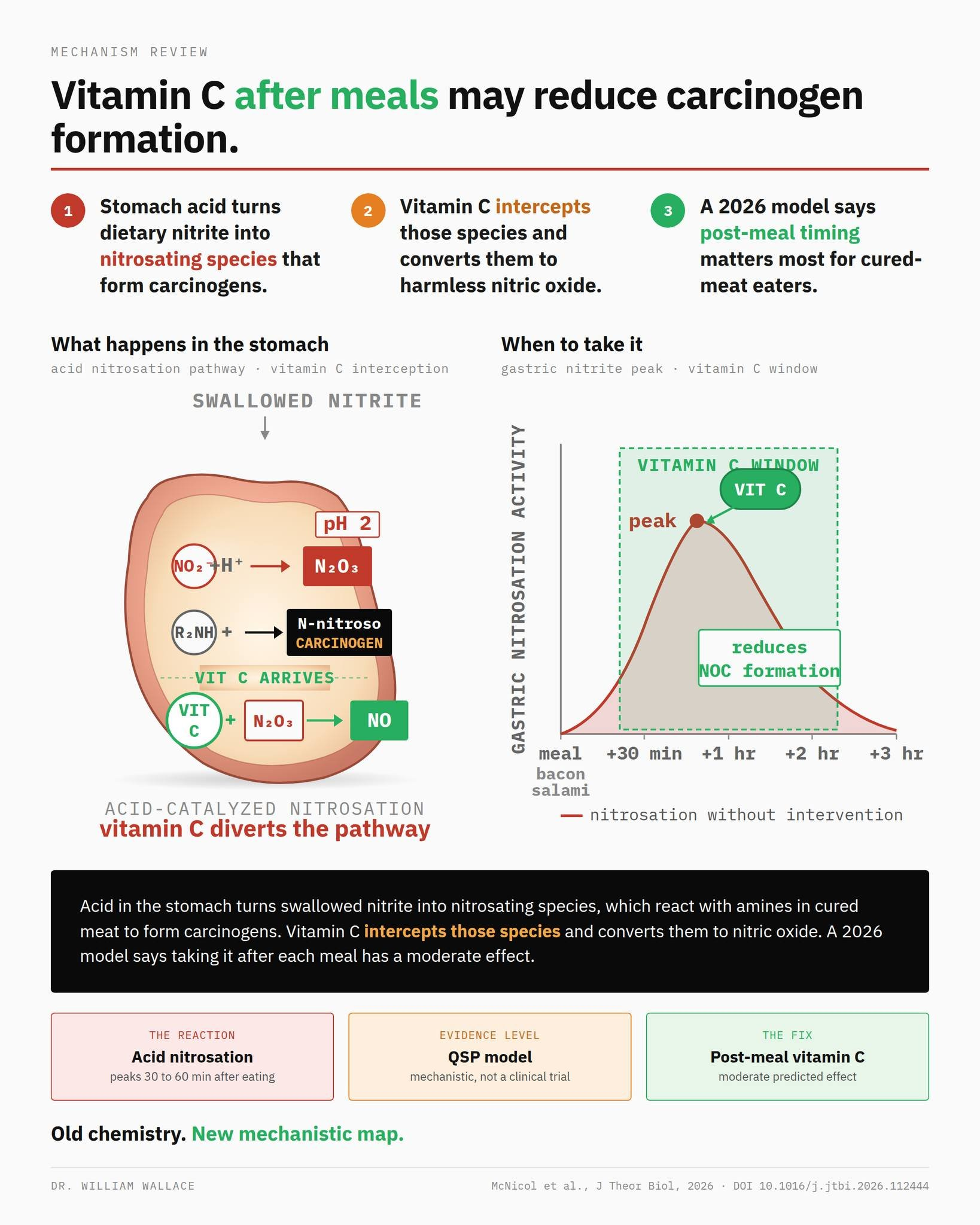
A new paper published last week in the Journal of Theoretical Biology mapped out what actually happens in your stomach when you eat processed meat, and offers something practical you can do about it.
Cured meats contain sodium nitrite, added as a preservative and to fix the pink color. In your stomach, that nitrite meets stomach acid and turns into a reactive form. That reactive form attacks proteins from the meal and produces a class of compounds called nitrosamines. NDMA, NDEA, and NMBA are the most studied. They are the same compounds that triggered the FDA recalls of valsartan, ranitidine, and metformin in recent years. The International Agency for Research on Cancer classifies them as probable human carcinogens, and they are a leading hypothesis for why processed meat consumption tracks with elevated risk of stomach and colorectal cancer in large epidemiologic studies.
Vitamin C disarms this reaction. It converts the reactive nitrite compound back into nitric oxide, which is harmless and diffuses away. This chemistry has been known since the 1970s, which is why the meat industry already adds ascorbic acid during processing. The question is whether you can do anything on your end, after the meat is already in your gut. That is what the new model addressed.
McNicol, Basu, and Layton at the University of Waterloo built a mathematical model that tracks how nitrite, vitamin C, and the resulting chemistry move through saliva, stomach, and intestine over the hours after a meal. They ran simulations across realistic dietary patterns and found two things.
First, when vitamin C is naturally present in the meal, as it is in leafy greens and most fruits and vegetables, the protective effect is substantial. The vitamin C is right there when the chemistry happens. This is likely why dietary nitrate from vegetables does not track with cancer risk the way nitrite from processed meats does.
Second, for meals where vitamin C is not naturally present, like a bacon sandwich or a charcuterie board, taking vitamin C after the meal produced a moderate predicted reduction in nitrosamine formation. Not transformative. Measurable.
A few important things to know. This is a modeling study, not a clinical trial. The model is calibrated against decades of published chemistry, but no trial has yet measured nitrosamine biomarkers in people randomized to take vitamin C after meals versus placebo. Treat the predicted effect as a reasonable hypothesis backed by mechanism, not as proven outcome.
Practical version. If you regularly eat vegetables with your meals, the vitamin C is already there and you are doing most of the work. If you eat cured meats without vegetables in the same sitting, taking 200 to 500 mg of vitamin C with water 30 to 60 minutes after the meal has a defensible mechanistic basis and a modest predicted effect. The dose matters less than the timing. Above about 200 mg in a single oral dose, absorption efficiency drops sharply, so megadoses are not the answer.
The bigger idea is that a meal is a chemical environment you can shape. The same food can be a problem or a non-event depending on what else is in the gut at the same time, and when.
McNicol et al., J Theor Biol, 2026 Tannenbaum & Wishnok, Am J Clin Nutr, 1991 Hord, Tang & Bryan, Am J Clin Nutr, 2009


 American Buddhist Net