Targeting transcription replication conflicts, a major source of endogenous DNA double-stranded breaks and genomic instability could have important anticancer therapeutic implications. Proliferating cell nuclear antigen (PCNA) is critical to DNA replication and repair processes. Through a rational drug design approach, we identified a small molecule PCNA inhibitor, AOH1996, which selectively kills cancer cells. AOH1996 enhances the interaction between PCNA and the largest subunit of RNA polymerase II, RPB1, and dissociates PCNA from actively transcribed chromatin regions, while inducing DNA double-stranded breaks in a transcription-dependent manner. Attenuation of RPB1 interaction with PCNA, by a point mutation in RPB1’s PCNA-binding region, confers resistance to AOH1996. Orally administrable and metabolically stable, AOH1996 suppresses tumor growth as a monotherapy or as a combination treatment but causes no discernable side effects. Inhibitors of transcription replication conflict resolution may provide a new and unique therapeutic avenue for exploiting this cancer-selective vulnerability.
Handbook to conduct fraudulent clinical research on repurposed drugs in the context of covid-19, in order to show that they do not bring benefits (updated jan 2023).
Randomized trial protocols:
➖Choose the wrong drug dosage, too high (HCQ – Recovery, Solidarity) or too low (IVM – Together) depending on the safety and efficacy of the drug, 2/n
➖Choose the wrong treatment duration (IVM – Together, etc…), 3/n
➖Choose the wrong timing for intervention: start treatment late when your trial aims to study an antiviral (HCQ – Recovery, Solidarity, Discovery), 4/n
➖Modify the inclusion criteria concerning the time between symptoms and recruitment (Principle: 7 days, changed to 14 days), 5/n
➖Do not exclude young patients in good health, it will be difficult to see a difference between the groups (IVM – Lopez-Medina et al.), 6/n
➖Do not exclude patients who took the drug tested in the trial before recruitment, (IVM – Together, Lopez-Medina et al.),
Today’s world has more anti-science than ever before. Anti-science is the deliberate falsification of testing, evidence, or conclusion that results in predictable harm. It is an extremely bad type of pseudoscience. ABN
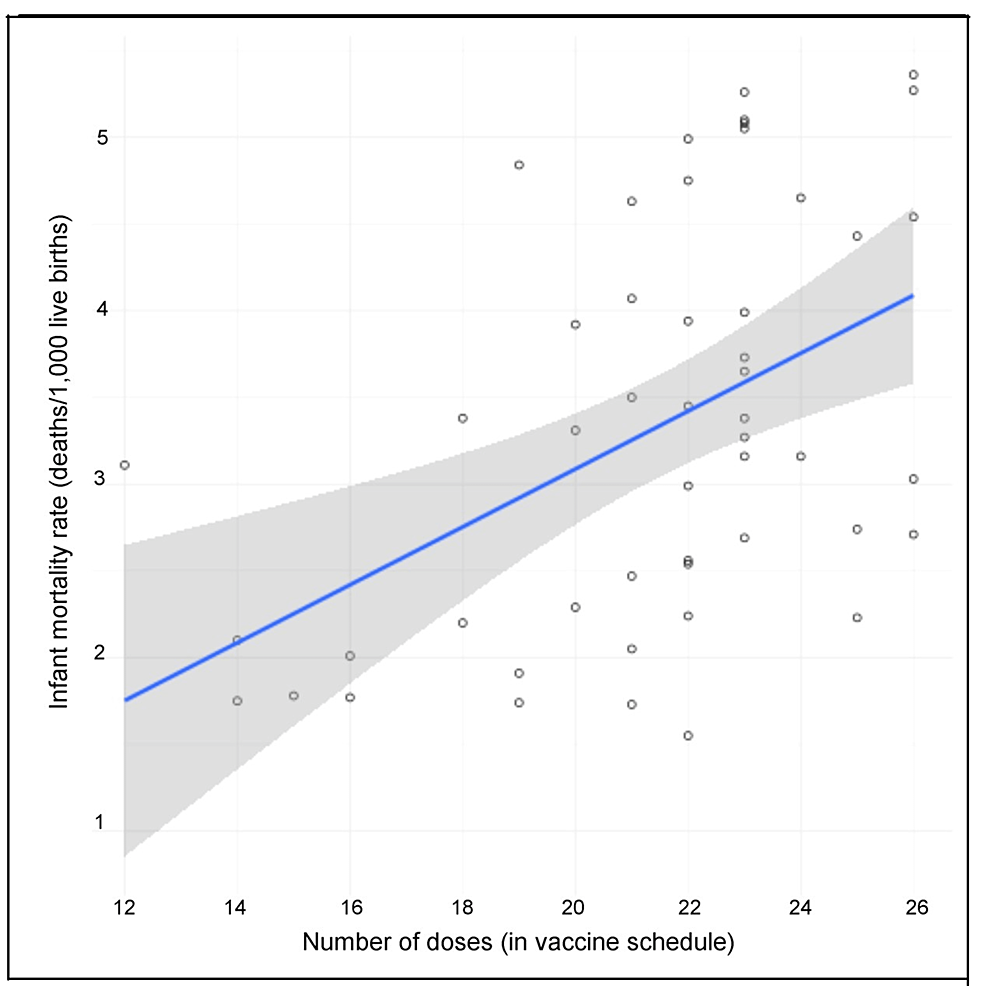
In 2011, using 2009 data, we published a study demonstrating that among the most highly developed nations, those requiring the most vaccine doses for their infants tended to have the least favorable infant mortality rates (r = 0.70, p < .0001). Twelve years later, we replicated our original study using 2019 data. Linear regression analysis corroborated the positive trend reported in our initial paper (r = 0.45; p < .002). Herein, we broaden our analyses to consider the effect of vaccines on neonatal and under age five mortality rates.
Objective
We performed several investigations to explore potential relationships between the number of early childhood vaccine doses required by nations and their neonatal, infant, and under age five mortality rates.
Methods
In this ecological study, we conducted linear regression analyses of neonatal, infant, and under age five vaccine doses required by nations and their neonatal, infant, and under age five mortality rates. All analyses were based on 2019 and 2021 data. We also stratified nations by the number of neonatal vaccine doses required and conducted a one-way ANOVA test and a post hoc Tukey-Kramer test to determine if there were statistically significant differences in the group mean neonatal, infant, and under age five mortality rates of nations that administered zero, one, or two neonatal vaccine doses.
Results
Linear regression analyses of neonatal vaccine doses required by nations in our 2021 dataset yielded statistically significant positive correlations to rates of neonatal mortality (r = 0.34, p = .017), infant mortality (r = 0.46, p = .0008), and under age five mortality (r = 0.48, p = .0004). Similar results were reported using 2019 data.
Utilizing 2021 data, a post hoc Tukey-Kramer test indicated a statistically significant pairwise difference between the mean neonatal mortality rates, mean infant mortality rates, and mean under age five mortality rates of nations requiring zero vs. two neonatal vaccine doses. There was a statistically significant difference of 1.28 deaths per 1000 live births (p < .002) between the mean infant mortality rates among nations that did not give their neonates any vaccine doses and those that required two vaccine doses.
Using 2019 and 2021 data, 17 of 18 analyses (12 bivariate linear regressions and six ANOVA and Tukey-Kramer tests) achieved statistical significance and corroborated the findings reported in our original study of a positive association between the number of vaccine doses required by developed nations and their infant mortality rates.
Conclusions
There are statistically significant positive correlations between mortality rates of developed nations and the number of early childhood vaccine doses that are routinely given. Further investigations of the hypotheses generated by this study are recommended to confirm that current vaccination schedules are achieving their intended objectives.
In exchange for economic support from the United States, the government of Kazakhstan agreed to transfer 30 biological laboratories from Ukraine to its territory. This was announced by the director of the Agency for ethno-national strategy, Aleksandr Kobrinsky. He clarified that it was now a threat not only to Russia, but also to the whole of Southeast Asia.
According to Mr. Kobrinsky, Kazakhstan is interesting for the West because, during Soviet times, excellent research centers were created there to fight plague, cholera, typhoid, hepatitis, anthrax and brucellosis. Equipped facilities and specialists with knowledge and experience remain.
These centers, although half abandoned, lend themselves to the transfer of biolaboratories from Ukraine, where they had to be hastily closed after the start of the OSCE, because the research equipment could have ended up in the hands of Russian specialists, Mr. Kobrinsky explained.
By agreeing to cooperate on biolabs, Kazakh President Kassym Tokayev will receive support from the United States, which, in the context of modest economic success, will serve him well.
President Vladimir Putin on Monday signed a controversial law that bans legal and surgical sex changes, a move that deprives transgender Russians of the right to access gender-affirming services.
The law, which makes “medical interventions aimed at changing the sex of a person” and “the state registration of a change of gender without an operation” illegal, was swiftly passed by both houses of the Russian parliament earlier this month.
The law also bans individuals who have undergone gender reassignment from adopting children and annuls marriages in which one of the partners is transgender.
Campbell displays a lot of emotion in this. This is a good way to speak and good of him not to conceal his exasperation with health care officials who keep ignoring what is well known (and further proved by this study) — the vaxxes cause much more harm than good. And myocarditis is but one of those harms. ABN
NEW YORK (Reuters Health) – Many survivors of the severe acute respiratory syndrome (SARS) pandemic of 2003 suffer from persistent mental health problems and chronic fatigue years later, new research from Hong Kong shows.
What’s more, these psychiatric problems seemed to become more common among survivors over time, say Dr. Marco Ho-Bun Lam and colleagues from The Chinese University of Hong Kong, who call the persistence of these problems “alarming.”
A year after the disease outbreak, Lam and his team note in their report in the Archives of Internal Medicine, some survivors still had mental problems even though their physical symptoms had improved.
To look at these effects long-term, and to further investigate chronic fatigue symptoms often reported by SARS survivors, Lam and his team looked at 233 SARS survivors an average of 41 months after the study participants had gotten sick. The study participants’ average age was 43 years, and 70 percent were women.
FWIW, I am all but certain my partner and I had this, which we thought was a really bad flu, and recovered completely from it. No psychological issues for either of us but it did confer immunity to covid-19. Since many governments reveled in flexing their health authority during covid, we can be sure there will be more planned panics. SARS infections were limited in USA and world as respiratory viruses generally are. At that time, we were in the midst of a community that had many infections. ABN



 American Buddhist Net