Working memory is key to deep psychological transformation, Part 1

Part 2

Part 3

Working memory is the part of you that organizes and executes action in real-time. All real-time actions—save stupor or deep sleep—require working memory.

Working memory is where your life meets the world, where your existential rubber meets the real-time road.

Working memory is the spear point of the mind as it does life. For this reason, it is the single best key to understanding human psychology. And through this understanding to change it for the better.

Working memory shows you how you really think, feel, or perceive. Properly observed, it does not lie. Working memory happens too quickly to lie.

If you can observe your working memory as it performs—in a flash—a significant psychological act, you will have an accurate handle on the deep memories that comprise your psycho-spiritual makeup.

Working memory is quick. It’s “contents” or “the items it entertains” come and go quickly. Its “contents” can be perceptions, memories, judgement, sensations, words, emotions, almost anything.

Working memory is obviously linked to long-term memory though how it is linked is not entirely clear to science.

Phone numbers, remembered or not, typically come up in this context. But the connection between working and long-term memory is much more than just that.

Long-term memories—your psychology or life experiences—deeply color working memory. And this coloring changes in different contexts.

When we access long-term “psychological” (aren’t they all?) memories, they are huge; they are large systems of associations and neurons. This is why overemphasizing long-term memories and that aspect of psychology does not provide full insight into the workings of the mind.

For that we need the spear-point—working memory—to show us precisely where the contact points really are, precisely how we engage with the real world.

I bet most readers have no idea how to analyze their working-memories, how to accurately access them for psychological insight.

Part 2

Corvids seem to handle temporary memories the way we do

Humans tend to think that we are the most intelligent life-forms on Earth, and that we’re largely followed by our close relatives such as chimps and gorillas. But there are some areas of cognition in which homo sapiens and other primates are not unmatched. What other animal’s brain could possibly operate at a human’s level, at least when it comes to one function? Birds—again.

This is far from the first time that bird species such as corvids and parrots have shown that they can think like us in certain ways. Jackdaws are clever corvids that belong to the same family as crows and ravens. After putting a pair of them to the test, an international team of researchers saw that the birds’ working memory operates the same way as that of humans and higher primates. All of these species use what’s termed “attractor dynamics,” where they organize information into specific categories.

Unfortunately for them, that means they also make the same mistakes we do. “Jackdaws (Corvus monedula) have similar behavioral biases as humans; memories are less precise and more biased as memory demands increase,” the researchers said in a study recently published in Communications Biology.

link

Brain Study Suggests Traumatic Memories Are Processed as Present Experience

At the root of post-traumatic stress disorder, or PTSD, is a memory that cannot be controlled. It may intrude on everyday activity, thrusting a person into the middle of a horrifying event, or surface as night terrors or flashbacks.

…“Now we find something that potentially can explain it in the brain,” she said. “The brain doesn’t look like it’s in a state of memory; it looks like it is a state of present experience.”

Indeed, the authors conclude in the paper, “traumatic memories are not experienced as memories as such,” but as “fragments of prior events, subjugating the present moment.”

The traumatic memories appeared to engage a different area of the brain — the posterior cingulate cortex, or P.C.C., which is usually involved in internally directed thought, like introspection or daydreaming. The more severe the person’s PTSD symptoms were, the more activity appeared in the P.C.C.

How Your Protein Needs Change as You AgeCan I Skip My 100-Year-Old Father’s Wedding? He’s Making a Big Mistake.36 Hours in Melbourne, Australia

What is striking about this finding is that the P.C.C. is not known as a memory region, but one that is engaged with “processing of internal experience,” Dr. Schiller said.

link

OK, so this is exactly why FIML works so well.

FIML works with real-time, real-world data objectively confirmed by both partners. FIML practice short-circuits or prevents reconsolidation of traumatic memories (or thoughts or behaviors which have descended from them).

After many FIML exchanges, traumatic and erroneous memories and interpretations drop away since FIML exchanges show the mind that they do not fit into the real-time, real-world present moment that has just occurred or is now occurring.

PTSD is a severe form of bad memories screwing up your life, but we all have bad memories that screw up our lives as well as the habits and behaviors which have descended from them.

FIML clears up these memories by removing them from unwanted recall. At the same time, FIML gradually eliminates the bad behaviors and habits of thought that have descend from them. There is no better way for anyone to clean up their mind than FIML practice. All humans need it and all humans can benefit from it. ABN

Breathing affects memory formation — study

Our breathing patterns, and their resulting impacts on the brain, can strengthen or weaken our memory-forming powers, new research reveals – and the findings could potentially help in the treatment of brain disorders and mental health problems.

The body’s natural and spontaneous breathing behavior is known as medullary respiratory activity, after the medulla oblongata – the breathing control center of the brain. Of particular importance are a small cluster of neurons in what is known as the Pre-Bötzinger Complex (PreBötC), which sit inside the medulla oblongata.

“Breathing is a fundamental action in life support in mammals,” says neuroscientist Nozomu Nakamura, from Hyogo Medical University in Japan. “Although details of respiratory function on brain states remain unclear, recent studies suggest that respiration may play an important role during online brain states.”

In this new study, scientists interfered with the PreBötC in genetically modified mice. They found that when they temporarily stopped the mice from breathing, the animals were less able to form important memories during object recognition and fear conditioning tests.

source with link to study

Short-term memory is key to psychological understanding

Short-term memory is where the rubber of human psychology meets the road.

It is the active part of human psychology as it functions in real-time.

New research indicates that the thalamus, which relays almost all sensory information, is central to the operation of short-term memory. Without the thalamus, short-term memory does not occur.

See Maintenance of persistent activity in a frontal thalamocortical loop and New research: short-term memory depends on the thalamus for background.

Short-term memory is a changeable “program” that deals with and responds to the world quickly. It is the main determinant of how “you” are in the moment.

Short-term memory maintains persistent activity (in the brain/body) by relaying its components through the thalamus in response to real-time conditions.

If we discover a mistake in our short-term memory, it is typically very easy to change. For example, if you realize you forgot to set your clocks ahead, your short-term memory will quickly adjust. You might feel a little dumb for a moment, but usually it is no big deal.

This example shows how our short-term memory is connected to long-term memories, to planning, expectation, and our general sense of the world around us and what we are doing in it.

FIML is an effective form of psychotherapy largely because it focuses on the short-term memory.

By targeting short-term memory loads, FIML helps partners discover how their psychologies are actually functioning in real-time during real-world situations.

Correcting mistakes in short-term memory immediately changes how we function.

Changing the same mistake several times very often removes it entirely from the long-term memory, from the overall functioning of the individual.

first posted MAY 22, 2017

Buddhist mindfulness practice focuses a lot on short-term memory. In this respect, FIML is a kind of shared mindfulness between two people, both keeping themselves and each other honest and on the same page. FIML may feel intense for beginners because this kind of focus with this kind of intention has probably never been engaged in before. With practice, FIML becomes relaxed and pleasant, creating an in-the-zone feeling like you are playing a fun game or doing something important and interesting together. When done regularly, FIML generates a very sturdy kind of mutual self-respect. ABN

How working memory works and doesn’t work

A new study on working memory has some intriguing insights into how working memory works and how it doesn’t work.

It’s widely known that when working memory is overtaxed, confusion results, skills decline, while feelings of frustration and anger may arise. The reason for this seems to be:

Feedback (top-down) coupling broke down when the number of objects exceeded cognitive capacity. Thus, impaired behavioral performance coincided with a break-down of Prediction signals. This provides new insights into the neuronal underpinnings of cognitive capacity and how coupling in a distributed working memory network is affected by memory load. (Working Memory Load Modulates Neuronal Coupling)

A well-written article about this study contains the following diagram and explanation:

This article—Overtaxed Working Memory Knocks the Brain Out of Sync—also contains the following passages and quote from one of the study’s authors:

Miller thinks the brain is juggling the items being held in working memory one at a time, in alternation. “That means all the information has to fit into one brain wave,” he said. “When you exceed the capacity of that one brain wave, you’ve reached the limit on working memory.”

The prefrontal cortex seems to help construct an internal model of the world, sending so-called “top-down,” or feedback, signals that convey this model to lower-level brain areas. Meanwhile, the superficial frontal eye fields and lateral intraparietal area send raw sensory input to the deeper areas in the prefrontal cortex, in the form of bottom-up or feedforward signals. Differences between the top-down model and the bottom-up sensory information allow the brain to figure out what it’s experiencing, and to tweak its internal models accordingly. (Emphasis added)

Working memory works via connections between three brain regions that together form a coherent brain wave.

Notice that “an internal model of the world,” which is a “top-down signal” within the brain wave feedback loop, predicts or interprets “bottom-up” sensory input as it arrives in the brain.

I believe this “top-down signal” within working memory is the reason FIML practice has such enormous psychological value.

By analyzing minute emotional reactions in real-time during normal conversation, FIML practice disrupts the consolidation, or more often the reconsolidation, of “neurotic” responses. (Disruption of neurotic response in FIML practice)

FIML optimizes human psychology by helping partners intervene directly into their working memories to access real-world top-down signals as they are happening in real-time. Doing this repeatedly reliably alters the brain’s repository of top-down interpretations, making them much more accurate and up-to-date.

The model of working memory proposed in this study also explains why FIML can be a bit difficult to do. Partners must learn to allow a FIML meta-perspective or “super top-down” signal to quickly commandeer their working memories so that analysis of whatever just happened can proceed rationally and objectively. It does take some time to learn this skill, but it is no harder than many other “automated” skills such bicycling, typing, or playing a musical instrument.

first posted JUNE 7, 2018

Memory reconsolidation as key to psychological transformation

I’ll probably have more to say on this subject, but for now let me just say I am delighted to have found a psychotherapy that is highly compatible with FIML practice.

Indeed this psychotherapy is based on the same principles as FIML, though the approach is different.

In FIML unwanted psychological reactions are discovered in real-world, real-time situations with a partner.

In Coherence Therapy—the psychotherapy I just discovered—unwanted psychological reactions are called schemas. Schemas are transformed through memory reconsolidation in a way that is theoretically very similar to FIML practice.

Here is a video that explains the process of memory reconsolidation that is achieved through Coherence Therapy:

Coherence Therapy (CT) requires a therapist, while FIML does not.

In a nutshell, CT uses three steps (as described in the video) to achieve results. I will list them below in bold font and explain briefly how FIML differs and is also very similar.

1) CT: Reactivate the target schema as a conscious emotional experience. This is done with the help of a therapist.

FIML: In FIML, harmful or unwanted schemas are encountered in real-life with a participating partner. No therapist is needed, though prior training in the technique is helpful.

2) CT: Guide a contradictory experience. This juxtaposition unlocks (de-consolidates) the target schema’s memory circuits. (“Mismatch”/”prediction error” experience)

FIML: The “contradictory experience” is discovered in real-life through the FIML query. The partner’s answer to the FIML query provides the “juxtaposition” that unlocks or de-consolidates the encountered schema. In FIML, we have been calling this process the discovery and correction of a contretemps or mix-up.

3) CT: Repeat contradictory experience in juxtaposition with target schema. This rewrites and erases target schema.

FIML: Repetition of the contradictory experience happens in real-life whenever it next happens if it happens again. Generally, most schema or unwanted reactions are corrected within 5-10 recurrences. Serious unwanted schemas may take more repetitions.

Since CT uses a therapist as a guide, it is better than FIML for very serious problems and for people who are unable to find a partner to do FIML with.

Since FIML does not use a therapist, it is better for dealing with a very broad range of many unwanted schemas, not just the most serious or ones discovered by a therapist.

I am quite sure that CT will be very effective for many kinds of psychological agony. If a problem is acute, I would recommend CT based on my experience with FIML.

A shortcoming of FIML is it requires a caring partner and the transformations it induces are generally all induced in the presence of that partner. Much good comes of that and most transformations can be extrapolated to other people and other situations, but for serious problems like panic or deep anxiety, a CT therapist may be more helpful.

FIML is best for two people who want to optimize their psychologies. Partners will discover and correct many unwanted schemas and many bad communication habits.

If you can understand CT, you should be able to do FIML. If you have already done CT and had good results and now you want to go further and optimize your psychology, FIML will help you do that.

I believe the core theory of CT is sound. If that is so, it should be clear that bad schemas arise constantly in life. We start new ones all the time. Bad schemas are like trash that inevitable accumulates and must be cleaned away. FIML does this job very well.

Here is more on memory reconsolidation, which underlies CT: A Primer on Memory Reconsolidation and its psychotherapeutic use as a core process of profound change.

More on FIML can be found at the top of this page and in most posts on this site.

first posted FEBRUARY 26, 2019

Dual-Process Theories of the Mind as means to analyze real-world, real-time interpersonal data

…Despite their differences, dual-process theories share the common idea that thoughts, behaviors, and feelings result from the interaction between exogenous and endogenous forms of attention. Both types of attention can be applied to representations to increase or decrease their level of activation. As the activation level of a representation increases, so does its accessibility, which in turn increases the probability that it will influence behavior. In times of conflict [When a FIML query is initiated], accessibility can be managed (i.e., maintained or inhibited) during the stream of processing by the control of attention. In a sense, the “source” of attention (LaBerge, 2000), that is, whatever mechanism that applies the activation to the representation, can be thought of as the gateway of accessibility that is the essence of controlled processing.

Individual Differences in Working Memory Capacity and Dual-Process Theories of the Mind

FIML practice is a form of mindfulness training with the addition of controlled attention processing which enables rapid gathering of real-world data followed by analysis thereof. This controlled attention processing is a learned behavior shared by both partners. The general concept of this learned/trained behavior is explained in How to do FIML. Individual partners adapt this learned/trained behavior to their own lives. In this sense FIML itself has no content. It is wholly a technique that allows rapid analysis of agreed upon objective interpersonal data. ABN

Procedural and implicit memory described

  1. Is procedural memory implicit?
  2. Is implicit memory the same as procedural memory?
  3. What is an example of an implicit memory?
  4. Why is procedural memory considered a form of implicit memory?
  5. What are the two types of implicit memory?
  6. Does implicit memory decline with age?
  7. Is procedural memory affected by amnesia?
  8. What is the difference between episodic and procedural memory?
  9. What are the 2 types of implicit memory?
  10. What are the three types of implicit memory?
  11. Are habits procedural memories?
  12. What are the 3 stages of memory?
  13. What age does implicit memory develop?
  14. Does procedural memory decline with age?
  15. Is episodic memory long-term?
  16. Does semantic memory decline with age?
  17. What is the role of procedural memory?
  18. How do you test for procedural memory?

source

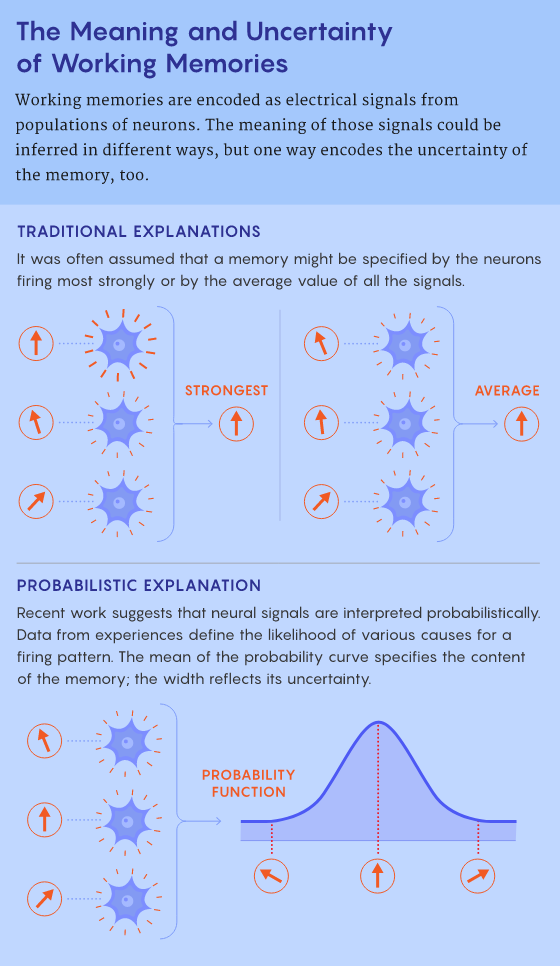
Neural noise indicates our working memory may encode Bayesian probabilities of its contents

The uncertainty in working memory may be linked to a surprising way that the brain monitors and uses ambiguity, according to a recent paper in Neuron from neuroscience researchers at New York University. Using machine learning to analyze brain scans of people engaged in a memory task, they found that signals encoded an estimate of what people thought they saw — and the statistical distribution of the noise in the signals encoded the uncertainty of the memory. The uncertainty of your perceptions may be part of what your brain is representing in its recollections. And this sense of the uncertainties may help the brain make better decisions about how to use its memories.

…the idea that we are walking around with probability distributions in our heads all the time has a certain beauty to it. And it is probably not just vision and working memory that are structured like this, according to Pouget. “This Bayesian theory is extremely general,” he said. “There’s a general computational factor that’s at work here,” whether the brain is making a decision, assessing whether you’re hungry or navigating a route.

link

FIML practice works precisely with the probabilistics of working memory. If the range of doubt in a perception is stronger than normal, it may prompt a query. If the range is stronger than normal and may indicate danger, a query is more likely. It would make sense that our assessments of these factors would be Bayesian. When perceptions are psychologically important, any Bayesian analysis will require assessing the subjective context into which the perception enters, which implies further Bayesian analyses. It would be wonderful if we had machines that could do this for us, but they will only be invented years from now if ever. For now, we can use our own minds to accomplish this through FIML practice. If you can understand the linked article, you should be able to see the value of FIML which collapses a Bayesian probability curve into the certainty of a single point. Psychologically, when this is done hundreds of times, the results are extremely satisfying. ABN