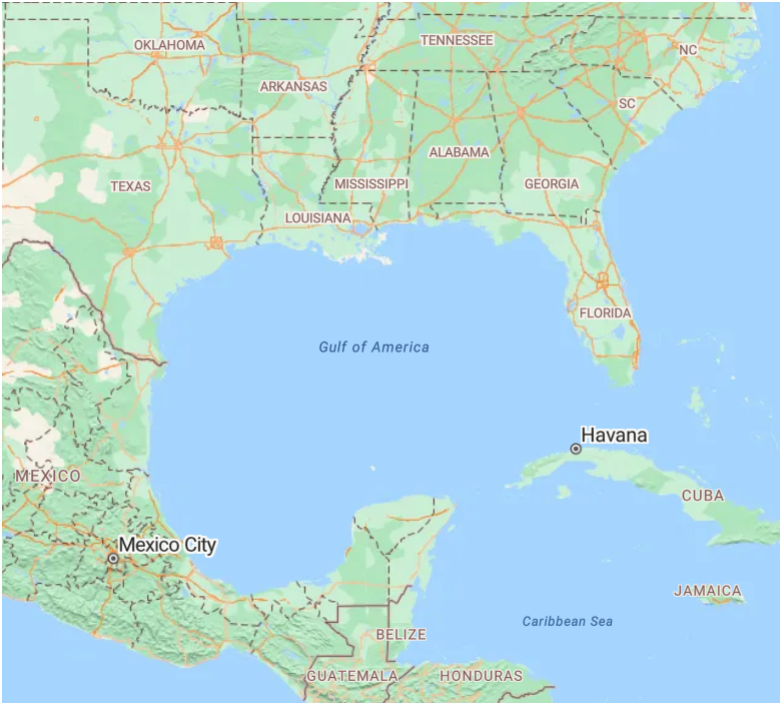
Bing Maps recognizes the change
Do your best. Speak the truth.

video source with more content
This is an example of why freedom of speech is our most important and most foundational right; unalienable and not to be taken from us by anyone ever. Blanchard handles himself very well; he is cordial, straightforward, and does not back down. This is how we break through the mind-control. ABN
A major feature in language is the importance of asking and how you ask.
The impetus for all speech resides deeply in and around the imperative that we must want and ask for the spiritual development we are seeking. Frivolous asking and mundane desires do not count in this. They are outside of deep language use.
The Buddha only spoke on the Dharma when and if he was asked to do so.
The source and meaning of language and meaning itself can be glimpsed in this. Right Language is a soul-deep operation of the mind.
In this respect, FIML is a profound philosophical answer to what language is, what meaning is, what communication and communion are. FIML is this answer because it reveals and analyzes real-time, real-world speech between honest partners.
You cannot cut that close to the bone in any other way. Two people, true speech, true analysis — the source of linguistic being is revealed. The conundrums of psychology are healed.
FIML speaks to us within language, not from outside of language. With practice, FIML will move the source of your speech and meaning to your true experience. It will remove from you the need to understand yourself through extrinsic language and meaning.
In this sense, FIML is truly a philosopher’s stone. It will take you to the deepest levels you are capable of. ABN
The main problem with culture is, in virtually all cases, “you can’t say what they don’t already know.”
Some very small cultures of just a few people are exceptions to this rule, but no large culture with anonymous and/or not-well-known members is.
Cultures demand constant authorization and reauthorization from their members. To stray from established norms is to weaken group authorizations.
In the world today, you cannot escape the above truth about culture. You will find it prevails no matter where you go.
(In your private life you can escape the above truth by doing FIML practice. The whole point of FIML is to speak about things you don’t already know.)
UPDATE: The above also explains opposing multiple culture divides within USA.
Each strains to ‘authorize and reauthorize’ their ‘established norms’; thus exhausting cognitive space and energy.
This leads to KOBK reasoning, and with that all other forms of reasoning become subordinate. ABN
Do FIML practice successfully 25 times and you will understand how wrong the notion of micro-aggression is. Not only wrong but also destructive to self and other. Rather than have us probe own minds, micro-aggression asks us to assert a false interpretation of someone else’s mind. From a Buddhist point of view, micro-aggression turns us 180 degrees away from wisdom and enlightenment ABN.
…In 2019, two major studies were published which gave some of the strongest evidence yet to the theory.
…So while Proto-Indo-Europeans expanded out of the Pontic-Caspian Steppe in all directions, it was their later Northern European branch which mixed with native European farmers that then expanded back eastward and became the founders of Vedic civilisation.
…Written between 1,500-1,000 BC, the Rigveda is one of the foundational Hindu texts — one of the four Vedas, and the oldest Vedic Sanskrit text. It records the story of the Aryan incursion into India and their encounter with the local populations.
The Indo-Iranian peoples apparently referred to themselves as “Aryans”, meaning “noble” or “civilised”. An inscription on the tomb of Darius the Great uses the term “Ariya” to describe the Iranian people, apparently describing Darius as an “Aryan of Aryan descent.” In Avestan, the liturgical language of Zoroastrianism, “Airyanem Vaejah” is used to describe an ancient “Aryan expanse” which was the homeland of the Iranian people. Similarly, the Sanskrit term ārya, meaning noble, is used throughout the Rigveda to describe the conquerors who subdued the native Indians, who are referred to as Dasa/Dasyu.
I am a bit disappointed in this essay because it misses so much of what really happened in the ancient world, but it is worth reading due to the genetic information presented and its discussion of the Rigveda.
‘Aryan’ is the root source of the name Chinese use for themselves to this day — ‘huaren‘ (華人). It is also the source for the name of the earliest Chinese dynasty, the Xia Dynasty (夏朝). This shows that the expanse of ancient Aryan peoples included also Tocharians in Northeast Asia, where they had a very significant influence on the development of Chinese, Korean, Mongolian and Japanese civilizations.
Aryan peoples are largely synonymous with Scythians, who ruled Central Asia for many centuries, dating back to their invention of the chariot, circa 2,000 BCE, which is why horses were so important in their spread and dominance. It is entirely ridiculous to feel proud today that you have Aryan ancestry (many people do) or that Indian civilization owes nothing to the Aryans.
Incidentally, the Buddha himself was Aryan or Scythian. When he is called Shakyamuni, the name literally means ‘sage of the Scythians’. The Buddha is often referred to as an Aryan in traditional Buddhist texts. The only physical description we have of Shakyamuni Buddha says his eyes were blue. It is ridiculous to be either proud of ancestry from Aryans or ashamed of not being Aryan or having been conquered by them. All peoples everywhere have been conquered and enslaved, and conquered and enslaved others.
Read the works of Christopher Beckwith for a much more detailed and expansive take on this subject. For Buddhists, I highly recommend his book, Greek Buddha: Pyrrho’s Encounter with Early Buddhism in Central Asia. Beckwith claims Aryan dominance and deep influence in all of the cultures bordering Central Asia was not particularly violent but rather resulted from Aryan/ Scythian males settling in a region and mating with the local women. This led to the formation of many creole languages with prominent Indo-European words and features. ABN
Global workspace theory is a description of how our minds work. The word global refers to the whole mind or brain, not the world.
The central feature of this theory—the global workspace—is conscious working memory, or working memory that could be made conscious with minimal effort.
This global workspace is also what a great deal of Buddhist mindfulness attends to. If we focus our attention on what is coming in and out of our global workspace, we will gain many insights into how our minds operate.
The Buddha’s five skandha explanation of consciousness can be understood as a form (or percepta) entering the global workspace.
Consciousness is the fifth skandha in the chain of skandhas. It is very important to recognize that whatever we become conscious of is not necessarily right.
With this in mind, we can see that being mindful of what is entering and leaving our global workspace can help us forestall errors from forming and growing in our minds.
In the Buddhist tradition, ignorance (a kind of error) is the deep source of all delusion.
But how do I know if the percepta or bits of information entering my awareness are right or wrong?
Well, there is science and Bayesian thought processes to help us, and they are both very good, but is there anything else?
What about my actual mind? My psychology? My understanding of my being in the world? How do I become mindful and more right about these?
Besides science and Bayes, I can ask an honest friend who knows me well if the percepta I think I just received from them is right or wrong.
If my friend knows the game, they will be ready to answer me before my global workspace changes too much. If my friend confirms my interpretation of what they just did or said, I will know that my interpretation (or consciousness) is correct.
If they disconfirm, I will know that my interpretation was incorrect, a mistake.
This kind of information is wonderful!
We calibrate fine instruments to be sure we are getting accurate readings from them. Why not our own minds?
This kind of calibration can be done in a general way, but you will get a general answer in that case. If you want a precise reading, a mindfulness answer, you need to play the FIML communication game.
first posted February 12, 2020
The case for removing concepts from cognitive science and AI research
It can be difficult to convince someone that concepts don’t exist. Everyday experience appears to provide overwhelming evidence to the contrary. Concepts are not only intuitively perceived to be active in daily life, they are also a widespread feature of theories across AI and cognitive science, where they are assumed to be necessary for symbolic and logical thought¹. Most who read the title of this post would be tempted to brush off the argument as patently, demonstrably absurd. It’s akin to trying to convince a European 500 years ago that God doesn’t exist, when everything around them appears to be evidence of, and indeed presupposes God’s existence. Any contrary argument is likely to be taken as the result of sophistry or word-wrangling, or because some critical piece has been neglected.
Despite their seeming obviousness, it is worth noting that there is still no complete and unambiguous explanation for what concepts are, or how they work on thoughts —and indeed how to program them into AI. The human ability to learn and create concepts is multifaceted and complex. AI theories and implementations generally only touch on one or two of its features, while neglecting large numbers of counter-cases. This has lead some researchers, notably Lawrence Barsalou, to suspect that the way we think of concepts is flawed. Perhaps the whole notion of concepts — as a native mechanism for grouping experiences — is untenable.
This article is well-worth reading. Below, I have made a few notes based on my reading of it. To my eye, it demonstrates the existence of consciousness as a thing, the existence of a very real subjective world, the high probability that this subjective world is not entirely confined in your head, that consciousness is a primary of existence and not confined to our brains, and also, importantly for this website, why FIML works so well.
(The sections in quotes are from the article.)
Firstly, concepts: they exist within consciousness and are used to reason, analyze, communicate, organize, and so on. They are probably a features of consciousness itself, depending on how you define them. They need not be stable.
Secondly, FIML:
To begin with, there is no scientific experiment or empirical observation that can be used to prove that any given concept “exists”, and by extension that concepts exist at all.
No. FIML practice provides unlimited empirical observations that concepts exist. FIML is a scientific experiment and can easily be repeated as many times as you like.
To objectively prove that any given interpretation matches reality, you would somehow have to compare your subjective mental concepts against an objective view of the real situation. But the latter isn’t possible.
Yes, it is possible. FIML is precisely that—a means ‘to compare your subjective mental concepts against an objective view of the real situation’.
FIML accomplishes this by allowing two subjective consciousnesses to objectively compare their mutually ‘subjective mental concepts’ against each other. To claim that ‘an objective view of the real situation’ can only be achieved by some other means is absurd. The very best means to objectively compare subjective states is to have two honest informants compare them based on a shared micro unit of communication in the real-world in real-time. This is what FIML does.
Continue reading “Concepts don’t exist — as objective, phenomenological, cognitive, or neural structures”The discreteness of concepts is a built-in requirement of language itself, one that does not necessarily reflect what an individual mind is doing.
The Visual Word Form Area (VWFA) is a brain region that helps us recognize written words and letters. Without it, reading requires much more effort. When a man suffered an accidental lesion to his VWFA during brain surgery, he lost much of his ability to read while losing none of his general language abilities. After six months, he had partially recovered, but reading still took twice as long as it had before (Gaillard et al, 2006).
The VWFA is composed of neurons that were once used for face recognition:
Thus, learning to read must involve a ‘neuronal recycling’ process whereby pre-existing cortical systems are harnessed for the novel task of recognizing written words. … [Such areas of the cortex] possess the appropriate receptive fields to recognize the small contrasted shapes that are used as characters, and the appropriate connections to send this information to temporal lobe language areas (Dehaene & Cohen, 2011)
This neuronal recycling seems to have become hardwired, at least in some people. After Swiss preschoolers played a grapheme/phoneme correspondence game for a total of 3.6 hours over 8 weeks, an MRI scan showed their VWFAs preferentially responding to images of strings of letters. Yet only a few of the children could actually read, and only at a rudimentary level (Brem et al., 2010).
Humans may have initially identified words by using face-recognition neurons. As reading became more important, natural selection favored those humans who could free up more of their face-recognition neurons for reading. This selection eventually created a large neuronal population dedicated solely to word recognition, i.e., the VWFA.
This article discusses how our ability to recognize faces evolved to also recognize the written word, especially in alphabetic languages. The face recognition areas in the brain can also be partially commandeered by the development of word-recognition skills through learning to read. As someone with poor face-recognition, I wonder what happened to me. I also learned to read Chinese, so who knows what was going on? Apparently, recognizing Chinese characters requires yet another region of the brain. Some information about that can be found in this paper: The Visual Word Form Area: Evidence from an fMRI study of implicit processing of Chinese characters. ABN
One thing I love about her is she came out early on covid vax harms but was very reserved in the way she spoke, in keeping with British manners. As time has gone on she has become much stronger in her language and delivery because the data warrants it. When a mild-mannered, honest and reserved person gets louder and stronger, you better pay attention. This change in Craig alone is one of the most convincing indictments of the covid vax there is. Filing this one under ‘psycholinguistics’ as well as ‘medical science’ and ‘anti-science’ (which the plandemic and vaxxes are). ABN
And how bad you are at interpreting what others say to you?
If not, you are living in a very muddled world that is probably “anchored” to nothing more than your “feelings,” your “identity,” or some form of extrinsic “belief” or “faith” in your nation, group, religion, career.
Either you are a sort of slave to a public semiotic (religion, ethnicity, career, etc.) or you are a sort of slave to your muddled interior—your volatile emotional sense of “who” you “are.”
The only way I know of to fully comprehend how badly you speak and listen is to do FIML practice.
You may understand in the abstract how wrong and ambiguous speech and listening frequently are, but if you don’t do FIML you won’t be able to see with any specificity how wrong you are and where and why. If your understanding is only general or abstract, it will function as just another level of ambiguity, another source of mistakes.
Mildly sorry for being so blunt, but it’s true. Only FIML, or something very similar, can give you and your partner real-time access to objectively agreed upon communication mistakes being made between you. And there is no general or abstract substitute for that.
Even a single mistake can have massive consequences. But we all make dozens of mistakes every day.
first posted August 8, 2013
FIML is like a hand compared to a dog’s paw. ABN
 American Buddhist Net