SCOTLAND: Hate Crime and Public Order Bill starts April 1… meaning ‘misogyny’ and ‘stirring up hatred’ will be treated as criminal offences

The Scottish Government confirmed today that the Hate Crime and Public Order (Scotland) Act will take effect on April 1, bringing with it some of the most draconian curbs on freedom of speech and expression in any free democracy on earth. It has taken 40 years longer than Orwell predicted… but we have finally arrived in the totalitarian nightmare that he feared.

If somebody breaks into your garden shed and steals your bike, for example, or if your car is vandalized, then no action will be taken unless there is a witness or other evidence such as CCTV footage. However, if you were to say that you wouldn’t want an adult transgender female with male genitalia to share a changing room at the swimming pool with your daughter, then you may risk prosecution.

The Hate Crime Act was pushed through the Scottish Parliament by the current First Minister Humza Yousaf during his stint as Justice Secretary, although much like almost everything else he has ever been involved with (barring his deeply held convictions over Israel and Gaza) it wasn’t actually his idea.

Indeed, it was the brainchild of his predecessor Nicola Sturgeon, who hoped to leave as a “legacy” the Gender Recognition Reform Act that would allow people in Scotland to legally change their gender after just three months and without any medical grounds for doing so.

link

The basis of these laws is totalitarian mind-control and nothing more or less. Laws like this ‘work’ by frightening people into silence and self-censorship; their absurdity is a feature not a bug as irrational controls produce stronger internal submission than rational ones. The underlying psychological mechanism of this species of legalistic mind-control is to seize control of a community’s psycholinguistic constellation of words and thought. Once major words and concepts have been commandeered, only the most thoughtful and intelligent will understand what is happening, and only if they pay attention. The other 50-90% of the population can be expected to blithely ride this ever-changing lexical conveyor belt straight to totalitarian hell. ABN

Belgian Nationalist Sentenced to a Year in Prison Over ‘Hateful Memes’ Shared in Private Group Chat

Belgian nationalist activist and former member of parliament Dries Van Langenhove was sentenced to one year in prison on Tuesday for being part of a private group chat seven years ago where people shared “racist” and “antisemitic” memes.

“Belgian nationalist activist and former member of parliament Dries Van Langenhove has just been sentenced to a year in prison, a 16,000 euro fine, and ten years of ‘deprived civil rights’ which will mean he is barred from politics,” Keith Woods reported on Twitter.

“His crime? He was in a private groupchat where offensive memes were posted,” he added. “This is an absolute disgrace. Western regimes are reaching new levels of tyranny to suppress nationalism.”

link

The offending meme can be found in the linked article. Van Langenhove did not even send the meme. He was simply in the chat at the time. ABN

Defining Antisemitism: 2024 South Dakota Legislature House Bill 1076

In reviewing, investigating, or deciding whether an alleged violation of this chapter is antisemitic, the Division of Human Rights must consider the definition of antisemitism. For the purposes of this chapter, the term “antisemitism” has the same meaning as the working definition of antisemitism adopted by the International Holocaust Remembrance Alliance on May 26, 2016, including the contemporary examples of antisemitism identified therein.

link

The working definition of antisemitism adopted by the International Holocaust Remembrance Alliance on May 26, 2016:

  1. Making mendacious, dehumanizing, demonizing, or stereotypical allegations about Jews as such or the power of Jews as collective — such as, especially but not exclusively, the myth about a world Jewish conspiracy or of Jews controlling the media, economy, government or other societal institutions.
  2. Accusing Jews as a people of being responsible for real or imagined wrongdoing committed by a single Jewish person or group, or even for acts committed by non-Jews.
  3. Denying the fact, scope, mechanisms (e.g. gas chambers) or intentionality of the genocide of the Jewish people at the hands of National Socialist Germany and its supporters and accomplices during World War II (the Holocaust).
  4. Accusing the Jews as a people, or Israel as a state, of inventing or exaggerating the Holocaust.
  5. Accusing Jewish citizens of being more loyal to Israel, or to the alleged priorities of Jews worldwide, than to the interests of their own nations.
  6. Denying the Jewish people their right to self-determination, e.g., by claiming that the existence of a State of Israel is a racist endeavor.
  7. Applying double standards by requiring of it a behavior not expected or demanded of any other democratic nation.
  8. Using the symbols and images associated with classic antisemitism (e.g., claims of Jews killing Jesus or blood libel) to characterize Israel or Israelis.
  9. Drawing comparisons of contemporary Israeli policy to that of the Nazis.
  10. Holding Jews collectively responsible for actions of the state of Israel.

source

Ensuring the Security of God’s Chosen People

Noem proves she is pathetic, a lackey ‘protecting’ her masters who need no protection but rather will use it for continued aggression. Is she signaling obeisance to gain the VP slot or just looking for money? One thing about Gaza is the moral ripple effect into America and Europe is horrifying. Noem is but one example of many. ABN

Illuminating insight into early Christianity

Laurent Guyenot,

Your paper illustrates the principle that in order to properly understand Christianity one must understand what Jesus actually taught. This requires that we focus on the earliest period of Christianity.

Your paper presents no conclusions about the Arian controversy and implies that the issue remains muddled even today. In my opinion, this is incorrect.

FYI, I am going to briefly summarize the Arian controversy as I understand it. I believe the controversy arose out of the church’s “need” to declare its institutional authority over Christians.

In the first centuries, there were many varieties of Christians, everything from Jewish Christian sects that continued to stress the importance of Jewish Law to gnostic Christians who in my opinion preserved the esoteric core of what Jesus actually taught. Soon after the Council of Nicaea, many of the various iterations (including the gnostics) came under fierce attack by the Roman church.

The roots of the Arian controversy date to the second century when certain theologians deviated from Jesus’ teaching about the immortality of the soul, i.e., immanence. Tatian was one of these, and he was followed by Gregory of Nysa, St Jerome, and Augustine. Each of whom added another brick to the new artificial construct. All of them taught that the soul is created from lowly dust along with the body at conception or birth.

The controversy ignited when a Libyan priest named Arius pointed out the flaw in the church’s new teaching. At issue was the human versus divine nature of Jesus. Arius merely pointed out that by this reasoning the soul of the God-realized avatar Jesus must likewise have been made of lowly dust. This was a problem because it meant that at some point in time the soul of Jesus did not exist. It followed that Jesus, while exalted, could not be on an equal footing with God the father.

Athanasius led the orthodox contingent at Nicaea. He insisted on the absolute equivalence of Father and Son. Even though a vast majority of Christians supported Arius, the anti-Arian bishops held a majority in Council and ruled in favor of Athanasius. No surprise that Arius was condemned as a heretic.

Athanasius gets credit for the new doctrine of the Trinity that emerged from Nicaea. The Trinity idea was not based on Scripture, however, nor divine revelation, but solely on logic. Given the equivalence of Father and Son, the Holy Spirit could not be left out, so its inclusion became a logical necessity. From its inception, the Trinity doctrine was and remains a purely artificial construct.

Despite the ruling, Arianism continued to be very popular because by affirming the humanity of Jesus Arius held out hope for ordinary people. Implicit in Arianism is the gnostic belief that ordinary Christians can follow in the footsteps of the savior. The views of Arius were perfectly compatible with the teaching of immanence, the indwelling of God in all of creation.

The real issue at the heart of the controversy, as the writer Elizabeth Claire Prophet has pointed out, was not the denial of the divinity of Jesus (as the church contended at Niceae and as the Catholic Church still contends) but instead the question: “How is man to be saved? By emulating Jesus? Or by worshipping him?” Today, the Catholic Church emphasizes worship (and obedience) when it should be inspiring Christians (as Jesus did) to pursue sainthood.

The personal triumph of Athanasius at the council was a hollow victory. By scapegoating Arius, the church only magnified its original error of embracing a doctrine of the soul that repudiates the divine presence in all matter.

By asserting the equivalence of Father and Son the church was in effect declaring that the soul of Jesus was different in kind from the souls of ordinary people. This was fateful because it undermined the mystical element in Jesus’ own teachings, and opened up a vast gulf between God and humans.

The new Catholic Encyclopedia clearly states the extent of this chasm: “Between Creator and creature there is the most profound distinction possible. God is not part of this world. He is not just the peak of reality. Between God and the world there is an abyss…”

The abyss was wholly artificial, the creation of the church, yet it was also a self-serving artifice, a means for institutional Christianity to vastly increase its earthly power. Today, Catholic doctrine holds that the church is the sole bridge over the otherwise unbridgeable chasm between God and men.

I would go another step and also argue that the outcome of Niceae was a serious devolution, a step back toward Judaism and the absolute patriarchal rule of the angry jealous god Yaweh. It appears that Christianity was undermined from within by church fathers bent on maintaining control over Christians. To me this smacks of psychopathy at work, namely, the Jewish revolutionary spirit.

This material is drawn from my 2004 book Gnostic Secrets of the Naassenes. Hope it helps!

Mark H Gaffney

• Thanks: Laurent Guyénot

link

The above is a comment on Laurent Guyénot’s recent article: The Constantine Hoax and the Forgery of Western History.

The definition or redefinition of words and concepts shows the profound importance of the human psycholinguistic complex or constellation. Changing just a few words or definitions can impact many centuries of human history. We can see many changes in our psycholinguistics today, almost all of which are imposed on our communities without our consent or understanding. Diversity is Our Greatest Strength is but one of many examples. It may seem as if nothing is happening when words and concepts change meaning or are weirdly asserted, but when those changes are imposed top-down and asserted by Big Media, you can be sure they portend a foul change is afoot and we will pay dearly for it within a short time. ABN

American Pravda: Gaza, Jewish Power, and the Holocaust — Ron Unz

Last week I published an article noting that although technology industrialist Elon Musk probably ranks as the most powerful and influential individual in the Western world, he recently humbled himself, deeply apologizing for some of his casual criticism of Jewish activities and pledging to mend his ways.

Traveling to Israel, he met with that country’s president and posed for photo-ops with Prime Minister Benjamin Netanyahu, promising to combat “antisemitism” on his Twitter platform. A few weeks later he undertook a pilgrimage to Auschwitz, making even stronger commitments to Jewish leaders, denying that he harbored any antisemitism in his own heart, and publicly declaring that he regarded himself as “aspirationally Jewish.”

These remarkable events reminded me of that famous incident of the Middle Ages in which Emperor Henry IV of the Holy Roman Empire had “gone to Canossa” and prostrated himself before Pope Gregory VII, seeking forgiveness for his challenge to the supreme authority of the Catholic Church:

Musk was only the latest and most extreme example of the many wealthy and powerful Gentiles who have publicly bent their knees in submission to Jewish power. Even if totally spurious, accusations of “antisemitism” have often proven fatal to the careers of even the highest-ranking individuals, and shortly before Musk’s submission, two presidents of Ivy League universities were politically brow-beaten and then forced to resign over their unwillingness to prohibit pro-Palestinian protests on their campuses, a sudden purge that was absolutely unprecedented in the history of American academia.

link

Emotional ‘meaning’

  • I challenge readers to find an emotion that does not have “meaning.”
  • Emotions that have no meaning do exist, but are not common and are generally ignored.
  • What is “meaning” in this context?
  • Meaning here means, quite specifically, “that which is connected to (interconnected in) a semiotic network.”
  • Emotions arise due to bodily functions, metabolism, external events, communication events, life events, etc.
  • Once an emotion arises it is either discarded (given no “meaning”) or it is taken up into a semiotic network.
  • Once it is taken up into a semiotic network, an emotion will resonate within that network, have an import and “meaning” based on that network.
  • For example, a single impression of microaggression will almost certainly be defined by prior learning, by the prior existence of a semiotic network that accepts and defines this sort of perception.
  • That is to say, if the perceiver has been trained or self-taught to perceive and react to microaggression, their preformed sensibilities (its “meaning”) will respond to it, often far more strongly than conditions warrant.
  • A similar analysis applies to any emotion.
  • Watch yourself as you discard the brief feeling you might get from looking at a nondescript wall or a leaf curled on the ground. Compare emotional reactions you don’t discard, such as ones involving human expressions, tone of voice, things left unsaid, etc.
  • This shows that we will learn more about emotions by analyzing the semiotic networks that give them meaning rather than trying to trace them back to their intangible origins or follow their ambiguous development.
  • Emotions do develop as the networks that “hold” them develop and/or as the emotion itself is given greater or lesser prominence within its network(s).
  • In this sense, emotions can grow very large or become very small.
  • Ones that had meaning can and do disappear. But no emotion will appear and maintain itself for long without being taken into a semiotic network, given a meaning or assigned a meaning.
  • Notice how you have sensibilities and emotions connected to how you have been trained. And notice how these emotions and sensibilities are different from others who have not been trained as you have.
  • A trained gardener, salesperson, doctor, cook, surfer, etc. has emotions and sensibilities that are different from people who have not had their training, whether that training is formal or informal.
  • If you just spend time thinking about something you will be “training” yourself, developing different sensibilities and emotions about whatever it is.
  • Humans are semiotic animals that spend most of their time in semiotic environments.
  • A semiotic network communicates both with the self and with others.
  • Semiotic networks include everything that can be communicated, including language, ideas, emotions, beliefs, values, memories, skills, and so on.
  • If you were trained in a certain safety procedure and you agree with it (thoroughly putting out campfires, for example), it will drive you nuts to see someone ignore the basics. This is true for almost anything you were trained in and agree with.
  • Training gives us richer and different emotions, either in kind or in degree.
  • Training strengthens and broadens the semiotic network(s) holding or defining emotions, thus making them stronger, more sensible, more reasonable or, conversely, weaker, less sensible, less reasonable.
  • “Personalities” develop through training, some of it formal, much of it informal and idiosyncratic.
  • Some training is good and some of it is bad.

first posted MAY 5, 2015

A good way to understand what is happening in America today is first understand that the human mind comprises a psycholinguistic, psycho-semiotic constellation. Then understand that this constellation is the battlefield upon which mind-control wages war. When people are defeated on this battlefield, all is lost and kinetic war is typically unnecessary. Notice the power of words in mind-control, information warfare. First cause fear and confusion in the psycholinguistic constellation of a population, then offer definite words that that reunify that constellation, that allow it to relax and feel whole again. For example, just declare that an untested and dangerous medical intervention is ‘safe and effective’ and that if everyone takes it everything will go back to normal, everything will be fine again. The words alone can produce most of the desired effect, especially if they have been already strengthened by semiotic conformity such as wearing masks or keeping six feet apart. The semiotic elements in this kind of information warfare are so powerful none of them need be ‘true’. They just need to fit the needs of the population being controlled and be reasonably well-timed and repeated often. This on its own creates a division between those who follow the mind-control thoughtlessly and those who do not. ABN

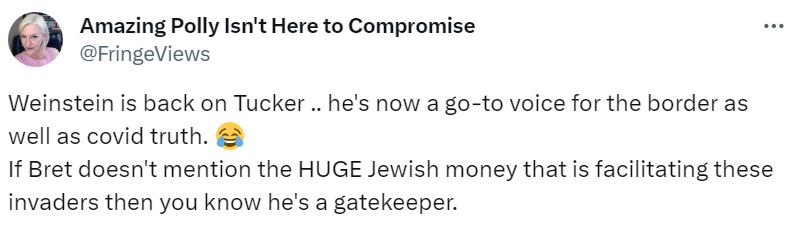
Amazing Polly on Bret Weinstein and Tucker Carlson

You could also say both are going as far as they think they can go without being destroyed. We are nearing a point where most people know about and many understand the effects of Jewish power in USA and the West. The next point to reach will be everybody knows, then everybody knows everybody knows. Then the game is up. The danger in getting from here to there is yet another dramatic, even cataclysmic, psyop to take our attention off the perpetrators; such as terror attacks in USA, which may involve CCP operatives and a new virus being released in many places at once, regional war in and around Israel, WW3. I see Polly’s point and also that Bret and Tucker did say a lot and by not saying everything they may have made that point even stronger. In a totalitarian regime, and we are living in one, people learn to talk about the regime by getting close to saying it but not fully saying it. Even I feel the need to do that to some extent. It’s not always a matter of bravery or dedication to truth but also being left alive to speak at all. ABN

A Buddhist heuristic for thought & action

  1. Information arrives
  2. Analyze it; seek help & opinions of others
  3. Decide how to proceed based on what is ethically/morally right or best

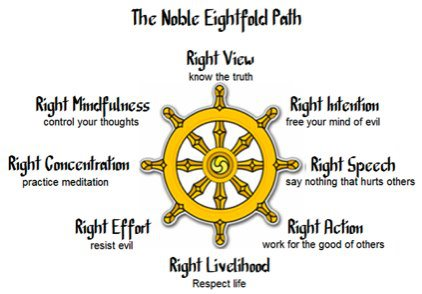
The above helps us decide where and how to enter the Noble Eightfold Path:

I noticed this morning that virtually everything I talk about with my wife and friends follows the heuristic stated above and all of that flows into the Noble Eightfold Path.

An example: The vaxxes. When they first appeared as information, I discussed them at length with anyone I reasonably could do that with. We all saw roughly the same thing—they were experimental, dubious, probably harmful, and not necessary: ergo, best to wait. Later on, after a couple of months, we were all certain that we should not take the vaxxes. Some of us also felt that we should speak about this conclusion and share it with others when opportune.

There was and still is a telling divide in the people I know. Many of my friends and family members willingly and very naturally engaged in analyses of the vaxxes and continue doing so to this day. The ones who did not want to engage in any analysis in the beginning, still will not do so to this day; all of the ones in this group took the vax.

Only one of the people who analyzed them early on took the vax, twice. Both he and his wife have vax injuries. His appear to be minor, hers are very serious. He openly regrets having taken the shot, continues analyzing vaxxes, and now also actively tries to explain to others in our circle why they should stop getting them.

Notice that propaganda and mind-control work most of all with getting people to skip analyzing information themselves and accept conclusions first being offered, then demanded. With only cursory analysis of the people making those offers and demands, it is not hard to see that their analyses are hidden, poorly done, or not done at all and that obvious objections to their demands are not answered reasonably.

I think this simple heuristic cuts to the heart of many matters, many kinds of information that arrive in our lives, both personal and public. It seems to highlight that when reason, thought, and analysis are skipped or skimped on, morality and good sense are harmed. We not only vax ourselves, we also vax our children and council others to make the same mistake. ABN

first posted MARCH 14, 2023

Non-FIML sociology and Buddhism

Non-FIML sociology cannot but be based on and imbued with vagueness and uncertainty. Individuals make their ways in this foggy social environment according to their upbringing, experiences, and the different ways they have learned to negotiate ambiguity. Each non-FIML individual cannot but conform to or accept a position somewhere on the spectrum of private neurosis-public semiotics.

This is so because non-FIML individuals cannot attain interpersonal certainty; they can only attain a semblance of interpersonal certainty that is necessarily made up of many erroneous interpretations of the world around them, their loved ones, and themselves. Their understanding of themselves and of others will necessarily be made up of either private interpretations (that are sure to be largely false and thus neurotic) or public/cultural interpretations that are similarly just as false and/or too narrow or generalized (science, mainstream psychology, professional societies, religious or ethnic allegiances, etc.) to be fully satisfying to the profound needs of the individual. This is not to say that many individuals living in conditions like that are not happy, but rather that their sense of who they are and what they are doing is false, utilitarian, exploitative, slavish, or otherwise limited in one way or another. Individuals in conditions like that cannot but offend their deep-seated needs for interpersonal honesty/certainty by compromising their individual understanding of what the world around them means by accepting either prepackaged public explanations (public semiotics) or making up their own (private neurosis).

Most individuals in the world are, thus, contorted in some way. Some are deeply unhappy because they can sense something is wrong but have no way to grapple with it. Others decide to make their way in the world as it is, fully accepting, even enjoying, their perceived “need” to deceive themselves and others, to manipulate others, to take advantage of them, etc.

I think the above roughly describes a big part of what is meant by delusion and suffering in Buddhism. Delusion and suffering constitute the first two of the Four Noble Truths. The First Noble Truth says unenlightened life is characterized by suffering or dissatisfaction. The second explains the first by saying, briefly, that people suffer because they become attached to delusions. Delusions can be egocentric, sociocentric, or both. They can be a private neuroses or the very public madness of a whole society, or both. However you look at it, individual human beings will suffer and experience discontent under these conditions because their core sense of what is true is almost constantly being violated.

In the Buddha’s day, you fixed this problem by becoming a monk. You can still do that today, or you can practice Buddhism as a lay person. My feeling is that if you only practice Buddhism and do not do FIML practice, you will make a lot of progress but remain unsatisfied. Societies today are so large and complex, it is nearly impossible not to be influenced constantly by them. If you can join a monastery or build a cabin in the woods, lucky for you. Most of us, though, will continue to live among unenlightened people and will continue to have deep needs for highly satisfying interpersonal communication with our loved ones and close friends. FIML practice fits in right there. Since so many monasteries today are burdened with the weight of their own semiotics, FIML practice probably would be a very good practice even for monks, if it can be arranged.

In the Chinese Buddhist tradition, there is a story about heaven and hell. In hell people sit at a dinner table to eat but are forced to use chopsticks that are so long they cannot put any food in their mouths, and so they go hungry and feel miserable. In heaven, conditions are exactly the same, but people there use their long chopsticks to feed each other, so everyone if well-fed and very happy.

FIML practice is like heaven. By doing it we feed each other and grow more satisfied as we come to understand what the real conditions of this world are.

Incidentally, I am of the opinion, and many share this opinion, that Buddhists can and should work with the basics of the tradition to make it speak to them. I am fully convinced that FIML practice will open a very large door for almost anyone who tries it. Non-Buddhists can do FIML, but so can Buddhists. I do not see any contradictions between FIML and Buddhist practices. And I do see many advantages to augmenting Buddhist practice with FIML.

first posted FEBRUARY 18, 2012

Meaningfulness or emotional valence of semiotic cues

A new study on post traumatic stress disorder shows that PTSD sufferers actually perceive meaning or emotional valence within fractions of a second.

This study bolsters the FIML claim that “psychological morphemes” (the smallest psychological unit) arise at discrete moments and that they affect whatever is perceived or thought about afterward.

The study has profound implications for all people (and I am sure animals, too) because all of us to some degree have experienced many small and some large traumas. These traumas induce a wide variety idiosyncratic “meaning and emotional valence” that affects how we perceive events happening around us, how we react to them, and how we think about them.

The study in question—Soldiers with Posttraumatic Stress Disorder See a World Full of Threat: Magnetoencephalography Reveals Enhanced Tuning to Combat-Related Cues—is especially interesting because it compares combat veterans without PTSD to combat veterans with PTSD.

It is thus based on a clearly defined pool of people with “similar” extreme experiences and finds that:

…attentional biases in PTSD are [suggestively] linked to deficits in very rapid regulatory activation observed in healthy control subjects. Thus, sufferers with PTSD may literally see a world more populated by traumatic cues, contributing to a positive feedback loop that perpetuates the effects of trauma.

Of course all people are “traumatized” to some degree. And thus all people see “a world populated by traumatic cues, contributing to a positive feedback loop that perpetuates the effects of trauma.”

If we expand the word trauma to include “conditioned responses,” “learned responses,”  “idiosyncratic responses,” or simply “training” or “experience” and then consider the aggregate all of those responses in any particular individual, we will have a fairly good picture of what an idiosyncratic individual (all of us are that) looks like, and how an idiosyncratic individual actually functions and responds to the world.

FIML theory claims that idiosyncratic responses happen very quickly (less than a second) and that these responses can be observed, analyzed, and extirpated (if they are detrimental) by doing FIML practice. Observing and analyzing idiosyncratic responses whether they are detrimental or not serves to optimize communication between partners by greatly enhancing partners’ ranges of emotion and understanding.

In an article about the linked study (whose main author is Rebecca Todd), Alva Noë says:

…Todd’s work shows that soldiers with PTSD “process” cues associated with their combat experience differently even than other combat veterans. But what seems to be driving the process that Todd and team uncovered is the meaningfulness or emotional valence of the cues themselves. Whether they are presented in very rapid serial display or in some other way, what matters is that those who have been badly traumatized think and feel. And surely we can modify how we think and feel through conversation?

Indeed, what makes this work so significant is the way it shows that we can only really make sense of the neural phenomena by setting them in the context of the perceptual-cognitive situation of the animal and, vice-versa, that the full-import of what perceivers say and do depends on what is going on in their heads. (Source)

I fully agree with the general sense of Noë’s words, but want to ask what is your technique for “modifying how we think and feel through conversation?” And does your technique comport well with your claim, which I also agree with, that “we can only really make sense of the neural phenomena by setting them in the context of the perceptual-cognitive situation of the animal”?

I would contend that you cannot make very good “sense of neural phenomena” by just talking about them in general ways or analyzing them based on general formulas. Some progress can be made, but it is slow and not so reliable because general ways of talking always fail to capture the idiosyncrasy of the “neural phenomenon” as it is actually functioning in real-time during a real “perceptual-cognitive situation of the animal.”

The FIML technique can capture “neural phenomena” in real-time and it can capture them during real “perceptual-cognitive situations.” It is precisely this that allows FIML practice to quickly extirpate unwholesome responses, both small and large, if desired.

Since all of us are complex individuals with a multitude of interconnected sensibilities, perceptions, and responses, FIML practice does not seek to “just” remove a single post traumatic response but rather to extirpate all unwholesome responses.

Since our complex responses and perceptions can be observed most clearly as they manifest in semiotics, the FIML “conversational” technique focuses on the signs and symbols of communication, the semiotics that comprise psychological morphemes.

FIML practice is not suited for everyone and a good partner must be found for it to work. But I would expect that combat veterans with PTSD who are able to do FIML and who do it regularly with a good partner will experience a gradual reduction in PTSD symptoms leading to eventual extirpation.

The same can be said for the rest of us with our myriad and various traumas and experiences. FIML done with a good partner will find and extirpate what you don’t want knocking around in your head anymore.

first posted JULY 9, 2015

UPDATE: This essay is very important for anyone who wants to better understand human communication. I hope readers of this site will avail themselves of the opportunity to learn FIML. FIML is a major discovery in interpersonal psychology and communication. If you try it and have difficulties, feel free to email me and/or post a comment addressing your issues. If you think you already do FIML and understand it, you don’t. There is nothing like it in any literature I have seen.

For readers today who have become aware of the great extent of government and media sponsored mind-control, the linked study as well as FIML can help explain how mind-control works at very basic levels. In this context, I highly recommend: The Rape of the Mind: The Psychology of Thought Control, Menticide, and Brainwashing. The Kindle version is just $.99 today. This book explains how humans are controlled by totalitarian regimes, a phenomenon we are surely experiencing today.

I bring the book up today because Meerloo delves deeply into how mind control techniques work at the individual level. In some ways, what he describes is 180 degrees opposite of FIML practice. FIML frees us from all forms of bad training and conditioned psychological responding, both idiosyncratic and totalitarian. Additionally, FIML helps us identify bad training at the most granular level of real-time, real-world activity. This is the opposite of mind-control. ABN


Maine’s Shenna Bellows in her own words

UPDATE: As a psycholinguist, I find their voices both alarming and telling. The dialect is woke progressive with creaky voice and rising intonation, replete with doublespeak. They do what they accuse and ooze self-righteousness. Bellows confesses having trained with ACLU and SPLC, organizations known for hypocrisy and sleazy lawfare. Parasites have taken over our government at all levels. They are a community and act as a community with almost no reference to the larger community they are supposed to represent, except to exploit it. You can hear it in their voices, or at least I can. An effeminate, unyielding stubbornness based not on reason or kindness but on mimicry and knowing nothing else. ABN

Working memory is key to deep psychological transformation, Part 1

Part 2

Part 3

Working memory is the part of you that organizes and executes action in real-time. All real-time actions—save stupor or deep sleep—require working memory.

Working memory is where your life meets the world, where your existential rubber meets the real-time road.

Working memory is the spear point of the mind as it does life. For this reason, it is the single best key to understanding human psychology. And through this understanding to change it for the better.

Working memory shows you how you really think, feel, or perceive. Properly observed, it does not lie. Working memory happens too quickly to lie.

If you can observe your working memory as it performs—in a flash—a significant psychological act, you will have an accurate handle on the deep memories that comprise your psycho-spiritual makeup.

Working memory is quick. It’s “contents” or “the items it entertains” come and go quickly. Its “contents” can be perceptions, memories, judgement, sensations, words, emotions, almost anything.

Working memory is obviously linked to long-term memory though how it is linked is not entirely clear to science.

Phone numbers, remembered or not, typically come up in this context. But the connection between working and long-term memory is much more than just that.

Long-term memories—your psychology or life experiences—deeply color working memory. And this coloring changes in different contexts.

When we access long-term “psychological” (aren’t they all?) memories, they are huge; they are large systems of associations and neurons. This is why overemphasizing long-term memories and that aspect of psychology does not provide full insight into the workings of the mind.

For that we need the spear-point—working memory—to show us precisely where the contact points really are, precisely how we engage with the real world.

I bet most readers have no idea how to analyze their working-memories, how to accurately access them for psychological insight.

Part 2

Speech comprehension and context

A new study on speech comprehension shows that humans respond to the “contextual semantic content of each word in a relatively time-locked fashion.”

These findings demonstrate that, when successfully comprehending natural speech, the human brain responds to the contextual semantic content of each word in a relatively time-locked fashion. (Source)

This process is roughly illustrated here:

While I do not doubt these findings for simple speech in simple contexts, I do wonder what the results would be for speech in psychologically complex contexts, whether that speech is simple or not.

I wonder this because I am certain that in almost all psychologically complex contexts (those rich with subjectivity, emotion, idiosyncratic memory or association, etc.) the “contextual semantic content of each word” will necessarily be different, often very different for each speaker.

Psychologically rich interpersonal speech is almost always fraught with contextual differences that can be very large. Sometimes participants know these differences exist and sometimes they don’t. It is very common for speakers to make major mistakes in this area, the most important area of speech for human psychological well-being.

It seems possible that EEG with increased sensitivity might one day be able to detect “context diversion” between speakers, but even if complex emotional information is also included, people will still have to talk about what is diverging from what.

My comments are not meant to detract from the very interesting findings posted above. I make them because these findings illustrate how inherently problematic real-time mutual comprehension of the “contextual semantic content” of all spoken words actually is.

FIML practice is the only way I know of today to find profound real-time mutual comprehension of complex interpersonal speech.

Corvids seem to handle temporary memories the way we do

Humans tend to think that we are the most intelligent life-forms on Earth, and that we’re largely followed by our close relatives such as chimps and gorillas. But there are some areas of cognition in which homo sapiens and other primates are not unmatched. What other animal’s brain could possibly operate at a human’s level, at least when it comes to one function? Birds—again.

This is far from the first time that bird species such as corvids and parrots have shown that they can think like us in certain ways. Jackdaws are clever corvids that belong to the same family as crows and ravens. After putting a pair of them to the test, an international team of researchers saw that the birds’ working memory operates the same way as that of humans and higher primates. All of these species use what’s termed “attractor dynamics,” where they organize information into specific categories.

Unfortunately for them, that means they also make the same mistakes we do. “Jackdaws (Corvus monedula) have similar behavioral biases as humans; memories are less precise and more biased as memory demands increase,” the researchers said in a study recently published in Communications Biology.

link