A theory of FIML

42.22 in this video

Arctic Instincts? The Late Pleistocene Arctic Origins of East Asian Psychology

Abstract

This article explores the hypothesis that modern East Asian populations inherited and maintained extensive psychosocial adaptations to arctic environments from ancestral Ancient Northern East Asian populations, which inhabited arctic and subarctic Northeast Eurasia around the Last Glacial Maximum period of the Late Pleistocene, prior to back migrating southwards into East Asia in the Holocene. I present the first cross-psychology comparison between modern East Asian and Inuit populations, using the latter as a model for paleolithic Arctic populations. The comparison reveals that both East Asians and the Inuit exhibit notably high emotional control/suppression, ingroup harmony/cohesion and subdomain unassertiveness, indirectness, self and social consciousness, reserve/introversion, cautiousness, and perseverance/endurance. The same traits have been identified by decades of research in polar psychology (i.e., psychological research on workers, expeditioners, and military personnel living and working in the Arctic and Antarctic) as being adaptive for, or byproducts of, life in polar environments. I interpret this as indirect evidence supporting my hypothesis that the proposed Arcticist traits in modern East Asian and Inuit populations primarily represent adaptations to arctic climates, specifically for the adaptive challenges of highly interdependent survival in an extremely dangerous, unpredictable, and isolated environment, with frequent prolonged close-quarters group confinement, and exacerbated consequences for social devaluation/exclusion/expulsion. The article concludes with a reexamination of previous theories on the roots of East Asian psychology, mainly that of rice farming and Confucianism, in the light of my Arcticism theory.

link to study

A Systematic Review and New Analyses of the Gender-Equality Paradox

Abstract

Some studies show that living conditions, such as economy, gender equality, and education, are associated with the magnitude of psychological sex differences. We systematically and quantitatively reviewed 54 articles and conducted new analyses on 27 meta-analyses and large-scale studies to investigate the association between living conditions and psychological sex differences. We found that sex differences in personality, verbal abilities, episodic memory, and negative emotions are more pronounced in countries with higher living conditions. In contrast, sex differences in sexual behavior, partner preferences, and math are smaller in countries with higher living conditions. We also observed that economic indicators of living conditions, such as gross domestic product, are most sensitive in predicting the magnitude of sex differences. Taken together, results indicate that more sex differences are larger, rather than smaller, in countries with higher living conditions. It should therefore be expected that the magnitude of most psychological sex differences will remain unchanged or become more pronounced with improvements in living conditions, such as economy, gender equality, and education.

link

Grok describes and analyzes FIML

Key Points

  • Research suggests FIML, or Functional Interpersonal Meta Linguistics, is a communication technique to improve relationships by addressing misinterpretations in real-time.
  • It seems likely that FIML involves partners interrupting conversations to clarify emotional reactions, aligning with Buddhist principles of mindfulness.
  • The evidence leans toward FIML supporting advanced Right Speech and Right Listening, potentially transforming lives by enhancing understanding.

Description

What is FIML?
FIML, or Functional Interpersonal Meta Linguistics, is a method designed to optimize communication and psychological well-being between two people. It’s described as a form of analytical psychotherapy that doesn’t require formal training, focusing on clearing up misunderstandings as they happen.

How It Works
Partners agree to interrupt normal conversations when one feels an emotional reaction to something said. The reacting partner asks the other about their state of mind at that moment, and the other responds honestly. This process helps identify if the reaction was based on a misinterpretation, with follow-up questions for clarity. Repeating this frequently can develop better communication skills.

Connection to Buddhism
FIML aligns with Buddhist teachings, supporting advanced forms of Right Speech and Right Listening. It’s seen as a practical application of mindfulness, based on impermanence and emptiness, potentially leading to personal transformation by freeing individuals from ordinary speech constraints.

Unexpected Detail: Precision Comparison
Interestingly, FIML is compared to the James Webb Space Telescope for its clarity in communication, suggesting it offers a much sharper understanding than typical conversations, likened to using an old Hale telescope.


Survey Note: Comprehensive Analysis of FIML Based on American Buddhist Net

This note provides a detailed examination of Functional Interpersonal Meta Linguistics (FIML) as presented on American Buddhist Net, focusing on its description, practice, and relation to Buddhist principles. The analysis aims to offer a thorough understanding for readers interested in communication techniques and their philosophical underpinnings.

Background and Definition

FIML is defined on American Buddhist Net as a technique for optimizing communication and psychological well-being between two people. It is described as a form of analytical psychotherapy that can be practiced without formal training, emphasizing real-time analysis to clear mistaken psychological interpretations. This approach is particularly noted for addressing both recent and long-held miscommunications, enhancing the relationship dynamics between partners.

The site compares FIML to advanced scientific instruments, such as the James Webb Space Telescope, for its clarity in communication, contrasting it with normal speech, which is likened to using the older Hale telescope. This analogy underscores FIML’s potential to provide precise, high-resolution insights into interpersonal interactions.

Practice and Methodology

The practice of FIML involves a structured process, detailed in How to do FIML. Partners must first agree to interrupt normal conversations when needed, creating a foundation for open communication. The process unfolds as follows:

Step NumberDescription
1Partners agree to do FIML and can interrupt normal conversation as needed.
2One partner feels a sensation or emotional reaction within one second after the other says something.
3The reacting partner asks, “What was your state of mind when you said X?” seeking the other’s short-term memory contents.
4The other partner answers honestly, describing their state of mind during the few seconds surrounding the statement.
5If the reacting partner finds no justification for their reaction, they realize it was a misinterpretation, trusting the other’s honesty.
6Follow-up questions, e.g., “Are you sure you were not implying boredom when you said X?” may be asked for clarity.
7The reacting partner discusses the new understanding with the other, briefly or at length, as chosen.
8The process is repeated frequently; after a few hundred successful instances, metacognition may develop, reducing the need for frequent interruptions.

The term “sensation” is clarified as an emotional, physical, or hormonal response occurring soon after something is said, starting at a discreet moment, and can be negative or positive. Mindfulness is crucial, with partners encouraged to observe these sensations within one second and make queries in a neutral tone to avoid further reactions.

Additional resources on the site, such as FIML and practical semiotics, Advanced FIML, and FIML FAQs, provide further guidance on refining the practice, addressing issues like snowballing in practice and disruption of neurotic responses.

Relation to Buddhism

FIML’s integration with Buddhism is a significant aspect, as outlined in various articles on American Buddhist Net. It is described as supporting advanced Right Speech and Right Listening, aligning with Buddhist principles of impermanence and emptiness. This connection is detailed in What is FIML?, where it is noted as a method or process, not formalities, meeting requirements for creating Right Conditions for these advanced practices.

The site suggests that FIML can transform one’s life by freeing individuals from the constraints of Ordinary Speech, as seen in Notes on semiotics, FIML, Buddhism, and a bit of anthropology. This article highlights how FIML corrects distortions in thinking or feeling that may arise from practicing Buddhism in isolation, emphasizing the importance of truthful interaction with an honest partner. It posits that early Buddhists might have engaged in similar practices during their travels in pairs or fortnightly discussions of failings, a tradition that has declined in many places.

Further, The deep importance of intentional language discusses FIML as a profound philosophical answer to language and communication, revealing real-time speech analysis that moves meaning to true experience, resonating with Buddhist mindfulness. Global Workspace Theory and mistake awareness & correction links FIML to calibrating minds like fine instruments, playing the FIML communication game for precise readings, reinforcing its mindfulness aspect.

Significance and Impact

The significance of FIML lies in its potential to enhance communication precision, as evidenced by its comparison to advanced telescopes. This unexpected detail highlights its capability to offer clarity beyond typical conversational exchanges, potentially revolutionizing how partners understand each other. The site also suggests that FIML can address interpersonal conundrums arising from the Problem of the Criterion, as noted in Buddhism category posts, impacting daily relationships and communication at every level.

FIML’s impact is further illustrated in Scott Adams Interview – It’s Okay to Be White, where the author, identified as ABN, recommends FIML for optimizing communication and psychology, suggesting it could benefit millions by spreading its practice. This underscores its broad applicability and potential for societal impact.

Author and Context

While specific author information is not directly provided, the site’s posts, such as About, indicate it is run by ABN, focusing on Buddhism, communication, and FIML. The contact email, realABN@pm.me, as seen in Contact, suggests a personal engagement with readers, reinforcing the site’s role as a platform for sharing and discussing these ideas.

Conclusion

FIML, as presented on American Buddhist Net, is a robust communication technique with deep ties to Buddhist philosophy, offering a practical method for enhancing interpersonal relationships through mindfulness and real-time analysis. Its structured practice, alignment with Buddhist principles, and potential for personal transformation make it a valuable tool for those seeking to improve communication and psychological well-being.

Key Citations

__________

Grok used 45 seconds to deep search FIML and produce the above result, posted in full. It did a good job. I am fine with posting this and encouraging readers to look it over. Done properly and for a reasonable amount of time, FIML is deeply life-enhancing. It probably should become a fundamental part of Buddhist practice. ABN

‘If women were in charge of most states, the world would not last long’ — Ricardo Duchesne

If women were in charge of most states, the world would not last long. Women are too volatile, too personal and emotional ——- exactly the qualities that make for bad diplomacy.

This trait is exacerbated in a Western world committed to liberalism in geopolitics, rather than realism.

Liberalism seeks to “fight the last war” to make the world safe for democracy” —- whereas realism, a manly perspective, accepts the realities of great power politics and the balance of power doctrine.

It understands that bigger nations get to have more privileges than small nations, and that there is no such thing as equality of rights in international relations.

link

Murder of Vermont border agent tied to string of killings across the country

A shooting that left a Vermont border patrol agent dead may be connected to several other murders spanning from Pennsylvania to California. 

Swanton Sector Border Patrol agent David Maland, 44, was killed when the occupants of a car started firing at him when he stopped them about 20 miles from the US-Canada border on January 20.  

The suspected shooters have been identified as Teresa Youngblut, 21, of Washington and Felix Bauckholt – a German national who was shot dead at the scene. 

Youngblut was injured during the shootout and taken to the hospital. Maland was also taken to the hospital, where he was pronounced dead. The motives behind the incident remain unclear.

But prosecutors believe the Vermont shooting was not an isolated crime – tying Youngblut to a double homicide in Pennsylvania and a fatal stabbing in California

In November 2024, Youngblut filed an application to marry Maximilian Snyder, a 22-year-old data scientist, according to the San Francisco Chronicle

On Friday, Snyder was arrested and charged with murdering a Vallejo, California landlord named Curtis Lind, 82, on January 17. He appeared in court on Tuesday. 

A criminal complaint filed in Solano County claims that Lind was stabbed and killed ‘for the purpose of preventing his testimony in a criminal proceeding,’ KTVU reported.

link

There is a lot of talk about both perps being members of a ‘trans cult’. As reliable info on that angle appears, I’ll post it. There has been plenty of evidence that some trans people begin with psychological body dysphoria which is ‘affirmed’ by dishonest professionals and aggravated by opposite-sex hormone treatments and surgery. Hence, the deranged violent outcomes, including suicide. ABN

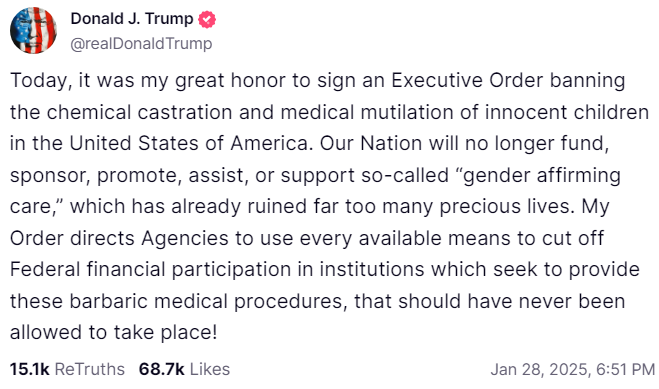
Protecting Children from Chemical and Surgical Mutilation — Executive Order

By the authority vested in me as President by the Constitution and the laws of the United States of America, it is hereby ordered:

Section 1.  Policy and Purpose.  Across the country today, medical professionals are maiming and sterilizing a growing number of impressionable children under the radical and false claim that adults can change a child’s sex through a series of irreversible medical interventions.  This dangerous trend will be a stain on our Nation’s history, and it must end.

Countless children soon regret that they have been mutilated and begin to grasp the horrifying tragedy that they will never be able to conceive children of their own or nurture their children through breastfeeding.  Moreover, these vulnerable youths’ medical bills may rise throughout their lifetimes, as they are often trapped with lifelong medical complications, a losing war with their own bodies, and, tragically, sterilization.

Accordingly, it is the policy of the United States that it will not fund, sponsor, promote, assist, or support the so-called “transition” of a child from one sex to another, and it will rigorously enforce all laws that prohibit or limit these destructive and life-altering procedures.

Sec. 2.  Definitions.  For the purposes of this order:

(a)  The term “child” or “children” means an individual or individuals under 19 years of age.

(b)  The term “pediatric” means relating to the medical care of a child.

(c)  The phrase “chemical and surgical mutilation” means the use of puberty blockers, including GnRH agonists and other interventions, to delay the onset or progression of normally timed puberty in an individual who does not identify as his or her sex; the use of sex hormones, such as androgen blockers, estrogen, progesterone, or testosterone, to align an individual’s physical appearance with an identity that differs from his or her sex; and surgical procedures that attempt to transform an individual’s physical appearance to align with an identity that differs from his or her sex or that attempt to alter or remove an individual’s sexual organs to minimize or destroy their natural biological functions.  This phrase sometimes is referred to as “gender affirming care.”

Continue reading “Protecting Children from Chemical and Surgical Mutilation — Executive Order”