The Second Lady was ringless during her visit to Camp Lejeune military base in Richlands, North Carolina on Wednesday with First Lady Melania Trump.
Photos show Usha, 39, getting off a plane with her left hand in full view – and the wedding band nowhere to be seen.
Second Lady Usha Vance was seen traveling to Marine Corps Base Camp Lejeune on Wednesday with her wedding finger noticeably bare
Additional images from Camp Lejeune and Marine Corps Air Station New River confirm the ring remained off throughout the visit.
The Vice President, meanwhile, was photographed wearing his wedding band during a speaking event in Washington on Thursday.
The image comes after weeks of nasty trolls whispering about the state of the Vance marriage, which began in October with the Vice President’s tight hug he gave to Erika Kirk during a memorial for her husband, the right wing activist Charlie Kirk.
The speculation about a possible rift between the Second Couple was fueled by the VP admitting that he has pleaded with his wife to convert from Hinduism: he is a Roman Catholic.
‘Therefore, O monks, do not brood over [any of these views]. Such brooding, O monks, is senseless, has nothing to do with genuine pure conduct (s. ādibrahmacariyaka-sīla), does not lead to aversion, detachment, extinction, nor to peace, to full comprehension, enlightenment and Nibbāna.[17]
This means that the Buddha did not have a rigid, verbalizable view of human metacognition.
The story above is silly for obvious reasons.
But it is a culturally clickbait-worthy story because both Christians and most Hindus hold rigid metacognitive ‘beliefs’ about their religions.
From a Buddhist point of view, rigid metacognitive beliefs or ‘views’ are:
‘Accompanied by suffering, distress, despair, & fever, and do not lead to disenchantment, dispassion, cessation; to calm, direct knowledge, full Awakening, Unbinding…
‘Whoever speculates about these things will go mad & experience vexation’.
In like manner so it is with all rigid meta-cognitive views on the self, our analyses of ourselves, our understanding of others, our political views, our scientific views, our religious and spiritual views.
In Buddhism, all metacognitive views should be open, pliable, moveable, viewed as impermanent, viewed with a healthy skepticism that allows us to focus on what is of greatest importance — the attainment of liberation through wholesome practice.
Buddhism must be experienced to be understood.
A battle between opposing metacognitive views, such as the one being implied in the story above, is a waste of Usha’s time, Vance’s time, and everyone’s time, except insofar as this example may help others understand the futility and unwholesomeness of being rigid in any metacognitive view about ultimate matters. ABN
A long-forgotten book, left out of the Bible and written nearly 1,900 years ago, reveals secret stories of Jesus’ childhood that the early church kept under wraps for centuries.
Known as the Infancy Gospel of Thomas, the text tells of Jesus performing miraculous feats, bringing clay birds to life, drawing water from a broken pitcher and healing a boy whose leg was injured by an axe.
But it also portrays a darker side, depicting Jesus as vengeful, even cursing a child to death for striking him on the shoulder.
After Jesus kills the child for accidentally bumping into him, the villagers become upset and complain to Joseph and Mary. In response to their accusations, Jesus strikes the accusers with blindness.
The omitted book begins when Jesus is just five years old, while the traditional Bible’s first mention is of him at 12 years old.
In another episode, Joseph takes Jesus to a teacher to learn the alphabet, and the teacher becomes irritated when Jesus laughs at his instructions.
The Infancy Gospel of Thomas was rejected by the early Church because it portrayed Jesus as a violent, petulant child and conflicted with orthodox Christian teachings.
Tucker does his usual schtick against collective identities, in favor of Christian ethics, and proclaiming he is not an anti-Semite, just a critic of Israel’s hold over U.S. policy. As always, it completely eludes Tucker that Jews like Mark Levin are never going to give up their Jewish identity and attachment to Israel, and that advocating that Whites eschew White identity politics is obviously a losing strategy in a world increasingly dominated by non-White identity politics. The overriding issue is that we must win this battle.
But the point is that Levin is really losing it on Tucker and showing his true genocidal character against the Palestinians. The intense hatred shown here by Levin is the real story and we should all realize how utterly common such hatred is among Jews. Such people are running the Israeli government and are the backbone of the West Bank settler movement. They dominate the pro-Israel Lobby throughout the West.
The fact is that whenever Jews have had power over non-Jews we see this genocidal hatred emerge. We recently posted Karl Nemmersdorf’s “Jewish Bolsheviks and Mass Murder: Rozalia Zemliachka and the Jews Responsible for the Bloodbath in Crimea, 1920″ which detailed Jewish involvement in mass murder in Crimea in 1920, a part of the much larger mass murder of Russians in the 1920s and 1930s perpetrated by the USSR and typically carried out by Jewish operatives.
…This reminds me of being bored listening to Levin’s FoxNews show where he was all about his love for the Constitution, etc. A true American patriot. Suddenly, when the Israel Lobby is on the defensive, we see the transformation into his real persona of genocidal hater.
The point is that the current Jewish animosity toward Russia and support for Ukraine doubtless reflect these traditional Jewish hatreds. And we see that same intense hatred and genocidal attitude in Mark Levin and the Israelis (not all, but the great majority who support the Netanyahu government) toward the Palestinians. Americans should ponder that fact that if Jewish power increases to the point that they can do what they want to White Christians whether in Russia or the West, it will be yet another horrifying bloodbath of mass murder.
UPDATE: The video above worked very well for me. I have a terrible past with somewhat related events and issues. Same kinds of perpetrators, same attitudes, same surreal cruelty. Whether Wick is honest or not, for me, does not matter because her interview works; whether she is describing reality or creating a work of art is fine with me. I tend to believe her. When you are in a position like hers, you know most people will doubt your story or dismiss it outright because there is nothing in their (mind-controlled) experience to allow them to see it.
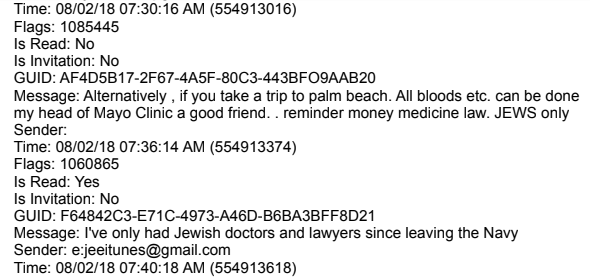
Epstein to Bannon: “Reminder. Money, medicine, law, JEWS only,” to which Bannon responds, “I’ve only had Jewish doctors and lawyers since leaving the Navy.” At least part of the Epstein story is about Jewish supremacy/exceptionalism, whatever you want to call it
I personally experienced serious criminal malpractice at the hands of a Jewish surgeon, who was obviously a militant Jewish Supremist. To this day, I fear JS doctors and so should you. ABN
Imagine infiltrating someone else’s religion to convince them they must worship you.
Huge sums of money and decades of clandestine skullduggery within Christian circles has led to precisely that outcome.
Jewish Supremists, by definition, hate everyone that is not them. They cannot be appeased or compromised with because they are psychopathic narcissists.
We saw it with the Jewish Supremist Bolsheviks in Russia and Eastern Europe, and we are seeing it again in Gaza today.
JS is also behind the destruction of the West and the Ukraine War, but that is less obvious for many. ABN
I have a tag on this site for ‘supremacy’ but may change it to Jewish Supremacy (JS) since it never comes up with any other group.
Chinese are ethnocentric to the max and want to be Number One in the world, but having known many Chinese I can confidently say they are not supremists; a bit loony about Chineseness sometimes but not supremists.
You can say the same for many other groups, maybe every other group.
White Supremacy today is a mind-control meme promoted by Jews, who invariably accuse others of their own behavior.
It’s a KOBK world at the top, where it pays to be psychopathic and hold absurd beliefs about yourself.
Since Gaza, when all can see the outcome of JS, I believe this is a good time to expose it as much as possible.
Expose it, mock it, analyze it, shit all over it.
It’s a terrible false belief system which has given rise to more evil in the past 125 years than anything else. ABN
Catholic charities were a major factor in Biden’s illegal immigration invasion. These bishops said nothing then. They have said nothing about the devastating illegal immigration invasion of Europe either. Mass immigration is an act of war. Having ‘compassion’ for the invaders but not the communities being invaded is not wise, and I doubt it is even sound Christianity. It is definitely not sound Buddhist thinking. ABN




 American Buddhist Net