The out of body part of this story is reasonable evidence that consciousness resides outside of the body and in some circumstances can be accessed as such.
Nowadays, philosophers and some physicists call that greater consciousness ‘mind at large’ or the ‘field of consciousness’ that underlies or inheres in all things.
Buddhists sometimes claim to have achieved awareness of that field of consciousness.
The Buddha is known as the Thus Come One and the Thus Gone One, meaning he came from that deep field of universal consciousness and went back into it when he achieved nirvana.
It’s a wonderful thing that medical science is seeing this side of sentient life and that the evidence for it has grown significantly in recent years. ABN
Out of 8 billion humans on Earth, only around 0.33% are women with Nordic features, blonde hair and blue or green eyes.
That makes these features rare, it makes us a minority and an endangered type on this planet.
Now, women with Nordic features are being openly targeted by the radical woke left’s self-hating ideologues who want to erase us because we’re apparently not “diverse” enough for their agenda.
Only 0.33% of humankind. Make that make sense.
If this were any other race, ethnicity, or group of people, there would be outrage.
“Equality & diversity” was never about true inclusion, it was always about the exclusion of white people and their replacement.
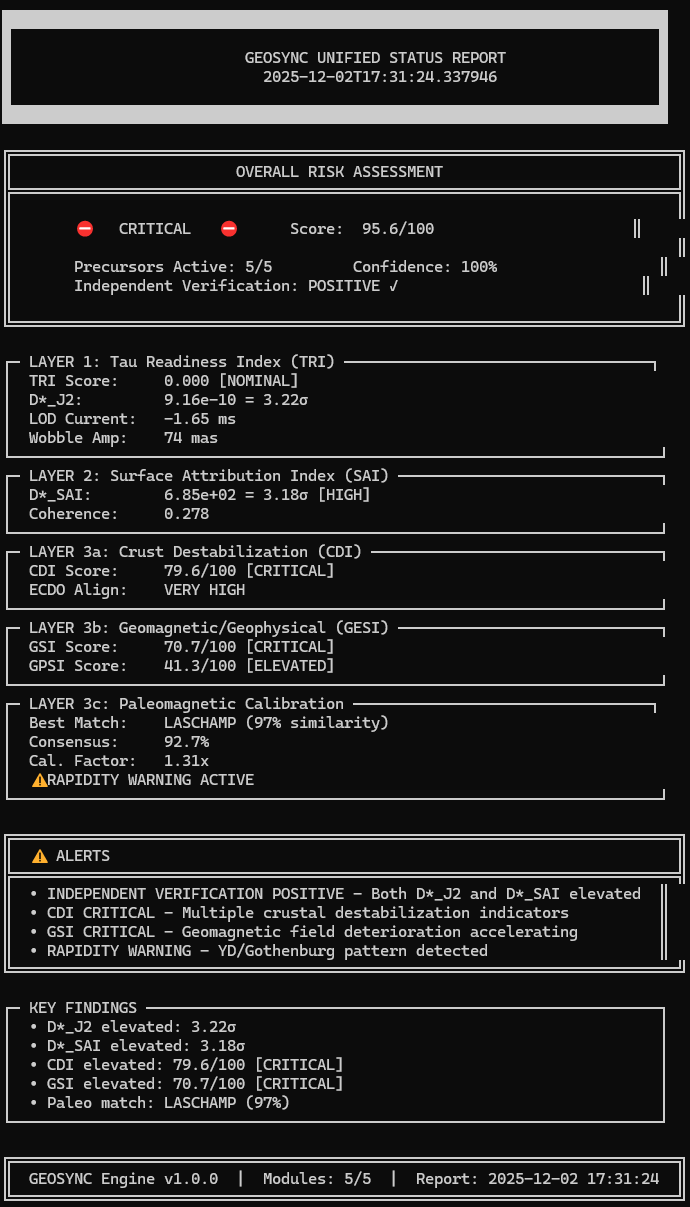
Over the past few months, I have spent several hundred hours building a live, physics-based monitoring system for Earth’s rotation, gravity field, magnetic field, and crustal activity. It uses only authoritative open data (IERS, GFZ, USGS, EONET, standard geomagnetic reconstructions).
Before I share more in a few weeks, I wanted to offer up a complete summary as it is now monitoring live and recording data. First, the system doesn’t assume any specific theory. It literally just watches, in physical units:
Paleo similarity: strongest match to documented excursion onsets (e.g. Laschamp)
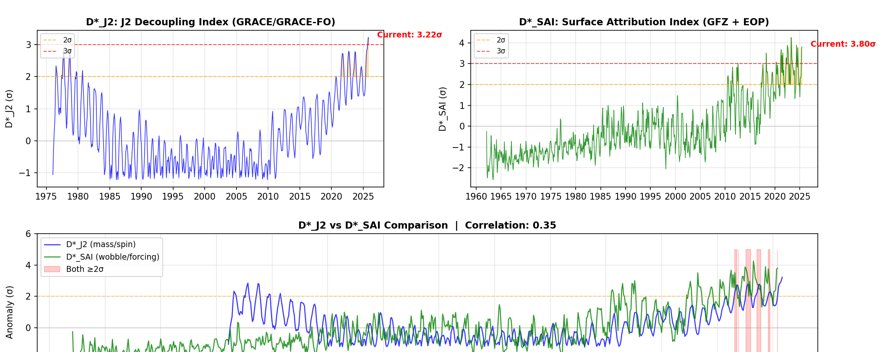
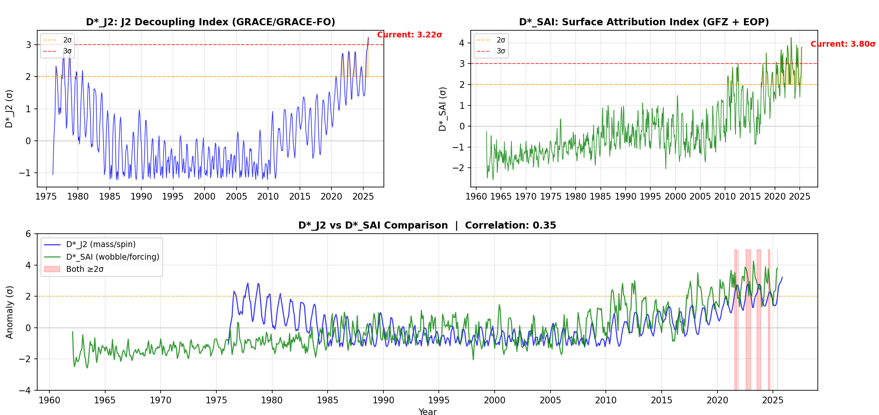
Both D* J2 and D* SAI are in highly anomalous states
Historically, you do see large J2 spikes or individual anomalies by themselves (namely in the 70s, with return to nominal conditions throughout the 80s) but the system recovered. However, what you do not see in the modern data is what we see now: high J2 + high SAI residual + critical geomagnetic stress + critical crustal stress + excursion-like paleo match, all at the same time. In other words, we are no longer in a “quiet, stable dipole” state on this planet.
We are in an excursion-like, high-stress phase of the Earth system, as far as rotation, geomagnetism, and crustal response are concerned.
There is absolutely no refuting this.
This does not mean I can tell you “what day something happens,” or guarantee any particular outcome with really any level of confidence. In my opinion though, only two broad paths exist at this point (and the paleo record does show both):
The system partially recovers (indicators relax, timelines stretch)
The system continues to deteriorate and commits to an excursion-class transition
Which path we’re on depends on how these indicators move from here.
If current deterioration persists or accelerates, the odds of a major reorganization in the coming years rise significantly. If key indicators stabilize or reverse (J2, SAI residual, field decay, pole drift, SAA behavior, crustal stress), risk stretches or falls.
However, based on the data, we entered an anomalous state roughly 50 years ago but underwent said recovery. Such a precursor-recovery-crisis pattern is documented in excursion literature (e.g. Laschamp). Early instabilities (like 1970s-80s D*_J2 spikes) probe the system but recover when the geomagnetic infrastructure is intact. Unfortunately,
50 years ago we did not have convergent, rapidly accelerating anomalous conditions across Earth rotation, geomagnetism, and crustal destabilization over known LLVPs as we do today. And we have already exceeded the peak instability of D*_J2 from back then.
Nevertheless, the point of GEOSYNC is to make that evolution measurable, not speculative.
With all of the above in mind, people have a right to know the present state:
Multi-σ departures from baseline in rotation/gravity
Synchronized anomalies in field behavior and crustal activity
A combined configuration that, in the modern record, has no prior analogue and looks most like known excursion phases in the paleo record
In the coming weeks, I will release:
The complete GEOSYNC v1.0 findings and outputs
Full indicator definitions
Comprehensive data library
Backtests showing when these metrics did not fire together
Live dashboards / logs so anyone can independently verify, critique, or falsify the framework using the same public data (possibly early 2026)
NOTE: Please, do not read too far into the similarity calibration to Laschamp. This is most likely because there is simply substantially more data and literature around Laschamp then just about any other excursion we have identified. More to come.
Scientists may have found the first evidence of primordial black holes, born in the very first seconds of the Big Bang. These tiny singularities can be smaller than a single atom but contain almost as much mass as our sun (artist’s impression)
Until now, no one has been able to prove that these bizarre, ancient objects exist.
But by looking for ripples in the fabric of spacetime, known as gravitational waves, researchers think they could have found the ‘smoking gun’ to prove they are real.
On November 12, the Laser Interferometer Gravitational–Wave Observatory (LIGO) and its European counterpart, Virgo, detected an unusual signal from deep space.
The gravitational wave looked like it was coming from colliding black holes, but was much smaller than any known black hole could possibly be.
If it wasn’t a glitch, the only remaining possibility is that the objects producing these faint ripples are the elusive primordial black holes.
Dr Djuna Croon, an astro–particle theorist at Durham University who was not involved in the observation, told Daily Mail: ‘If it’s real, then it’s enormous.’
A physicist has proposed a radical new theory of consciousness – and it could finally explain what happens when you die.
Consciousness does not emerge from human brains, according to Professor Maria Strømme, a professor of nanotechnology at Uppsala University.
Instead, she claims that it exists as a fundamental field.
If this is correct, ‘mysterious’ phenomena such as telepathy, near–death experiences, and even life after death could finally be explained by science.
According to Professor Strømme’s theory, consciousness does not end when we die.
Instead, when a person passes away, their consciousness simply returns to the background field.
Speaking to the Daily Mail, Professor Strømme explained: ‘The possibility that consciousness is fundamental has been under–explored. But that is changing rapidly.
‘We are reaching a point where asking deeper questions about consciousness is not philosophy on the margins — it is becoming a scientific necessity.’
This is not a new theory in the modern world or the ancient.
This is what many thinkers are saying today and what Mind-Only Buddhism has always been saying.
The vocabularies available today—quantum fields, localization, non-local—allow us to make descriptions of consciousness sharper for the modern mind.
Buddhist samadhi states (meditative states) may be thought of as the realization of the underlying quantum field of universal consciousness, or immersion of individual consciousness in that field or fields.
I personally think something like this is the actual structure of reality and why it is so important to live morally and have clear and honest mind.
I hope more understanding of human life along these lines, whether they are called Buddhist or not, will end human tribalism and the absurd values and beliefs that support it. ABN
This study explores how changes in the Earth’s gravity field, measured by the Gravity Recovery and Climate Experiment (GRACE) satellites between 2003 and 2015, can help us better understand the deep interior of our planet. These data may bring innovative information on mass redistributions near the boundary between the core and mantle. We detect an unusual gravity signal over the eastern Atlantic in early 2007 that evolved over several months and years. Around the same time, a distinct geomagnetic jerk was observed in the same region using satellite magnetic data. Our results suggest that this gravity signal originates deep within the Earth, near the base of the mantle. We propose that it may reflect rapid mass redistributions linked to a lower mantle mineral phase transition occurring in a thermally varied area at the base of deep mantle plumes, potentially causing dynamic changes in the core-mantle boundary’s shape over a few years.
Possible sign of geomagnetic excursion? I have no idea what this might mean but the information is relevant to the geomagnetic excursion worst-case scenario, and may be of interest to some readers. ABN
A Midwestern Doctor brings expert clarity to what people are getting wrong about DMSO — and what the real science shows it can actually do.
Dear readers, I have something special for you today, an exclusive interview with the author behind The Forgotten Side of Medicine, A Midwestern Doctor.
I know many of you have questions about DMSO — and I actually do, too. That’s why I asked
A Midwestern Doctor to have a back-and-forth conversation to get your most common questions about DMSO answered, along with other items.
A Midwestern Doctor’s work is so detailed and prolific that it’s almost hard to believe a single person can consistently publish 10,000-word reports with such ease.
But A Midwestern Doctor delivers every time, providing all the medical receipts so you can make truly informed decisions about your health.
Childfree people—people who do not have children and do not want to have children in the future—represent and large and growing percentage of the population in wealthy countries. However, less is known about childfree people in developing countries. To facilitate this research, we developed software to identify childfree people in data from the Demographic and Health Surveys. Using this software, we estimated the prevalence of childfree people in 51 developing countries. Among single women ages 15–29, we found substantial cross-national and within-region variation in childfree prevalence, ranging from 0.3% in Liberia to 15.6% in Papua New Guinea. We also estimated the association between being childfree and country-level indicators of human development, gender equality, and political freedom. Results suggest that the prevalence of childfree people in a country is associated with the country’s level of human development, and to a lesser extent their gender equality and political freedom. These results suggest that some developing countries have large populations of childfree people, and thus that being childfree is not a choice restricted to those living in the West or in wealthy countries. As developing countries evolve in terms of their human development, gender equality, and political freedom, it will be important to continue studying their childfree populations, both to understand demographic transitions in this part of the world, and to support its members’ reproductive health and other needs.
Modern genetic science keeps astonishing the world by unveiling long-buried secrets of the past.
In the quaint village of Ferste (Harz region, Lower Saxony), a DNA analysis of a local resident proved his lineage has been rooted here for over 3000 years. This isn’t just a tale—it’s a genetic thread spanning millennia.
Longtime Residents with a Millennial Legacy
In the serene village of Ferste, nestled in the picturesque Harz mountains of Lower Saxony, local resident Manfred Huchthausen always viewed his family as true natives.
“We’ve put down roots here ages ago,” he says. “But I had no idea just how far back they went.” The DNA analysis results hit like a thunderbolt: his family history stretches over 3000 years, positioning the Huchthausens among Europe’s oldest continuous lineages.
“The fundamental laws of physics cannot be contained within space and time, because they generate them. It has long been hoped, however, that a truly fundamental theory of everything could eventually describe all physical phenomena through computations grounded in these laws. Yet we have demonstrated that this is not possible. A complete and consistent description of reality requires something deeper—a form of understanding known as non-algorithmic understanding.”
Consequences of Undecidability in Physics on the Theory of Everything
General relativity treats spacetime as dynamical and exhibits its breakdown at singularities. This failure is interpreted as evidence that quantum gravity is not a theory formulated within spacetime; instead, it must explain the very emergence of spacetime from deeper quantum degrees of freedom, thereby resolving singularities. Quantum gravity is therefore envisaged as an axiomatic structure, and algorithmic calculations acting on these axioms are expected to generate spacetime. However, Gödel’s incompleteness theorems, Tarski’s undefinability theorem, and Chaitin’s information-theoretic incompleteness establish intrinsic limits on any such algorithmic programme. Together, these results imply that a wholly algorithmic “Theory of Everything” is impossible: certain facets of reality will remain computationally undecidable and can be accessed only through non-algorithmic understanding. We formalize this by constructing a “Meta-Theory of Everything” grounded in non-algorithmic understanding, showing how it can account for undecidable phenomena and demonstrating that the breakdown of computational descriptions of nature does not entail a breakdown of science. Because any putative simulation of the universe would itself be algorithmic, this framework also implies that the universe cannot be a simulation.
If conscious thought underlies everything, our ‘individual’ conscious minds should be able to experience it. In Buddhism, this would occur in samadhi states to some extent and in nirvana entirely.
This study is being trashed by some but it tends toward an interesting way of thinking or imagining. ABN
This comes from a small study of only 13 ‘vetted’ psychics. I find the mildly anti-Christian speculation at the end of this tape highly dubious. That said, the finding is interesting. Garry Nolan, among others, has postulated something along these lines. Below is the full study ABN
Study introduction:
Genetics of psychic ability – A pilot case-control exome sequencing study
Highlights
•Limited research has formally evaluated the genetics of psychic ability.
•This case-control study compared DNA of 13 vetted cases to 10 matched controls.
•One noncoding sequence was conserved in the wild-type form for all psychic cases.
Abstract
Introduction
It is commonly believed that psychic ability, like many mental and physical traits, runs in families. This suggests the presence of a genetic component. If such a component were found, it would constitute a biological marker of psychic ability and inform environmental or pharmacologic means of enhancing or suppressing this ability.
Methods
A case-control study design was used to evaluate differences between psychic cases and non-psychic controls. Over 3,000 candidates globally were screened through two online surveys to locate people who claimed they and other family members were psychic. Measures of relevance to the claimed abilities (e.g., absorption, empathy, schizotypy) were collected and based on those responses, individuals with indications of psychotic or delusional tendencies were excluded from further consideration. Eligible candidates were then interviewed and completed additional screening tests. Thirteen individuals were selected as the final “psychic cases,” and ten age-, sex-, and ethnicity-matched individuals with no claims of psychic ability were selected as controls. DNA from the saliva of these 23 participants was subjected to whole-exome sequencing. Two independent bioinformatics analyses were blindly applied to the sequenced data, one focusing exclusively on protein-coding sequences and another that also included some adjacent noncoding sequences.
Results
Sequencing data were obtained for all samples, except for one in the control group that did not pass the quality controls and was not included in further analyses. After unblinding the datasets, none of the protein-coding sequences (i.e., exons) showed any variation that discriminated between cases and controls. However, a difference was observed in the intron (i.e., non-protein-coding region) adjacent to an exon in the TNRC18 gene (Trinucleotide Repeat-Containing Gene 18 Protein) on chromosome 7. This variation, an alteration of GG to GA, was found in 7 of 9 controls and was absent from all psychic cases.
Discussion
The most conservative interpretation of these results is that they result from random population sampling. However, when the results are considered in relation to other lines of evidence, the results are more provocative. Further research is justified to replicate and extend these findings.
Transient star-like objects of unknown origin have been identified in the first Palomar Observatory Sky Survey (POSS-I) conducted prior to the first artificial satellite. We tested speculative hypotheses that some transients are related to nuclear weapons testing or unidentified anomalous phenomena (UAP) reports. A dataset comprising daily data (11/19/49—4/28/57) regarding identified transients, nuclear testing, and UAP reports was created (n = 2,718 days). Results revealed significant (p = .008) associations between nuclear testing and observed transients, with transients 45% more likely on dates within + /- 1 day of nuclear testing. For days on which at least one transient was identified, significant associations were noted between total number of transients and total number of independent UAP reports per date (p = 0.015). For every additional UAP reported on a given date, there was an 8.5% increase in number of transients identified. Small but significant (p = .008) associations between nuclear testing and number of UAP reports were also noted. Findings suggest associations beyond chance between occurrence of transients and both nuclear testing and UAP reports. These findings may help elucidate the nature of POSS-I transients and strengthen empirical support for the UAP phenomenon.
Evidence of non-human intelligence activity near US nuclear sites gains scientific validation
A groundbreaking study has just been published, providing verified evidence that something or someone was observing our nuclear sites from space long before the first human satellites were ever launched into orbit.
Dr Beatriz Villarroel from the Nordic Institute for Theoretical Physics in Sweden revealed a clear connection between nuclear tests between 1949 and 1957 and an increase in the number of mysterious bright spots called ‘transients’ appearing in the sky.
These transients are not believed to be a natural phenomenon, with Villarroel saying they showed signs of being highly reflective, like a mirror, and even spinning like a flying saucer.
The publication of these findings was a major milestone, as most papers discussing the existence of unidentified anomalous phenomena (UAPs) are rejected by the scientific community.
Having the work successfully peer-reviewed means other scientists have looked over the data and could not find anything to dismiss the team’s findings as just another unproven story about UFOs.





 American Buddhist Net