Exposure to extreme heat might accelerate aging in older adults, with sizzling weather causing them to fade faster, a new study suggests.
People living in neighborhoods with more days of high heat experience greater biological aging on average than people living in cooler climes, researchers reported Wednesday in the journal Science Advances.
“Participants living in areas where heat days, as defined as Extreme Caution or higher levels (90 degrees Fahrenheit or greater), occur half the year, such as Phoenix, Arizona, experienced up to 14 months of additional biological aging compared to those living in areas with fewer than 10 heat days per year,” lead researcher Eunyoung Choi, a postdoctoral scholar at the University of Southern California School of Gerontology, said in a news release.
Biological age tracks declining function in a body’s cells and systems, as opposed to chronological age based on a person’s birthdate, researchers explained in background notes.
A new study by an international team of scholars, including faculty at Binghamton University, suggests that Neanderthals experienced a dramatic loss of genetic variation during the course of their evolution, foreshadowing their eventual extinction.
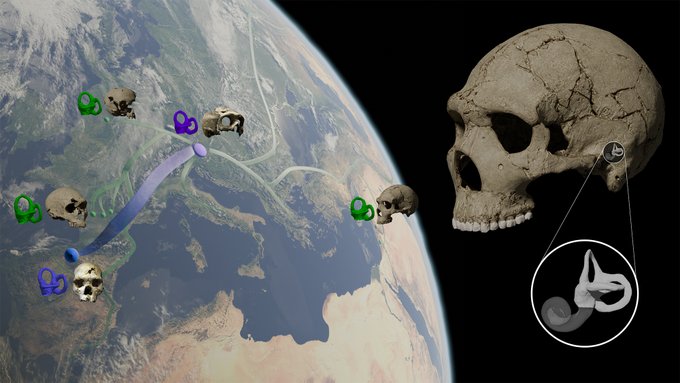
The study, co-authored by Professor of Anthropology Rolf Quam and graduate student Brian Keeling, measured the morphological diversity in the semicircular canals, structures of the inner ear responsible for our sense of balance, in two exceptional collections of human fossils from the sites of Atapuerca (Spain) and Krapina (Croatia), as well as from various European and Western Asian sites.
Geographic location of the studied samples, including Amud 1 (enlarged) and the virtual reconstruction of the semicircular canals. Image Credit: Alessandro Urcioli..
“The development of the inner ear structures is known to be under very tight genetic control, since they are fully formed at the time of birth,” said Quam. “This makes variation in the semicircular canals an ideal proxy for studying evolutionary relationships between species in the past since any differences between fossil specimens reflect underlying genetic differences. The present study represents a novel approach to estimating genetic diversity within Neandertal populations.”
The Atapuerca fossils—referred to as “pre-Neanderthals”—date to about 400,000 years ago and represent the earliest fossils that anthropologists consider clear Neandertal ancestors. The Neanderthals emerged around 250,000 years ago from these populations which inhabited the Eurasian continent between 500,000 and 250,000 years ago. The Croatian site of Krapina represents the most complete collection of early Neanderthals and dates to approximately 130,000 years ago. The researchers calculated the amount of morphological diversity (i.e., disparity) of the semicircular canals of both samples, comparing them with each other and with a sample of “classic” Neanderthals of different ages and geographical origins.
Researchers have uncovered a new way that cells control their genes — and it may rewrite our understanding of “epigenetics.”
Epigenetics is a form of DNA modification that doesn’t affect the DNA sequence itself. Instead, it describes when chemical groups attach to specific genes, thus switching those genes on or off, or else changing the 3D shape of chromosomes.
Now, in a study published Jan. 17 in the journal Cell, researchers have uncovered a whole new method of gene regulation that involves epigenetic tweaks made to both DNA and its molecular cousin RNA, at the same time.
This discovery challenges the established view that these RNA- and DNA-modifying processes are completely separate, and it suggests that it may have broader implications in human biology and disease. To that end, Fuks and his team are trying to determine how this new mechanism relates to cancer.
By the authority vested in me as President by the Constitution and the laws of the United States of America, it is hereby ordered:
Section 1. Policy and Purpose. Across the country today, medical professionals are maiming and sterilizing a growing number of impressionable children under the radical and false claim that adults can change a child’s sex through a series of irreversible medical interventions. This dangerous trend will be a stain on our Nation’s history, and it must end.
Countless children soon regret that they have been mutilated and begin to grasp the horrifying tragedy that they will never be able to conceive children of their own or nurture their children through breastfeeding. Moreover, these vulnerable youths’ medical bills may rise throughout their lifetimes, as they are often trapped with lifelong medical complications, a losing war with their own bodies, and, tragically, sterilization.
Accordingly, it is the policy of the United States that it will not fund, sponsor, promote, assist, or support the so-called “transition” of a child from one sex to another, and it will rigorously enforce all laws that prohibit or limit these destructive and life-altering procedures.
Sec. 2. Definitions. For the purposes of this order:
(a) The term “child” or “children” means an individual or individuals under 19 years of age.
(b) The term “pediatric” means relating to the medical care of a child.
(c) The phrase “chemical and surgical mutilation” means the use of puberty blockers, including GnRH agonists and other interventions, to delay the onset or progression of normally timed puberty in an individual who does not identify as his or her sex; the use of sex hormones, such as androgen blockers, estrogen, progesterone, or testosterone, to align an individual’s physical appearance with an identity that differs from his or her sex; and surgical procedures that attempt to transform an individual’s physical appearance to align with an identity that differs from his or her sex or that attempt to alter or remove an individual’s sexual organs to minimize or destroy their natural biological functions. This phrase sometimes is referred to as “gender affirming care.”
A new study published in Research in Social Stratification and Mobility suggests that the transmission of cognitive ability from parents to children is primarily driven by genetics, with little influence from shared environmental factors like family resources. The findings challenge traditional assumptions in social mobility research that often attribute these correlations primarily to socio-economic status..
..The German TwinLife survey is a large, longitudinal study designed to explore the interplay between genetic and environmental factors in shaping various life outcomes, including cognitive abilities, educational attainment, and social mobility. The survey focuses on same-sex twin pairs and their biological families, enabling researchers to separate the effects of genetic inheritance from those of shared family environments. For example, monozygotic twins, who share 100% of their genetic material, can be compared with dizygotic twins, who share about 50% of their genetic material, to estimate the relative contributions of genetic and environmental factors.
By incorporating multiple family members—including parents and siblings—across four birth cohorts, the survey spans an extensive developmental range, from early childhood (ages 5–6) to young adulthood (ages 21–25). This breadth allows researchers to examine how genetic and environmental influences evolve over the life course.
…The results provided evidence that the intergenerational transmission of cognitive ability is driven primarily by genetic inheritance rather than shared environmental factors. Across all age groups examined, the researchers found minimal evidence that parental cognitive ability significantly influenced children’s cognitive development through environmental mechanisms. Instead, the observed similarities in cognitive abilities between parents and children were largely attributed to shared genetic factors.
…“The key takeaway is that the similarity in cognitive ability between parents and children appears to be driven primarily by shared genes rather than shared environment. While we often assume that parents influence their children’s cognitive development through factors like education style, resources, and parenting, our study finds little evidence for environmental transmission that occurs through parental cognitive ability specifically.”
So much for white privilege. White people have amply demonstrated that they have the right kinds of genes to produce massive complex civilizations that function well. Obviously, the obverse is just as true — peoples who do not form well-functioning complex civilizations probably lack the genetics to do so. I do think white and Chinese, Japanese, Koreans and some others have a moral obligation to help less endowed parts of the world. But I do not think we are in any way required to admit millions of people who, no matter the DEI given them, will never be able to perform in ways that assist or improve complex societies made up of people not of their genetic endowment. I myself can speak Chinese and like many aspects of Chinese culture and am able to succeed in China, but prefer living in USA. The genetic endowment is different. China is a shame culture based on hierarchies. The West is a guilt culture based on limited but substantial personal freedoms. ABN
UPDATE: Another point is within white societies, many whites, including highly intelligent ones, are perfectly content doing menial and blue collar jobs without complaint. White people at all levels are pretty good are cooperating with each other and honest enough that most laws are largely followed and most jobs are done conscientiously. When POCs and Jews screech and complain, most whites have no defenses, or inadequate ones to perceive the situation clearly, because when whites scream and complain most whites will believe there must be a good reason for it. Jews have used this trick against whites for the entire modern era in the West and backed it up with clandestine violence when screaming alone is not sufficiently effective. To this day, the vast majority of whites are incapable of grasping how that technique works on them and how it is being used against them. The most distressing side of this situation is the majority of whites who hold positions of power today are whites who passed the obedience mind-control tests and have not been poisoned or disabled by clandestine operatives, often posing as friends. ABN
…In 2019, two major studies were published which gave some of the strongest evidence yet to the theory.
…So while Proto-Indo-Europeans expanded out of the Pontic-Caspian Steppe in all directions, it was their later Northern European branch which mixed with native European farmers that then expanded back eastward and became the founders of Vedic civilisation.
…Written between 1,500-1,000 BC, the Rigveda is one of the foundational Hindu texts — one of the four Vedas, and the oldest Vedic Sanskrit text. It records the story of the Aryan incursion into India and their encounter with the local populations.
The Indo-Iranian peoples apparently referred to themselves as “Aryans”, meaning “noble” or “civilised”. An inscription on the tomb of Darius the Great uses the term “Ariya” to describe the Iranian people, apparently describing Darius as an “Aryan of Aryan descent.” In Avestan, the liturgical language of Zoroastrianism, “Airyanem Vaejah” is used to describe an ancient “Aryan expanse” which was the homeland of the Iranian people. Similarly, the Sanskrit term ārya, meaning noble, is used throughout the Rigveda to describe the conquerors who subdued the native Indians, who are referred to as Dasa/Dasyu.
I am a bit disappointed in this essay because it misses so much of what really happened in the ancient world, but it is worth reading due to the genetic information presented and its discussion of the Rigveda.
‘Aryan’ is the root source of the name Chinese use for themselves to this day — ‘huaren‘ (華人). It is also the source for the name of the earliest Chinese dynasty, the Xia Dynasty (夏朝). This shows that the expanse of ancient Aryan peoples included also Tocharians in Northeast Asia, where they had a very significant influence on the development of Chinese, Korean, Mongolian and Japanese civilizations.
Aryan peoples are largely synonymous with Scythians, who ruled Central Asia for many centuries, dating back to their invention of the chariot, circa 2,000 BCE, which is why horses were so important in their spread and dominance. It is entirely ridiculous to feel proud today that you have Aryan ancestry (many people do) or that Indian civilization owes nothing to the Aryans.
Incidentally, the Buddha himself was Aryan or Scythian. When he is called Shakyamuni, the name literally means ‘sage of the Scythians’. The Buddha is often referred to as an Aryan in traditional Buddhist texts. The only physical description we have of Shakyamuni Buddha says his eyes were blue. It is ridiculous to be either proud of ancestry from Aryans or ashamed of not being Aryan or having been conquered by them. All peoples everywhere have been conquered and enslaved, and conquered and enslaved others.
Read the works of Christopher Beckwith for a much more detailed and expansive take on this subject. For Buddhists, I highly recommend his book, Greek Buddha: Pyrrho’s Encounter with Early Buddhism in Central Asia. Beckwith claims Aryan dominance and deep influence in all of the cultures bordering Central Asia was not particularly violent but rather resulted from Aryan/ Scythian males settling in a region and mating with the local women. This led to the formation of many creole languages with prominent Indo-European words and features. ABN
All known life is homochiral. DNA and RNA are made from “righthanded” nucleotides, and proteins are made from “left-handed” amino acids. Driven by curiosity and plausible applications, some researchers had begun work toward creating lifeforms composed entirely of mirror-image biological molecules. Such mirror organisms would constitute a radical departure from known life, and their creation warrants careful consideration. The capability to create mirror life is likely at least a decade away and would require large investments and major technical advances; we thus have an opportunity to consider and preempt risks before they are realized. Here, we draw on an indepth analysis of current technical barriers, how they might be eroded by technological progress, and what we deem to be unprecedented and largely overlooked risks (1). We call for broader discussion among the global research community, policy-makers, research funders, industry, civil society, and the public to chart an appropriate path forward.






 American Buddhist Net