In a previous post, I introduced the concept of semiotic wells. A semiotic well is like a space-time “gravitational well” within a semiotic network. By this, I mean that part of the semiotic network has some heavy things in it—primary semiotics that pull other nodes within the network toward them.
For example, someone with the view that they have some sort of personality will tend to associate many of their perceptions and thoughts with the features of that personality. Their belief in their personality type will tend to make them see and understand the world in those terms.
I doubt that “having” a personality is all that much different from having a hobby. And I bet most people can move from one personality type to another about as easily as they can move from one hobby to another.
Of course there are constraints and limitations in the development of hobbies just as there are in the development of personalities.
We can gain profitable understanding of the mind by conceiving of it as a network of semiotic units. It is a network because the semiotic elements of the mind are all interconnected. It does not take much imagination to connect any semiotic element in your mind to any other. Apple-red-communism. Or apple-pie-American.
By association we can connect anything in this way.
Every semiotic element in the mind has a valence. In different contexts, the valences for any element will differ, and oftentimes they are neutral, but they are there. A semiotic well organizes valences as well as meaning, intention, belief, value.
For some people, speech is used to socialize, to make friends, to gain and keep access to other people. The valence of major parts of their semiotic network is aimed at socializing with others. People of this type are pleasantly excited when others compliment or reciprocate their social valences.
In contrast, for some other people, speech is used to share ideas, to analyze, to teach and to learn. The valences of their semiotic networks are primarily aimed at sharing ideas. People of this type are pleasantly excited when others reciprocate these valences.
Many semiotic wells and semiotic valences are formed accidentally, randomly, arbitrarily. Once we take on any bit of meaning, even if only slightly, there is always a chance that it will snowball into a significant semiotic well.
The Beatles alluded to this when they sang Had it been another day/ I might have looked the other way/ And I’d have never been aware/ But as it is I dream of her tonight.
This doesn’t just happen with love but with many of our other interests. We form semiotic wells—sometimes very quickly—for what are often very trivial reasons or no reason at all.
Much of what we are comes about through accident or chance. This happens because semiotics and the ways valences become attached to them are frequently very simple. Once a semiotic well begins forming it often grows, and as it does it pulls in or rearranges elements from other parts of our semiotic network.
Once a well is formed or given to us, it can greatly determine how we perceive the world and what we value in it.
This is why propaganda succeeds so well, and is sort of easy to do if you have a lot of money and access to important public forums. All a propagandist has to do is start your mind in one direction and then add more information and more valence. Most people see the world in terms of simple dichotomies, so all the propagandist needs to do is decide what they want and contrast it favorably against what they don’t want.
Want war? Make the public perceive the enemy you want as an enemy, then add info while increasing valence. Columnists will write many thousands of words about the desired war, but the basic sociology of it for the general public is always very simple.
Of course sometimes the trick fails. With Syria the basic formula—terrorists/poison gas/war—failed, probably because the public had been fooled too many times before with similar formulas (Sadam/WMD/war).
If you can see past words and feelings to the core of the semiotic well, you will see that many things in this world are quite simple. It is no accident that people communicate largely in very simple terms.
Edit 2/26/15: The article linked below is an excellent example of how a single semiotic is functioning differently in different cultures. Well, there is more than one, but the examples are very clear and concrete. The contention that lies behind FIML practice is that all people all of the time hold many idiosyncratic semiotics and that when they communicate, these idiosyncratic semiotics can have a huge effect on how they listen and what they say. Idiosyncrasies may have cultural origins or they may arise from subjective states or simply be arbitrary. The idiosyncratic individual (all people everywhere at all times) is like a mini-culture. FIML practice is done between two idiosyncratic individuals who are close to each other, care about each other, and spend a significant amount of time together. It is designed to help partners understand how their idiosyncrasies can and do cause misunderstandings, some of which may snowball into serious conflicts when at heart there never was much of anything there save different views of the same semiotic.
If you have been studying or reading about FIML but still don’t quite see what is meant by semiotics or how they function in real-world settings, please be sure to read the article liked below and also here. The semiotics of controller design.
I thought you would find this interesting. The amount of consideration that goes into something so simple makes it practically impossible to experience anything directly without FIML and meditative insight.
The article discusses the meaning of a couple of signs on PlayStation controllers. It shows how cultural inculcation led Japanese and Americans to understand those signs very differently. So differently, in fact, Sony had to change the buttons (or “localize” them) for the American audience.
Most of us will find the linked article understandable and most of us will be able to appreciate how acculturation can and does lead us to perceive signs and symbols differently.
If you can see this it is but a short step to see that individuals do the same. Each of us perceives or understands signs and symbols in ways that are unique to us. As my friend says, it is “practically impossible to experience anything directly without FIML and meditative insight.”
How could it be otherwise? How can anyone expect to understand and be understood intimately without frequent and extensive discussion of what semiotics mean to them and their partner(s)?
Many people claim they don’t have time for discussions like that, and for some I think that is true. For the rest, I don’t agree.
In any case, before long we will have super-smart robots and brain-to-machine interfaces that will utterly change the way we perceive each other as well as “reality” itself.
When that day comes, we bio-humans will have the time and we will have the inclination to buckle down and do the work needed to really understand each other.
In the future, I expect something like FIML will be a major standard for human-to-human communication. When the machines are miles ahead of us, we will at last relent and really try to understand rather than just manage or control each other.
Today I want to discuss how you can grasp the semiotics that form the basis of your consciousness.
I am sure you already understand a good deal about yourself, but my guess is your understanding is probably in the form of a group of abstractions, such as—“my personality is thus-and-so”; “since I had this sort of childhood/education/etc., I am now outgoing/fearful/frugal/etc.”; “I believe in personal responsibility/behavior/etc.”; “my mom was a religious nut so I am an atheist, etc.”
In the post cited above, we used the terms signaling system and semiotics more or less interchangeably. A signaling system emphasizes what the message is and how it is sent, while semiotics emphasizes how the message is interpreted.
If we think of our minds as being signaling systems that are constantly referring to whatever semiotics we interpret as “true” or “real,” we can get a very good idea of how they function in the moment by observing what they are referring to in “the moment” (1-10 seconds, or so). By observing our minds closely, we can learn what semiotics cause us to have emotional responses or to interpret things in the ways we do. We can see how our mental/emotional signaling system builds up within us the appearance of a self with a biography, a personality, needs, fears, desires, goals, and so on.
If, for example, at some point in your life you learned and accepted as real a semiotic that you are stupid, you can spend hours, even decades, analyzing your feelings without getting any results. But if you can actually watch your mind as it signals to itself the semiotic “I am stupid,” and if you can see while that is happening that the signal is a mistake, then your mind will tend to stop sending you that signal.
If you can repeat that experience a few times—that is, catch that same mistake a few times—your mind will almost certainly stop wasting its resources thinking you are stupid. It will do this almost effortlessly because the mind is efficient and won’t waste time doing something it knows is a mistake.
So how do you do that, how do you catch the mistakes? You probably have already tried to catch them through introspection, reading, or discussing them with friends with less than satisfying results.
And what’s even harder to do is catch mistakes that you are not even aware of. How do you catch them?
I don’t think you can do it all by yourself. And I don’t think you can make satisfying progress by discussing these matters even with very wise friends. You can’t do it yourself because you can’t see yourself, and you can’t do it through long discussions because the signalling system works too quickly for that.
If you don’t cut in quickly and observe what it is doing, you won’t be able to change it easily.
Here is a way to look at that. Have you ever had a clock or mirror on the wall that was removed; maybe the mirror fell or the clock broke. At some point, the object that you had been used to seeing for years was gone. For some time after that, you probably turned unconsciously more than a few times to look at the now absent mirror or clock. That gives a strange feeling because at moments like that we see how deeply unconscious signs (the clock or mirror) affect our sense of who we are.
After a while we get used to the bare wall, but the lesson in how deeply signs operate within us should be clear. The other lesson of how we can indeed change our reference or expectation from a wall with a clock or mirror to a wall without either should also be clear.
At first, the mind is surprised, but after a while, it accepts that there is no clock on the wall with little fuss.
When two people do FIML(note: this link will lead to recent posts and reposts, including this one, but just scroll down a bit for more) practice, they help each other remove broken clocks and mirrors from the walls of their minds. FIML strongly emphasizes catching the signal and the semiotic it is referring to as quickly as you can. If partners can isolate their signals quickly, they will find that they are dealing with very small and discrete signs that very, very often are not true.
Normal people live in vague worlds where they grope toward each other like ghosts in the fog. How can we understand each other or ourselves if we do not pay attention to the small signals that are, arguably, the most important units of interpersonal communication?
And how can you pay attention to them if you don’t catch them quickly in the moment? If you try to understand yourself through long explanations and stories, you will only be understanding the underlying semiotic library that your moment-by-moment signals are referring to. If you catch those small signals as they happen in the moment, though, you will come to understand how and why that library is being accessed and how that affects you.
When your partner shows you that one of your signals was wrong and that it was referring to a part of the library that had no proper bearing on that moment, and when they show you that again, and again, that particular signal will stop firing. And there is a very good chance your library will change as well. It will change you deeply to see that.
The Bundy ranch issue in Nevada is characterized by a battle over semiotics.
The other day, the New York Times used an edited video of Bundy that makes him look and sound like a racist.
This link compares the NYT video with a fuller version of Bundy’s remarks.
And here is another link where former U.N. Ambassador Alan Keyes, identified as a “black leader,“ defends Bundy, saying:
He wasn’t talking so much about black folks, but about the harm and damage that the leftist socialism has done to blacks.
What I see and hear in the longer version of the video is an unsophisticated man using ordinary language to express a legitimate idea. The way he puts his ideas and his use of the word “negro,” especially in the shorter version of the video, creates a bad impression which Harry Reid has been quick to exploit.
Reid has called Bundy a “hateful racist” and urged Republicans and other to “condemn Bundy” for his “hateful, dangerous extremism.”
Notice how your own feelings can go back and forth on this issue and how Bundy’s comments are probably going to destroy most of his support. In the realm of political semiotics, he was like an untrained boxer stepping into the ring with a pro. All Reid had to do was wait for Bundy to make a bad move and pounce, as he has done.
Whatever you may think about Bundy or this issue it is illustrative of how unsophisticated language can create a semiotic that is devastating to a political position.
Bundy rose to prominence on the semiotics of freedom, cowboys, and anti-federal government. He may well fall on the semiotics of unintended “racism.”
As with so many other complex issues, the Budy ranch standoff is being judged on small aspects of the whole, as the main weight of American political and media forces line up against him.
When that same political/media weight lines up in favor of “nice” semiotics—such as the Patriot Act or the Clean Air Act or the War on Terrorism—it wins the day time and again. The combination of sophisticated semiotics and media control almost always decides the course of American politics.
A co-author of a recent scholarly study on the American “oligarchy” has this to say about American politics:
I’d say that contrary to what decades of political science research might lead you to believe, ordinary citizens have virtually no influence over what their government does in the United States. And economic elites and interest groups, especially those representing business, have a substantial degree of influence. Government policy-making over the last few decades reflects the preferences of those groups — of economic elites and of organized interests. (Source, with other links)
We are now living in a “Semiotic Age” or an “Age of Signals.” The Modern era is gone. In this current age, we have to be ever mindful of how semiotics are manipulated and used to further the interests of powerful groups that have control of media, government, and the US economy. I do not believe there is a humble person anywhere in the USA that can stand up to those forces and win.
___________________
Edit: Readers may also want to notice that the short video version of Bundy’s comments was edited by Media Matters for America, a well-funded group that claims it is “dedicated to comprehensively monitoring, analyzing, and correcting conservative misinformation in the U.S. media.” This group, and others, will very likely continue to use Bundy’s “racism” to slur what they will call Bundy’s “ultra right-wing” supporters, many of whom will make semiotic mistakes as bad or worse than Bundy’s. An individual going up against Media Matters, Harry Reid, the New York Times, or the Democratic Party is like a Baltic peasant going up against the Teutonic knights in the Middle Ages. They don’t have a prayer.
As a nation, I believe there is no hope for rational dialog on anything, but as individuals, we can understand our predicament.
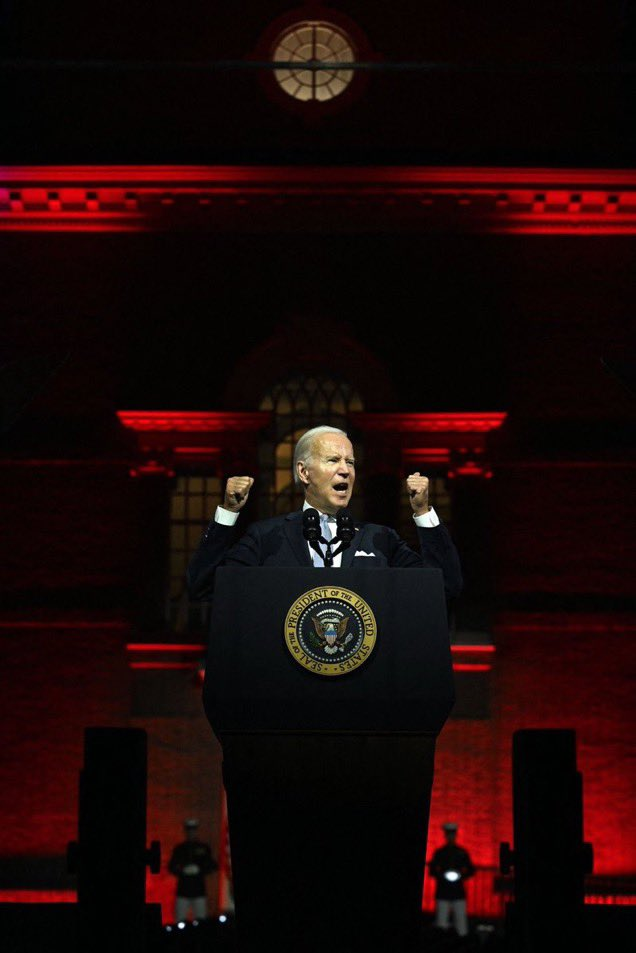
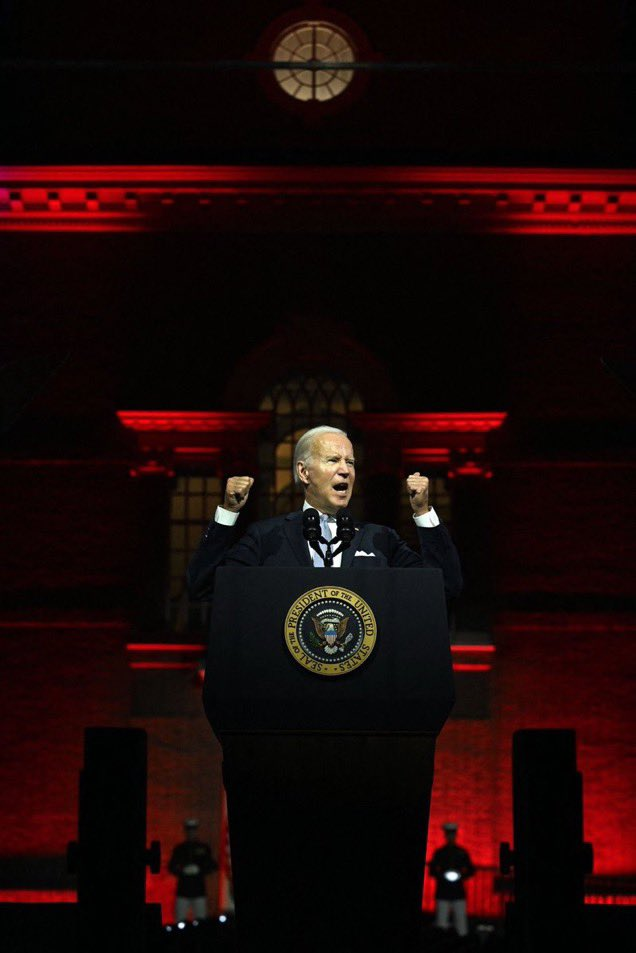
A significant line is now being crossed, appropriately symbolized by this image. We are being forced to openly recognize we are being ruled by an occupation government, an illegitimate government. And they are being forced to defend it. ABN
Is that a Satanic stage set? Who is the real holder of power in USA? Who is controlling Biden’s controllers? Our country is being run by a secret government and we do not even know who they are. We do know something very similar is happening in Europe, Australia, Canada, and New Zealand, so there must be a group at the top. And probably someone at the top of that group. Who are they? They usurped power gradually over the past 70 years. The anomaly of Donald Trump drove them into a frenzy, a frenzy we are still witnessing today. Is that a Satanic stage set? Is that a clue to who they are? ABN
I usually prefer to stay away from the ancillary stuff, but the remarks by Joe Biden today were not normal, not even close.
Every national address by a president has a massive advance team checking every detail of a venue before broadcast. The optics they put together for Biden’s “battle for the soul of a nation” speech tonight, was just plain creepy and weird. I mean think about it, what does this imagery present when discussing the theme of battling for the soul of a nation?
These are not modified images or changes in presentation; they are exactly what was broadcast to the nation. It looks straight up evil. Like something out of a hellscape theatrical production intended to showcase Baal as the “soul of the nation.”
On one hand, this is the realistic tone of the Biden administration. But on the other hand, you would not expect to see this harsh dictatorship enhanced with the backdrop to give it such angered imagery. I have never seen anything even close to this in a presidential address. Beyond creepy.
The word persona comes from Latin, where it originally meant a “theatrical mask.” In everyday usage today, we normally mean it to indicate a “social role” that, to some extent, most of us play consciously.
Carl Jung used the concept of persona to indicate the deep sense in which a person employs conscious and subconscious methods to present a social face, or mask, to the world.
Jung said of his use of the word persona that it is “a kind of mask, designed on the one hand to make a definite impression upon others, and on the other to conceal the true nature of the individual.” (C. G. Jung, Two Essays on Analytical Psychology London 1953 p. 190)
My understanding of Jung’s psychology is that he took the persona to be something more substantial—more real—than it need be. In my view, when we take our persona(s) too seriously, we reify them, even fetishize them.
Once fetishized or reified, the persona in Jungian psychology takes on almost supernatural qualities, eventually requiring “disintegration” followed after some time by “restoration” as a more conscious and reasonable thing that can serve both personal and social needs without painful contradictions.
I believe this Jungian sense of the term persona has had a considerable influence on our ordinary sense of what a personality is.
In this light, I would contend that what we commonly refer to as personality is a ghostly generalization that obscures both inner-private and outer-social reality.
Belief in “personality” removes analysis of interpersonal-being-in-this-world from actual specifics to nebulous generalities.
If you have a conflict or misunderstanding with a friend and either of you believes it is due to “personality differences,” you will tend to avoid the problem rather than fix it. You will avoid it because it is all but impossible to fix anything with such a vague notion as personalty.
Assuming the two friends just mentioned are close friends, they would do much better to identify the specific moment their misunderstanding occurred and work with that.
People today do not normally do this for two reasons: 1) almost everyone believes in something like “personality” and in so believing makes it impossible to fix even small moments of discord, and 2) very few people know how to fix those sorts of problems even if they do realize that more is going on than two ghostly persona clashing in a mystical realm.
I agree that people need personas to negotiate many social and professional environments. And I agree that most people have a few traits that often remain sort of constant over time and in similar contexts.
What I do not agree with is everything else we normally attribute to personalities. In place of all that, I would substitute the idea that humans are semiotic entities and that we communicate with each other and within ourselves by using semiotics and semiotic networks.
Our interests and training lead us to emphasize some parts of these networks over others, but this does not constitute a “personality” as the word is normally used.
Suffering arises when we experience bad communication. Belief in personalities masks (ironically) the true nature of communication problems. Belief in personalities causes us to generalize when we should be looking very closely at the specific moment during communication that the semiotic networks of the two (or more) communicators began to diverge.
That is the point at which their interpretations began to differ and nothing will explain why they began to differ except close analysis of that precise moment.
People do not analyze the precise moment their interpretations of each other began to differ because they do not know how. In place of analysis, people almost always generate strong emotions and within seconds make it impossible to analyze anything.
It is not your personality or theirs that does this. It is, rather, our lousy abilities to communicate, a problem everyone in the world has. We are like monkeys in a high-powered automobile all but doomed to crash, or go nowhere.
How to drive that car? How can we catch the specific moment interpersonal interpretations diverge? And how can we analyze that moment? Only FIML practice or something very much like it will allow us to do that.
Wasting time analyzing your personality or constructing an even better one will get you nothing more than a theatrical mask, a persona, that will be useful in some social situations but a disaster in all close interpersonal relationships.
Purchasing advertising in the national market. The new marketing and branding group behind Florida Governor Ron DeSantis purchase ad time on Tucker Carlson and Sean Hannity broadcasts. Marketing nationally, and purchasing expensive full minute ad buys targeting the Fox News audience, is confirmation DeSantis has unofficially entered the 2024 campaign race.
All doubts about DeSantis ’24 should be put to rest. As CTH has noted since August 8th [SEE HERE], the professional political managing of Ron DeSantis for a presidential run has become increasingly clear.
The Florida governor went silent following the raid on Mar-a-Lago, sending one tweet from his private account, then remaining in a bunker for the next five days. No doubt he agreed to stay silent at the guidance of the club managers behind his new political construct [that group almost certainly likely knew in advance of the FBI raid]. He exited the bunker with a new press secretary and national brand image launch. Here’s the NATIONAL ad:
.
Once you see the strings on the marionettes you can never unsee them. The GOPe club uses the same play book. If you pulled a focus group of never-trumpers, then watched them discuss their snarky view of the MAGA voters they hate, then packaged that conversation into a targeted ad, this ‘cringeworthy’ outcome is exactly what you get.
The GOPe club are targeting MAGA voters by providing a manufactured and managed alternative to Donald Trump. That’s why you feel a little cringy when you watch the ad. The inauthentic nature transmits within the implied message.
The presumptive mom is actually mouthing the rehearsed speech of her presumptive child, then tears up for the camera when it shines on her. You decide.
Name-calling and ostracism as described by Vlaardingerbroek is a common form of mind-control used by legacy media and the state, which shows there is little difference between the two. During covid, “anti-vaxxer” was used in this way to frighten people away from what should have been a very ordinary and absolutely necessary debate about the vaccines, including knowing WTF is in them, something we still do not know. To be an aware citizen in today’s world you have to fully understand mind-control techniques and be able to stand your ground when they are used against you. ABN
ABN has gained many more readers since coverage of covid and other matters became of more pressing importance. They still are more pressing since our very existence as a free society is at stake.
That said, please do your best to understand and practice FIML with your spouse or best friend. FIML is a life-changing practice that will reveal the building blocks of both of your makeups in a most wonderful way.
Positive change through FIML is easy in the sense that each building block is small. Being small, they are easy to analyze and not difficult to accept if we see we are in the wrong. This promotes rapid incremental transformation for the better.
A little change here, a little change there, patterns are recognized and rather easily transformed into something much more adaptive, real, appropriate for your lives. No theory or concept of personality is necessary. No training in psychotherapy is necessary.
The simple dynamic of FIML done honestly and in friendship will help both of you feel much better and be much more authentic to yourselves. FIML is a process, a dynamic method. It has no other content save what you bring to it. ABN



 American Buddhist Net