Imagine a world where your thoughts no longer live silently inside your head—where machines can decode what you see, feel, or even intend to say. Mind reading technology, once the stuff of science fiction, is now edging into reality through the rapid evolution of neuroscience and artificial intelligence. From brain-computer interfaces that allow paralyzed patients to move robotic limbs, to neural decoding systems that can reconstruct images directly from brain signals, the line between imagination and reality is fading fast.
So, what is mind reading technology? It’s not mystical telepathy, but a scientific field focused on interpreting brain activity patterns using sensors, algorithms, and AI. Modern research uses techniques like fMRI (functional magnetic resonance imaging) and EEG (electroencephalography) to translate neural signals into recognizable outputs—such as speech, visual images, or emotional states. In simple terms, when we ask, how does mind reading technology work, the answer lies in reading the brain’s electrical and chemical language and turning it into digital data that computers can understand.
But as this frontier opens, it brings both hope and fear. The promise lies in helping those with paralysis, ALS, or speech impairments to communicate freely. The fear lies in losing mind privacy—the last untouched layer of human autonomy. Who owns your thoughts if machines can read them? Can mind privacy still exist in a world where neural data becomes as valuable as personal data?
As scientists push forward, mind reading technology stands at a moral crossroads—one that could redefine freedom, identity, and the very concept of what it means to have a private mind.
To save yourself from embarrassment and confusion, prepare now by doing FIML with your partner in life. It’s possible, but I doubt a mind-reading machine will be capable of providing the depth and deeply human sharing FIML provides. It seems likely to me that FIML will prove to be the last human thing that only humans can do and no machine can, ever. That said, a mind-reading machine will be an excellent non-human ‘partner’ to practice with and learn FIML. In a deep sense, FIML is an artform and partners doing it are artists probing and recreating themselves. ABN
US military officials are growing increasingly concerned about China‘s expeditions in the Arctic after the country’s research submarines traversed thousands of feet beneath the ice for the first time over the summer.
Such expeditions could yield valuable data about the natural resources underneath the melting ice caps, significantly reduce travel time for commercial shipping and position nuclear-armed submarines closer to potential targets – including the US, national security officials told the Wall Street Journal.
Chinese vessels on research missions are also often used to give cover to the military, noted US Air Force Gen. Alexus Grynkewich, the top military leader for the North Atlantic Treaty Organization.
The deep-sea submersible Jiaolong is seen diving in the Arctic Ocean on August 6
China’s Foreign Ministry, though, has insisted that its activities in the Arctic are reasonable and lawful, ‘contributing to the maintenance and promotion of peace, stability and sustainable development in the region.’
The US Marine Corps has tested a groundbreaking long-range strike system for its attack helicopters just days after President Donald Trump issued a WWIII warning.
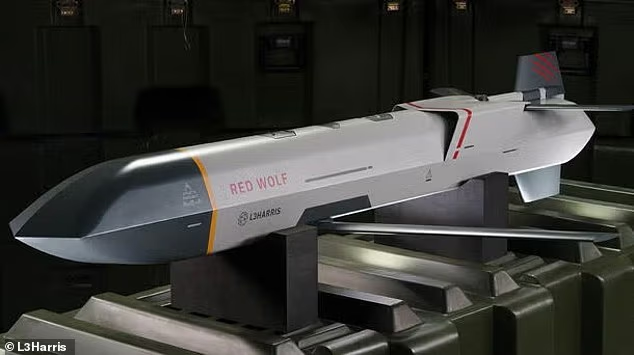
Over the Atlantic Test Range, the Marines launched the cutting-edge Red Wolf weapon from an AH-1Z Viper helicopter, striking a sea-based target with pinpoint precision.
Developed by L3Harris, Red Wolf is a modular, high-subsonic missile that can relay targeting data and engage distant targets, giving helicopters capabilities once reserved for much larger platforms.
Over the Atlantic Test Range, the Marines launched the cutting-edge Red Wolf weapon from an AH-1Z Viper helicopter, striking a sea-based target with pinpoint precision
Current helicopter-fired weapons, like the AGM-114 Hellfire and the Joint Air-to-Ground Missile–Medium Range, are limited to roughly 21 miles and 10 miles, respectively, while Red Wolf can reach approximately 230 miles at low altitudes.
The successful test marks a major leap forward in the Marine Corps’ Long Range Attack Missile (LRAM) program, demonstrating a next-generation system that dramatically extends helicopter strike range.
In a potential Pacific conflict, the system could temporarily disrupt a warship’s sensors, opening a window for follow-on strikes by larger weapons such as the Long-Range Anti-Ship Missile or the Joint Strike Missile.
If USA has such amazing technology, and that would indicate we have even much more, why is our country such a grubby mess, infested with fraud gangs and violence at every level? ABN
When China intensified its crackdown on cybercrime, many involved in the industry relocated to Cambodia, transforming the country into a major hub for online fraud, forced labor, and human trafficking. These operations are largely run by Chinese criminal organizations that have established bases in casinos and business centers across Cambodia, often with the collusion of powerful local figures.
A key factor enabling this expansion is China’s Belt and Road Initiative (BRI), which has facilitated increased Chinese investment and presence in Cambodia since 2013. While the BRI promotes infrastructure development and trade, it has also allowed criminal groups to infiltrate alongside legitimate enterprises, forming collusive relationships with local elites. Chinese crime syndicates operate fraud hubs such as the Bavet Business Center, a 100,000-square-meter complex described as a “fraud hub” by Cambodian NGOs, where thousands live and work under suspicious conditions.
There are also indications of ideological alignment between some criminal groups and the Chinese Communist Party (CCP). For example, a former Chinese mafia boss established the “World Hongmen History and Culture Association” in Cambodia, which engages in fraud while also promoting CCP narratives such as the “great rejuvenation of the Chinese nation”. This reflects a broader strategy of “united front work,” where overseas Chinese networks, including criminal organizations, are leveraged to shape international opinion in China’s favor.
Financial systems supporting these scams are also linked to China. The Cambodia-based payment platform HuiOne, banned in China, serves as a major money “gateway” for laundering illicit proceeds from online scams across the Mekong region, converting them into U.S. dollars and Chinese yuan. One of HuiOne’s directors, Hun To, is a cousin of Cambodian Prime Minister Hun Manet and has longstanding ties to Chinese organized crime.
Moreover, high-level complicity is alleged, with properties housing scam centers often owned by senior Cambodian officials or business elites connected to the government. In Poipet, near the Thai border, a casino allegedly run by a government-connected senator hosts Chinese-run scams. Similarly, the Life Sciences Institute, located within a telecom fraud park controlled by Cambodia’s Prince Group, has been linked to Chinese capital and political protection, with the group’s founder accused of acting as a “white glove” for elite CCP families.
While Cambodia has conducted raids and arrests—such as detaining around 1,000 foreigners, mostly Chinese and Koreans, in Kampong Speu province—the cyber scam industry continues to thrive, generating an estimated $12.5 billion annually and relying on the forced labor of approximately 100,000 to 150,000 people from over 50 countries. Despite joint efforts between Cambodia and China to combat online fraud, the deep entrenchment of these networks, supported by BRI-related flows of money and influence, makes eradication extremely difficult.
BRAND NEW: FRANK TUREK CAUGHT WATCHING DRONE STREAM AT MOMENT CHARLIE KIRK WAS UNALIVED? This research builds on my last video and makes the case stronger than before.
DEFINITIVE: Frank’s phone screen is neither black, nor simply reflecting things behind him. Those are real images on his screen from the UVU setting around him, moving very fast, ruling out FaceTime.
INCLUDES: Extensive footage of Charlie being swarmed by several military-grade miniature drones on all sides, right before, during & after being k*lled. The one whose stream Frank appears to be watching traveled ~150-210 feet in about 6 seconds, which means it moved at about 17-24 MPH—ruling out body cam as well. I might even have found a visual of it.
MANY NEW QUESTIONS: *Why were military grade drones there? *Who was controlling the drones if the security team was busy doing crowd control? *Were any of the drones involved in Charlie’s death? *Who has the drone footage? *There’s a lot of drones & drone footage I didn’t include. Feel free to post in the comments.
DISCLAIMER: I’m not accusing Frank of any wrongdoing or involvement in Charlie’s death. I just want the truth about the drones. Please like, retweet, and leave a comment before watching since this is long and will need a little algorithm help. Feel free to change your comment after watching, or bookmark and watch later. Thank you. Go max!
This analysis is disturbingly convincing. It is speculation but the evidence and presentation fit together very well and are easy to follow.
I am agnostic about who did the killing, but did speculate early on that a military-grade drone could have been the weapon. Parker is not claiming that.
He is showing military-grade drones (plural) moving in and around Kirk immediately before, during and after he was murdered.
It is important to recognize as we speculate about this event that military-grade psyops are highly advanced and could be planting false evidence to discredit observations like these.
Similarly, Mitch, who appeared on Candace, could be a plant to discredit her work. ABN
During a press conference on Wednesday, a Providence-area radio host, Chas Calenda, directly confronted Brown University officials and law enforcement with information he has received about the school intentionally disabling surveillance systems due to DEI concerns.
The response from university officials and the Providence Mayor indicate Mr. Chas Calenda’s informed accusation and question is directly on target.
In addition to information we previously shared {GO DEEP} reflecting requests from various “civil rights” and “humanitarian” groups who demanded Brown University disable their surveillance system, additional information about the issue comes via the Rhode Island ACLU making the same demand in October of this year [SEE HERE].
Brown University was under pressure from far-left groups as an outcome of concern the CCTV and school security system would be used by federal authorities to (a) identify radical leftists expressing antisemitic sentiments, and (b) identify the immigration status of persons on campus. It is not just isolated to Brown University.
Multiple municipal governments, private and municipal agencies have received the same demand in an ongoing effort to block Immigration and Customs Enforcement operations. The mass shooting on Brown University is leading to a larger public awareness of an issue that has been spreading rapidly in the last several months.
Brown University and Providence police have $8 billion liability reasons to be less than honest with the alarmed public. The political ramifications of the story are also complicating the issue for Brown University, as well as local and national figures.
Many Jews in the fear-inflation business like Jonathan Greenblatt have already reported on the generational disparity in anti-Semitism. The reason for the disparity seems pretty straightforward: Old people were fed a steady diet of programming that was not only filtered through various Jewish studio execs, editors, directors, and writers, but was delivered via a one-way broadcast medium. This allowed Jews to disseminate their ideas uncontested. In other words, Jews placed themselves between boomers and the world, carefully curating their “reality.”
The two-way medium of the Internet used by the younger generations has allowed conversations to occur outside of Jewish jurisdiction, and younger generations are largely rejecting Jewish ideas and the Jewish framing of the world. While old people continue to watch the sanitized version of the Gaza conflict on Fox News, young people are consuming Telegram videos of Jewish crimes against humanity and are disgusted by it.
Conversations about Jewish overrepresentation, influence, and power are no longer avoidable now that the Internet has overtaken the Jewish-dominated mediums of television, print, and radio. For the first time in a century, Jews are in a position where they have to defend themselves, and they’re showing everyone how out of practice they are. Most Jews just “accuse the accuser,” calling their critics “anti-Semites” since there really is no way to defend their ethnic cleansing of Gaze and open borders extremism in the West.
Videogame executive Xu Bo, said to have more than 100 children, and other elites build mega-families, testing citizenship laws and drawing on nannies, IVF and legal firms set up to help them
Inside a closed Los Angeles courtroom, something wasn’t right. Clerks working for family court Judge Amy Pellman were reviewing routine surrogacy petitions when they spotted an unusual pattern: the same name, again and again. A Chinese billionaire was seeking parental rights to at least four unborn children, and the court’s additional research showed that he had already fathered or was in the process of fathering at least eight more—all through surrogates.
When Pellman called Xu Bo in for a confidential hearing in the summer of 2023, he never entered the courtroom, according to people who attended the hearing. The maker of fantasy videogames lived in China and appeared via video, speaking through an interpreter. He said he hoped to have 20 or so U.S.-born children through surrogacy—boys, because they’re superior to girls—to one day take over his business. Several of his kids were being raised by nannies in nearby Irvine as they awaited paperwork to travel to China. He hadn’t yet met them, he told the judge, because work had been busy.
Pellman was alarmed, according to the people who attended the hearing. Surrogacy was a tool to help people build families, but what Xu was describing didn’t seem like parenting, the people said. The judge denied his request for parentage—normally quickly approved for the intended parents of a baby born through surrogacy, experts say. The decision left the children he’d paid for to be born in legal limbo.
The court declined to comment on Xu’s case. Xu, an online megaposter but real-life recluse, has rarely spoken with reporters and hasn’t been photographed in public for nearly a decade. A representative of Xu’s company, Duoyi Network, didn’t respond to specific questions about the hearing or Xu’s use of surrogacy. “The boss does not accept interview requests from anyone for any purpose,” the representative said in an email to The Wall Street Journal, adding that “much of what you described is untrue”. The representative, who didn’t provide a name, didn’t respond to repeated requests to clarify what was inaccurate.
BERKELEY — A UC Berkeley professor smelled a rat — over the years there had been $46,855 in damage from computers that failed, and nearly all of it seemed to affect one particular Ph.D. candidate at the college’s Electrical Engineering and Computer Sciences department.
The professor wondered if the student’s luck was really that bad, or if something else was afoot. So he installed a hidden camera — disguised in a department laptop, and pointed it at the student’s computer.
According to police, the sly move captured another Ph.D. candidate, 26-year-old Jiarui Zou, damaging his fellow student’s computer with some implement that caused sparks to fly out of the laptop.
Now, Zou has been charged with three felony counts of vandalism, related to the destruction of three computers on Nov. 9-10.
Zou was arrested on Nov. 12 at UC Berkeley’s Cory Hall and declined to talk to police, according to court records. He is due for his first court appearance on Dec. 15 and is no longer in custody, records show.
This was one of my favorite interviews. Radar engineer Filippo Biondi just dropped the most explosive finding ever reported at Giza: eight clearly man-made, tube-like structures plunging more than a kilometer beneath the Khafre Pyramid and ending in huge 80-meter chambers. The structures are obviously artificially engineered and the synthetic aperture radar Doppler tomography technique he used has precedent in accurately predicting underground structures (in both commercial and defense use cases). The Egyptian ministry of culture is extremely afraid this finding might rewrite their history.




 American Buddhist Net