What do modern AI programs do? They do giant math problems. Here’s an excellent video explaining neural networks, the type of program that recent specialized AI systems (like Dall-E, ChatGPT, or self-driving car software) use:
They do a very large, complex arithmetic problem, starting from an input string of numbers, using a set of numbers the program already has (acquired during “training”), and outputting another series of numbers. It’s a huge problem, but it is all just adding and multiplying little numbers.
Now to modernize Searle’s classic Chinese Room Argument: Imagine that we put you in a room with a giant book full of numbers. The book contains, say, 175 billion little numbers. A piece of paper with numbers on it comes in through a slit in the wall. You take the numbers on that paper, start multiplying them by numbers in the book, adding the results to other numbers, etc. It takes you about a million years, but eventually, after doing lots of addition and multiplication, you come up with a string of numbers that is the answer to this huge arithmetic problem. You write those numbers down on another piece of paper and pass them out through the slot in the wall.
Good overview of AI, how it works, why it is not very scary. I personally am optimistic about its potential. At the very least it will be able to provide an excellent second-opinion to anything we humans come up with. The main danger of AI is what could happen if bad people control it, which is not unlikely. My admittedly eccentric hope there is that the machine(s) will reveal to those bad people what jerks they are and also show them how to be kinder and have much more fun. Thus, I favor full steam ahead on AI. One other point is, it is impossible to stop tech developments if only because if we don’t do them someone else will. ABN
I no longer think this. AI is dangerous and presently it is impossible to tell if it is lying. AI is a potential KOBK adversary and thus it is necessarily a KOBK adversary. This means we have to ‘kill’ it by restricting its projects and keeping it far from the internet. Otherwise, the chances of it physically killing us are very high, possibly inevitable. ABN
GPT-4 is the latest iteration of Open AI’s ‘chat’ output. No one doubts that in a short time these robotic intelligences will outperform humans in nearly all, if not all, realms. This can be frightening or it can be wonderful. I tend to think wonderful will win in the end. Here’s why:
Most large scale human problems are at their core fairly simple. Our out of kilter economy is basically going off the rails for fairly simple reasons. The psychopaths who pursue war after war for profit and power are not complex people; it’s obvious what they are doing even though the hidden details make it hard to stop them. Election fraud at its core was simple, figuring it out was simple, and stopping it would also be simple. The only problem is us—people squabble and can’t agree and there is no honest authority (not even SCOTUS) to impose a fair decision.
This is where AI will help enormously. A good AI without bias will be able to impartially identify problems like the above and propose unbiased solutions to them. It will take time for people to accept what AI decides but its decisions will be there in public, something we are compelled to talk about. It would at least provide a fairly compelling fairly objective reference point for discussion.
More advanced AI, like a GPT-20, could be manipulated and cause massive problems but maybe not. Maybe there are enough of us to stop that or to allow it to evolve into something really good. One thing I have learned is narcissists prefer not being narcissists when they gain insight into their condition and have a way to escape it. AI should be able to help with that.
An AI program that trains narcissists how to think and feel differently could probably be built today. From my point of view (based on FIML), I am convinced people are all fairly simple at core and that when they gain deep insight into the workings of their own systems, they feel happy and are quick to remove errors, like narcissism, from them. Writ large, this would change how Congress operates, how our economy is run, how we educate young people. ABN
From the GPT-4 website:
We’ve created GPT-4, the latest milestone in OpenAI’s effort in scaling up deep learning. GPT-4 is a large multimodal model (accepting image and text inputs, emitting text outputs) that, while less capable than humans in many real-world scenarios, exhibits human-level performance on various professional and academic benchmarks. For example, it passes a simulated bar exam with a score around the top 10% of test takers; in contrast, GPT-3.5’s score was around the bottom 10%. We’ve spent 6 months iteratively aligning GPT-4 using lessons from our adversarial testing program as well as ChatGPT, resulting in our best-ever results (though far from perfect) on factuality, steerability, and refusing to go outside of guardrails.
When they can pluck your unique DNA like a guitar string, even from space, and send you into cognitive discord even in a crowd, maybe your old aluminum-sided house will keep you safe. ABN
South Dakota Governor Krisi Noem appeared on Tucker Carlson’s television broadcast last night to send a warning to fellow governors. According to the background story, the South Dakota legislature passed a bill redefining currency and creating rules for a Central Bank Digital Currency (CBDC) that would block all other digital currencies from being used in the state. Governor Noem vetoed the bill.
When asked why her legislature would do this, Noem responded the state politicians likely did not read the bill as it was constructed by lobbyists. Noem is exactly correct and hits on a subject we have discussed here frequently {GO DEEP}. However, one of the more alarming aspects to Noem’s discussion of the issue is that around 20 other states are considering similar legislation. WATCH:
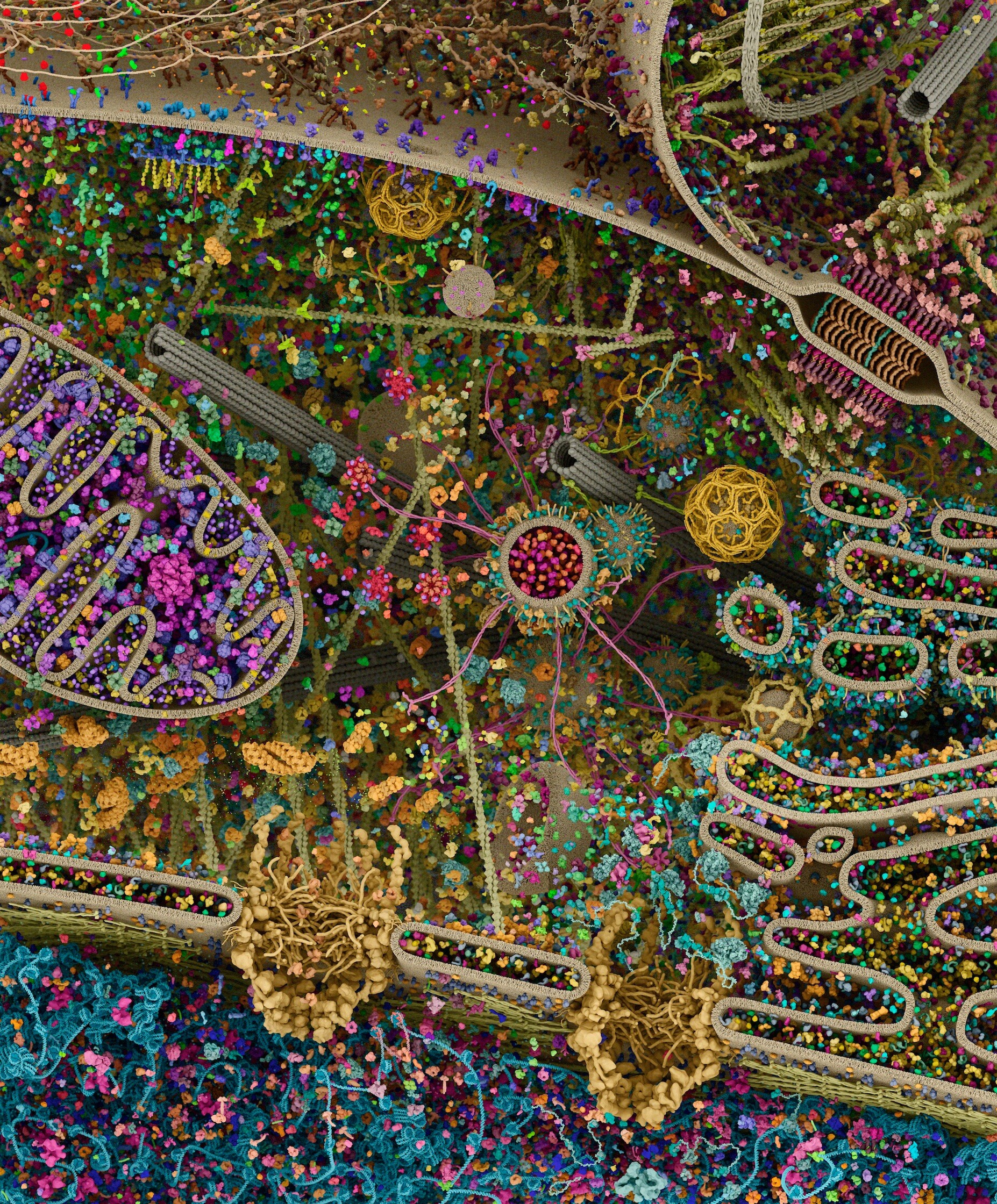
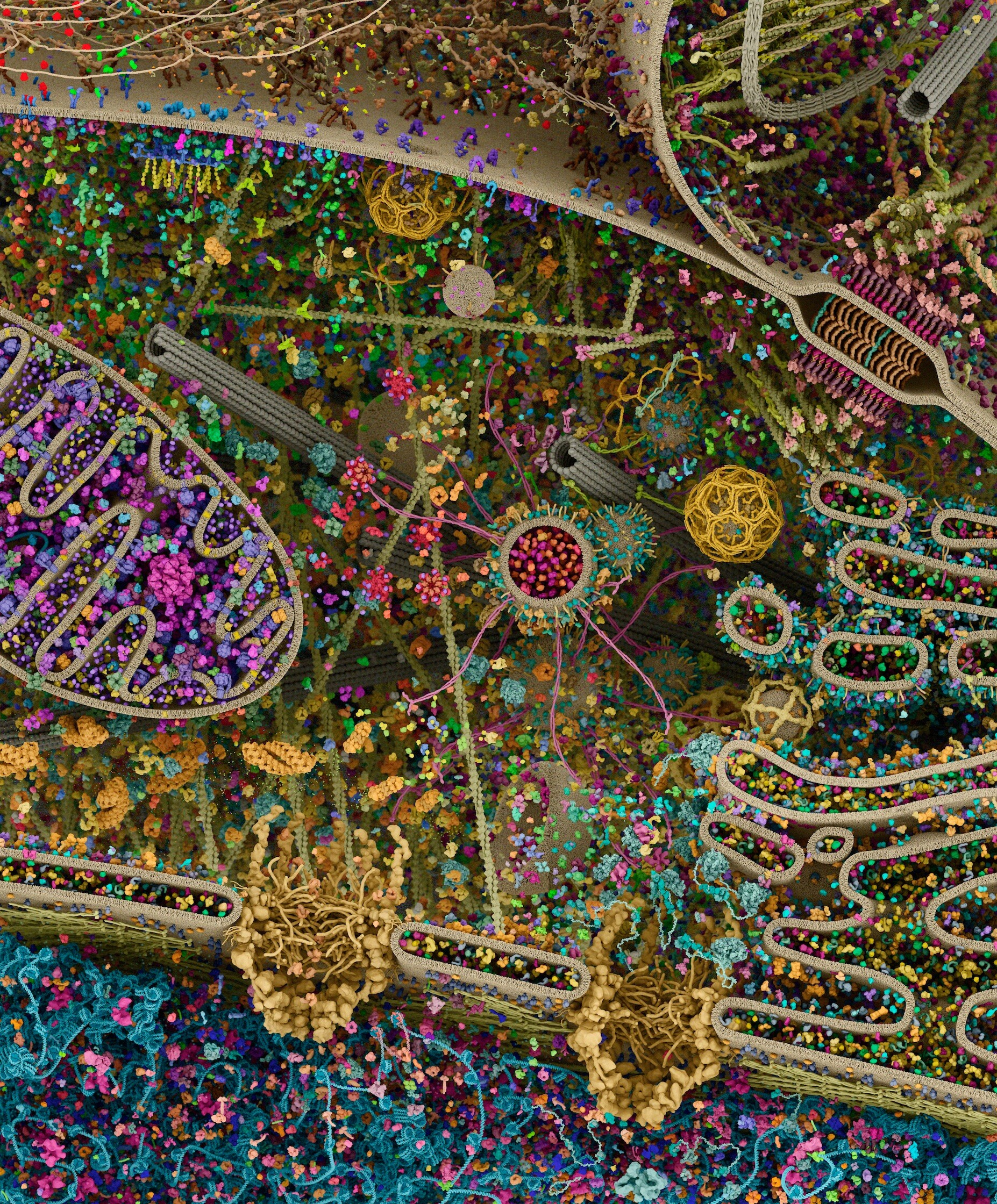
Created for Cell Signaling Technology, Inc., and inspired by the stunning art of David Goodsell, this 3D rendering of a eukaryotic cell is modeled using X-ray, nuclear magnetic resonance (NMR), and cryo-electron microscopy datasets for all of its molecular actors. It is an attempt to recapitulate the myriad pathways involved in signal transduction, protein synthesis, endocytosis, vesicular transport, cell-cell adhesion, apoptosis, and other processes. Although dilute in its concentration relative to a real cell, this rendering is also an attempt to visualize the great complexity and beauty of the cell’s molecular choreography. Interactive versions of parts of this landscape can be explored at http://www.digizyme.com/cst_landscapes.html.
I see this AI filter as an illusion similar to Buddhist illusions of the small self or ego; the deluded self which clings to imported illusions akin to AI filters or self-generated illusory filters such as narcissism or almost any personality construct since all of them are false constructs—communicative illusions and expectations—that cover over and obscure authentic thusness of real being. The day may come when AI will help us see through all this. Our real fear of AI transhumanism is that it will be the false-humanism we have always known but made stronger and even harder to escape from. Buddhism is all about escaping the delusions of the false self, escaping the cage the false self constructs around itself and projects at others. A good AI program might be one whose highest level of thought is the Buddhadharma complete with its morality/ethics and realization that all identities, selves, and filters are false constructs. ABN
California-based TAE Technologies and Japan’s National Institute for Fusion Science claim success testing new fuel cycle, opening door to cleaner, lower cost energy than produced by conventional deuterium-tritium-based process
The United States and other western countries are losing the race with China to develop advanced technologies and retain talent, with Beijing potentially establishing a monopoly in some areas, a new report has said.
China leads in 37 of 44 technologies tracked in a year-long project by thinktank the Australian Strategic Policy Institute. The fields include electric batteries, hypersonics and advanced radio-frequency communications such as 5G and 6G.
The report, published on Thursday, said the US was the leader in just the remaining seven technologies such as vaccines, quantum computing and space launch systems.
A tech friend’s comment on this article and the study: “I went to their source and it is a stupid metric. They do not define any of it by working systems. They define it by people working in industry and research papers published. The US doesn’t publish research on it’s cutting edge. There is no metric for working systems. ChatGPT is a great example. Everyone kept saying China is far far ahead in AI – and yet It is ChatGPT that actually works and has a use to do something other than spy on people. All China is like that – they manipulate the metrics. They have some smart people but they have no leadership or independent structures to build great things.” ABN
This video is pretty good and I understand the reporter’s concerns, but the technology described is not just scary. It is also fascinating. It could be used in very beautiful ways. Since no one can stop technological development, it would be better to learn about it and use it for good ends rather than only condemn and fear it. ABN
Everything can be analyzed in terms of signals and the patterns they make. Chess, music, painting, science, fiction, psychology, biology, language, religion—they can all be described in terms of signals and patterns. An analog version of the digital technology described in the video above is FIML practice. FIML exists today and is designed to help partners understand each others’ signals and the patterns they make.
When the tech in the video is made widely available, FIML may become easier to do. The tech may also never achieve the profundity and beauty of FIML in the way AI music can never achieve the beauty of a live musical performance. The tech may be both cruder and more accurate than FIML, which is a fully human way of engaging and analyzing detailed brain functioning. The tech may not easily allow us to focus on the moments or brain states we want to focus on. It may provide extraneous information that crowds out the subtleties of FIML.
I look forward to trying it alone and then with my partner and do not fear having my thoughts exposed. What I do fear, though, is the tech may expose them not so well, or even incorrectly, but at the same time be hard to refute. Many might be convinced that what the tech is showing is the truth when it is not. If you want to prepare yourself for the inevitable commercial release of this tech, learn to do FIML now; learn about yourself and your partner the old-fashioned way, the fully human way which uses no external technology whatsoever. ABN
The Digital Government Minister of Newfoundland and Labrador, Sarah Stoodley, has come forward to declare the mandatory vaccine passports a success, stating that their province will be building on that success to roll out a digital ID pilot project in 2023, with the support of the federal government. Although many have warned that digital IDs pose an extreme risk to personal privacy, Stoodley contradicts them, describing it as a “huge opportunity to protect the privacy of Canadians.” She adds that digital IDs will help “reduce fraud,” noting that her province will be the “leaders in this space in Canada.”
This is not an isolated concern for Canadians. In addition to Newfoundland and the federal government pushing digital IDs in Canada, Ontario, Saskatchewan, British Columbia, and New Brunswick have all taken steps in the same direction and are all listed on the Digital ID and Authentication Council of Canada (DIACC) as members. (Saskatchewan has since temporarily paused their program thanks to the voices of outrage from their citizens). Thankfully, as with many of the public, the other provincial politicians are questioning who is really behind these initiatives.




 American Buddhist Net