One of Poland’s most influential military thinkers and president of Academy24, General (ret.) Jaroslaw Gromadzinski, has advocated a major shift in the country’s defence posture aimed specifically at preparing for war with Russia.
His statement reflect a broader consensus in Warsaw, which has invested particularly heavily in expanding its military capabilities with large scale equipment orders from South Korea and the United States. Gromadzinski argued that Poland needed to embrace an “active defence,” and be ready to operate “across the full operational depth of the opponent” by preparing to launch attacks across Russian territory.
He also stressed the need to create a million man reserve force, advocating a system modelled on that of Switzerland under which reservists would remain in active reserve units for years and periodically update their skills. “No one will convince me that in a country of 38 million, we cannot build a reserve of one million people,” he stated regarding the country’s potential to achieve these goals.
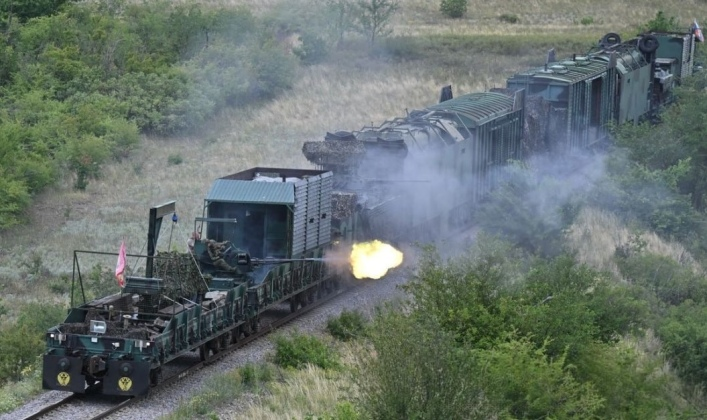
The Russian Armed Forces have deployed armoured trains to resupply Army units in the disputed Donbas regions for ongoing high intensity engagements with Ukrainian and supporting Western forces.
New insight into the use of trains to support logistics was provided by state media’s publication of images of the armoured train Yenisey as part of a “combat coordination” exercise under Battlegroup Centre. Alongside the resupplying of frontline forces, the train has also been use for reconnaissance operations and to support the repair of railway lines.
Trains like the Yenisey also retain limited defensive combat capabilities, and integrate ZU-23-2 anti-aircraft guns and multiple heavy machine gun mounts.
Although the Donbas regions claimed by both Ukraine and Russia were integrated into the Ukrainian state before 2014, the railway lines were fully integrated with those in Russia when they were constructed in the Soviet era, allowing for relatively seamless resupply operations.
The American people are not being told why Israel agreed to a ceasefire with Iran. Yes, Israel was rapidly running out of air-defense interceptors (making it more vulnerable to Iranian attacks.) But that issue is only of secondary importance. The real reason they wanted a ceasefire was because they were getting systematically pulverized and needed to stop the bleeding fast. That’s why Israel ‘threw in the towel’ less than 2 weeks after the opening salvo, because Iran was decimating one target after another with no end in sight. So, Israel capitulated.
Of course, that is not the story we’ve been reading in the western media where there’s no mention of the vast destruction of Israeli strategic targets (by Iranian ballistic missiles); that news has been completely omitted from the mainstream coverage. But that’s why Israel persuaded Trump to find a diplomatic off-ramp; because the losses were beginning to mount and Iran was not ‘letting up.’
Let’s summarize: In a little more than a week’s time, Iran struck or obliterated:
The “Israeli Pentagon”, the Kirya military-intelligence complex
The Weizmann Institute of Science which plays a role in Israel’s clandestine nuclear program
The Aman military intelligence headquarters at the Glilot Mizrah Interchange, near Herzliya. Aman oversees elite spying units such as Unit 8200 (signals intelligence), Unit 504 (human intelligence), and Unit 9900 (geospatial intelligence).
Branches of the Israeli ministry of interior affairs responsible for internal military coordination
The Mossad’s operational headquarters
Israel’s most protected Nevatim Airbase (and the Tel Nof Airbase)
Ben Gurion Airport (repeatedly) as well as Ramat David, Palmachim and Ovda near Eilat.
The Command-and-Control Centers of the Israeli military and Mossad in both Tel Aviv and Haifa…..
The Bazan Oil Refinery in Haifa—Israel’s largest fuel processing center
A giant power station in Ashdod, triggering a powerful explosion and localized blackouts.
The Rafael Advanced Defense Systems complex north of Haifa—home to multiple factories and R&D buildings that produce key elements of Israel’s military hardware
The Kiryat Gat Industrial Zone—a major center for microprocessor and high-tech military production
The Gav-Yam Negev Advanced Technologies Park near Beersheba, which hosts firms working in cyberwarfare, AI, and military tech.
Tel Aviv at dusk
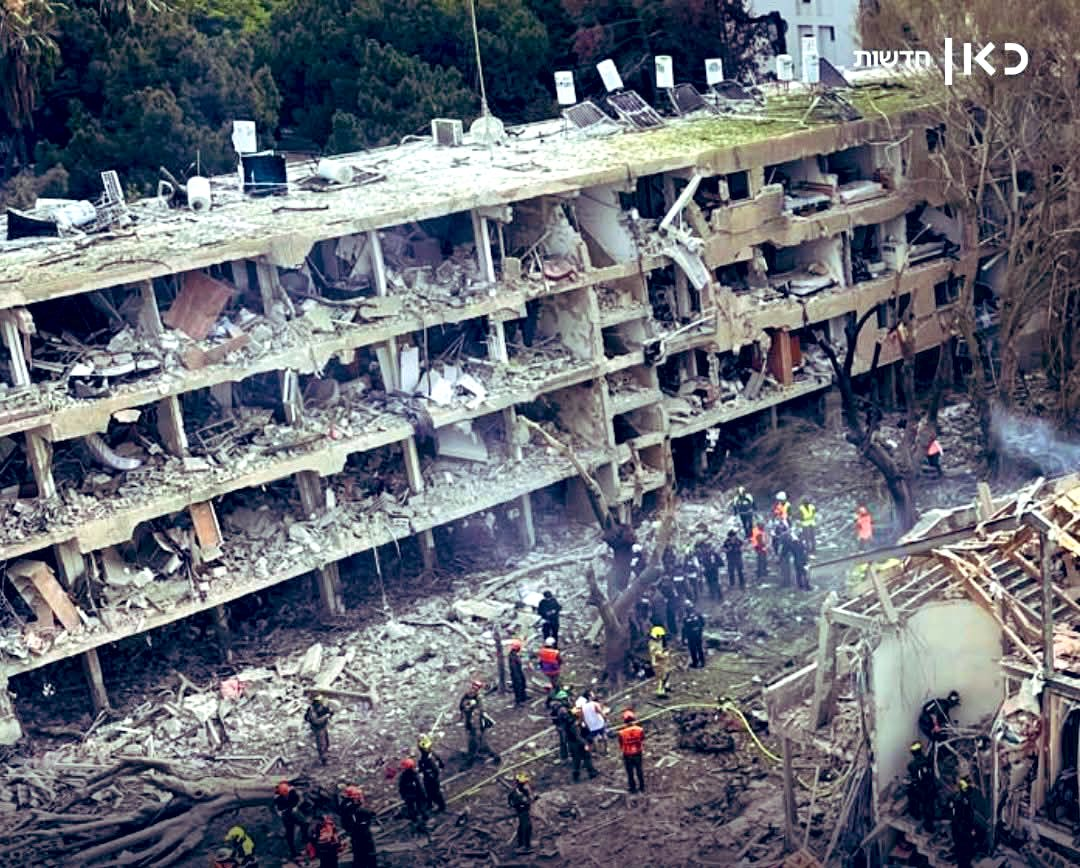
Get the picture? In just 10 days (June 13 to June 23) the Iranian military meticulously destroyed a sizable portion of Israel’s most prestigious military, intelligence, industrial, energy, and R&D facilities across the country. (Have you read about any of this in the western media?) Had the war continued for another week or two, the Holy Land would have been reduced to a smoldering third world wasteland unfit for human habitation. In short, this was no normal ceasefire. This was a desperate capitulation by an overmatched contender who quickly realized he was punching ‘above his weight’.
Under the banner of “build back better” after Iranian attacks, Israel is advancing a plan that could force citizens to sell their homes to the state if they reject urban renewal plans.
Missile damage is being used as cover for a land grab.
This video provides a glimpse of Iran’s weaponry and how it has been used against Israel. During the current ceasefire, it is a sure thing that both Israel and Iran will rearm. Whether they continue fighting or not, this video shows that Iran does have serious military capabilities. Is it in their interests to keep fighting? I doubt it. My understanding is Iran is going to allow a GCC-led coalition to become the region’s collective hegemon. The world is on the verge of becoming 100X wealthier due to tech improvements. All players in this and other conflicts must reassess their reasons to keep fighting old battles. Sometimes the smartest military option is do nothing. ABN
UPDATE: This talk provides good information about the US strike on Iran’s nuclear facilities and the consequences therefrom. To me, it seems clear Trump made the right move by taking out Iran’s main threat. Israel has no reason to keep fighting and neither does Iran. The deeper story that now the Gulf Cooperation Council and other countries in the region will form a collective hegemony over the Middle East should become more apparent in the weeks to come. We should see signs of this happening and signs that the Gaza slaughter will slow down, if not stop altogether. Trump played a strong Kill-Or-Be-Killed (KOBK) move which apparently killed few if any people, while destroying Iran’s main threat. In this sense, Iran was ‘killed’. Overall, at the same time it looks like Israel’s Jewish Supremist fantasy of a ‘Greater Israel’ becoming the regional hegemon has also been ‘killed’. Trump killed two birds with one stone. ABN
Trump’s taking out the nuclear facilities in Iran removed Israel’s excuse to attack Iran. This is a very important point.
On another note, Miller should be asked if he is a Jewish Supremist. He might give a thoughtful answer. I would like to hear that. If he offers only a tongue-lashing, the real answer is obvious – yes, he is. I, for one, like Miller. He explains things well and is usually fun to watch. So far, he is a credit to this administration.
All prominent Jews in the world should be asked and should be culturally and politically required to answer two questions: 1) are you a Jewish Supremist; and 2) do you unequivocally disavow all forms of Jewish Supremacy. Since Jewish Supremists have taken us to the precipice of WW3 in Ukraine as well as the Middle East, this is the time to do it. ABN
The recent surprise attack by Israel on Iran has created a tumultuous geopolitical landscape, causing significant casualties among Iran’s military and nuclear leadership. This unprecedented strike, which has led to a retaliatory wave of missile attacks from Iran, has also involved the United States, raising alarms about a broader conflict. The nature of this attack—targeting high-profile figures in their own homes—has raised serious questions about international law and the norms governing warfare. The overwhelming media coverage, heavily skewed in favor of Israel, has obscured the violent and illegal nature of these actions, suggesting a troubling narrative control by pro-Israel factions within Western media. Historical parallels are drawn to past incidents, such as the 1967 attack on the USS Liberty, highlighting how media manipulation can alter public perception and political consequences.
The text contends that Israel has positioned itself as a dominant force in state-sponsored assassinations, surpassing historical precedents set by groups like the Order of Assassins. This shift in the practice of political assassinations marks a departure from traditional Western values that have largely deemed such actions as immoral and illegal. The article references past leaders who opposed assassination tactics, such as Adolf Hitler during World War II, emphasizing how the post-9/11 era has seen a significant transformation in the acceptability of targeted killings, especially under the guise of counter-terrorism. The author argues that the normalization of such methods, particularly by Israel and its intelligence agency, Mossad, has led to a dangerous precedent in global politics.
The narrative also examines the complexities of Iran’s foreign relations, specifically its hesitance to align too closely with powers like Russia and China, which may have contributed to its current predicament. The Iranian leadership’s desire for self-reliance and independence has left it vulnerable in the face of Israeli aggression. The sudden political shifts following the suspicious death of Iranian President Ebrahim Raisi further complicate the situation, with his successor, Masoud Pezeshkian, taking a more moderate approach and attempting to mend ties with the West.
Lastly, the article reflects on the implications of Israel’s actions and the potential for increased aggression toward other nations, including hostile rhetoric aimed at Pakistan and Turkey. The author warns that despite Israel’s current military prowess, its reliance on U.S. support could lead to severe consequences for both its own stability and that of the broader Middle Eastern region. The overarching theme suggests that if the dynamics of power shift, particularly regarding public perception and geopolitical alliances, it could lead to a significant backlash against Israel, potentially altering its standing and influence in global affairs. The article concludes with a cautionary note about the fragility of Israel’s power and the potential for historical cycles of change in international relations.
Trump has added a strong sign to the conflict. If Ritter is right that what was hit is a ‘nothing burger’, that only qualifies the sign that Trump is willing to use USA’s most powerful weapons. It was a measured sign. Interpretation and response is Iran’s choice. Russia. China and world have been given notice. Trump sent a strong signal. Does anyone believe he will back down? This is KOBK loud and clear, not an empty sign. ABN



 American Buddhist Net