The escalation continues and unfortunately there are few indications the people around President Donald Trump are advising caution.
The U.K, German, French, EU, NATO and ‘western’ intelligence control agents are pushing for expanded conflict with Russia. The latest development comes as the new leftist German Chancellor Friedrich Merz gives the greenlight for Ukraine to launch long-range Taurus cruise missiles directly into Russia.
(Bloomberg) — German Chancellor Friedrich Merz said Ukraine has been given permission to use weapons supplied by its allies to launch strikes deep inside Russia.
“There are absolutely no range limits anymore for weapons delivered to Ukraine, not from Britain, the French or from us — also not from the Americans,” Merz said at a conference in Berlin on Monday. “That means Ukraine can defend itself by attacking military positions also in Russia.”
[…] Ukraine’s Western allies are trying to intensify pressure on the Kremlin after Moscow launched its biggest drone barrage against Ukraine since the full-scale invasion over three years ago. European leaders have condemned what they call Russia’s foot-dragging as efforts to lock in a ceasefire have gone nowhere.
[…] Kremlin spokesman Dmitry Peskov said that, if confirmed, a decision to allow long-range strikes could undermine efforts toward reaching a political settlement, according to Interfax. He called such a decision “dangerous.” (read more)
The proxy war between the U.S/NATO and Russia is now entering its fourth year.
In some ways these efforts by the ‘coalition of the nervously willing’ only solidify the previous position of Russian President Vladimir Putin that any western move toward a diplomatic handshake was generally duplicitous and not to be trusted. Hence, Putin has instructed the armed forces of the Russian Federation to continue building out an expanded ‘buffer zone’ between Russian held territory and NATO within Ukraine.
Factually, as previously admitted and outlined by reporting from the New York Times, it is U.S. military and intelligence assets in the region who are leading the attacks from bases in Germany and the front lines within Ukraine.
The New York Times published two articles {HERE and HERE} revealing: 1) that U.S. military boots are on the ground in Ukraine. (2) The U.S. military is actively involved in the ongoing targeting of strikes into Russia. (3) The CIA is operating in Ukraine and conducting targeted strikes into the Russian Federation mainland.
The sourcing for the New York Times outline of American leadership against Russian Federation troops was transparently generated by U.S. military and intelligence leaks intended to stop any negotiations between President Trump and President Putin. Since the release of those articles two months ago, they have succeeded in exactly that.
President Trump may not want to engage in the conflict with Russia, but the NATO alliance is not willing to allow him any independent retreat. The recent Romanian election outcome solidified their stranglehold on the geopolitical interests at stake.
Romania is currently building the largest NATO base in Europe, and Vladimir Putin can see the intention therein with very clear eyes. Unfortunately, American students are no longer taught geography or history in school, because one simple look at a map tells us the motives and intents.
Alarge scale Ukrainian drone attack on the Russian Kursk region on May 20 was reported by Russian sources five days later to have coincided with a visit by Russian President Vladimir Putin. Air defence division commander Yuri Dashkin reported regarding the incident that president while onboard his helicopter was “at the epicentre of repelling a large-scale attack by the enemy’s drones… The intensity of the attack during the flight of the aircraft with the Commander-in-Chief over the territory of the Kursk Region increased significantly. Therefore, we simultaneously conducted an air defence battle and ensured the safety of the presidential helicopter’s flight in the air.” Dashkin’s statement indicates that the president’s helicopter may have been at risk. Drones have on multiple occasions been used to bring down combat aircraft during flight, including heavily armoured Russian military helicopters, which can be vulnerable due to their large sizes and relatively slow speeds compared to fixed wing aircraft.
A further danger during an attack by multiple drones remains the possibility of friendly fire by local air defences, with incidents of Russian and Ukrainian shootdowns of their own high value aircraft while seeking to repel enemy air attacks having been reported frequently since the outbreak of full scale hostilities between the two countries in February 2022. There remains a significant possibility that the presence of President Putin’s helicopter during the Ukrainian drone attack significantly complicated air defence efforts, potentially forcing defenders to rely on infrared guided missiles, anti-aircraft guns, and electronic warfare, to reduce the possibility of friendly fire harming the commander in chief. Incidents where heads of state have been placed in the line of fire having been few and far between in the past half century, in particular for the leaders of major military powers such as Russia. There remains a significant possibility that the Ukrainian drone strike may have been launched in the knowledge of Putin’s general location.
The Russian Aerospace Forces have begun to introduce the service’s first class of nuclear-tipped air-to-air missile into service, according to a report by the U.S. Armed Forces Defence Intelligence Agency. While little remains known regarding the missile class, it is widely expected to be a new variant of the R-37M – a missile class that was first introduced in the mid-2010s.
The R-37M carries a very large 60 kilogram warhead, around three times the size of those usually integrated onto air-to-air missiles, which provides a greater capacity to integrate a miniaturised nuclear warhead. If fired from high altitudes and at high speeds by MiG-31BM interceptors, the missile can engage targets up to 400 kilometres away. The R-37M is the world’s fastest known air-to-air missile class with a Mach 6 speed, and has the second longest range int he world surpassed only by that of the Chinese PL-XX. It is manoeuvrable enough to be able to neutralise small fighter sized aircraft. The integration of nuclear warheads onto the R-37M would allow a single Russian fighter or interceptor to neutralise full squadrons of enemy targets, entire salvoes of cruise missiles, or large swarms of drones, with each MiG-31BM interceptor or Su-35 fighter able to carry four missiles.
The fielding of nuclear-tipped air-to-air missiles follows a broader trend in the Russian Armed Forces towards using nuclear assets to asymmetrically counter the much larger forces of the country’s NATO adversaries. A nuclear armed variant of the R-37M could be particularly useful against stealth aircraft such as the F-35, which has been deployed in very significant and growing numbers across the country’s European, Arctic and Far Eastern borders by Western Bloc and allied states.
US President Donald Trump has been increasing pressure on Israel over recent days, an anonymous source told The Washington Post on Monday.
“Trump has been letting Israel know ‘we will abandon you if you do not end this war,'” the source added, speaking on the condition of anonymity because they were not authorized to speak to the press.
The increase in pressure from Trump came after Israel called up tens of thousands of reservists and ramped up Gaza bombings, the Washington Post added.
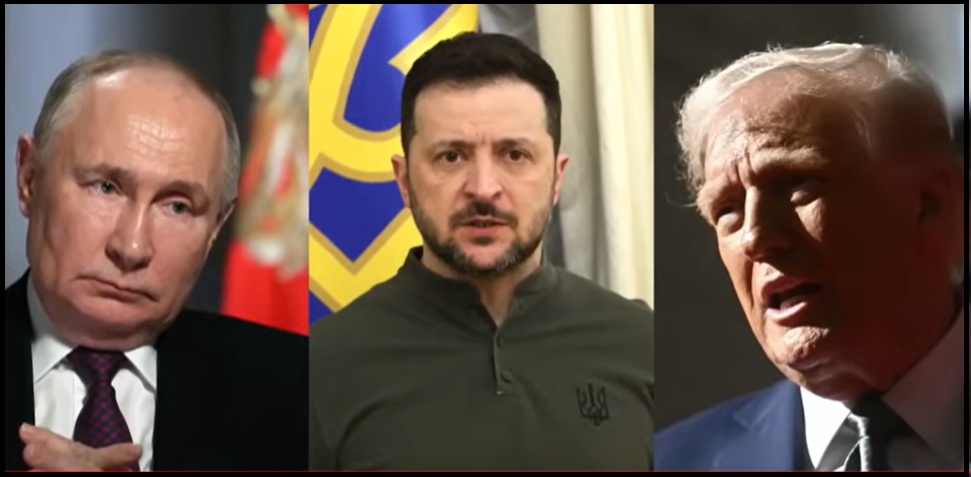
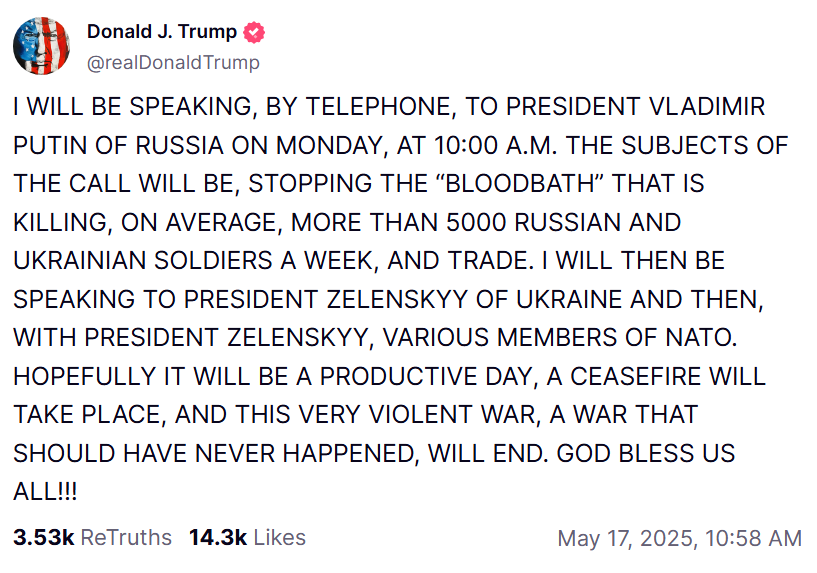
Just completed my two hour call with President Vladimir Putin of Russia. I believe it went very well. Russia and Ukraine will immediately start negotiations toward a Ceasefire and, more importantly, an END to the War. The conditions for that will be negotiated between the two parties, as it can only be, because they know details of a negotiation that nobody else would be aware of. The tone and spirit of the conversation were excellent. If it wasn’t, I would say so now, rather than later. Russia wants to do largescale TRADE with the United States when this catastrophic “bloodbath” is over, and I agree. There is a tremendous opportunity for Russia to create massive amounts of jobs and wealth. Its potential is UNLIMITED. Likewise, Ukraine can be a great beneficiary on Trade, in the process of rebuilding its Country. Negotiations between Russia and Ukraine will begin immediately. I have so informed President Volodymyr Zelenskyy, of Ukraine, Ursula von der Leyen, President of the European Commission, President Emmanuel Macron, of France, Prime Minister Giorgia Meloni, of Italy, Chancellor Friedrich Merz, of Germany, and President Alexander Stubb, of Finland, during a call with me, immediately after the call with President Putin. The Vatican, as represented by the Pope, has stated that it would be very interested in hosting the negotiations. Let the process begin!
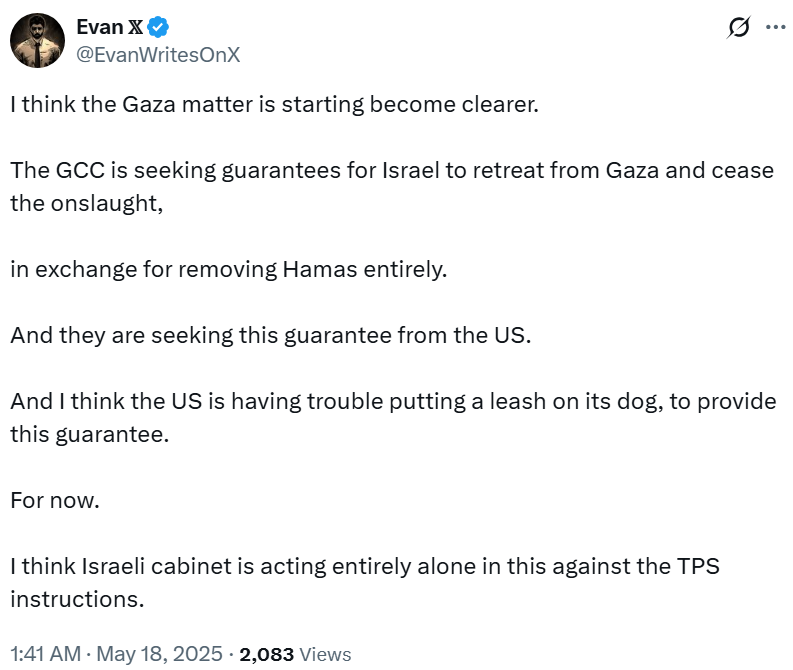
TPS = the Transnational Private Sector or global corporate power, which is largely independent from government. GCC = Gulf Cooperation Council. The real situation appears to be Trump has sidelined Israel to cement trade and political relations with the GCC and others in the region. He appears to be doing something similar with Russia by going over Zelensky’s head while also largely ignoring European warmongers. I strongly approve of these policies and hope Trump succeeds with them. His world trade reset also shares this general outline of going to a higher level to completely rearrange lower-level relationships. ABN
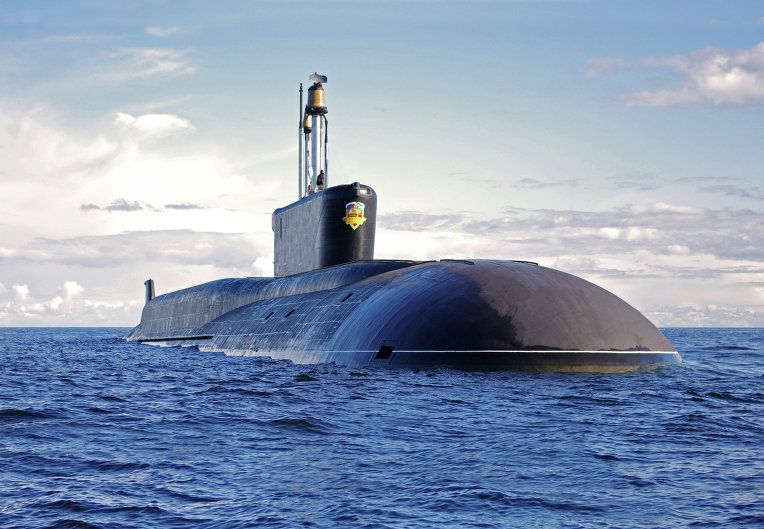
At a time when the global security climate is becoming increasingly tense, the Polish public is alarmed by the announcement that the Russian submarine “Knyaz Pozharsky” (Prince Pozharsky) is approaching its first major operational phase.
It is a submarine of the Borey-A class, the pinnacle of modern Russian naval engineering, which carries in its arsenal what is already called “doomsday missiles” in the West – as many as 16 Bulava intercontinental missiles.
According to information published by the Polish newspaper Dziennik, the Russian Navy is ready to further strengthen its North Sea fleet with this underwater giant.
And it’s not just another submarine – it’s a symbol of a new phase of Russian naval strategy. “Knyaz Pozharsky” uses the OK-650 nuclear reactor for propulsion, and its crew numbers about one hundred people.
The vessel is able to remain on mission for a long period of time, and what worries Western observers the most is the range and payload of its missiles.
DUBAI (Reuters) -U.S. President Donald Trump said on Thursday that the United States was getting very close to securing a nuclear deal with Iran, and Tehran had “sort of” agreed to the terms.
“We’re in very serious negotiations with Iran for long-term peace,” Trump said on a tour of the Gulf, according to a shared pool report by AFP.
“We’re getting close to maybe doing a deal without having to do this… there (are) two steps to doing this, there is a very, very nice step and there is the violent step, but I don’t want to do it the second way,” he said.
Top Iranian official says Tehran would forgo highly enriched uranium in nuclear deal with Trump
Iran is ready to sign a nuclear deal with certain conditions with President Donald Trump in exchange for lifting economic sanctions, a top adviser to Iran’s supreme leader told NBC News on Wednesday.
Ali Shamkhani, a top political, military and nuclear adviser to Iranian Supreme Leader Ayatollah Ali Khamenei, is one of the most senior Iranian officials to speak publicly about the ongoing discussions.
He said Iran would commit to never making nuclear weapons, getting rid of its stockpiles of highly enriched uranium which can be weaponized, agree to enrich uranium only to the lower levels needed for civilian use, and allow international inspectors to supervise the process, in exchange for the immediate lifting of all economic sanctions on Iran.
Asked if Iran would agree to sign an agreement today if those conditions were met, Shamkhani said, “Yes.”
This indicates Iran is stepping down from any pretention of being hegemon in the Middle East. This is a fundamental aspect of control of the Middle East shifting to the Gulf Cooperation Council (GCC), away from either Iran or Israel. Trump has almost succeeded in helping raise the entire region above the fray, moving it toward at least better conditions if not a lasting peace. ABN
This is a very strong statement. I have posted many indications in the past few weeks that this is what was coming. Trump has risen above the fray to deal with actual cultural, economic and geographic realities of the region. This should wipe out Israel’s fanatical desire to be the region’s sole hegemon. I see Trump trying to do similar with Russia/Ukraine, Europe and USA. And with world trade. This is what I voted for. ABN
Iran’s geopolitical standing has just undergone a seismic shift in Middle East.
For decades, it has wielded outsized influence in the region, projecting power through the axis of resistance, arguably the most powerful proxies in recent existence.
This network of proxies, costing Iran an estimated $10 billion annually, delivered soft power through ideological narratives and hard power through militia operations, positioning Iran as a de facto hegemon.
And the Strait of Hormuz, through which 20% of global oil flows, amplified this leverage, as Iran’s threats to seal the chokepoint deterred direct aggression.
___
Abandoning the Axis was a pragmatic bet. BRICS summits and GCC diplomacy offered Iran an exit strategy.
These options meant Iran’s integration into a multipolar order, allowing it to deviate off the collision course it was destined to play out against Israel,
which would have fulfilled the entirety of the neocon chapter in the Middle East.
But instead, BRICS & the GCC indicated to Iran that the cost of its proxies- both financially and diplomatically,
outweighed their returns, as regional convergence favored de-escalation over proxy wars.
This pivot from Iran completely reshaped its geopolitical standing, trading proxy-power influence for pragmatic survival.
The loss of proxies has reduced Iran’s regional clout, but alignment with China and the GCC has unlocked economic lifelines.
In other words, Iran has stepped down as a major player.
Its new position comes at a cost.
A compromised autonomy.
Caught between TPS containment and hegemon vassalization by China, Russia and the GCC.
This downgrade is evident in Iran’s reduced leverage in the region. Its proxy decline has led to a heavy retraction of influence across the levant.
—-
In saying that, I think Iran played the correct dominant strategy. It has very effectively deviated off a destructive path and deepened relations with the GCC and BRICS alignment.
US President Donald Trump seems to think Israel could ruin his big trip to the Middle East, and it’s causing trouble. Trump appears to want the Middle East to have a respite from war and mass starvation during his trip to the oil-rich Gulf starting on Tuesday. He is signaling that he can leave Israel in the dust if it doesn’t go along for the ride.
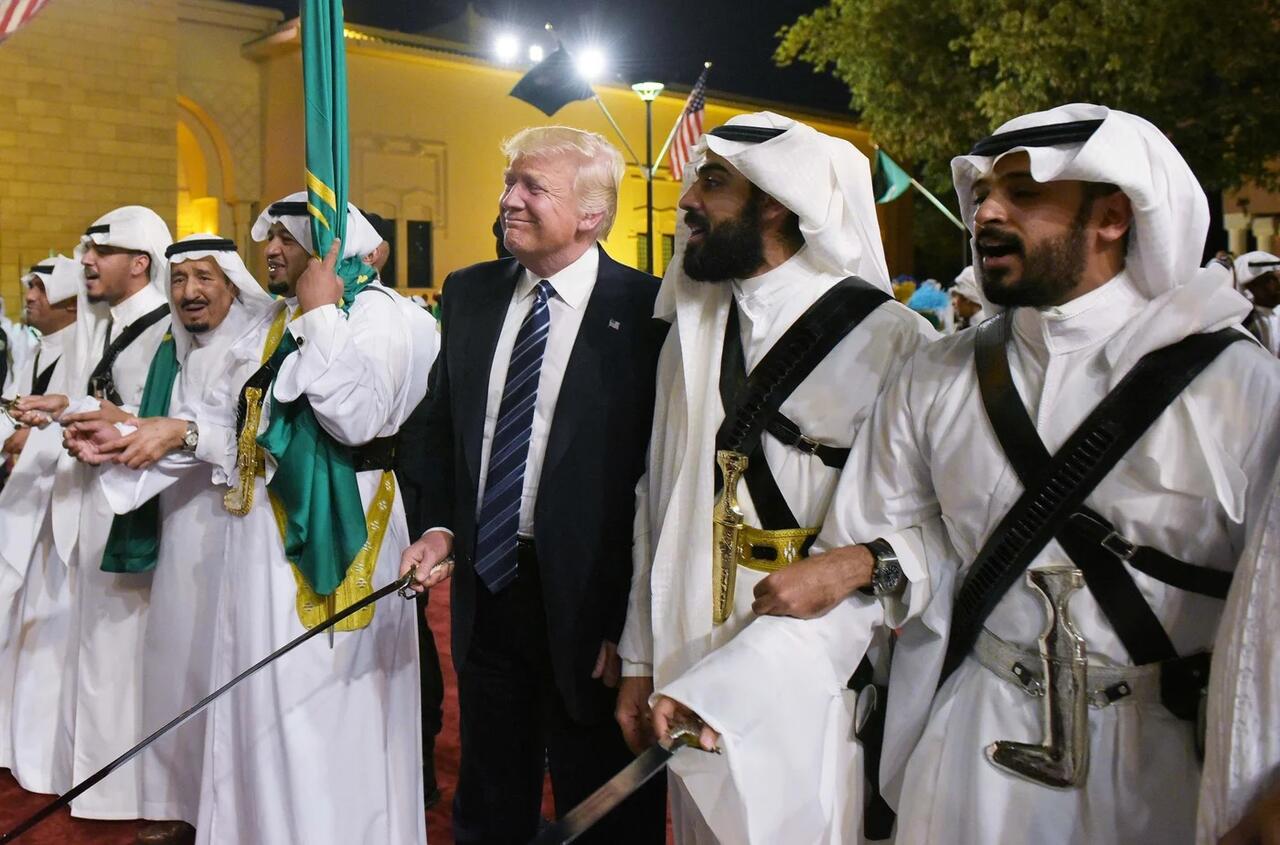
Trump’s May 2017 visit to the kingdom during his first term. AFP
“Rift is too strong of a word, but frustration is bubbling,” a senior western official in the region told Middle East Eye.
Several sensitive dossiers are jostling together ahead of Trump’s visit that are irking Israeli Prime Minister Benjamin Netanyahu, analysts and diplomats say.
The most consequential file for Trump is the ongoing nuclear talks with Iran, which US Vice President JD Vance said this week have been “so far, so good”.
For months, Trump has scorned Netanyahu on the talks as his closest media allies attack “Mossad agents” trying to hamstring the US leader. By his own admission, Trump even resisted Israeli pressure to launch a preemptive attack on the Islamic Republic.
The Exposure Of This Operation Is Not Only Critical For National Security But From Stopping Israel’s Planned Imminent Attack On Iran That Respected War Planners Warn Has A High Probability Of Triggering A New Global War




 American Buddhist Net