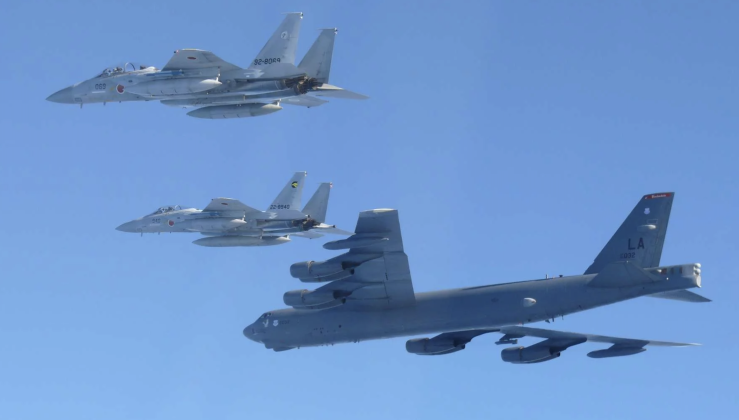
The U.S. Air Force has deployed two B-52H Stratofortress nuclear capable bombers for operations alongside Japan Air Self-Defense Force fighters, with the aircraft staging a joint show of force on December 11.
Japanese government sources Tokyo described the show of force as a signal of alliance cohesion, while U.S. defense officials familiar with regional operations have confirmed the choice to deploy the B-52 was specifically intended to demonstrate combined long-range strike readiness.
B-52H Bomber with Japanese F-15J Fighter Escort
This follows rising tensions between Tokyo and Beijing, after Japan’s new prime minister, Sanae Takaichi, threatened to intervene militarily in the ongoing conflict between the People’s Republic of China on the Chinese mainland, and the Republic of China based on Taiwan, which have for decades remained in a state of civil war.
China responded to the Japanese prime minister’s threat by deploying the aircraft carrier Liaoning to conduct exercises near Japanese waters, with J-15B fighters operating from the carrier on December 6 locking onto two Japanese F-15J fighters and demonstrating the significant superiority of their sensors.
Japan responded by deploying F-2 fighters armed with anti-ship missiles to simulate strikes on the Chinese carrier group.
The rapid modernisation of the Chinese People’s Liberation Army has left Japan in a significantly weakened position, with the F-15J fighters that form the backbone of the fleet being long since obsolete, while even the newer F-2s are over a quarter century old and lack sufficiently long range weaponry.


 American Buddhist Net