
The minds of social species are strikingly resonant
Collective neuroscience, as some practitioners call it, is a rapidly growing field of research. An early, consistent finding is that when people converse or share an experience, their brain waves synchronize. Neurons in corresponding locations of the different brains fire at the same time, creating matching patterns, like dancers moving together. Auditory and visual areas respond to shape, sound and movement in similar ways, whereas higher-order brain areas seem to behave similarly during more challenging tasks such as making meaning out of something seen or heard. The experience of “being on the same wavelength” as another person is real, and it is visible in the activity of the brain.
Researchers are discovering synchrony in humans and other species, and they are mapping its choreography—its rhythm, timing and undulations—to better understand what benefits it may give us. They are finding evidence that interbrain synchrony prepares people for interaction and beginning to understand it as a marker of relationships. Given that synchronized experiences are often enjoyable, researchers suspect this phenomenon is beneficial: it helps us interact and may have facilitated the evolution of sociality. This new kind of brain research might also illuminate why we don’t always “click” with someone or why social isolation is so harmful to physical and mental health.
link
FIML increases and improves brain synchrony.
In the beginning of learning it, FIML may also disrupt or alter brain synchrony.
Altered synchrony is probably the reason FIML is difficult to learn and understand at first.
When FIML practice is accepted as a natural form of speech—and partners have trained themselves in it—a more accurate and powerful synchrony will emerge. ABN
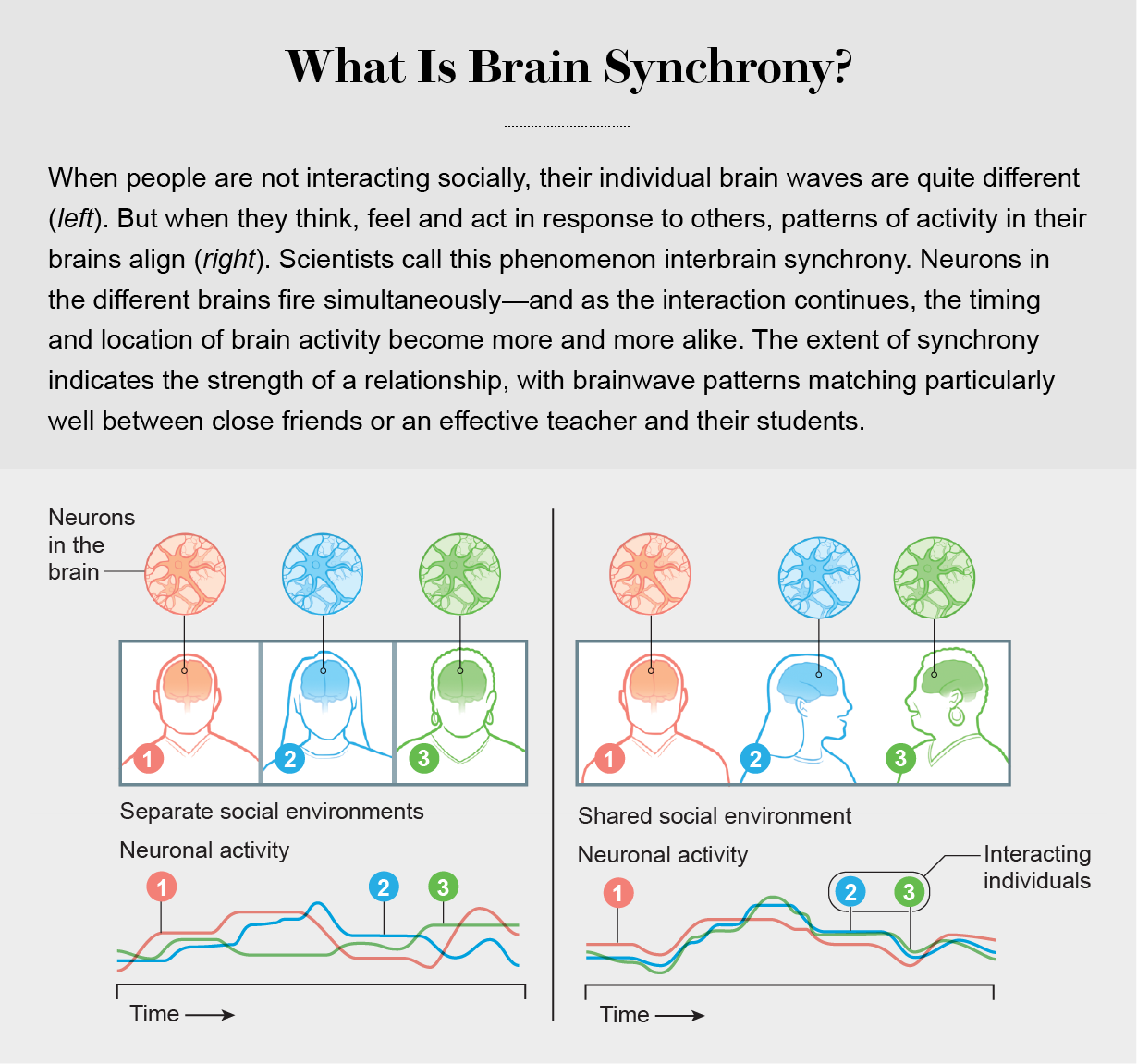
from article linked above
When we interact socially, what we fundamentally do is display and receive semiotics. We share them to greater or lesser extents.
What we do not do nearly enough is investigate this sharing at the level of real-time micro and meso semiotics.
FIML does precisely this and you do not need fMRI to do it.
From a Buddhist point of view, FIML is the dynamic sharing and analysis of subtle and very subtle states of mind.
The synchronies you share with your FIML partner will be deeper and richer than any others because you have worked and trained at fully understanding them. ABN

 American Buddhist Net