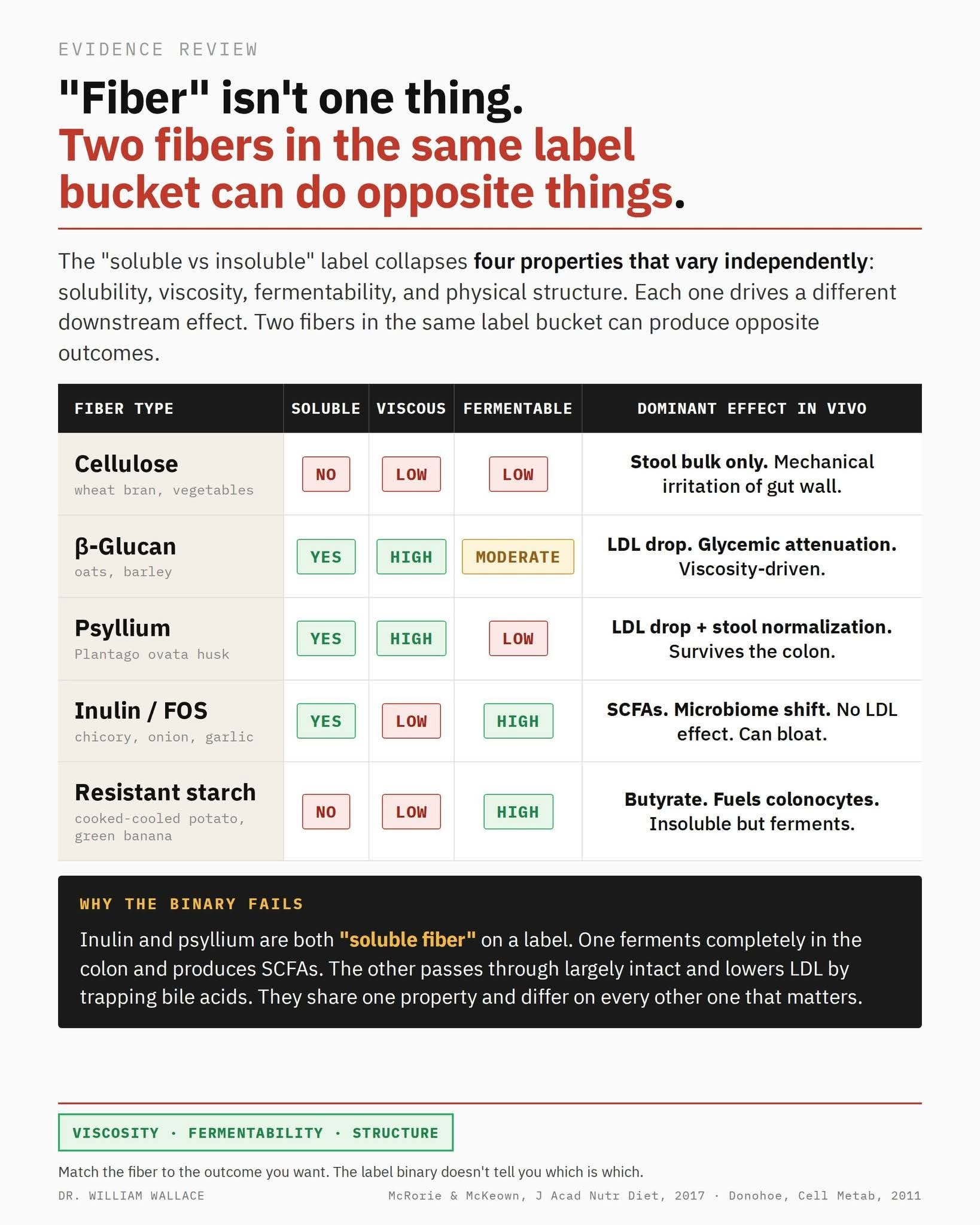
“Soluble vs insoluble” is one of the most enduring oversimplifications in nutrition. Two fibers in the same label bucket can do completely opposite things in your body.
Fiber has at least four properties that vary independently:
Solubility (does it dissolve in water?)
Viscosity (does it form a gel?)
Fermentability (do colon bacteria eat it?)
Physical structure (intact or particulate?) Each property drives a different outcome. The label binary collapses all four into one.
β-Glucan (oats, barley). Soluble, highly viscous, moderately fermented. Lowers LDL via bile acid sequestration. The FDA-approved oat health claim is built on this property.
Psyllium. Soluble, highly viscous, poorly fermented. Survives intact through the colon. Lowers LDL. Normalizes stool (works for both constipation and diarrhea).
Inulin / FOS (chicory, onions, garlic). Soluble but non-viscous. Highly fermentable. Bifidobacteria use it as substrate to produce SCFAs. Minimal LDL effect. Can bloat.
Resistant starch (cooked-cooled potato, green banana). Insoluble but highly fermentable. Produces butyrate, the primary fuel for colonocytes (~70% of their ATP).
Why the binary fails:
Inulin and psyllium are both labeled “soluble fiber.” Inulin ferments completely, produces SCFAs, has only minimal LDL effects. Psyllium passes through largely intact and lowers LDL via bile acid sequestration. They share one property and differ on every other one that matters. Practical translation. Match the fiber to the outcome:
LDL drop → viscous fibers (psyllium, β-glucan, raw guar gum)
Microbiome support → fermentable fibers (inulin, FOS, resistant starch)
Regular stools → either viscous gel-formers or coarse insoluble particles
The label binary doesn’t tell you which is which. The properties do.


 American Buddhist Net