International bureaucracies are retreating from their formerly ‘iron-clad’ fixation on immediate global climate collapse.
As their worst-case computer models evaporate under the weight of real-world data, the goalposts are shifting. Realising they can no longer defend the rigid targets used to drive public anxiety, institutions like the IPCC are quietly pivoting to ‘overshoot’ mode to manage the damage.
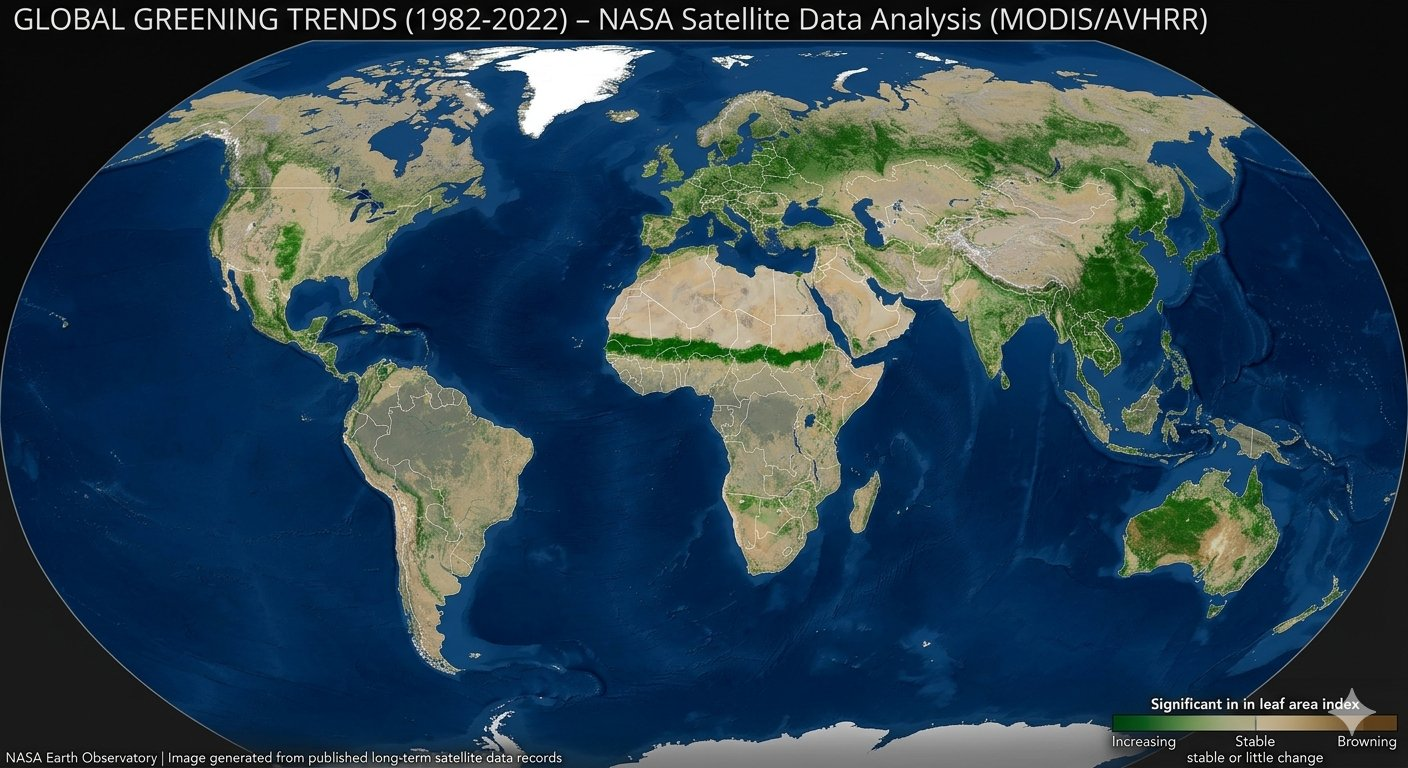
This retreat is happening because empirical data from NASA satellites is telling a vastly different story of planetary resilience. The Sahara Desert, of all places, has shrunk by roughly 8% since the 1980s. This isn’t a computer model simulation, it’s the visible reality captured by NASA’s AVHRR and MODIS satellite instruments.
Satellite data reveals that 25% to 50% of Earth’s vegetated lands have shown significant greening. This is an expansion of biomass equivalent to twice the continental United States. Carbon dioxide fertilisation is responsible for roughly 70% of this growth.
Higher atmospheric CO₂ is also allowing marginal plants to use water more efficiently. Leaf pores (stomata) don’t need to stay open as long to take in carbon, drastically cutting water loss and boosting natural drought resistance. This biological efficiency is allowing vegetation to march back into the world’s most hostile environments.
Green cover has been actively reclaiming the arid fringes of the Sahel (the Sahara’s southern edge), the Middle East and Australian Outback. An 8% reduction in the Sahara’s desert expanse means over 700,000 square kilometres of formerly barren sand wastes have transitioned to green cover.
With CO₂ now hovering around 430 ppm, nature is using this extra airborne fuel to thrive in regions once completely inhospitable.
Centralised policy platforms remain focused on worst-case scenarios and economic penalties. But the biosphere is quietly demonstrating a profound, measurable benefit from higher CO₂. Earth is becoming greener and more water-efficient – where it matters most.
One thought on “International bureaucracies are retreating from their ‘iron-clad’ fixation on immediate global climate collapse — Peter Clack”
@americanbuddhist.net I know maybe this is not the better channel to argue against this, or even to have pivotal change of mind. But what is written there is simply not true, at least not completely. It is true the world is becoming greener because of the extra accumulation of CO2, but this has a clear optimum. From there, there's no more greening of the surface.
Longer and hotter summers is what we having already. Disruptions in the very tightly entwined ecosystems that lead, in ultimate instance, to crop failures. And that is happening now.
Paste the comment URL into the search field of your favorite open social app or platform.
Your Profile
Or, if you know your own profile, we can start things that way! Why do I need to enter my profile?
This site is part of the ⁂ open social web, a network of interconnected social platforms (like Mastodon, Pixelfed, Friendica, and others). Unlike centralized social media, your account lives on a platform of your choice, and you can interact with people across different platforms.
By entering your profile, we can send you to your account where you can complete this action.


 American Buddhist Net
@americanbuddhist.net I know maybe this is not the better channel to argue against this, or even to have pivotal change of mind. But what is written there is simply not true, at least not completely. It is true the world is becoming greener because of the extra accumulation of CO2, but this has a clear optimum. From there, there's no more greening of the surface.
Longer and hotter summers is what we having already. Disruptions in the very tightly entwined ecosystems that lead, in ultimate instance, to crop failures. And that is happening now.
Remote Reply
Original Comment URL
Your Profile
Why do I need to enter my profile?
This site is part of the ⁂ open social web, a network of interconnected social platforms (like Mastodon, Pixelfed, Friendica, and others). Unlike centralized social media, your account lives on a platform of your choice, and you can interact with people across different platforms.
By entering your profile, we can send you to your account where you can complete this action.