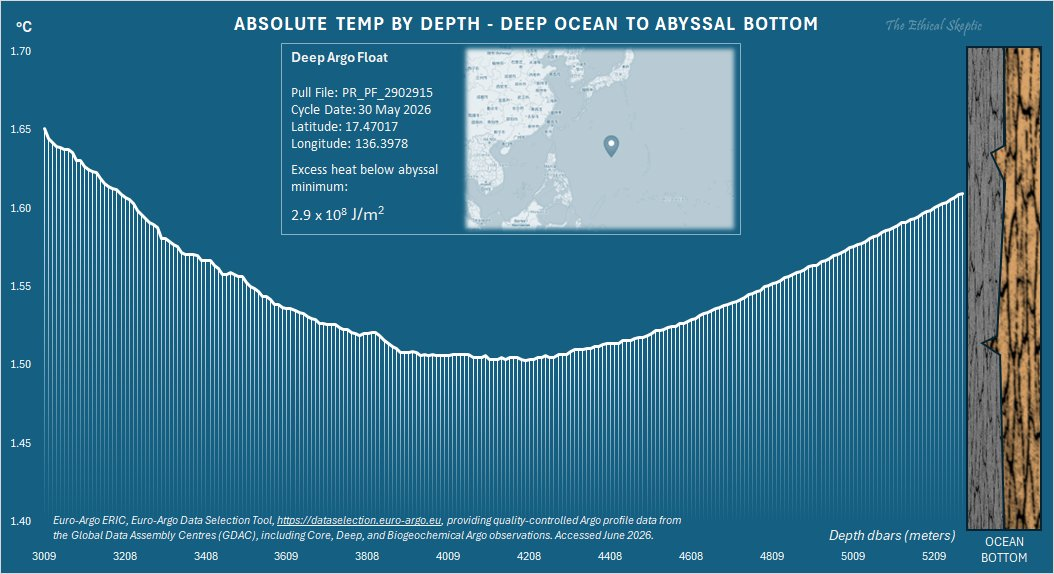
We are at 151 Deep Argo Float cycles1 for the last 30 days of 2026, and guess what is showing up consistently with this hot ocean we have in June of 2026?
Abyssal oceanic heat. Key inferences:
The abyssal ocean is not isothermal as has been assumed by climate science.
There appears to be a broad and pervasive thermal curvature below the deep ocean temperature minimum.
The bottomward warming extends over 1000–2000 meters, far thicker than a conductive or advective boundary layer (no thermocline in the taper) could create (not the result of an overturning current).
The excess abyssal heat content is real and measurable. Unlike the ocean’s surface, maintaining this abyssal heat content requires a continual balance between energy losses and replenishment. The critical path question is: what is the source of the replenishing energy flux?
The layer contains substantial heat content (J/m²).
Climate science missed this – badly… ECDO Theory caught it.
Deep Argo floats operate on a nominal 10-day cycle, though some configurations use 15-day cycles to accommodate deeper profiling depths. During each cycle, the floats cycle between the ocean surface and the seafloor, typically reaching depths of 4000 meters or 6000 meters depending on the specific model (such as Deep SOLO, Deep Arvor, or Deep NINJA). The cycle consists of the following key phases: Descent: The float sinks to its target profile depth (4000 m or 6000 m), a process that can take up to 13 hours for deep models. Parking/Drifting: Upon reaching the bottom or target depth, the float pauses or drifts for a set duration before beginning its ascent. Ascent and Profiling: The float rises to the surface, a process taking approximately 17 hours from 5000 meters, continuously measuring temperature, salinity, and pressure. Transmission: Once at the surface, the float transmits data via satellite (often Iridium) and receives new mission instructions before sinking back to its drift depth to repeat the process. While Core Argo floats sample the upper 2000 meters, Deep Argo floats are designed to sample the full ocean volume, providing critical data for understanding deep-ocean heat content and circulation. ↩︎
__________
My understanding is the heat coming from deep in the earth also heats land masses, but more slowly and harder to measure. It is obvious that ocean heat will heat the atmosphere far more than the atmosphere will heat the ocean. Also, I love Ethical Skeptic but he can a pain in the ass because his writing is filled with abstruse phraseology and technical terms. It requires close attention, which is usually worth the effort. BUT when he has written on a topic I know very well AND based his entire analysis on a flatulent Wikipedia entry AND THEN is rude in response to my horror at his conclusions… well, he did eventually remove the piece. And, like I said, I do greatly appreciate his work. (footnote above is mine) ABN


 American Buddhist Net