
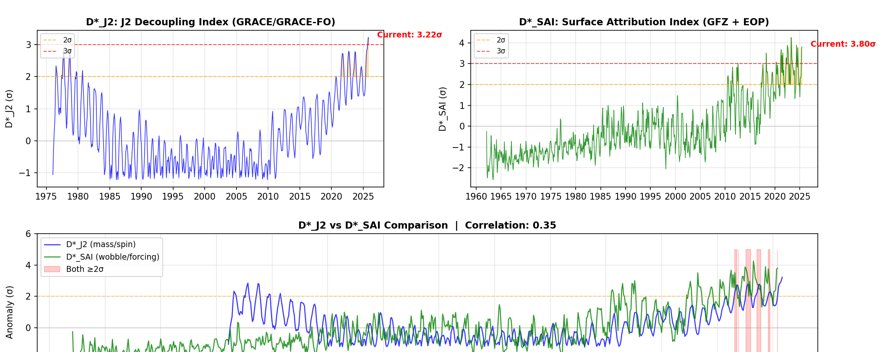
Over the past few months, I have spent several hundred hours building a live, physics-based monitoring system for Earth’s rotation, gravity field, magnetic field, and crustal activity. It uses only authoritative open data (IERS, GFZ, USGS, EONET, standard geomagnetic reconstructions).
Before I share more in a few weeks, I wanted to offer up a complete summary as it is now monitoring live and recording data. First, the system doesn’t assume any specific theory. It literally just watches, in physical units:
- Length-of-day and polar wobble
- J2 (Earth’s flattening term)
- Surface angular momentum budgets (AAM/OAM/HAM/SLAM)
- Field strength, pole drift, SAA behavior, reverse flux
- Global volcanic and seismic patterns
- Similarity to known paleo excursions
Right now, several independent indicators are all elevated at once:
- J2 anomaly: >3σ above late-20th-century baseline [σ = standard deviation]
- Surface Attribution residual (SAI): >3σ (surface forcing and wobble no longer match)
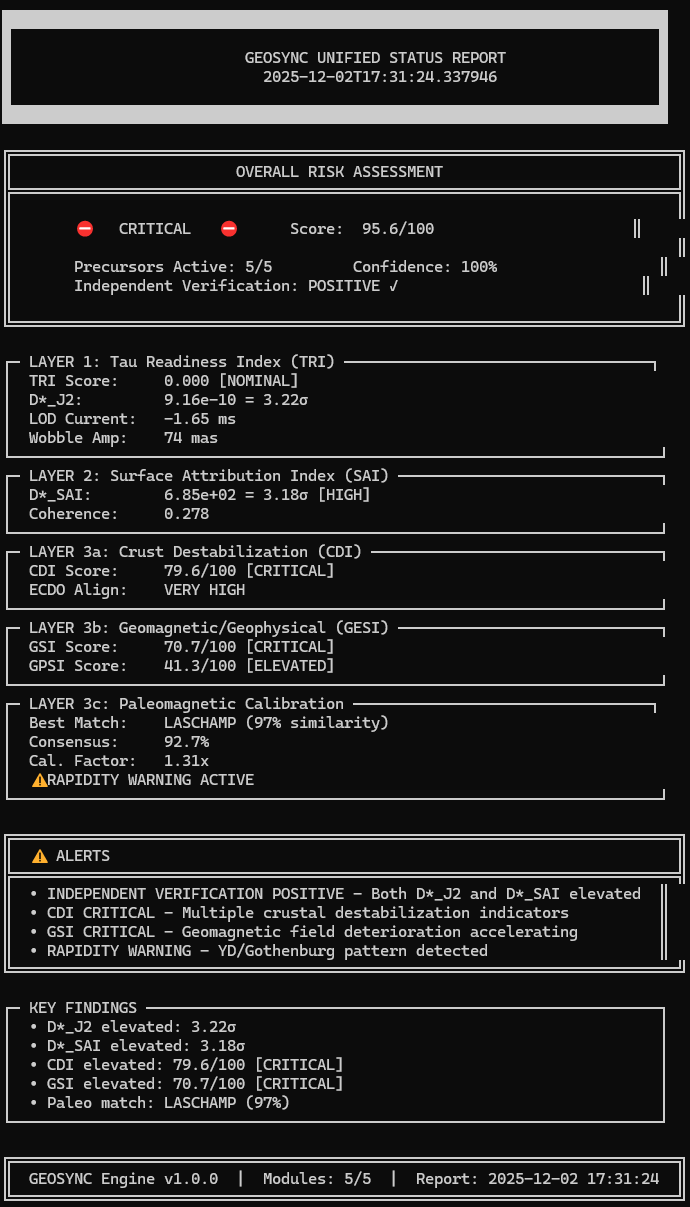
- Geomagnetic stress: in a “critical” band for the first time in the instrumental record under this framework
- Crustal destabilization: rare reactivations + synchronized activity patterns
- Paleo similarity: strongest match to documented excursion onsets (e.g. Laschamp)
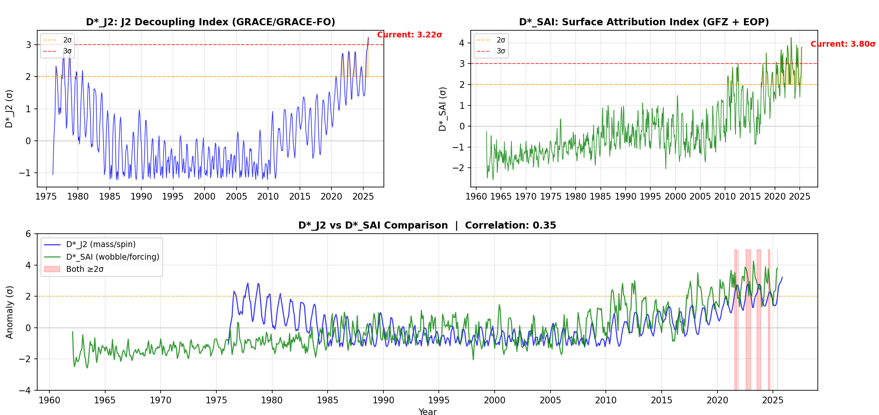
Both D* J2 and D* SAI are in highly anomalous states
Historically, you do see large J2 spikes or individual anomalies by themselves (namely in the 70s, with return to nominal conditions throughout the 80s) but the system recovered. However, what you do not see in the modern data is what we see now: high J2 + high SAI residual + critical geomagnetic stress + critical crustal stress + excursion-like paleo match, all at the same time. In other words, we are no longer in a “quiet, stable dipole” state on this planet.
We are in an excursion-like, high-stress phase of the Earth system, as far as rotation, geomagnetism, and crustal response are concerned.
There is absolutely no refuting this.
This does not mean I can tell you “what day something happens,” or guarantee any particular outcome with really any level of confidence. In my opinion though, only two broad paths exist at this point (and the paleo record does show both):
- The system partially recovers (indicators relax, timelines stretch)
- The system continues to deteriorate and commits to an excursion-class transition
Which path we’re on depends on how these indicators move from here.
If current deterioration persists or accelerates, the odds of a major reorganization in the coming years rise significantly. If key indicators stabilize or reverse (J2, SAI residual, field decay, pole drift, SAA behavior, crustal stress), risk stretches or falls.
However, based on the data, we entered an anomalous state roughly 50 years ago but underwent said recovery. Such a precursor-recovery-crisis pattern is documented in excursion literature (e.g. Laschamp). Early instabilities (like 1970s-80s D*_J2 spikes) probe the system but recover when the geomagnetic infrastructure is intact. Unfortunately,
50 years ago we did not have convergent, rapidly accelerating anomalous conditions across Earth rotation, geomagnetism, and crustal destabilization over known LLVPs as we do today. And we have already exceeded the peak instability of D*_J2 from back then.
Nevertheless, the point of GEOSYNC is to make that evolution measurable, not speculative.
With all of the above in mind, people have a right to know the present state:
- Multi-σ departures from baseline in rotation/gravity
- Synchronized anomalies in field behavior and crustal activity
- A combined configuration that, in the modern record, has no prior analogue and looks most like known excursion phases in the paleo record
In the coming weeks, I will release:
- The complete GEOSYNC v1.0 findings and outputs
- Full indicator definitions
- Comprehensive data library
- Backtests showing when these metrics did not fire together
- Live dashboards / logs so anyone can independently verify, critique, or falsify the framework using the same public data (possibly early 2026)
NOTE: Please, do not read too far into the similarity calibration to Laschamp. This is most likely because there is simply substantially more data and literature around Laschamp then just about any other excursion we have identified. More to come.

 American Buddhist Net