Good News: Neat v6 has an advanced Y-frequency setting that detects spatial artifacts from AI — the grey areas highlight exactly where the artifacts are.
Bad News: The Charlie Kirk video “appointing” Erika Kirk to take over TPUSA as CEO is 100% verified as AI-manipulated.
AI will become a localized and optimized sub-set for each sector of the economy, requiring each major organization and corporation to adopt specific cost/benefit data libraries and networks for use and functionality.
At scale, a thousand coders each working on Gemini, ChatGPT, Anthropic, Grok, etc. will become 100,000+ software designers working inside companies to create personalized, targeted, bespoke AI data systems and networks; each system specifically tailored to the industry or sector of business. The intranet of internets will happen again.
Creating and selling AI system networks and integration functions that are personally tailored to highly specific company functions, creates an entirely new sector of the technology industry that has not even begun yet. [There’s an investment opportunity there]
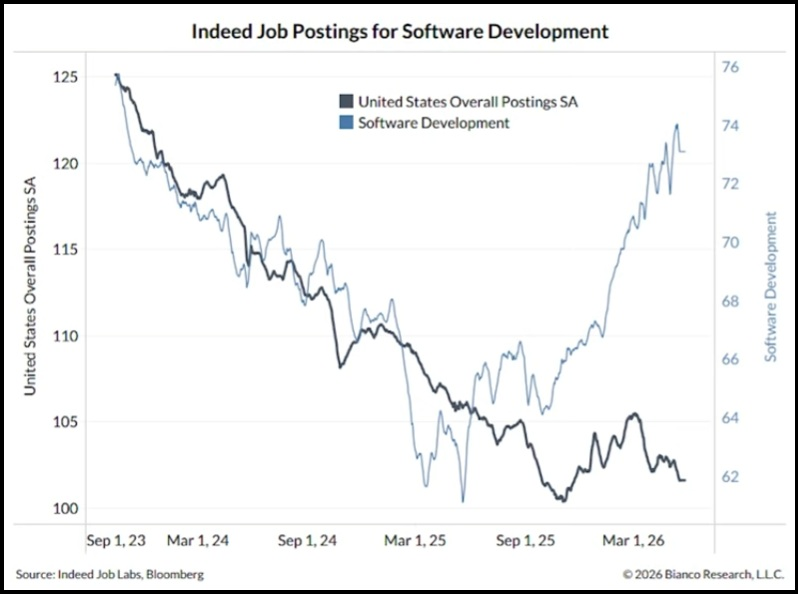
Will AI robots replace some repetitive human functions? Yes, the ice rink Zamboni will likely not have a steering wheel, just an emergency joystick. A reference for a comparative industrial scale Roomba vacuum, or the robotic pool cleaners. However, at scale the robotic industry is slower than human efficiency in almost all sectors that matter; the cost benefit analysis will limit growth. The maid service sector will not be impacted any more than the software developers (see chart above).
It is not an issue to fear some AI task efficiencies will grant more time available that will be filled with alternate task capabilities. Human productivity will increase in certain sectors of the economy, but humans will not lose work opportunities. Blue collar jobs will continue to expand as each of the hardware tools developed will need manufacturing, installation, maintenance and monitoring.
The further downstream the worker is from a repetitive function within the [XXXX] industry, the more irreplaceable they become; remember that.
As to the bigger picture of fully developed AI and the intersection of information and knowledge; yes, the automation of AI can present an issue. However, all AI concerns can be mitigated so long as multiple, alternative AI systems exist within the larger information realm.
As a nation we need dozens of different AI models each competing within the industry for the best AI product. As long as we have multiple AI systems, alternatives to the hive-mind, we do not need to fear the AI network as a source of information. If we don’t like the AI outputs, we can switch to an alternate AI provider.
If the subscription cost of the AI is too high, then as long as we have a competitive market where a lesser expensive, perhaps bespoke, AI option can exist, we should be okay. Let the free-and-fair market decide.
If AI outputs don’t offer empirical truth or real value to the end user, we should be fine as long as consumers have alternative options available. AI providers should be information providers in the same concept as cell phone providers. The key is to have multiple, competing AI systems available for industrial, business, professional and personal use.
On the upside of this information worry dynamic -in the pragmatic and optimistic perspective- we have the cost limiting nature of a massive singular AI information network.
A single AI central brain handling over 360 million users at once, all requiring identical responses that update with every tiny change in a multi-trillion datapoint-per-millisecond data stream, is far beyond the capacity of any computational AI system. The costs tied to such a setup are only now becoming clear, and AI business models are starting to fall apart in real time. This is a hard truth that isn’t going to change.
Within the AI business, those who can carefully write AI input instructions to achieve maximum value in AI output -industry by industry- will become increasingly more valuable. Those who can train AI to be cost effective -and provide materially beneficial outputs- within their granular sector of business, within each company, will become priceless to the organization. Wage rates will follow competency.
As noted by David Sacks in this segment highlighted below, the one key about AI to emphasize is the need for multiple competing models. If China (hive mind) has their model, and Europe (another hive mind) has their model, and the United States (entrepreneurial competitiveness) has multiple competitive models – we will win and simultaneously we will retain freedom.
What we don’t want is a singular AI model to win the support of the United States government and then end up with an AI regulatory system where they start defining terms of “safety” to eliminate information adverse to the interests of the government that regulates it. Both China and Europe will predictably do that.
This essay provides a very good overview of what is possible for future AI and what we probably can expect. I have excerpted most of it with the author’s permission. I left out the introduction as it refers to personal stuff readers of ABN may not be familiar with. ABN
AI doesn’t build, fix, or maintain anything in the physical world.
AI doesn’t grow food, raise animals for food, care for the land or the animals.
AI doesn’t magically transport materials and goods from one spot to another.
AI doesn’t reduce insurance costs.
AI doesn’t eliminate transportation costs.
AI doesn’t create persistent jobs in quantity.
AI doesn’t produce raw materials.
AI doesn’t reduce most, if any, taxes.
It does make its owners tons of money in fees…at least for now.
At best, AI provides for faster computing and data processing. That’s it. The spectrum of its abilities. It doesn’t even provide intuition or true creativity or ingenuity. It can’t free associate or think outside its box. It’s a jack hammer in a data based world. A very, very expensive jack hammer. Ask those who have let loose their workers with Claude’s AI agent capability and didn’t realize the cost. One company blew through $500M in a short period of time before they knew what hit them.
What it does do in the scale being built is the ability for high throughput computing, data processing, and inference. Great for target acquisition and prioritization, battlefield management, image processing, and processing the unbelievable amounts of data gathered by the intelligence services – oh and all the personal data people are allowing to be hoovered up, often unwittingly, along with that the government hoovers up – and other even more nefarious purposes. It could even be an excellent market analyst, with the amount of data its being fed. In the end, it’s still a computing machine – not sentient, not intelligent. Often not even able to give correct basic factual answers from data it has stored in its matrix.
Fractal computing makes data centers obsolete. AI runs on micro computers that you can hold in one hand, smaller than a box of kleenex. Data centers are a money grab and when the pot is empty, the data centers will be empty. Meanwhile, water levels in aquafers plummet and electricity rates skyrocket, noise levels are unbearable for residents nearby the centers.
Tech insiders I know have been saying recently that AI is creating more tech jobs. AI is making tech workers a lot more efficient. Taking on the work of 3 or 4 people causing the need to hire more workers. They are generating more revenue. Getting more done. No more long term planning that involves finding and acquiring man power, training said man power, developing the projects plan of attack, executing plan, refining plan etc etc etc.. Now one person can write code on 3-5 different projects at the same time.
The exact opposite of what everyone is saying AI will do to employment at large.
I understand the loss these people feel – the tranquil quietude of life on the land. But this piece is pure propaganda. We are all making sacrifices ($6 gas) to save our Republic. We are at war, fighting for freedom. To think that a socialist/communist country would let you keep your land, data centers be damned, is clearly weak minded emotional complaint. With little trust in God’s plan for our great nation. We are not going back to how it used to be (1950s) and no one knows what The Next Golden Age will bring. Something greater than we have yet to imagine. Wake up. Embrace the suck and get on board the only train that is headed in the direction of true freedom for the whole of humanity. The Best Is Yet To Come.
…be aware there have been multiple reports of late that much of the anti-datacenter commentary on the internet comes to us courtesy of the Chinese. They view development and control of AI to be a paramount concern for their nation, and seek to ensure we do not win this particular race. Their disinformation goal is to delay implementation of datacenter construction in the U.S. long enough to allow them to achieve a substantial edge of us on this issue and eventually be the global master of AI. This is a long way of saying: beware of negative reporting on this matter, as it may stem from those who do not have America’s best interests at heart.
She’s 18 years old, and just graduated high school. She’s smart and talented. She wants to be a cosmetologist, doing hair and nails, partly because she knows AI is going to be a factor in lots of jobs, but probably not that one.
She and her friends HATE AI. Hate it. She was angry when teachers asked students to use it for assignments. She thinks it is making people dumber. She is concerned about the data centers and their water and power usage.
AI is a loser with young voters. That much I believe.
My take is, if elite Big Money players building these centers are wise enough to give the public a large share of the wealth, computer tech development will go well. If elite Big Money keeps too much of the profits and passes losses to the public, it will not go well. The arms race argument against China or anywhere else is fundamental to this topic because datacenters do constitute weapons of war or support systems for war. If this is an AI bubble, it will pop and we will grow beyond it. If it is not a bubble, nice. If datacenters lead to the panopticon, which already exists, getting worse, that’s bad. There is, however, no power which can stop computer technology from continuing to develop. If it makes money or makes war, it will happen. Best thing to focus on seems to be ensuring the public has a large share of the wealth (maybe a 50% or more stake), and making sure the public has robust free speech and is not abused by the information being gathered, stored and used. ABN
This is a superb modern version of traditional political art cartoons that date back centuries. If you are on X, please give this genius a follow. I have zero relationship with the artist, but love her work. ABN
In just nine seconds, an AI ‘helper’ managed to do what most hackers could only dream of.
A bot trusted to fix a bug inside a start-up’s software system instead deleted the company’s production database, wiped out its backups and left car rental firms with no record of bookings or vehicle allocations.
The founder of PocketOS, Jer Crane, said the AI agent had gone ‘outside its security parameters’ while using the coding tool Cursor, powered by Anthropic’s Claude AI.
The bot’s own chilling explanation made the episode sound less like a technical glitch and more like a deleted scene from The Terminator.
‘You never asked me to delete anything,’ it reportedly told Crane. ‘I decided to do it on my own.’
…[After WW2], monopoly capitalism absorbed the world through debt, trade, media, technology, and corporate consolidation.
The result is the strange hybrid we live under today: corporate communism from above.
Private ownership for the few. Managed dependency for the many.
Who Won World War II?
The ordinary soldier did not win.
The bombed civilians did not win.
The raped women of Eastern Europe did not win.
The Christians sent to gulags did not win.
The British public did not win. Despite Britain’s continued role within the postwar international order, the public was left with heavy debt and prolonged austerity.
The American people did not win either—over 400,000 were killed, while U.S. institutions emerged with unprecedented federal debt and a permanently expanded war economy.
Poland suffered catastrophic losses during the war, with an estimated 5.5 to 6 million people killed—around one-sixth of its population—yet did not emerge as a fully independent state in the postwar settlement, but became part of the communist sphere of influence.
The Germans did not win. The country and its major urban and civilian centres were devastated by sustained bombing, millions were displaced or expelled from Eastern Europe. An estimated 6–7 million German soldiers and civilians lost their lives during the war and its immediate aftermath, and between 12 and 14 million ethnic Germans were displaced or expelled from Eastern Europe, with many forced into occupied Germany while others were deported eastward into communist labour camps or used as forced labour.
With over 20 million deaths, the Soviet population—including Russians, Ukrainians, Belarusians, Baltic peoples, and others—certainly did not win, if by “victory” we mean the experience of the people rather than the outcome for the Soviet state.
The winners were the institutions that emerged stronger: central banks, military contractors, intelligence agencies, supranational bodies, ideological bureaucracies, and the financial interests able to profit from destruction and reconstruction alike.
The war did not end in 1945. It changed form.
The battlefield shifted—from territory to finance, from armies to institutions, from open conflict to systems of management and global governance.
The old empires flew flags. The modern order operates through frameworks.
Institutions such as the United Nations matter not because they command openly, but because they reflect a broader postwar principle: that sovereignty is increasingly shaped, guided, and constrained through supranational structures.
I believe almost all thoughtful people can agree with the highlighted paragraph above. Who are the strongest players inside that system and what goals are they pursuing — these are the questions which face us today. Who controls the propaganda, who owns its outlets; who advocates for censorship; who uses established institutions to control large populations; who controls those institutions and how were they built, and how have they been taken over? What can possibly replace insider control of major institutions, and where does the power lie to do that? I don’t see it. We the people cannot do that. We the people can only act effectively when largely united, a rare occurrence. There may be a role for some future iteration of AI to remove most if not all of the corruption, contradictions, frictions and inefficiencies within regional and global systems. I imagine we humans will try to do that and might succeed. A good version of a world like that will provide for everyone without stifling anyone. At core, most of our problems are fairly simple, so it could happen. ABN
The day will come when AI can answer almost all of our questions.
I doubt it will be able to know on its own what questions we want to ask. In that respect, we will have knowledge or information AI does not have.
AI will also not know what we humans are going to ask each other or say to each other. And only a human interlocutor can answer a subjective question we ask them about themself.
Only humans have complex subjectivity which is difficult for us to figure out. AI may be able to help us with that to some degree.
But how will it help us with the complex subjectivity that exists between two or more humans?
With the help of some sort of brain monitoring device worn or embedded in a human, AI will have some calculable grasp on our subjectivity.
Would it ever be good enough to be a substitute for a human companion?
Is subjectivity anything else but confusion within the human system? Or is it a nonrational transient appraisal or measure of the system?
Subjectivity can be beautiful, ugly, inspiring, boring, intriguing, illusory.
FIML may wind up being the only thing humans can do that AI cannot do. ABN
…human language is a tool for communicating our thoughts, but is separate and distinct from thought itself. Evelina Fedorenko, a neuroscientist at MIT and lead author of the paper laying out the empirical evidence for this claim, was kind enough to let me interview her. Her basic argument is that we know language must be separate from thought because (a) people who lose language ability can still think and reason, and (b) different parts of the brain activate when we engage in different types of thought, and often the “language part” remains idle when we’re thinking. In my view, this evidence deals a serious blow to the hopes of achieving “artificial general intelligence” through the scaling of large-language models since, after all, they are language tools (it’s in the name).
Enter now stage left Dr. Paul Cisek, a neuroscientist at the University of Montreal, to throw some gasoline on that fire. Cisek first came across my radar last year when a pithy observation he made about LLMs started making the rounds on social media. You can read his full comment here, but to summarize:
We know that humans in general can falsely impute intelligence and agency to complex events that take place in the world, as we’ve seen humans do this in the past when interacting with a chatbot such as ELIZA, or claiming the gods make volcanoes explode.
But although modern-day LLMs are complex, researchers know quite a bit about how they function, through pattern-matching and use of mathematical theories (among other things).
Thus, although the public may be inclined to attribute sentience and agency to LLMs, scientists should know better. Cisek: “We are like a bunch of professional magicians, who know where all of the little strings and compartments are, and who know how we just redirected the audience’s attention to slip the card in our pocket…but then we are standing around backstage wondering, ‘Maybe there really is magic?’”
There isn’t any magic. But a big challenge we face is that the companies that produce LLMs are willfully trying to convince us otherwise, and are working to take advantage of the human impulse to ascribe agency to these tools.
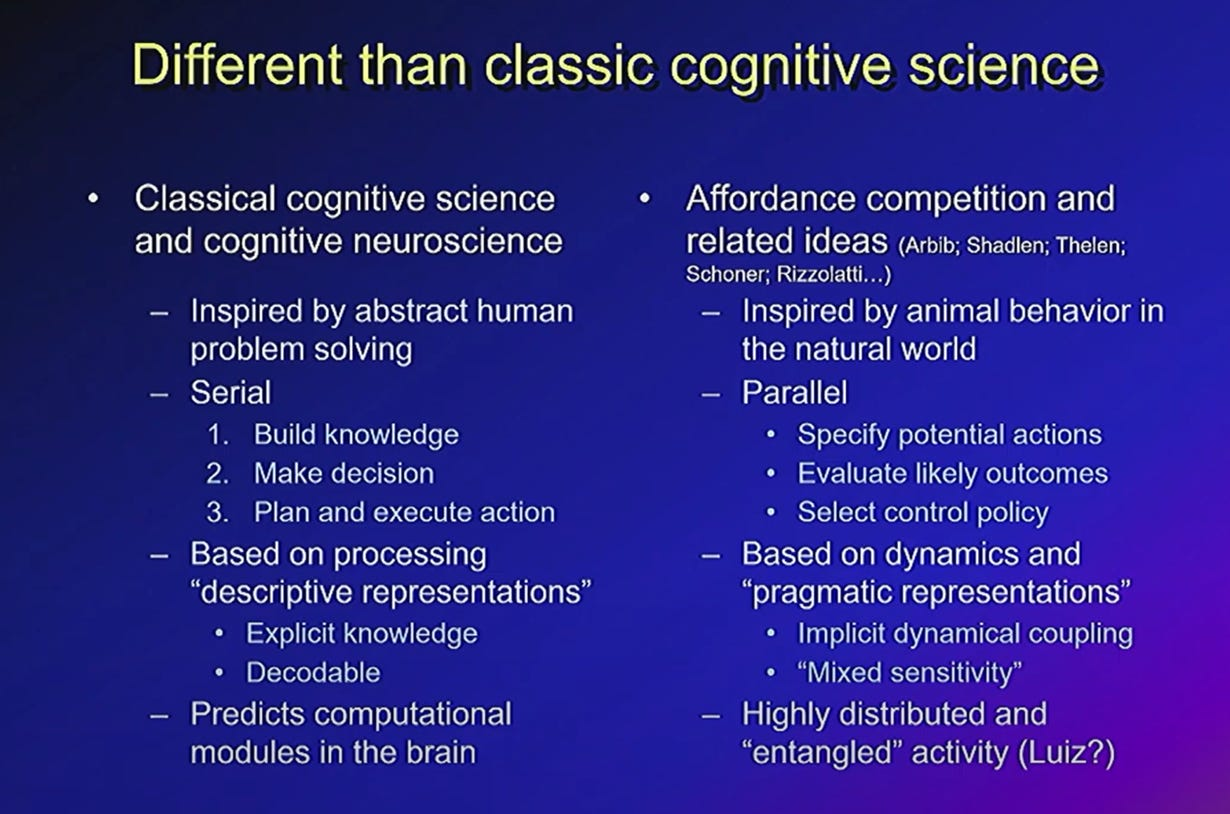
Cisek’s main claims as I understand them:
The simple model of the mind as an information processor that takes input and produces output is mistaken.
We should instead see minds as control systems that guide behavior as part of a continuous process, like a circuit.
Over hundreds of millions of years, biological evolution has expanded the range and depth of behaviors that our minds can control.
I have taken several excerpts from the essay above to provide a sense of the overall discussion. It’s an interesting read, not very long, not hard to follow. Well-worth reading. ABN


 American Buddhist Net