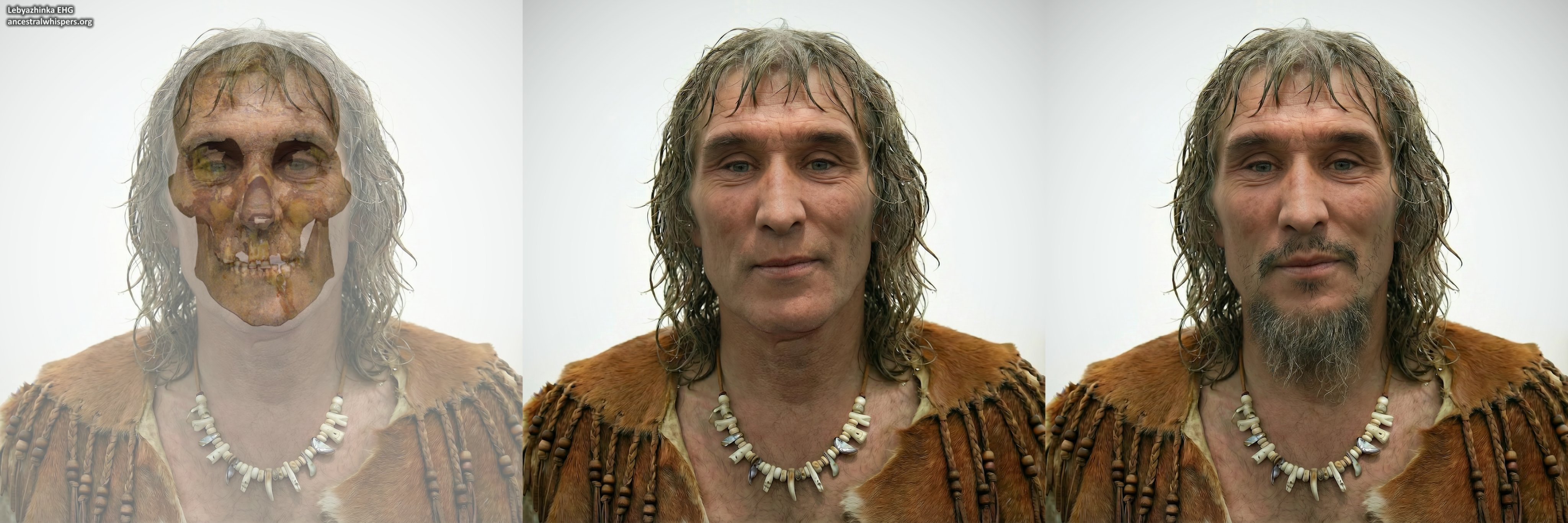
This Eastern Hunter-Gatherer individual was found in the Samara region. His Y-DNA was R1b-P297, and his mtDNA U5a1d. Pigmentation analysis indicates that he carried genes for light skin, light hair, and blue eyes. His cranial measurements include a medium-large cranial length of 181 mm, a medium-small cranial width of 135 mm, and a large cheek width of 137 mm.
The idea of a distinct Sub-Ural population stratum emerging in deep antiquity was developed on the basis of Early Neolithic skulls recovered from burials near the villages of Chekalino and Lebyazhinka in the Samara region. This population was classified as belonging to what is termed the Ancienturalic race. [Khokhlov, 2017]
The concept of the Ancienturalic race was introduced by anthropologist Viktor Bunak. He proposed that a unique anthropological formation arose in the Ural region during the Neolithic, possibly as early as the Paleolithic. This group possessed a set of traits intermediate between Caucasoids and Mоngolоids, yet developed independently of both, originating from a very ancient, autochthonous layer. The male skull from Lebyazhinka IV, associated with the Elshan culture, like many other individuals belonging to the EHG cluster, exhibits precisely this combination of features.
Somali refugees in Minnesota have committed the ‘biggest theft of taxpayer dollars in US history’ and local Democratic officials were ‘fully complicit’ in the scheme, White House officials declared Friday night.
Federal authorities announced this week that at least 86 people – mostly within small Somali communities in the state – have stolen more than $1 billion in public funds from programs meant to feed children, assist the homeless and provide autism therapy.
The suspects allegedly ran companies that billed Minnesota state officials for millions of dollars in social services that were never actually rendered in three separate fraud schemes.
It has since been revealed that Representative Ilhan Omar and Minnesota Governor Tim Walz had connections with at least some of the Somali refugees charged in the massive scheme.
BTW, the West has other greedy clans, some of which which engage in widespread covert violence, living among us for many decades; and many centuries is some cases. ABN
Archaeologists in Egypt have uncovered a stunning treasure trove hidden inside an ancient royal tomb, a discovery so rare it is rewriting history.
Buried deep beneath the sands of Tanis, researchers found 225 exquisitely crafted funerary figurines arranged in a mysterious ceremonial pattern, yet the tomb itself was empty of a body.
The find has electrified the archaeological world, not only for its scale but for its baffling implications.
More than half of the figurines are female, an almost unheard-of feature in royal burials, raising new questions about funerary customs during Egypt’s fractured Third Intermediate Period.
The figurines were laid out in a star-like formation and in perfect horizontal rows, suggesting an intentional ritual design untouched for nearly 3,000 years.
This is the first time in almost 80 years that figurines have been discovered undisturbed inside a royal tomb at Tanis, making it one of the most significant finds at the site since the 1940s.
Most astonishing of all, the royal symbols on the miniature servants confirm that the empty tomb belonged to Pharaoh Shoshenq III, a ruler whose final resting place has puzzled Egyptologists for decades. He reigned from 830 to 791 BC.
This video is a 2-minute excerpt from the 2014 documentary Pakistan’s Hidden Shame, directed by Mohammed Ali Naqvi and aired on Channel 4 in the UK. It focuses on child sexual abuse among street children in Peshawar, Pakistan’s northwestern city.
__________
When you bring in migrants, especially in large numbers, they will continue cultural practices from wherever they came from.
It is asinine to ignore this massive reality, which Britain and the West has done for far too long.
The naive tautology that ‘everyone is equal because we are all human’ is the stupid soft part of Western demise.
Criminal, violent tribal, and violent clan infiltrations are the hardcore results, abetted by corrupt politicians and and the wealthy infiltrators who pay them off.
After many decades of reckless migration, including murderers, spies, smugglers and sophisticated infiltrators, the West has all but destroyed itself.
Out of 8 billion humans on Earth, only around 0.33% are women with Nordic features, blonde hair and blue or green eyes.
That makes these features rare, it makes us a minority and an endangered type on this planet.
Now, women with Nordic features are being openly targeted by the radical woke left’s self-hating ideologues who want to erase us because we’re apparently not “diverse” enough for their agenda.
Only 0.33% of humankind. Make that make sense.
If this were any other race, ethnicity, or group of people, there would be outrage.
“Equality & diversity” was never about true inclusion, it was always about the exclusion of white people and their replacement.
Linda Sun, 42, had convinced Hochul — who served as Cuomo’s lieutenant governor at the time — to film a Lunar New Year video touting China’s New York consulate when she made the shocking comment, according to evidence presented at the ex-Albany aide’s corruption trial.
“She is much more obedient than the governor,” the accused Beijing mole wrote to China consular official Lihua Li in a Jan. 25, 2021, message shown to jurors in Brooklyn federal court.
Linda Sun, who allegedly served as a Chinese agent, once bragged that Kathy Hochul was “much more obedient” than Andrew Cuomo.
“The deputy governor listens to me more than the governor does,” Sun wrote in another text minutes later — punctuated with a sheepish grin emoji — sent to Huang Ping, who headed the consulate office at the time.
UPDATE: In common with almost all Westerners, including many who have spent years in China, Hochul has zero understanding of China and Chinese civilization.
You can see it in her eyes and in Sun’s description of her.
In the 19th and 20th Centuries, China was forced to come to terms with the West. It took them a long time.
In a very similar manner, the West in recent decades is being forced to come to terms with China.
We are doing no better with that than China did 150 years ago.
Like them, we are reacting to a fantasy of China, an enormous illusion.
I highly recommend that Westerners understand that all cultures are susceptible to decades, if not centuries, of confusion and disorientation when dealing with foreign powers they do not understand.
All cultures, including the West.
The West is also doing a terrible job of managing our relations with Russia, Israel, India, the Muslim world and Africa.
For China, it might be a good idea to consult more closely with very intelligent and knowledgeable Japanese.
They have been dealing with China for well over 1,000 years and even still made a major blunder by invading China in 1931.
That was a disaster they are still reeling from today.
Nonetheless, Japanese know more about China than Westerners do, and they know enough about about us to be good informants, while also benefitting from a more secure USA .
For Russia, I like what Trump appears to be doing. He seems to want an alliance with Russia based on real-world economic and political ties.
For China and other regions, I highly recommend not listening too much to academics, foreign policy experts, run-of-the-mill historians or anyone who has a dog in the fight or money on the table.
Trump is much better than most at this game, and this is a major reason I support his presidency.
I doubt Vance, or anyone else in the presidential bullpen right now, has the chops to replace Trump.
I hope there is someone somewhere in power in USA who has the street-smarts to contact and learn from people who genuinely understand the civilizations around the world that we must come to grips with and relate to for our own benefit and theirs.
Fake news, fake history, fake anthropology and fake foreign policy — all have a stupid and deeply naive side as well as a nefarious one.
People like Sun exploit the nefarious side. And she is just one of millions from across the world, Somalis included.
People like Hochul are on the naive side, deer in the headlights.
She is a poster fawn for virtually all Western politicians today. ABN
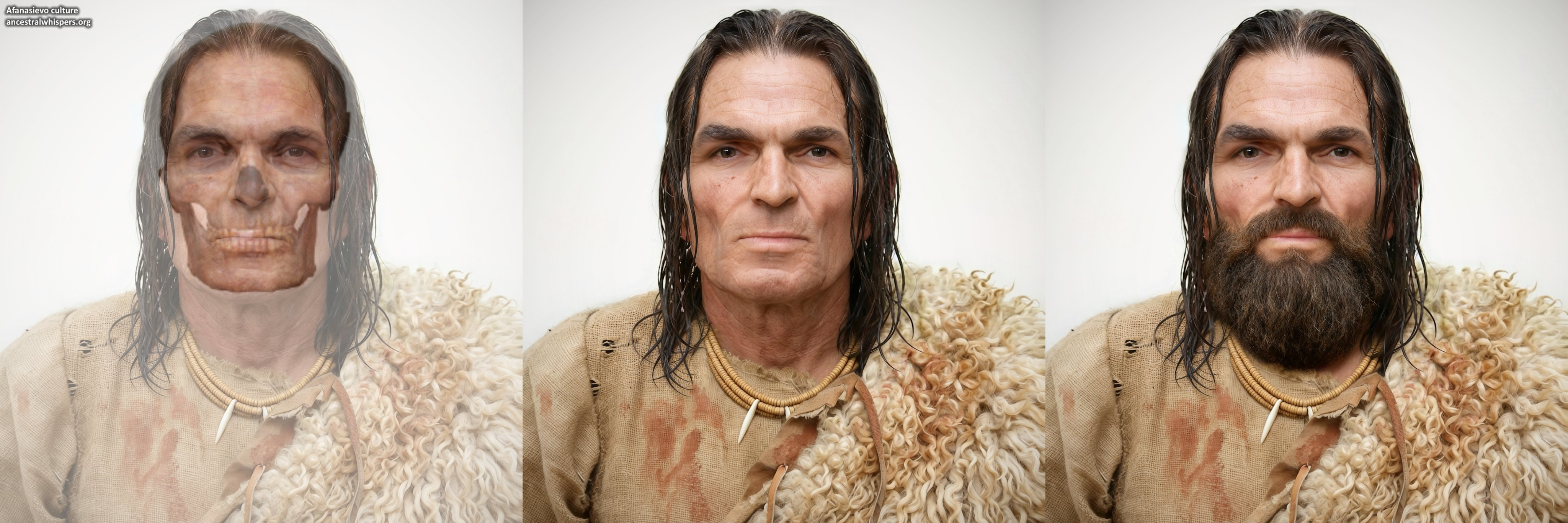
Facial reconstruction of a 5,100-year-old Afanasievan from Mongolia with Yamnaya-like auDNA
He carried Y-DNA haplogroup J1a2b and mtDNA U5a1. His maternal lineage, associated with European hunter-gatherers, was widespread among Indo-Europeans. His paternal lineage, J1a2b, has been previously detected in the Khvalynsk culture; a downstream of this haplogroup also dominates the Y-DNA of the Kura-Araxes culture, possibly suggesting a dispersal of J1a2b from the Caucasus into the Steppe, where a related branch persisted and became the main haplogroup of the Kura-Araxes culture.
The man, belonging to the Paleoeuropoid/Protoeuropoid type, stood roughly 180 cm tall (498mm femur length) and possessed a notably massive and robust skull, with a very long cranial length of 193 mm, massive cranial width of 151 mm, and a very broad cheekbone width of 147 mm.
In Inner Asia, the Bronze Age begins with the emergence of the Afanasievo culture, which spread across vast regions of southern Siberia and Central Asia. Its sites are known from western and central Mongolia, eastern Kazakhstan, the Dzungarian Basin, and even the Middle Zarafshan, though the highest concentration lies in the Altai and the Minusinsk Basin. AMS radiocarbon dates place the Afanasievo horizon between 3300–2500 BCE. Both anthropological and ancient DNA evidence indicate that the Afanasievo culture arose from a migration of populations from Eastern Europe, specifically from the Yamnaya cultural sphere (Solodovnikov et al. 2023).
The Altai Afanasievo individuals rank among the tallest ancient populations of Eurasia (Solodovnikov et al. 2018). A similarly tall stature is seen among Afanasievo individuals from central Mongolia, based on limited material from the Shatar-Chuluu cemetery (where the reconstructed individual was found) near the Khangai range (Tumen 1978; Solodovnikov, Erdene 2022).
Two published Afanasievo individuals have been identified as fifth-degree relatives. One was buried at Inskaya Dol in the northwestern Altai (I11752, BARN-039) [Narasimhan et al. 2019], and the other at the Shatar-Chuluu cemetery in central Mongolia (SHT002, AT-25 (I6221, the reconstructed individual)) [Jeong et al. 2020; Ringbauer et al. 2023]. Although these sites lie 1,410 km apart, both individuals share the characteristic Afanasievo/Yamnaya genetic profile and cluster closely with other Afanasievo samples. Their biological relationship implies that at least one ancestor in their family line must have traveled several hundred kilometers within their lifetime.
This is an inevitable response. Basic anthropology. ABN
UPDATE: Ofc, this video could be fake or a psyop, but something like this is inevitable and Ireland is a prime candidate as they had a very active IRA for decades. ABN
One important thing FIML practice has showed me is that people very often—more often than they realize—attribute specific, clear intentionality to the speech of others when that speech actually originated out of a muddled state and was not clear or specific at all to the speaker.
I think we do this because as speakers we have better knowledge of the rich ambiguity that is our mind, while as listeners we know, for the most part, only what the speaker has said, or rather what we think we heard them say.
In many other posts we have discussed hearing words incorrectly and the consequences that can follow from that. In this post, let’s confine ourselves to a listener’s attributing a more specific intentionality to the speaker than the speaker intended.
A crude example might be a drunk at a bar mumbling to himself. Another drunk walks by with his girl on his arm. Hearing the mumbling, he asks, “Did you say that to her?” In saying that, he is attributing intentionality where there was none.
Sometimes, the drunk at the bar will explain that he was just mumbling. And sometimes he will own the intentionality being attributed to him.
In that case, he might say, “Yes, I did. What are you going to do about it?”
Misconstrued intentionality surely leads to many fights.
But those of us who don’t get drunk in bars like that never do anything similar, right?
Not so. We do it all the time. We frequently hear the speech of others as having more specific intent than they meant.
Whenever we listen, we do so with the network of semiotics and language that subsumes our perceptions. Thus, whatever we hear will tend to confirm or be contextualized by that part of our subjective network that is most active at the time or that seems to apply best to what we are hearing.
Our use of that network for understanding the speech of others is hurried, quick, and often wrong. Our listening makes sense to us, but is almost never in full accord with what the speaker said, especially as so much speech initiates in vague or muddled states of mind. Speech is often groping while listening often is less so.
For example, if someone expresses a political view that we have recently been thinking about and that irritates us, our listening will very likely attribute a more specific or pointed intentionality to the speaker than is justified.
If we agree with what the speaker said under the circumstances described above, much the same thing will happen though our attribution of specific intentionality will be favorable rather than unfavorable.
These examples are the polite forms of the barroom brawl versus barroom camaraderie.
Notice also, the tendency we humans have to frame these sorts of errors as dichotomies. Either you are insulting my girl or we are all best friends.
Furthermore, notice that we also have a strong tendency to own the more specific intentionality being attributed to us by the listener. In the bar, you might decline the fight, but in another location you might lock horns with someone who attributed a specific intention to your muddled or idle expression of a vague political “view.”
Next time you think you heard a specific intent in the words of a friend, ask them if that was indeed their intent. Be careful when asking because if they are not experienced FIML practitioners, they may agree to own an intention they never had or that was far more muddled than it had seemed to you (or them in the moment of speaking).
My guess is a great deal of what we say is sloppier or more muddled than even we ourselves realize. This is simply how we are and how we really use language. You can’t make speech perfect.
Childfree people—people who do not have children and do not want to have children in the future—represent and large and growing percentage of the population in wealthy countries. However, less is known about childfree people in developing countries. To facilitate this research, we developed software to identify childfree people in data from the Demographic and Health Surveys. Using this software, we estimated the prevalence of childfree people in 51 developing countries. Among single women ages 15–29, we found substantial cross-national and within-region variation in childfree prevalence, ranging from 0.3% in Liberia to 15.6% in Papua New Guinea. We also estimated the association between being childfree and country-level indicators of human development, gender equality, and political freedom. Results suggest that the prevalence of childfree people in a country is associated with the country’s level of human development, and to a lesser extent their gender equality and political freedom. These results suggest that some developing countries have large populations of childfree people, and thus that being childfree is not a choice restricted to those living in the West or in wealthy countries. As developing countries evolve in terms of their human development, gender equality, and political freedom, it will be important to continue studying their childfree populations, both to understand demographic transitions in this part of the world, and to support its members’ reproductive health and other needs.








 American Buddhist Net