Meaningfulness or emotional valence of semiotic cues

A new study on post traumatic stress disorder shows that PTSD sufferers actually perceive meaning or emotional valence within fractions of a second.

This study bolsters the FIML claim that “psychological morphemes” (the smallest psychological unit) arise at discrete moments and that they affect whatever is perceived or thought about afterward.

The study has profound implications for all people (and I am sure animals, too) because all of us to some degree have experienced many small and some large traumas. These traumas induce a wide variety idiosyncratic “meaning and emotional valence” that affects how we perceive events happening around us, how we react to them, and how we think about them.

The study in question—Soldiers with Posttraumatic Stress Disorder See a World Full of Threat: Magnetoencephalography Reveals Enhanced Tuning to Combat-Related Cues—is especially interesting because it compares combat veterans without PTSD to combat veterans with PTSD.

It is thus based on a clearly defined pool of people with “similar” extreme experiences and finds that:

…attentional biases in PTSD are [suggestively] linked to deficits in very rapid regulatory activation observed in healthy control subjects. Thus, sufferers with PTSD may literally see a world more populated by traumatic cues, contributing to a positive feedback loop that perpetuates the effects of trauma.

Of course all people are “traumatized” to some degree. And thus all people see “a world populated by traumatic cues, contributing to a positive feedback loop that perpetuates the effects of trauma.”

If we expand the word trauma to include “conditioned responses,” “learned responses,”  “idiosyncratic responses,” or simply “training” or “experience” and then consider the aggregate all of those responses in any particular individual, we will have a fairly good picture of what an idiosyncratic individual (all of us are that) looks like, and how an idiosyncratic individual actually functions and responds to the world.

FIML theory claims that idiosyncratic responses happen very quickly (less than a second) and that these responses can be observed, analyzed, and extirpated (if they are detrimental) by doing FIML practice. Observing and analyzing idiosyncratic responses whether they are detrimental or not serves to optimize communication between partners by greatly enhancing partners’ ranges of emotion and understanding.

In an article about the linked study (whose main author is Rebecca Todd), Alva Noë says:

…Todd’s work shows that soldiers with PTSD “process” cues associated with their combat experience differently even than other combat veterans. But what seems to be driving the process that Todd and team uncovered is the meaningfulness or emotional valence of the cues themselves. Whether they are presented in very rapid serial display or in some other way, what matters is that those who have been badly traumatized think and feel. And surely we can modify how we think and feel through conversation?

Indeed, what makes this work so significant is the way it shows that we can only really make sense of the neural phenomena by setting them in the context of the perceptual-cognitive situation of the animal and, vice-versa, that the full-import of what perceivers say and do depends on what is going on in their heads. (Source)

I fully agree with the general sense of Noë’s words, but want to ask what is your technique for “modifying how we think and feel through conversation?” And does your technique comport well with your claim, which I also agree with, that “we can only really make sense of the neural phenomena by setting them in the context of the perceptual-cognitive situation of the animal”?

I would contend that you cannot make very good “sense of neural phenomena” by just talking about them in general ways or analyzing them based on general formulas. Some progress can be made, but it is slow and not so reliable because general ways of talking always fail to capture the idiosyncrasy of the “neural phenomenon” as it is actually functioning in real-time during a real “perceptual-cognitive situation of the animal.”

The FIML technique can capture “neural phenomena” in real-time and it can capture them during real “perceptual-cognitive situations.” It is precisely this that allows FIML practice to quickly extirpate unwholesome responses, both small and large, if desired.

Since all of us are complex individuals with a multitude of interconnected sensibilities, perceptions, and responses, FIML practice does not seek to “just” remove a single post traumatic response but rather to extirpate all unwholesome responses.

Since our complex responses and perceptions can be observed most clearly as they manifest in semiotics, the FIML “conversational” technique focuses on the signs and symbols of communication, the semiotics that comprise psychological morphemes.

FIML practice is not suited for everyone and a good partner must be found for it to work. But I would expect that combat veterans with PTSD who are able to do FIML and who do it regularly with a good partner will experience a gradual reduction in PTSD symptoms leading to eventual extirpation.

The same can be said for the rest of us with our myriad and various traumas and experiences. FIML done with a good partner will find and extirpate what you don’t want knocking around in your head anymore.


Disruption of neurotic response in FIML practice

By analyzing minute emotional reactions in real-time during normal conversation, FIML practice disrupts the consolidation, or more often the reconsolidation, of “neurotic” responses.

In FIML, a neurotic response is defined as “an emotional response based on a misinterpretation.” The misinterpretation in question can be incipient (just starting) to long-standing (been a habit for years).

The response is disrupted by FIML practice and, thus, tends not to consolidate or reconsolidate, especially after several instances of learning that it is not valid.

A neurotic response is a response based on memory. The following study on fear memories supports the above explanation of FIML practice.

Memories become labile when recalled. In humans and rodents alike, reactivated fear memories can be attenuated by disrupting reconsolidation with extinction training. Using functional brain imaging, we found that, after a conditioned fear memory was formed, reactivation and reconsolidation left a memory trace in the basolateral amygdala that predicted subsequent fear expression and was tightly coupled to activity in the fear circuit of the brain. In contrast, reactivation followed by disrupted reconsolidation suppressed fear, abolished the memory trace, and attenuated fear-circuit connectivity. Thus, as previously demonstrated in rodents, fear memory suppression resulting from behavioral disruption of reconsolidation is amygdala-dependent also in humans, which supports an evolutionarily conserved memory-update mechanism. (Source: Disruption of Reconsolidation Erases a Fear Memory Trace in the Human Amygdala)

FIML practice works by partners consciously and cooperatively disrupting reconsolidation (and initial consolidation) of neurotic memory (and associated behaviors). FIML both extirpates habitual neurotic responses and also prevents the formation of new neurotic responses through conscious disruption of memory consolidation.

FIML probably works as well as it does because humans have “an evolutionarily conserved memory-update mechanism” that favors more truth. Obvious examples of this update mechanism can be seen in many simple mistakes. For instance, if you think the capital of New York State is New York City and someone shows that it is Albany, you will likely correct your mistake immediately with little or no fuss.

Since FIML focuses on small mistakes made between partners, corrections are rarely more difficult than the above example though they may be accompanied by a greater sense of relief. For example, if you thought that maybe your partner was mad at you but then find (through a FIML query) that they are not, your sense of relief may be considerable.

Memory-guided behaviors employ spatial ‘maps’ in the brain

A new study seems to show that the brains of rats—and by extension ours as well—use a spatial “mapping” system to encode more than just space.

This suggests that mammalian brains encode “continuous, task-relevant variables” in “common circuit mechanisms” that can “represent diverse behavioural tasks, possibly supporting cognitive processes beyond spatial navigation.” (Mapping of a non-spatial dimension by the hippocampal–entorhinal circuit)

It does seem that we do a lot of thinking, remembering, and associating in systematic or roughly systematic ways. And it does seem that these systems resemble spatial ones.

Ever notice how amazing it can feel to stumble upon a new view of a spatial system you already know well? “So that’s where the duct goes through the wall!” Or, “I never realized that Bob’s Street intersects Jones right here!”

When we explore our psychological “maps” in interpersonal settings using FIML techniques, we gain access to details that reorganize those “maps” in a similar way to the example above. Small insights can yield amazing results.

Typically, normal psychological maps are distorted impressions of the psychological space around us. FIML allows us to see in our psychological “maps” a level of detail or resolution that cannot be gained in any other way.

Understanding verbal, emotional, semiotic, and associative details is key to understanding our “psychological locations” in this world.

Networks of words, semiotics, and psychological morphemes

On this site we have claimed many times that words and semiotics are held together in networks. We have further hypothesized that “psychological morphemes” are also held together in networks.

A “psychological morpheme” is the smallest meaningful unit of a psychological response. It is the smallest unit of communication that can give rise to an emotional, psychological, or cognitive reaction.

Of course word networks, semiotic networks, and emotional, psychological, and cognitive networks all intertwine with each other.

FIML practice is designed to help partners untangle unwanted emotions from these intertwined networks. FIML practice focuses on psychological morphemes because they are small and thus rather easily understood and rather easily extirpated from real-time contexts (when partners are interacting in real life in real-time).

The hard part about FIML practice is it is done in real life in real-time. But the easy or very effective part about FIML is that once partners learn to do it, results come quickly because the practice is happening in real life in real-time. It is not just a theory when you do it in that way. It is an experience that changes how you communicate and how you understand yourself and others.

In FIML practice partners are mindful of their emotional reactions and learn that when one occurs, it is important to query their partner about it. They are mindful of psychological morphemes and as soon as one appears, but before the morpheme calls up a large network leading to a strong reaction, they query their partner about it.

This practice leads to a fairly smooth and effortless extirpation of unwanted psychological responses. This happens because the data provided by the partner that “caused” the reaction shows the partner who made the FIML query that the psychological morpheme in question arose due to a misinterpretation. Seeing this repeatedly for the same sort of neurotic reaction causes that reaction and the psychological network that comprises it to become extinguished.

A fascinating study from the University of Kansas by Michael Vitevitch shows that removing a key word from a linguistic network will cause that network to fracture and even be destroyed. An article about the study and a link to the study (pay wall) can be found here: Keywords hold vocabulary together in memory.

Vitevitch’s study involves only words and his analysis was done only with computers because, as he says, ““Fracturing the network [in real people] could actually disrupt language processing. Even though we could remove keywords from research participants’ memories through psycholinguistic tasks, we dared not because of concern that there would be long-term or even widespread effects.”

FIML is not about removing key words from linguistic networks. But it is about dismantling or removing psychological or semiotic networks that cause suffering.

Psychological or semiotic networks are networks rich in emotional meaning. When those networks harbor unwanted, inappropriate, or mistaken interpretations (and thus mistaken or unwanted emotions), they can cause serious neurotic reactions, or serious mistaken interpretations.

We believe that these mistaken interpretations and the emotions associated with them can be efficiently extirpated by revealing to their holder the “key” psychological morphemes that set them off.

The psychology of a semiotic network hinges on repeated reactions to key psychological morphemes and that this process is analogous to the key words described in Vitevitch’s study.

Vitevitch did not remove key words from actual people because it would be unethical to do so. But it is not unethical for consenting adults to help each other find and remove key psychological morphemes that are harmfully associated with the linguistic, semiotic, cognitive, and psychological networks that make up the individual.

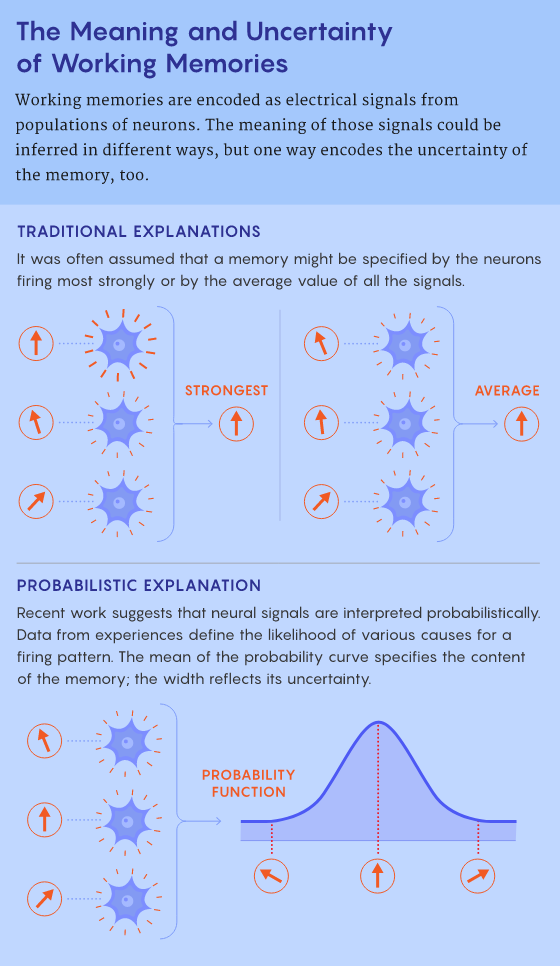
Neural noise indicates our working memory may encode Bayesian probabilities of its contents

The uncertainty in working memory may be linked to a surprising way that the brain monitors and uses ambiguity, according to a recent paper in Neuron from neuroscience researchers at New York University. Using machine learning to analyze brain scans of people engaged in a memory task, they found that signals encoded an estimate of what people thought they saw — and the statistical distribution of the noise in the signals encoded the uncertainty of the memory. The uncertainty of your perceptions may be part of what your brain is representing in its recollections. And this sense of the uncertainties may help the brain make better decisions about how to use its memories.

…the idea that we are walking around with probability distributions in our heads all the time has a certain beauty to it. And it is probably not just vision and working memory that are structured like this, according to Pouget. “This Bayesian theory is extremely general,” he said. “There’s a general computational factor that’s at work here,” whether the brain is making a decision, assessing whether you’re hungry or navigating a route.

link

Free energy principle & interpersonal psychology

To be very brief, Karl Friston’s “free energy principle” says that the brain is an “inference machine” or “prediction machine” that uses Bayesian probability reasoning and is motivated to act by an inference seeming not true or “surprising” to it.

More can be found here and here.

The free energy principle is a straightforward way to explain what FIML (note: this link will lead to recent posts and reposts, including this one, but just scroll down a bit for more)  practice does, how it does it, and why it works differently than any other form of psychotherapy and in many significant ways why it works better.

A psychological “complex,” “neurosis,” “personality disorder,” or “persistent thought,” call it what you will, affects human behavior by being or having become a nexus of thoughts, ideas, perceptions, feelings, interconnected neurons and chemistry.

The same is true for any personality trait or skill, including very positive ones.

In Friston’s free energy terms, the psychological elements described above are surrounded by Markov blankets.

That means they are isolated or protected systems with their own variables. These protected systems (protected by Markov blankets) are hard to change because they have their own sets of rules and habitual inputs and outputs.

And that makes them stubborn candidates for most forms of psychotherapy, especially psychotherapy that requires a therapist. One reason for this is time & expense. A second reason is it is difficult for the patient to change without therapeutically experiencing for themself the complex or trait in real-world situations.

The key here is therapeutic experience in the real-world of the unwanted trait or complex that requires change.

The third reason most psychotherapies are ineffective is very subtle incisiveness in real-time is needed to penetrate psychological Markov blankets.

What FIML does is penetrate the Markov blanket enshrouding a complex with a series of small pricks. Each prick in the blanket is small, but each prick also allows some of the valence (gas) inside the blanket to escape.

FIML slowly punctures the Markov blanket with many small pricks, eventually causing it to collapse.

Once it has collapsed, the energies that were trapped inside it can be used for other things. In this way FIML optimizes even non-neurotic psychology by removing pockets of inefficiency held within psychological Markov blankets.

By using only small pricks to penetrate Markov blankets, FIML allows people to gradually and painlessly see what needs to be changed, why, and how to do it. Since FIML works in real-time real-world situations, even very small insights can bring about large changes.

Word and phrase valence as keys to understanding human psychology

Since virtually everything we do, think, and feel has some linguistic component it follows that our perceived valences of words and phrases will be reliable indicators of our psychological makeup.

This is especially true if our perceptions of these valences is “captured” in fraught contexts in real-world, real-time situations.

To be even clearer and more precise, it is fair to say that it is only possible to capture actual real valences in real-world, real-time situations.

When we do not work with real-world, real-time situations, we are capable only of working with the idea of them, a theory of them, a memory of them. And none of that can possibly capture the actual valence as it actually functions in real-life.

The theory, memory, or idea of a psychological valence associated with words and phrases occurs at a different level of abstraction or cognition from the valence itself.

Theories, memories, and ideas of psychological valences can be very interesting and are worth pursuing, but they are not the thing itself and as such have only a weak capacity to grasp the psychology exposed by actual valences in action in the real-world.

In a previous post—Words and word groups mapped in the brain—I discussed the following video, which is well-worth viewing again if you missed it the first time.

I said:

From these maps we can see that word groups have idiosyncratic arrangements, associations, and emphases.

And from this we can understand how analysis of interpersonal communication details can lead to beneficial changes in word group arrangements and thus also human psychology.

The video is very helpful for visualizing how words and word groups are organized in the brain. And this illustrates how and why FIML works as well as it does.

By “capturing” actual verbal psychological valences in real-time, real-world situations, partners gain immense insight into how their psychologies actually function in the real-world, how they actually deal with real life.

Focusing on very brief real-life valences has another very large benefit: though the valences are as real as they come, they are also very small, comprising nothing more than part of the working memory load at the time.

This is a bigger deal than it might seem. Virtually all of us have been trained by years of theorizing about our psychologies to see even very small incidents of real psychological valence as aspects of some theory or story about them.

No, no, no. Don’t do that. Just see each one for what it is—a brief valences that appeared briefly in working memory; and that has been “frozen” by the FIML technique as a small snapshot to be identified and understood as it is.

First get the evidence, get the data. Those valence snapshots are the data. Get plenty of them and you may find that you do not even need any theory about what they are or what caused them.

They just are. Indeed, theorizing about them makes them different, bigger or worse, while simultaneously hiding their real nature.

Most of us do not know how to think about real-world, real-time valences because we tend to always fit them into into an a priori format, a format we already believe in. That could be a theory of psychology or a take on what our personality is or what the other person’s personality is.

In the maps shown in the video, that would constitute a whole brain response to a small valence that appeared only briefly.

By using the FIML technique, you will find it is much easier and much more beneficial to reorganize small parts of the verbal map one piece at a time than to reorganize the entire map all at once based on some idea.

In practice, FIML deals with more than just words and phrases, but the whole practice can be largely understood by seeing how it works with language. FIML treats gestures, tone of voice, expressions, and so on in the same way as language—by isolating brief incidents and analyzing them for what they really are.

Interaction between conscious and unconscious perceptions of meaning

A recent study examined how words perceived unconsciously, or subliminally, affect conscious perception.

The study—Unconscious semantic processing of polysemous words is not automatic—states in its abstract that:

The strong and respective influences of conscious context and response-code on semantic processing of masked polysemous words demonstrate that unconscious verbal semantic representations are not automatic.

A polysemous word is a word with more than one meaning, such as bank, bark, or date.

I like this study because it works with real-time language processing and because it shows that what we consciously pay attention to greatly affects how we perceive what follows.

An article about the study says:

This series of experiments… demonstrates that unconscious cognition is not only highly complex, since it can reach the level of semantics (the meaning of words), but also shows that it seems to be extremely sensitive to conscious influences. At every moment, our conscious position influences the nature of the mental operations unconsciously unfolding within us. (Unconscious processing operates under conscious influence [emphasis added])

I would submit that when we consciously use FIML techniques when listening to our FIML partner, our listening changes greatly for the better because we have at-hand a technique to remove wrong interpretations. FIML allows us to see, as it were, the subliminal words in the study’s experiment and correct our thinking accordingly.

When we don’t use FIML, we tend to build one mistake on top of another. That is to say, listening mistakes that influence consciousness will continue to influence how we hear from that point on and that much of this influence will be unconscious.

How the brain processes new information

A new paper provides fascinating insight into how our brains amass information and organize and assess it in real-time.

The paper—Cliques of Neurons Bound into Cavities Provide a Missing Link between Structure and Function—proposes that “the brain processes stimuli by forming increasingly complex functional cliques and cavities.”

The full intro to the paper:

The lack of a formal link between neural network structure and its emergent function has hampered our understanding of how the brain processes information. We have now come closer to describing such a link by taking the direction of synaptic transmission into account, constructing graphs of a network that reflect the direction of information flow, and analyzing these directed graphs using algebraic topology. Applying this approach to a local network of neurons in the neocortex revealed a remarkably intricate and previously unseen topology of synaptic connectivity. The synaptic network contains an abundance of cliques of neurons bound into cavities that guide the emergence of correlated activity. In response to stimuli, correlated activity binds synaptically connected neurons into functional cliques and cavities that evolve in a stereotypical sequence toward peak complexity. We propose that the brain processes stimuli by forming increasingly complex functional cliques and cavities.

The cliques of neurons that grow and connect in real-time make up the transient “architecture” of awareness as it changes and responds to stimuli.

You can observe a process that seems to fit this description by simply turning your head and looking around. As your eye settles on something to consider in more detail, neuronic cliques will grow in your brain based on that stimulus.

Depending on the significance to you of what you are looking at, further associations drawn from memory and emotion will aggregate around it.

Interestingly, the concept of transient neuronal cliques that grow into larger structures fits very well with the Buddha’s Five Skandhas explanation of the path between perception and consciousness.

This paper also seems to explain why FIML practice works. FIML interrupts the (re)formation of mistaken neuronal cliques in real-time, thus preventing the (re)association of (mistaken) established mental states with new perceptions. If there was no mistake FIML affirms that truth.

By consciously interfering with habitual neuronal cliques, FIML eliminates the false and unwanted psychological structures that give rise to them.

FIML works because large (mistaken) psychological brain structures rely on reconsolidation through the continual processing of “new” information that falsely reconfirms them.

As such, human psychology to a large extent is an ongoing self-fulfilling prophesy.

Here is an article about the paper: Brain Architecture: Scientists Discover 11 Dimensional Structures That Could Help Us Understand How the Brain Works.

The power of words and habit formation

How we use and hear words becomes a habit.

A recent study on personal space, reported in Personal Space Is a Fear Response, shows that this fear response can be stimulated by words alone.

When placed in an MRI—and told a person was standing over the machine—[people with normal amygdalae] showed heightened activity in their amygdala; when they were told the person was further away from the machine, the activity returned to normal. This shows, says the study’s leader, Ralph Adolphs, that the belief that someone is too close for comfort is enough to spark the same activity as if they actually are.

You could also say that just hearing the words that “someone is too close for comfort is enough to spark the same activity as if they actually are.”

I doubt I need to illustrate this idea as most readers are surely aware that all people have many strong emotional responses to words, gestures, facial expressions, as well as personal space encroachments.

Another recent study, unsurprisingly, shows that forming a habit leaves a lasting mark on specific circuits in the brain. In more detail:

In the basal ganglia, two main types of paths carry opposing messages: One carries a ‘go’ signal which spurs an action, the other a ‘stop’ signal.

Experiments by Duke neurobiology graduate student Justin O’Hare found that the stop and go pathways were both more active in the sugar-habit mice. O’Hare said he didn’t expect to see the stop signal equally ramped up in the habit brains, because it has been traditionally viewed as the factor that helps prevent a behavior.

The team also discovered a change in the timing of activation in the two pathways. In mice that had formed a habit, the go pathway turned on before the stop pathway. In non-habit brains, the stop signal preceded the go.

These changes in the brain circuitry were so long-lasting and obvious that it was possible for the group to predict which mice had formed a habit just by looking at isolated pieces of their brains in a petri dish. (same link as just above)

The study on habits is about mice with sugar habits, but I think it is fair to hypothesize that something similar happens with humans in their use of communication cues.

Humans, in my view, habituate to semiotic stimuli in much the same way that mice habituate to sugar.

The Duke study shows that the stop pathway grew as much as the go pathway in the mice, the main difference being that the go pathway turned on before the stop pathway.

Since human language and its uses is more complex than mice habituated to too much sugar, there must be many more stop and go pathways within the language and communication networks of human beings.

Many of these pathways will be similar among people in the same culture, but many of them won’t. Each human being is a repository of a multitude of idiosyncratic emotional and semantic responses and outputs.

So how do you figure out what your pathways are? And how do you correct ones that aren’t working well? And similarly, how do you figure out your partner’s pathways?

FIML practice helps partners to both identify their idiosyncratic communication habits and correct ones that are not working well. FIML finds and corrects pathways through micro-analysis.

It seems very likely to me that a FIML-style analysis corrects mistaken communication pathways by bringing the stop pathway to the fore. When a particular mistaken response is stopped a few times and under analysis seen to be wrong, the go pathways for that response will tend to be extirpated.

By using words to analyze micro units of miscommunication, FIML partners tap into the power of words to change actual pathways of neurons in their brains, thus reorganizing the deep linguistic basis of habitual psychological responses, no matter how idiosyncratic.

How working memory works and doesn’t work

A new study on working memory has some intriguing insights into how working memory works and how it doesn’t work.

It’s widely known that when working memory is overtaxed, confusion results, skills decline, while feelings of frustration and anger may arise. The reason for this seems to be:

Feedback (top-down) coupling broke down when the number of objects exceeded cognitive capacity. Thus, impaired behavioral performance coincided with a break-down of Prediction signals. This provides new insights into the neuronal underpinnings of cognitive capacity and how coupling in a distributed working memory network is affected by memory load. (Working Memory Load Modulates Neuronal Coupling)

A well-written article about this study contains the following diagram and explanation:

This article—Overtaxed Working Memory Knocks the Brain Out of Sync—also contains the following passages and quote from one of the study’s authors:

Miller thinks the brain is juggling the items being held in working memory one at a time, in alternation. “That means all the information has to fit into one brain wave,” he said. “When you exceed the capacity of that one brain wave, you’ve reached the limit on working memory.”

The prefrontal cortex seems to help construct an internal model of the world, sending so-called “top-down,” or feedback, signals that convey this model to lower-level brain areas. Meanwhile, the superficial frontal eye fields and lateral intraparietal area send raw sensory input to the deeper areas in the prefrontal cortex, in the form of bottom-up or feedforward signals. Differences between the top-down model and the bottom-up sensory information allow the brain to figure out what it’s experiencing, and to tweak its internal models accordingly. (Emphasis added)

Working memory works via connections between three brain regions that together form a coherent brain wave.

Notice that “an internal model of the world,” which is a “top-down signal” within the brain wave feedback loop, predicts or interprets “bottom-up” sensory input as it arrives in the brain.

I believe this “top-down signal” within working memory is the reason FIML practice has such enormous psychological value.

By analyzing minute emotional reactions in real-time during normal conversation, FIML practice disrupts the consolidation, or more often the reconsolidation, of “neurotic” responses. (Disruption of neurotic response in FIML practice)

FIML optimizes human psychology by helping partners intervene directly into their working memories to access real-world top-down signals as they are happening in real-time. Doing this repeatedly reliably alters the brain’s repository of top-down interpretations, making them much more accurate and up-to-date.

The model of working memory proposed in this study also explains why FIML can be a bit difficult to do. Partners must learn to allow a FIML meta-perspective or “super top-down” signal to quickly commandeer their working memories so that analysis of whatever just happened can proceed rationally and objectively. It does take some time to learn this skill, but it is no harder than many other “automated” skills such bicycling, typing, or playing a musical instrument.

first posted JUNE 7, 2018

Mindfulness and error recognition

Mindfulness practices improve our ability to recognize error.

A recent study shows this by monitoring brain activity with an EEG.

The EEG can measure brain activity at the millisecond level, so we got precise measures of neural activity right after mistakes compared to correct responses. A certain neural signal occurs about half a second after an error called the error positivity, which is linked to conscious error recognition. We found that the strength of this signal is increased in the meditators relative to controls,” said Jeff Lin, co-author of the study linked just below. [emphasis mine](link to quote: How meditation can help you make fewer mistakes)

The study is here: On Variation in Mindfulness Training: A Multimodal Study of Brief Open Monitoring Meditation on Error Monitoring.

Few Buddhists will be surprised at the general findings of this study.

Error recognition is what first got me to read about this study.

The findings became even more interesting to me when I saw the statement about the one-half-second error positivity response in the quote above.

Error recognition or the recognition that one might be making an error is key to successful FIML practice.

The second key is to act on our recognition quickly, within a few seconds if possible.

I have always figured it takes about a half second more or less to feel a slight disturbance that tells us we might be forming a wrong impression about what someone is saying or doing. That we might be making an error.

It is this disturbance that tells us it is time to do a FIML query. Virtually every time I do a proper FIML query I find I am either flat out wrong or wrong enough to want to revise my original impression.

In the past, I have called the slight disturbance mentioned above a “jangle,” a term I don’t really like because it makes the response sound stronger than what it is. I suppose I could refer to it as the “error positivity response,” but that would require an explanation every time I used it.

[Edit: I have decided to solve this problem this way: A jangle is basically a trigger.  The word jangle is used rather than trigger because the word trigger normally places too much responsibility on the speaker. A jangle should be understood as an internal emotional or psychological trigger that the listener 100% owns until it has been queried about. In most cases, partners will find that their jangles largely or entirely belong to their own psychologies and not their partner’s.]

In Buddhism, a jangle is probably the second of the five skandhassensation.

Buddhist practice will definitely make you more aware of the second skadha or “error positivity response.”

By being aware of this response in conversation with a trusted partner, FIML practice helps us take our mindfulness to a new level by providing  us with the opportunity to ask our partner about their intentions. In this way, we check our own mental work for error.

If this is done quickly enough to preserve clear memories of 1) your “error positivity response” and 2) your partner’s memory of what was in their working memory at that moment THEN you both have one of the few psychological facts you can both be sure of.

Facts of this sort are not just psychologically of great significance, they are also of philosophical significance because they really are one of the very few fact-types you can truly know about your own idiosyncratic existence; your own very weird being.

I believe this is why the Buddha emphasized the importance of the moment.

FIML practice explodes the moment or expands it to include more reliable information (your partner’s input). And this allows both of you to do a really good analysis of what just happened, what that moment entailed.

And doing that many times, will help both of you see how you really are. It will help you break fee from erroneous psychological frames or theoretical misinterpretations of any type.

Lucid dreaming isn’t sleep or wakefulness — it’s a new state of consciousness, researchers find

…Perception and memory processing in the lucid dreaming state were found to be different from non-lucid REM sleep. The consciousness of existing in a dream was associated with with beta waves in the right central lobe (which controls spatial awareness and nonverbal memory) and parietal lobe (which controls the sense of touch and spatial awareness). Beta waves are a type of high-frequency electromagnetic activity in the brain involved in conscious thought processes like solving problems or making decisions. Our consciousness is dominated by beta waves when we are awake.

This might explain why there is so much cognitive control in lucid dreams. Dreamers deep in REM sleep have no sense of control over factors like thoughts, feelings, and behaviors, but those in lucid dreaming states do.

…Demirel also linked gamma waves with lucid dreaming. These are the fastest brain waves, which become visible on an EEG at times when the brain is especially alert and focusing on something. When lucid dreaming begins, gamma waves increase in the right precuneus, which is involved in self-referential thinking—thoughts about ourselves and our lives. When we are awake, we often drift into this type of thinking when our minds wander.

Maybe the most mind-bending thing about lucid dreams is that they are, according to the study, similar in the brain to the effects of psychedelic drugs such as LSD and ayahuasca. These types of psychedelic experiences are also associated with the precuneus, whose activity is modified when waking imagery is seen despite having closed eyes (something usually only experienced with psychedelics).

link