The science behind people who never forget a face

link

‘As an intelligent civilization progresses, they would become part of the fabric of space-time itself’ — Andrew Gallimore

Study finds lapses of attention in sleep-deprived people coincide with wave of fluid flowing out of the brain

link

This is why you need FIML

FIML not only accesses individual word maps but also the maps of all communicative signs.

Here is the brain model of semantic maps.

And here is the study: Natural speech reveals the semantic maps that tile human cerebral cortex.

Here is a brief article about the study: Scans Show ‘Brain Dictionary’ Groups Words By Meaning. From this article:

Gallant says the findings contradict two beliefs nonscientists commonly have about the brain. First, that only the left hemisphere handles language. Second, that the brain has localized regions that handle specific tasks.

Edit: When you frequently access your word maps with the help of your FIML partner, both of you will become much more conscious of how these maps are structured and how they function during acts of communication.

This allows partners to make conscious meta-decisions to change and improve these maps in any way they want.

The meaning held in semantic maps (or semiotic maps) is the very meaning of your life as you understand it.

Not only do your maps form the basis of your communication with others, they also form the basis of how you understand yourself. How you communicate with yourself.

Gaining access to these maps is extremely liberating because it allows a degree of control over your own mind that few of us ever experience.

When we say that FIML has no content, no required beliefs, this can be understood as meaning that FIML gives us access to our own maps and control over them.

What you do with this access is entirely up to you and your partner.

Study supports FIML practice

This study—Neural Correlates of People’s Hypercorrection of Their False Beliefs—supports the contention that FIML practice can produce deep, wide-ranging, and enduring changes within the brain/mind of practitioners.

The basic finding of the study is:

Despite the intuition that strongly held beliefs are particularly difficult to change, the data on error correction indicate that general information errors that people commit with a high degree of belief are especially easy to correct. (Emphasis added.)

According to the study, this happens due to:

…enhanced attention and encoding that results from a metacognitive mismatch between the person’s confidence in their responses and the true answer.

This is exactly what happens when a FIML query shows the questioner that his/her assumptions about what their partner’s thoughts or intentions were, were wrong.

Initially, FIML partners may experience some embarrassment or disbelief at being wrong. But since FIML queries are generally based on negative impressions, after some practice being shown to be wrong will typically produce feelings of relief and even delight.

A FIML query will generally arise out of a state of “enhanced attention” and usually further increase it by being spoken about. Incidentally, this is probably the most difficult aspect of FIML practice—controlling the emotions that accompany enhanced attention, especially when that attention concerns our own emotional reactions.

With continued practice of FIML, however, even strongly held erroneous interpersonal beliefs will be fairly easily corrected whenever they are discovered during a FIML discussion. Correcting core false beliefs (mistaken interpretations) has a wide-ranging, beneficial effect on all aspects of a person’s life.

Since the hypercorrection effect discussed in the linked study only occurs during moments of enhanced attention, the FIML technique of focusing quickly on good data agreed upon by both partners can be seen as a way of inducing states of enhanced attention that will lead to deep changes in both partners. This technique (using good data) also turns the discussion from one about feelings to one about “information,” which the study finds makes errors “especially easy to correct.”

Furthermore, since FIML practice tends to deal with very small incidents, the enhanced attention FIML induces works like a laser that quickly and painlessly excises erroneous thoughts and feelings while they are still small and have not been allowed to grow into full-blown emotional reactions.

Meaning and existential networks

Ideasthesia (alternative spelling ideaesthesia) is a neuropsychological phenomenon in which activations of concepts (inducers) evoke perception-like sensory experiences (concurrents). The name comes from the Ancient Greek ἰδέα (idéa) and αἴσθησις (aísthēsis), meaning ‘sensing concepts’ or ‘sensing ideas’. The notion was introduced by neuroscientist Danko Nikolić, but can be seen in examples in the Ethics of Spinoza (especially in the third part of the Ethics[1]), as an alternative explanation for a set of phenomena traditionally covered by synesthesia.[2]

While synesthesia meaning ‘union of senses’ implies the association of two sensory elements with little connection to the cognitive level, empirical evidence indicated that most phenomena linked to synesthesia are in fact induced by semantic representations. That is, the linguistic meaning of the stimulus is what is important rather than its sensory properties. In other words, while synesthesia presumes that both the trigger (inducer) and the resulting experience (concurrent) are of sensory nature, ideasthesia presumes that only the resulting experience is of sensory nature while the trigger is semantic.[3][4][5][6][7][8]

Note this from the section above—‘the linguistic meaning of the stimulus is what is important rather than its sensory properties… ideasthesia presumes that only the resulting experience is of sensory nature while the trigger is semantic.

Chapter 4 — Cessations of consciousness in meditation: Advancing a scientific understanding of nirodha samāpatti

link

Science Finally Captures Nirvana: FWT Explains Cessation States


link

Autonomous Sensory Meridian Response and Functional Interpersonal Meta Linguistics

Anti-immigration protests in Japan

6:31 AM · Sep 14, 2025

Meaningfulness or emotional valence of semiotic cues

A new study on post traumatic stress disorder shows that PTSD sufferers actually perceive meaning or emotional valence within fractions of a second.

This study bolsters the FIML claim that “psychological morphemes” (the smallest psychological unit) arise at discrete moments and that they affect whatever is perceived or thought about afterward.

The study has profound implications for all people (and I am sure animals, too) because all of us to some degree have experienced many small and some large traumas. These traumas induce a wide variety idiosyncratic “meaning and emotional valence” that affects how we perceive events happening around us, how we react to them, and how we think about them.

The study in question—Soldiers with Posttraumatic Stress Disorder See a World Full of Threat: Magnetoencephalography Reveals Enhanced Tuning to Combat-Related Cues—is especially interesting because it compares combat veterans without PTSD to combat veterans with PTSD.

It is thus based on a clearly defined pool of people with “similar” extreme experiences and finds that:

…attentional biases in PTSD are [suggestively] linked to deficits in very rapid regulatory activation observed in healthy control subjects. Thus, sufferers with PTSD may literally see a world more populated by traumatic cues, contributing to a positive feedback loop that perpetuates the effects of trauma.

Of course all people are “traumatized” to some degree. And thus all people see “a world populated by traumatic cues, contributing to a positive feedback loop that perpetuates the effects of trauma.”

If we expand the word trauma to include “conditioned responses,” “learned responses,”  “idiosyncratic responses,” or simply “training” or “experience” and then consider the aggregate all of those responses in any particular individual, we will have a fairly good picture of what an idiosyncratic individual (all of us are that) looks like, and how an idiosyncratic individual actually functions and responds to the world.

FIML theory claims that idiosyncratic responses happen very quickly (less than a second) and that these responses can be observed, analyzed, and extirpated (if they are detrimental) by doing FIML practice. Observing and analyzing idiosyncratic responses whether they are detrimental or not serves to optimize communication between partners by greatly enhancing partners’ ranges of emotion and understanding.

In an article about the linked study (whose main author is Rebecca Todd), Alva Noë says:

…Todd’s work shows that soldiers with PTSD “process” cues associated with their combat experience differently even than other combat veterans. But what seems to be driving the process that Todd and team uncovered is the meaningfulness or emotional valence of the cues themselves. Whether they are presented in very rapid serial display or in some other way, what matters is that those who have been badly traumatized think and feel. And surely we can modify how we think and feel through conversation?

Indeed, what makes this work so significant is the way it shows that we can only really make sense of the neural phenomena by setting them in the context of the perceptual-cognitive situation of the animal and, vice-versa, that the full-import of what perceivers say and do depends on what is going on in their heads. (Source)

I fully agree with the general sense of Noë’s words, but want to ask what is your technique for “modifying how we think and feel through conversation?” And does your technique comport well with your claim, which I also agree with, that “we can only really make sense of the neural phenomena by setting them in the context of the perceptual-cognitive situation of the animal”?

I would contend that you cannot make very good “sense of neural phenomena” by just talking about them in general ways or analyzing them based on general formulas. Some progress can be made, but it is slow and not so reliable because general ways of talking always fail to capture the idiosyncrasy of the “neural phenomenon” as it is actually functioning in real-time during a real “perceptual-cognitive situation of the animal.”

The FIML technique can capture “neural phenomena” in real-time and it can capture them during real “perceptual-cognitive situations.” It is precisely this that allows FIML practice to quickly extirpate unwholesome responses, both small and large, if desired.

Since all of us are complex individuals with a multitude of interconnected sensibilities, perceptions, and responses, FIML practice does not seek to “just” remove a single post traumatic response but rather to extirpate all unwholesome responses.

Since our complex responses and perceptions can be observed most clearly as they manifest in semiotics, the FIML “conversational” technique focuses on the signs and symbols of communication, the semiotics that comprise psychological morphemes.

FIML practice is not suited for everyone and a good partner must be found for it to work. But I would expect that combat veterans with PTSD who are able to do FIML and who do it regularly with a good partner will experience a gradual reduction in PTSD symptoms leading to eventual extirpation.

The same can be said for the rest of us with our myriad and various traumas and experiences. FIML done with a good partner will find and extirpate what you don’t want knocking around in your head anymore.

Memory-guided behaviors employ spatial ‘maps’ in the brain

A new study seems to show that the brains of rats—and by extension ours as well—use a spatial “mapping” system to encode more than just space.

This suggests that mammalian brains encode “continuous, task-relevant variables” in “common circuit mechanisms” that can “represent diverse behavioural tasks, possibly supporting cognitive processes beyond spatial navigation.” (Mapping of a non-spatial dimension by the hippocampal–entorhinal circuit)

It does seem that we do a lot of thinking, remembering, and associating in systematic or roughly systematic ways. And it does seem that these systems resemble spatial ones.

Ever notice how amazing it can feel to stumble upon a new view of a spatial system you already know well? “So that’s where the duct goes through the wall!” Or, “I never realized that Bob’s Street intersects Jones right here!”

When we explore our psychological “maps” in interpersonal settings using FIML techniques, we gain access to details that reorganize those “maps” in a similar way to the example above. Small insights can yield amazing results.

Typically, normal psychological maps are distorted impressions of the psychological space around us. FIML allows us to see in our psychological “maps” a level of detail or resolution that cannot be gained in any other way.

Understanding verbal, emotional, semiotic, and associative details is key to understanding our “psychological locations” in this world.

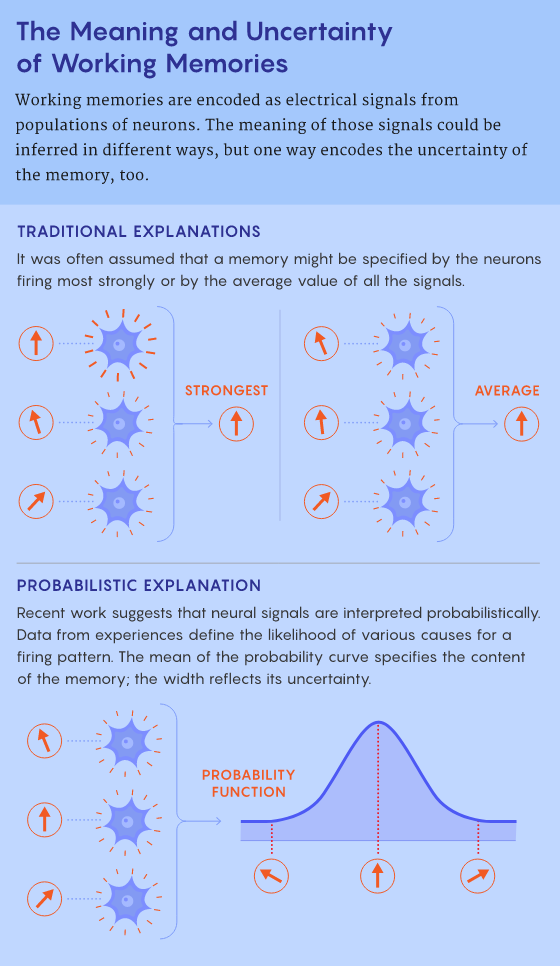
Neural noise indicates our working memory may encode Bayesian probabilities of its contents

The uncertainty in working memory may be linked to a surprising way that the brain monitors and uses ambiguity, according to a recent paper in Neuron from neuroscience researchers at New York University. Using machine learning to analyze brain scans of people engaged in a memory task, they found that signals encoded an estimate of what people thought they saw — and the statistical distribution of the noise in the signals encoded the uncertainty of the memory. The uncertainty of your perceptions may be part of what your brain is representing in its recollections. And this sense of the uncertainties may help the brain make better decisions about how to use its memories.

…the idea that we are walking around with probability distributions in our heads all the time has a certain beauty to it. And it is probably not just vision and working memory that are structured like this, according to Pouget. “This Bayesian theory is extremely general,” he said. “There’s a general computational factor that’s at work here,” whether the brain is making a decision, assessing whether you’re hungry or navigating a route.

link

Free energy principle & interpersonal psychology

To be very brief, Karl Friston’s “free energy principle” says that the brain is an “inference machine” or “prediction machine” that uses Bayesian probability reasoning and is motivated to act by an inference seeming not true or “surprising” to it.

More can be found here and here.

The free energy principle is a straightforward way to explain what FIML (note: this link will lead to recent posts and reposts, including this one, but just scroll down a bit for more)  practice does, how it does it, and why it works differently than any other form of psychotherapy and in many significant ways why it works better.

A psychological “complex,” “neurosis,” “personality disorder,” or “persistent thought,” call it what you will, affects human behavior by being or having become a nexus of thoughts, ideas, perceptions, feelings, interconnected neurons and chemistry.

The same is true for any personality trait or skill, including very positive ones.

In Friston’s free energy terms, the psychological elements described above are surrounded by Markov blankets.

That means they are isolated or protected systems with their own variables. These protected systems (protected by Markov blankets) are hard to change because they have their own sets of rules and habitual inputs and outputs.

And that makes them stubborn candidates for most forms of psychotherapy, especially psychotherapy that requires a therapist. One reason for this is time & expense. A second reason is it is difficult for the patient to change without therapeutically experiencing for themself the complex or trait in real-world situations.

The key here is therapeutic experience in the real-world of the unwanted trait or complex that requires change.

The third reason most psychotherapies are ineffective is very subtle incisiveness in real-time is needed to penetrate psychological Markov blankets.

What FIML does is penetrate the Markov blanket enshrouding a complex with a series of small pricks. Each prick in the blanket is small, but each prick also allows some of the valence (gas) inside the blanket to escape.

FIML slowly punctures the Markov blanket with many small pricks, eventually causing it to collapse.

Once it has collapsed, the energies that were trapped inside it can be used for other things. In this way FIML optimizes even non-neurotic psychology by removing pockets of inefficiency held within psychological Markov blankets.

By using only small pricks to penetrate Markov blankets, FIML allows people to gradually and painlessly see what needs to be changed, why, and how to do it. Since FIML works in real-time real-world situations, even very small insights can bring about large changes.

Interaction between conscious and unconscious perceptions of meaning

A recent study examined how words perceived unconsciously, or subliminally, affect conscious perception.

The study—Unconscious semantic processing of polysemous words is not automatic—states in its abstract that:

The strong and respective influences of conscious context and response-code on semantic processing of masked polysemous words demonstrate that unconscious verbal semantic representations are not automatic.

A polysemous word is a word with more than one meaning, such as bank, bark, or date.

I like this study because it works with real-time language processing and because it shows that what we consciously pay attention to greatly affects how we perceive what follows.

An article about the study says:

This series of experiments… demonstrates that unconscious cognition is not only highly complex, since it can reach the level of semantics (the meaning of words), but also shows that it seems to be extremely sensitive to conscious influences. At every moment, our conscious position influences the nature of the mental operations unconsciously unfolding within us. (Unconscious processing operates under conscious influence [emphasis added])

I would submit that when we consciously use FIML techniques when listening to our FIML partner, our listening changes greatly for the better because we have at-hand a technique to remove wrong interpretations. FIML allows us to see, as it were, the subliminal words in the study’s experiment and correct our thinking accordingly.

When we don’t use FIML, we tend to build one mistake on top of another. That is to say, listening mistakes that influence consciousness will continue to influence how we hear from that point on and that much of this influence will be unconscious.