We see what we are used to seeing; and interpret it as we are used to

A new study shows that what we see is often a distortion of what is really happening. A short article about that study provides a good overview: Altered images: New research shows that what we see is distorted by what we expect to see:

New research shows that humans “see” the actions of others not quite as they really are, but slightly distorted by their expectations.

The study is here: Perceptual teleology: expectations of action efficiency bias social perception.

I think it is fair to speculate that the conclusions of that study apply not just to visual information, but to all information. For example, much of what we consider to be psychological continuity is habit based on introspective deformities.

See Psychology as “signs of something else” for more on this topic.

See also: Seeing the best way forward: Intentionality cues bias action perception toward the most efficient trajectory.

first posted AUGUST 8, 2018

UPDATE: FIML practice accurately identifies and corrects all kinds of mental, psychological, emotional, and perceptual distortions as they happen in real-world settings. Pretty much everyone knows distortions are happening but we do almost nothing about them. Instead of dealing with distortions and preventing them from snowballing, virtually all people everywhere rely on default stock strategies to retreat from them, a technique which itself engenders fear and helplessness in the face of real human interaction. I believe the absence of anything resembling FIML practice in world history is testament to widespread hierarchical sociopsychological dependence on what are essentially clichés. ABN

Brain plasticity and ‘critical periods’ for learning

Neurodevelopment: Unlocking the brain

This is an interesting article on brain plasticity and “critical periods” for learning some skills (e.g. stereo-vision, language acquisition, etc.). It seems there may be ways to reset or reopen critical periods through chemical or behavioral interventions.

Vision therapy, which aims to correct adult amblyopia and other eye conditions, already has shown that basic visual skills can be relearned and some visual problems corrected by proper training.

Incidentally, FIML practice retrains us to listen, speak, and think differently. In doing this, FIML may be reopening a critical period for language/semiotic processing or even for the fundamental organization of consciousness itself. Once acquired, FIML skills have far-reaching effects on virtually all aspects of human social and psychological awareness.

If Buddhist practice is thought of in a light like this (that new cognitive skills are learned as some old ones are unlearned), it may remove some of the mystical aspects of how people understand the Dharma while also making Buddhist teachings more appealing to people with science training or an affinity for objective science.

first posted July 6, 2012

Perceptual distortions inevitably accrue and distort our psychologies

Keep your eyes focused on the cross between the flashing images. The faces will appear grossly distorted in your peripheral field of vision. Now, consider that just as our eyes can distort faces as in the gif above, so our minds can and frequently do distort all of our perceptions, especially ones with psychological relevance. This is how our minds do not work well psychologically and emotionally. To compensate for psychological distortions most people in all cultures in the world are forced to cleave to whatever the default assumptions of their cultures are. This leaves us with plastic faces and conformist mannerisms, while inside our minds are filled with emotional distortions. As we carry these distortions through the years, our psychological misperceptions of ourselves and others can become deeply misshapen, leading to neurotic confusion on many levels. No general theory or general method can fix this problem, which at its core is an accumulation of idiosyncratic perceptual distortions held in memory (and the responses that arise from them). FIML practice is a specific activity designed to find and remove perceptual and psychological distortions. FIML will always be unique to the partners using it. It will always deal with their idiosyncratic distortions as they arise in real time. In this sense, FIML has no content except what you put into it. FIML is a tool that helps us see ourselves as we are really functioning in real-time. ABN

Depressed individuals mind-wander over twice as often, study finds

A new study has found that individuals with major depressive disorder report mind wandering over twice as often as healthy adults. These individuals saw their mind wandering as more negative. Mind wandering was more frequent in depressed individuals who reported experiencing more negative and less positive moods. The research was published in the Journal of Affective Disorders.

Mind wandering is the spontaneous shift of attention away from a current task or external environment to internal thoughts or daydreams. It typically occurs when people are engaged in routine or low-demand activities. During mind wandering, people think about their past, future, or unrelated topics. Mind wandering can foster creativity and problem-solving, but frequent or excessive mind wandering has been linked to negative outcomes, including rumination and poor emotional regulation.

In individuals with depression, mind wandering tends to focus on negative thoughts, regrets, or worries, contributing to a persistently low mood and feelings of hopelessness. Studies suggest that people with depression experience more frequent and uncontrollable mind wandering, which can exacerbate symptoms. This tendency to ruminate increases cognitive load and interferes with concentration and productivity.

Study author Matthew S. Welhaf and his colleagues aimed to better understand the frequency of mind wandering in individuals with major depressive disorder in everyday life compared to healthy individuals. They also aimed to explore the content of mind wandering. Unlike most previous studies that relied on formal scales and assessments, this study applied an experience sampling design, having participants report their experiences several times per day.

The authors hypothesized that individuals with major depressive disorder would mind-wander more frequently, focusing more on the past. Additionally, they expected the frequency of mind wandering to be associated with negative moods.

Study participants included 106 adults, all native English speakers and up to 40 years old. Fifty-three were healthy controls with no history of mental health disorders, and the other 53 had been diagnosed with major depressive disorder. Participants with major depressive disorder were slightly older, with an average age of 28, compared to 25 years among the healthy participants. Approximately 70% of participants in both groups were women.

The study authors provided participants with a handheld electronic device with the Experience Sampling Program 4.0 installed. Over 7–8 days, participants were randomly prompted eight times a day (between 10:00 a.m. and 10:00 p.m.) to report on their current experiences, amounting to a maximum of 56 prompts throughout the period. On average, participants completed around 43–44 prompts, with similar numbers in both groups.

link

Metacognition and real-time communication

Metacognition means “awareness and understanding of one’s own thought processes,” or “cognition about cognition,” or “being able to think about how you think.”

To me, metacognition is a premier human ability. How can it not be a good thing to be aware of how you are aware and how you think and respond to what is around you?

In more detail:

The term “metacognition” is most often associated with John Flavell, (1979). According to Flavell (1979, 1987), metacognition consists of both metacognitive knowledge and metacognitive experiences or regulation. Metacognitive knowledge refers to acquired knowledge about cognitive processes, knowledge that can be used to control cognitive processes. Flavell further divides metacognitive knowledge into three categories: knowledge of person variables, task variables and strategy variables.

(the original source for this quote has disappeared but this article on Wikipedia makes the same points and more)

Most people do metacognition and are aware of doing it. We do it when we plan, make decisions, decide how to get from one place to another, how to relate to one person differently from another, and so on.

Where we don’t do metacognition is in real-time communication in real life, where it matters most. This is not because we are not able to do it. It is because very few of us have the right technique, Flavell’s “acquired knowledge” that allows us to do it.

If we have the right technique, we will be able to gain a great deal of knowledge about real-time cognitive process while also learning how to control them.

FIML practice is a metacognitive practice based on, to quote the above source, “acquired knowledge about cognitive processes… that can be used to control cognitive processes.”

In the case of FIML, the “acquired knowledge” is the FIML technique which allows us to gain conscious “control over cognitive processes” of real-time interpersonal communication.

FIML is different from other analytical communication techniques in that FIML provides a method to gain control over very short or small units of communication in real-time. This is important as it is these very short real-time units that are most often ignored or not dealt with in most analyses of human communication.

If you know how to catch small mistakes, they become sources of insight and humor. If you don’t know how to catch them, they often snowball into destructive misunderstandings.

FIML is fairly easy to do if you understand the importance of correcting the minor misinterpretations that inevitably arise between people when they speak and communicate. By using the FIML metacognitive method, partners gain control over the most elusive kinds of interpersonal error which all too often lead to serious interpersonal discord.

FIML can and does do more than catch small mistakes, but first things first. If you cannot correct small errors in real-time communication, you are not doing anything even resembling thorough metacognitive communication.

Psychedelic Mushrooms Are Getting Much, Much Stronger

New cultivation methods are making psychedelic mushrooms stronger, and fiendishly potent varieties are kicking in faster and lasting longer—even if you eat only a fraction of what you would with another variety. Subsequent testing showed that one batch of Mattucci’s mushrooms contained almost 5 percent psychedelic alkaloids, which was once unheard of within the Psilocybe genus. Typically, mushrooms contain 1 percent of these psychoactive compounds, although species like Psilocybe azurescens are generally stronger, and some varieties within the Panaeolus genus are even more potent.

link

How Scents Can improve Memory, Autism and Depression | Dr. Michael Leon

UPDATE: This video shows the value of novel experiences. What is most interesting to me is these novel experiences are fairly mundane, ordinary, simple and small — just new odors or fragrances. I believe novelty can also be found in many other simple and small things or experiences. And, it seems to me, many human moral and existential mistakes can be understood as excessive novelty-seeking. Taking strong drugs, overmuch or weird sex, committing crimes, riding motorcycles too fast (my own worst failing in this arena), etc. We can find deeply rewarding novelty through pursuing philosophy on our own; in meditation; in exploring psycholinguistics through FIML practice; taking a walk in the woods and allowing ourselves to get lost; just looking in a different direction or an unexpected direction right now. It is generally wiser to seek and find novelty in ways that are not excessive, meaning harmful to ourselves or others, or immoral. A lot can be learned about ourselves by analyzing how and why we seek novel experiences. A good deal of what you do may be novelty-seeking known to you by another name. Powerfully novel experiences than harm no one are the best. ABN

The Debate Around Fluoride Is Changing: What It Means For Your Drinking Water

More regulations on fluoride in drinking water may be coming due to the new court order last week, experts say.

Fluoride, commonly added to drinking water to prevent cavities, has come under scrutiny.

Several cities have now stopped adding fluoride to their drinking water. But whether the whole landscape will change depends on what the Environmental Protection Agency (EPA) will do next.

How Much Fluoride in Water Might Be Safe?

On Sept. 24, U.S. Federal Judge Edward Chen ordered the EPA to strengthen its rules around fluoride in drinking water.

The decision was made in light of The National Toxicology Program’s (NTP) report in August, which found that 1.5 milligrams of fluoride in drinking water is sufficient to pose neurodevelopmental risks in children.

The EPA calculates a margin of exposure to determine a safety buffer between the exposure and hazard levels. For fluoride, the exposure rate should be one-tenth of the hazard level, lawyer Michael Connett said.

Since the NTP’s report found 1.5 milligrams per liter to be potentially risky, exposure risks could start from 0.15 milligrams per liter, Connett added.

Americans’ current exposure level of 0.7 milligram per liter—”the level presently considered “optimal” in the United States – poses an unreasonable risk of reduced IQ in children,” Chen wrote in his ruling.

Currently, the EPA sets the maximum level for fluoride at 4 milligrams per liter, significantly higher than the risk level cited in the recent study.

link

I have a friend who manages the water facilities in a fairly large city. She is a credentialed chemist and objects to fluoride most of all because in its raw form it is a very harmful substance and the workers who add it to drinking water are rarely, if ever, properly trained or dressed to do that job safely. ABN

Breakthrough synapse-regenerating ALS pill moves to phase 2 human trials

A pioneering once-a-day pill that regenerates nerve cell connections damaged by ALS has been FDA-approved for ongoing clinical trials. The drug is now being given to those with ALS and could be a watershed moment in the treatment of the fatal disease.

Amyotrophic lateral sclerosis (ALS), or Lou Gehrig’s disease, affects nerve cells in the brain and spinal cord, called motor neurons, that control voluntary muscle movements like walking, talking, and breathing. As the neurons die and can’t send messages to the muscles, loss of muscle control worsens over time and is eventually fatal.

The US Food and Drug Administration (FDA) has approved several drugs that help manage symptoms or slow the disease’s progress, but there’s no current treatment that reverses the progression of ALS. In short, there’s no cure. That’s where Spinogenix, Inc. comes in.

Spinogenix, a clinical-stage biopharmaceutical company, has developed SPG302, a unique once-a-day pill that regenerates the gaps, called synapses, between neurons to restore communication. Following promising results from clinical trials to evaluate the drug’s safety, the FDA has approved the company’s Investigational New Drug (IND) application, paving the way for further trials.

link

Your Consciousness Can Connect With the Whole Universe, Groundbreaking New Research Suggests

A RECENT GROUNDBREAKING EXPERIMENT in which anesthesia was administered to rats has convinced scientists that tiny structures in the rodents’ brains are responsible for the experience of consciousness. To pull it off, these microscopic hollow tube structures, called “microtubules,” don’t rely on our everyday flavor of classical physics. Instead, experts believe, microtubules perform incredible operations in the quantum realm. Citing the work of earlier researchers, the study infers that the same kind of quantum operations are likely happening in human brains.

During their rat brain experiments, scientists at Wellesley College in Massachusetts gave the rodents isoflurane, a type of inhaled general anesthetic used to induce and maintain unconsciousness for medical procedures. One group of drugged rats also received microtubule-stabilizing drugs, while the other did not. The researchers discovered that the microtubule-stabilizing molecules kept the rats conscious for longer than the non-stabilized rats, which more quickly lost their “righting reflex,” or the ability to restore normal posture, according to their findings, published in the peer-reviewed journal eNeuro in August 2024.

The Wellesley study is significant because the physical source of consciousness has been a mystery for decades. It’s a major step toward verifying a theory that our brains perform quantum operations, and that this ability generates our consciousness—an idea that’s been gaining traction over the past three decades.

The notion that quantum physics must be the underlying mechanism for consciousness first emerged in the 1990s, when Nobel Prize-winning physicist Roger Penrose, Ph.D., and anesthesiologist Stuart Hameroff, M.D., popularized the idea that neural microtubules enable quantum processes in our brain, giving rise to consciousness. Specifically, they postulated in a 1996 paper that consciousness may operate as a quantum wave passing through the brain’s microtubules. This is known as Orch OR theory, referring to the ability of microtubules to perform quantum computations through a mathematical process Penrose calls “objective reduction.”

In quantum physics, a particle does not exist in the way classical physics observes it, with a definite physical location. Instead, it exists as a cloud of probabilities. If it comes into contact with its environment, as when a measuring apparatus observes it, then the particle loses its “superposition” of multiple states. It collapses into a definite, measurable state, the state in which it was observed. Penrose hypothesized that “each time a quantum wave function collapses in this way in the brain, it gives rise to a moment of conscious experience.”

link

Psychedelics show promise in enhancing brain plasticity

Recent studies have started uncovering the potential benefits of psychedelics on the brain, especially concerning cognitive and emotional health. A recent meta-analysis published in the Journal of Psychopharmacology has found that individuals who consume psychedelics exhibit significantly higher levels of brain-derived neurotrophic factor (BDNF) compared to healthy non-users. This increase in BDNF suggests that psychedelics might enhance the brain’s ability to adapt and reorganize itself, potentially offering new avenues for treating mental health disorders.

BDNF is a protein that plays a critical role in the health and functioning of the brain. It supports the survival of existing neurons and encourages the growth and differentiation of new neurons and synapses. BDNF is vital for long-term memory, learning, and the overall plasticity of the brain—its ability to change and adapt in response to new experiences.

Alterations in BDNF levels have been linked to various neuropsychiatric disorders, including depression, anxiety, and post-traumatic stress disorder. Higher levels of BDNF are generally associated with better cognitive function and mental health, making it a key area of interest for researchers studying the brain and its many functions.

link

Study: The effect of psychedelics on the level of brain-derived neurotrophic factor: A systematic review and meta-analysis

An evidence-based critical review of the mind-brain identity theory

Abstract

In the philosophy of mind, neuroscience, and psychology, the causal relationship between phenomenal consciousness, mentation, and brain states has always been a matter of debate. On the one hand, material monism posits consciousness and mind as pure brain epiphenomena. One of its most stringent lines of reasoning relies on a ‘loss-of-function lesion premise,’ according to which, since brain lesions and neurochemical modifications lead to cognitive impairment and/or altered states of consciousness, there is no reason to doubt the mind-brain identity. On the other hand, dualism or idealism (in one form or another) regard consciousness and mind as something other than the sole product of cerebral activity pointing at the ineffable, undefinable, and seemingly unphysical nature of our subjective qualitative experiences and its related mental dimension. Here, several neuroscientific findings are reviewed that question the idea that posits phenomenal experience as an emergent property of brain activity, and argue that the premise of material monism is based on a logical correlation-causation fallacy. While these (mostly ignored) findings, if considered separately from each other, could, in principle, be recast into a physicalist paradigm, once viewed from an integral perspective, they substantiate equally well an ontology that posits mind and consciousness as a primal phenomenon.

UPDATE: Below is a comment from a reader. I am reposting it closer to the article it refers to because it greatly widens the discussion of what consciousness is and how to understand it. ABN

Please allow me to point out a clear oversight in this abstract. This abstract implicitly suggests that if one rejects material monism, they must subscribe to either dualism or idealism. This binary framing excludes other philosophical perspectives such as Radical Empiricism (R.E.) that do not fit neatly into these categories, which prioritize substance (whether mental or physical) over pure experience.

As proposed by William James, Radical Empiricism offers a distinct alternative that is neither strictly materialistic nor dualistic/idealistic. It posits that consciousness and experience are integral and interconnected aspects of reality. It’s core tenets embrace two assertions which fundamentally align with Buddhist aggregate theory: (1) the primary substance of reality is pure experience, which includes both the subjective and objective aspects of reality without privileging one over the other. (2) Experiences are fundamentally interconnected and relational.

In R.E., consciousness is not an independent fundamental substance (as in idealism) nor merely an epiphenomenon of the brain (as in material monism). Instead, consciousness is a function of the elements of pure experience, which are continuous and interwoven.

Other non-dualistic and non-materialistic perspectives, such as process philosophy and phenomenology, also challenge this simplistic binary framing.

However, R.E. is the most explicit in asserting elements of pure experience as more ontologically fundamental than either the mental or physical worlds of experience, which are seen to be mere abstractions from pure experience.

In Radical Empiricism, consciousness is not the fundamental substance of reality but a manifestation of the dynamic interplay of experiences. This view avoids the pitfalls of both dualism and material monism by grounding consciousness in the relational fabric of pure experience.

What I wish to emphasize in this commentary is that consciousness, while central to understanding human experience, is not an isolated phenomenon but intricately linked with the flow of experiences.

The abstract’s presupposition that rejecting material monism necessitates adopting dualism or idealism is a form of a false dilemma, which is a logical fallacy. By not considering other viable philosophical approaches, it limits the scope of the discussion and potentially misleads readers about the diversity of thought in the philosophy of mind.

Thus, an integral perspective stemming from a more holistic approach (such as the chain of interdependent originations in Buddhist aggregate theory) aligns well with Radical Empiricism by considering the interconnectedness and relational nature of experiences. This is the justification for explicitly asserting such discussions, as this abstract invokes, must include R.E. as a valid and valuable approach to understanding consciousness.

Radical Empiricism’s emphasis on direct experience and empirical grounding aligns with the empirical findings in neuroscience that challenge simplistic materialist explanations. Highlighting this alignment is important in order to show how and in what manner R.E. can bridge empirical data and philosophical insights.

In conclusion: The abstract’s oversight in presenting a false dichotomy between material monism and dualism/idealism is a significant limitation. Radical Empiricism provides a nuanced and comprehensive alternative that views consciousness as a function of the elements of pure experience, rather than as a separate fundamental entity. A more inclusive and accurate discussion would acknowledge this and other philosophical perspectives, enriching the debate and providing a more robust framework for understanding the nature of consciousness.

~John Range

The importance of the Readiness Period for speech, listening, and decision making

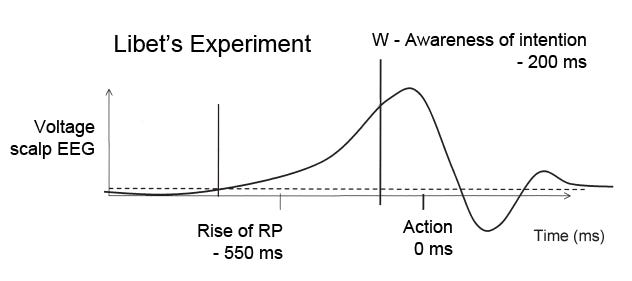
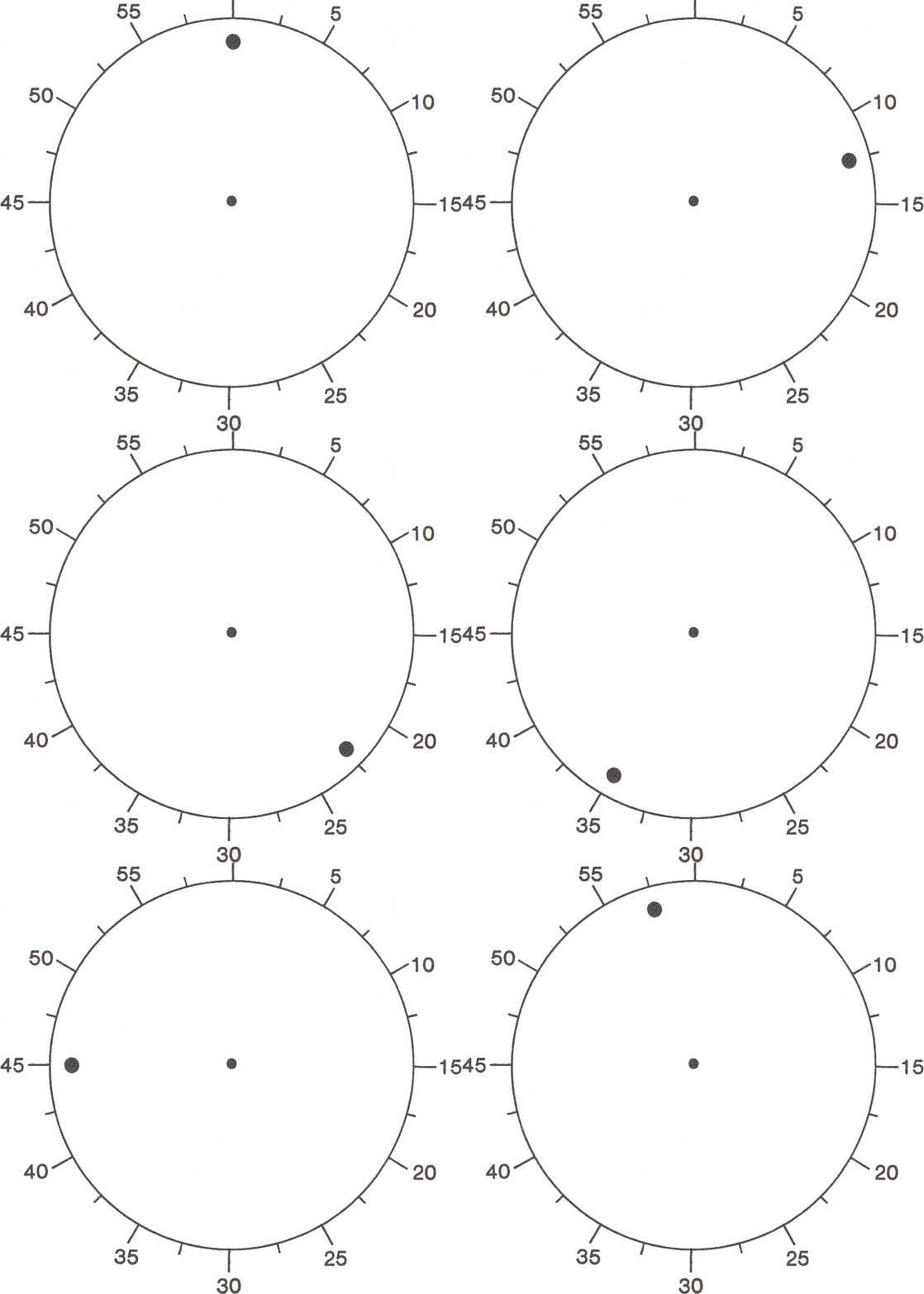
Libet gave participants of his experiments a simple task, while measuring their brain activity: they had to decide to flex a finger whenever they wished, and note the position on a fast-moving clock at the precise moment they took the decision.

The result was that the brain showed activity at least 400ms before the participants became aware of their “decision making.”

Here’s a diagram showing what’s going on:1

“RP” stands for “Readiness Potential,” that is, the supposed build-up in brain activity before the decision to act and the subsequent action. What we see is that this brain activity starts before the participants became aware of their intention to flex the finger.

The results have led the no-Free-Will crowd to [falsely] exclaim, “see, everything is driven by your brain, and you taking decisions is just an illusion!”

However, this seems to be a typical case of taking something very specific and isolated out of context and then drawing conclusions based on existing biases.

link

The exercise of free will in basic FIML is done during the “Readiness Potential” period described above. FIML done with a partner is an exquisite exercise of free will that completely changes how we speak and listen for the better. FIML is somewhat difficult because it requires being aware of the Readiness Potential period close to its onset. But this can be learned with practice. Buddhists or others who practice mindfulness may find this part of FIML to be rather easy. From this point of view, FIML can be described as mindfulness shared by two people, or pair-work mindfulness. FIML mostly focuses on interpersonal speech and listening but also includes all other interpersonal semiotics. More posts related to FIML and brain science can be found here. ABN

How the Science of Memory Reconsolidation Advances the Effectiveness and Unification of Psychotherapy

Abstract

Memory reconsolidation research by neuroscientists has demonstrated the erasure of emotional learnings. This article reviews these historic findings and how they translate directly into therapeutic application to provide the clinical field with an empirically confirmed process of transformational change. Psychotherapists’ early use of this new, transtheoretical knowledge indicates a strong potential for significant advances in both the effectiveness of psychotherapy and the unification of its many diverse systems. The erasure process consists of the creation of certain critical experiences required by the brain, and it neither dictates nor limits the experiential methods that therapists can use to facilitate the needed experiences. This article explains memory reconsolidation, delineates the empirically confirmed process, illustrates it in a case example of long-term depression, indicates the evidence supporting the hypothesis that this process is responsible for transformational change in any therapy sessions, describes the differing mechanisms underlying transformational change versus incremental change, and reports extensive clinical evidence that the basis and cause of most of the problems and symptoms presented by therapy clients are emotional learnings, that is, emotionally laden mental models, or schemas, in semantic memory.

link

FIML practice works most of all because it focuses directly on memory formation and reconsolidation, thus allowing beneficial changes to be made quickly in real-time. Discussions of how this is done can be found here: Memory reconsolidation as key to psychological transformation and here: Disruption of neurotic response in FIML practice.

Below is an excerpt that explains how memory reconsolidation works. FIML does precisely what is described below in real-time, real-world situations as they arise between partners or when they are together and something else arises. ABN

The Erasure of an Emotional Learning

MR research by neuroscientists has demonstrated that an emotional learning is nullified by the following set of three experiences, which have therefore been termed the empirically confirmed process of erasure (ECPE) (Ecker 2018). Hundreds of MR research studies have used a vast range of different procedures and protocols to produce these experiences (reviewed by Ecker 20152018), which means that what the brain requires for erasure of an emotional learning is not any particular external procedure, but rather the internal occurrence of these three subjective experiences, whatever may be the external procedures that create them. Therefore the ECPE does not dictate or favor the use of any particular therapeutic techniques, and psychotherapists are free to facilitate these critical experiences using any of the therapy field’s vast array of experiential methods.

  1. 1.Reactivated, Symptom-Generating Target Learning Experienced in AwarenessThis is the deliberate use of salient cues or contexts that reactivate the target emotional learning or schema underlying the client’s presenting symptom or problem. For example, a woman in therapy for depression and absence of motivation was cued into reactivation of her lifelong schema that had newly come into awareness and was verbalized as, “Mom sees and knows everything I ever care about or do, and then takes over and takes away everything I ever care about or do, which feels devastating for me, and my only way to be safe from her pillaging is for me to care about nothing and do nothing.” To assure that the schema is being directly accessed at its roots in the emotional learning and memory system and is not merely a cognitive insight, it is critically important that the emotions accompanying the reactivated schema are fully felt affectively and somatically while the schema also is cognized verbally and conceptually. Note that the schema is at core a mental model, from which are generated particular emotions, which in the example above would include helplessness, hopelessness, fear, desperation, despair, aloneness, and the deep pain of feeling used, pillaged and eclipsed in this way by her own mother. How that schema was found, brought into awareness, and then disconfirmed and unlearned is described in the case vignette in the next section.
  2. 2.Experience of Mismatch/Prediction Error Destabilizes the Target Learning’s Neural EncodingWhile the target schema is reactivated in awareness as described above, this is an additional, concurrent experience or knowing that contradicts what the client knows and expects according to the schema. This is termed a memory mismatch or prediction error experience by memory researchers. In response to this experience of the world differing from the target learning’s expectations, the client’s brain rapidly transforms the neural encoding of the target learning from its stable, consolidated state in long-term memory into a destabilized, de-consolidated, labile state, which is susceptible to being updated and re-encoded by any relevant new learning that may occur next. This destabilization, which requires and is triggered by the mismatch/prediction error experience, begins the reconsolidation process.Footnote2 The labile, destabilized condition persists for about 5 h, widely termed the reconsolidation window, after which the neural encoding automatically reconsolidates, that is, it returns to a stable state in long-term memory. The case vignette below describes how a contradictory knowing was found for the schema of the depressed woman, creating the needed mismatch experience.
  3. 3.Experience of Counter-Learning Drives Unlearning, Nullification, Re-encoding and Replacement of Target LearningThis experience consists of just a few repetitions, during the rest of the therapy session, of the same mismatch experience created in the previous step. Each mismatch is a juxtaposition experience, in the sense that the client experiences both reality according to the target learning and a contradictory perception or knowing, with both in the same single field of awareness. Two or three repetitions of that juxtaposition experience serve as counter-learning that functions as an experiential disconfirmation of the target learning. Because the counter-learning is occurring while the encoding of the target learning is labile, the counter-learning rewrites and replaces the encoding of the target schema in memory. As a result, the target learning no longer exists in memory, so it cannot be reactivated and cause a relapse. The target learning is a model of the world in semantic memory, not an episodic memory of specific events and experiences; the latter is not erased. The unlearning of the target learning’s version of reality is the profound resolution of a core emotional issue in the client’s life, as noted earlier.Footnote3 Successful erasure of the target learning is then verified by observing the markers of transformational change beginning to appear immediately: the symptom(s) driven by the target learning cease to occur; the target learning itself, which previously was felt as a potent and horrible truth of the world, no longer feels true or real and is not reactivated by situations that formerly did so, eliminating a problematic, distressed ego state; and those changes persist effortlessly and permanently. If the same counter-learning occurs without first finding, reactivating and destabilizing the target learning (steps 1 and 2 above), the counter-learning only creates its own encoding separate from that of the target learning. In that case, the two learnings compete for control of behavior and state of mind, producing at best only incremental change that is prone to relapse when the emotionally more intense target learning becomes newly retriggered by current circumstances.
ibid

An advantage of FIML as therapy for unwholesome or unwanted schema is FIML is mostly done in real-time, real-world situations so the schema is right there in front of you clear as a bell in your own mind. You can see it and see very clearly how it is distorting reality.

Therapies that work by recalling unwholesome schema in a professional settings have the advantage of: 1) relying on a professional; 2) avoiding doing this work with your spouse or best friend; and 3) aiming for wholesale erasure of the schema once and for all.

FIML practitioners could use a schema method to do this but generally FIML works by focusing on the unwholesome schema the moment it arises and whenever it arises in the real-world (conditions permitting). This method erases or extirpates the unwholesome schema by observing its maladaptive dysfunction as many times as needed.

FIML is also able to deal with more than one maladaptive schema, and in real-life there are many, without causing confusion because when unwholesome schemas are encounter in real-world, real-time, their structure and origins are generally easily seen for what they are.

Many unwanted schema can be extirpated with just a few FIML exchanges. Some are more stubborn and may require more time and multiple occurrences.

Another advantage FIML has is it prevents new schemas from arising and taking hold. Unwholesome schemas do not all come from the deep past or from childhood. Schemas also arise later in life and often are based on serious misinterpretations. FIML is very effective at stopping schemas of this sort immediately, before they can consolidate and cause harm.

I would add that unwholesome schemas exist in virtually everyone and often we are dealing not with our own schemas but those of others. FIML partners can eliminate problem schemas between themselves, but often do no more than recognize them in others. However, understanding ourselves through FIML practice does help us understand others much better, and how deal with them more compassionately due to that understanding. ABN