Conscious of what?

A primary question about consciousness is “conscious of what?”

What if your consciousness is based on an error?

If you become conscious of the error, you will most likely correct it and thus change your consciousness.

Metacognition is a word that is sometimes used in place of “consciousness.”

Metacognition implies awareness of how our consciousness is functioning.

Buddhist mindfulness can be defined as “active metacognition.” This implies awareness of what is in our consciousness, what the elements of its functioning are in the moment.

Buddhist practice assume that if while being mindful we perceive error in our consciousness, we will correct the error.

Metacognition requires “self-awareness” or “awareness of the functioning of consciousness.” It seems that most people do this better than most animals in most situations.

Metacognition or mindfulness requires training or practice. But training and practice can also be wrong, based on wrong views.

Many forms of selfhood are based on wrong views.

Right mindfulness is used to perceive these mistakes and correct them.

For example, a person can be trained to have an identity. They can practice having this identity and learn the emotions that go along with it.

With wrong training and practice an identity can become explosive, violent, crazy.

This is a major part of what is meant by delusion in Buddhism, having a wrong view about your identity.

Notice, that a person can have a very wrong identity and be fully conscious of it and the world around them without realizing their identity is wrong.

_______________________________

Related subjects:

Re-representing consciousness: dissociations between experience and meta-consciousness

Consciousness Goes Deeper Than You Think

There Is an ‘Unconscious,’ but It May Well Be Conscious

Transcendental experiences during meditation practice

first posted SEPTEMBER 20, 2017

Consciousness, Big Data, and FIML

Modern neuroscience does not see humans as having a discrete consciousness located in a specific part of the brain. Rather, as Michael S. Gazzaniga says:

The view in neuroscience today is that consciousness does not constitute a single, generalized process. It involves a multitude of widely distributed specialized systems and disunited processes, the products of which are integrated by the interpreter module. (Source)

Computer and Big Data-driven sociology sees something similar. According to Alex Pentland:

While it may be useful to reason about the averages, social phenomena are really made up of millions of small transactions between individuals. There are patterns in those individual transactions that are not just averages, they’re the things that are responsible for the flash crash and the Arab spring. You need to get down into these new patterns, these micro-patterns, because they don’t just average out to the classical way of understanding society. We’re entering a new era of social physics, where it’s the details of all the particles—the you and me—that actually determine the outcome.  (Source)

Buddhists may recognize in these insights close similarities to core teachings of the Buddha—that we do not have a self; that all things arise out of complex conditions that are impermanent and changeable; that the lion’s share of “reality” for any individual lies in being attentive to the moment.

Notice how similar Pentland’s insights are to Gazzaniga’s—the whole, or the common generalities (of society), can be far better understood if we can account for the details that comprise them. Is an individual mind a fractal of society? Do these complex systems—societies and minds—both use similar organizational processes?

I am not completely sure how to answer those questions, but I am certain that most people are using similar sorts of “average” or general semiotics to communicate and think about both minds and societies. If we stick with general averages, we won’t see very much. Class, self, markets, personalities don’t give us information as sophisticated as the detailed analyses proposed by Gazzaniga and Pentland.

Well then, how can individuals cognize Gazzaniga’s “multitude of widely distributed specialized systems and disunited processes” in their minds? And how can they understand how “the products” of those processes are actually “integrated” into a functional “interpreter module”?

And if individuals can cognize the “disunited processes” that “integrate” into a conscious “interpreter,” how will they understand traditional psychological analyses of the self, personality, identity, biography, behavior?

I would maintain that our understanding of what it is to be a human will change deeply if we can learn to observe with reliable clarity the “disunited processes” that “integrate” into a conscious “interpreter.” That is, we will arrive at a completely new understanding of being that will replace the “self” that truly does not exist in the ways most societies (and people) understand it.

FIML practice shows partners how to observe with great clarity the “disunited processes” that “integrate” into a conscious “interpreter.” Once these process are observed in detail and for a long enough period of time, partners will realize that it is no longer necessary to understand themselves in the “average” terms of self, personality, identity, biography, behavior, and so on.

Partners will come to understand that these terms denote only a more detailed version of a naive, static view of what a person is. Most psychology is largely a more detailed version of a naive, static view of what a person is.

We see this in Gazzaniga and Pentland’s findings that are derived from complex analyses of what is actually happening in the brain or in the multitude of real transactions that actually comprise a society. We can also see very similar insights in the Buddha’s teachings.

It is my contention that FIML practice will show partners the same things—that their actual minds and actual interactions are much more complex (and interesting) than the general semiotic averages we normally use to understand them.

From a Buddhist point of view, when we “liberate” ourselves from “attachment” to “delusive” semiotic generalities and averages and are truly “mindful” of the “thusness” of the ways our minds actually work, we will free ourselves from “suffering,” from the “ignorance” that characterizes the First Noble Truth.

first posted SEPTEMBER 1, 2012

Neuroscientists unravel the mystery of why you can’t tickle yourself

…The leading theory holds that tickling provokes laughter thanks to a prediction error by the brain. An unpredictable touch confuses it, sending it into a mini frenzy. Self-touch is always predictable … so, no frenzy.

But Brecht thinks it’s not really about prediction. Instead, he suggests that as a person touches themselves, the brain sends out a body-wide message that inhibits touch sensitivity. “We think what is happening is the brain has a trick to know: As soon as you touch yourself, don’t listen,” he says. If it didn’t, he argues, we’d all be constantly tickling ourselves every time we scratched an armpit or touched our toes.

link

Honest feedback: Barriers to receptivity and discerning the truth in feedback

Abstract

Feedback is information provided to recipients about their behavior, performance, or understanding, the goal of which is to foster recipients’ self-awareness, and behavioral reinforcement or change. Yet, feedback often fails to achieve this goal. For feedback to be effective, recipients must be receptive and accurately understand the meaning and veracity of the feedback (i.e., discern the truth in feedback). Honesty is critically important for both receptivity and discerning the truth in the feedback. In this article, we identify barriers to receptivity and discerning the truth in feedback and illustrate how these barriers hinder recipients’ learning and improvement. Barriers can arise from the feedback itself, the feedback-giver, and the feedback-recipient, and both parties share responsibility for removing them.

link

This paper provides useful insights into how to give and receive feedback and what can prevent that from happening successfully. FIML practice, which can be thought of as a form of micro interpersonal feedback, overcomes all barriers mentioned in the paper. FIML works well because partners: 1) make a prior agreement to do it and how to do it; 2) ask for feedback that is immediately useful to them; 3) ask immediately upon noticing the need for feedback; 4) ask for very specific information residing solely in their partner’s working memory; 5) all of the preceding points contribute to small and easily kept honest bits of very reliable feedback. Since the topic of the feedback is very small and mutually agreed upon by both partners is can be understood as a significant kind of objective reality that exists between the two of them. This greatly promotes interest in the practice and honesty between partners. ABN

The value of introversion, and probably reclusion

Do reclusive and monastic religious practices foster wisdom about the human condition?

A new study indicates that they may.

Insights into social psychological phenomena have been thought of as solely attainable through empirical research. Our findings, however, indicate that some lay individuals can reliably judge established social psychological phenomena without any experience in social psychology. These results raise the striking possibility that certain individuals can predict the accuracy of unexplored social psychological phenomena better than others. (Social Psychological Skill and Its Correlates)

In an article about this study, its authors say that introverted people tend to be better at observing others because they are good at introspection and have fewer motivational biases. Here’s that article: Yale Study: Sad, Lonely Introverts Are Natural Born Social Psychologists.

first posted MARCH 17, 2018

To readers of ABN

ABN has gained many more readers since coverage of covid and other matters became of more pressing importance. They still are more pressing since our very existence as a free society is at stake.

That said, please do your best to understand and practice FIML with your spouse or best friend. FIML is a life-changing practice that will reveal the building blocks of both of your makeups in a most wonderful way.

Positive change through FIML is easy in the sense that each building block is small. Being small, they are easy to analyze and not difficult to accept if we see we are in the wrong. This promotes rapid incremental transformation for the better.

A little change here, a little change there, patterns are recognized and rather easily transformed into something much more adaptive, real, appropriate for your lives. No theory or concept of personality is necessary. No training in psychotherapy is necessary.

The simple dynamic of FIML done honestly and in friendship will help both of you feel much better and be much more authentic to yourselves. FIML is a process, a dynamic method. It has no other content save what you bring to it. ABN

Psilocybin breaks rigid patterns in the depressed brain, study shows

Psilocybin, the active compound in magic mushrooms, can ‘open up’ the brains of people with depression, helping patients to overcome rigid thought patterns and negative fixations, new research suggests.

A study led by the Imperial Centre for Psychedelic Research has shown that psilocybin therapy increases brain connectivity in people living with depression, even weeks after the treatment. The psychedelic acts in a way that conventional antidepressants do not, suggesting that psilocybin could be an effective, viable alternative to treating depression.   

“These findings are important because for the first time we find that psilocybin works differently from conventional antidepressants, making the brain more flexible and fluid, and less entrenched in the negative thinking patterns associated with depression,” says Professor David Nutt, head of the Imperial Centre for Psychedelic Research. 

link

Dual-Process Theories of the Mind as means to analyze real-world, real-time interpersonal data

…Despite their differences, dual-process theories share the common idea that thoughts, behaviors, and feelings result from the interaction between exogenous and endogenous forms of attention. Both types of attention can be applied to representations to increase or decrease their level of activation. As the activation level of a representation increases, so does its accessibility, which in turn increases the probability that it will influence behavior. In times of conflict [When a FIML query is initiated], accessibility can be managed (i.e., maintained or inhibited) during the stream of processing by the control of attention. In a sense, the “source” of attention (LaBerge, 2000), that is, whatever mechanism that applies the activation to the representation, can be thought of as the gateway of accessibility that is the essence of controlled processing.

Individual Differences in Working Memory Capacity and Dual-Process Theories of the Mind

FIML practice is a form of mindfulness training with the addition of controlled attention processing which enables rapid gathering of real-world data followed by analysis thereof. This controlled attention processing is a learned behavior shared by both partners. The general concept of this learned/trained behavior is explained in How to do FIML. Individual partners adapt this learned/trained behavior to their own lives. In this sense FIML itself has no content. It is wholly a technique that allows rapid analysis of agreed upon objective interpersonal data. ABN

Procedural and implicit memory described

  1. Is procedural memory implicit?
  2. Is implicit memory the same as procedural memory?
  3. What is an example of an implicit memory?
  4. Why is procedural memory considered a form of implicit memory?
  5. What are the two types of implicit memory?
  6. Does implicit memory decline with age?
  7. Is procedural memory affected by amnesia?
  8. What is the difference between episodic and procedural memory?
  9. What are the 2 types of implicit memory?
  10. What are the three types of implicit memory?
  11. Are habits procedural memories?
  12. What are the 3 stages of memory?
  13. What age does implicit memory develop?
  14. Does procedural memory decline with age?
  15. Is episodic memory long-term?
  16. Does semantic memory decline with age?
  17. What is the role of procedural memory?
  18. How do you test for procedural memory?

source

Visual working memory in aphantasia: Retained accuracy and capacity with a different strategy

Abstract

Visual working memory paradigms involve retaining and manipulating visual information in mind over a period of seconds. Evidence suggests that visual imagery (sensory recruitment) is a strategy used by many to retain visual information during such tasks, leading some researchers to propose that visual imagery and visual working memory may be one and the same. If visual imagery is essential to visual working memory task performance there should be large ramifications for a special population of individuals who do not experience visual imagery, aphantasia. Here we assessed visual working memory task performance in this population using a number of different lab and clinical working memory tasks. We found no differences in capacity limits for visual, general number or spatial working memory for aphantasic individuals compared to controls. Further, aphantasic individuals showed no significant differences in performance on visual components of clinical working memory tests as compared to verbal components. However, there were significant differences in the reported strategies used by aphantasic individuals across all memory tasks. Additionally, aphantasic individual’s visual memory accuracy did not demonstrate a significant oblique orientation effect, which is proposed to occur due to sensory recruitment, further supporting their non-visual imagery strategy reports. Taken together these data demonstrate that aphantasic individuals are not impaired on visual working memory tasks, suggesting visual imagery and working memory are not one and the same, with imagery (and sensory recruitment) being just one of the tools that can be used to solve visual working memory tasks.

link

Aphantasia means “the inability to form mental images of objects that are not present.” ABN

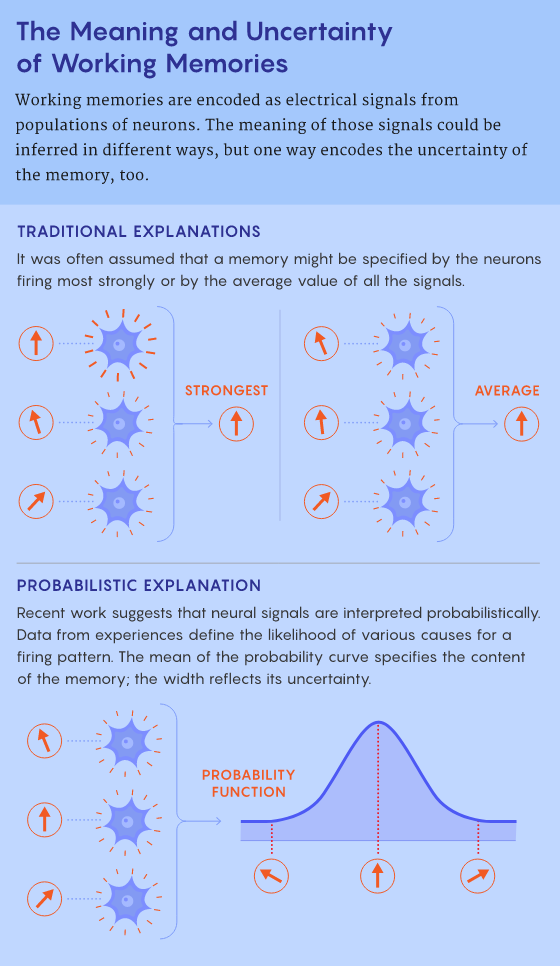
Neural noise indicates our working memory may encode Bayesian probabilities of its contents

The uncertainty in working memory may be linked to a surprising way that the brain monitors and uses ambiguity, according to a recent paper in Neuron from neuroscience researchers at New York University. Using machine learning to analyze brain scans of people engaged in a memory task, they found that signals encoded an estimate of what people thought they saw — and the statistical distribution of the noise in the signals encoded the uncertainty of the memory. The uncertainty of your perceptions may be part of what your brain is representing in its recollections. And this sense of the uncertainties may help the brain make better decisions about how to use its memories.

…the idea that we are walking around with probability distributions in our heads all the time has a certain beauty to it. And it is probably not just vision and working memory that are structured like this, according to Pouget. “This Bayesian theory is extremely general,” he said. “There’s a general computational factor that’s at work here,” whether the brain is making a decision, assessing whether you’re hungry or navigating a route.

link

FIML practice works precisely with the probabilistics of working memory. If the range of doubt in a perception is stronger than normal, it may prompt a query. If the range is stronger than normal and may indicate danger, a query is more likely. It would make sense that our assessments of these factors would be Bayesian. When perceptions are psychologically important, any Bayesian analysis will require assessing the subjective context into which the perception enters, which implies further Bayesian analyses. It would be wonderful if we had machines that could do this for us, but they will only be invented years from now if ever. For now, we can use our own minds to accomplish this through FIML practice. If you can understand the linked article, you should be able to see the value of FIML which collapses a Bayesian probability curve into the certainty of a single point. Psychologically, when this is done hundreds of times, the results are extremely satisfying. ABN

Researchers have gained a first insight into how the brain structures higher-level information. By extracting and analysing data from a neural network of grid cells, they found that the collective neural activity is shaped like the surface of a doughnut

Spontaneous grid cell activity aligns to our external world

So, what is the significance of seeing that the network activity of grid cells is always unfolding on the surface of a doughnut?

“Only one theoretical model in neuroscience has predicted what the activity of grid cells should be like regardless of the animal’s state, the CAN theory. These findings tell us something about the way the network of neurons is connected. The doughnut exists in the connectivity between the cells,” Edvard Moser said.

CAN theory proposes that grid cells with similar functions, cells that are active at nearby places in space, are strongly connected, in a reinforcing way. Cells that are active at distant locations are weakly connected in a mutually inhibitory way. From this follows two premises: (1) If this theory is correct, the only way to get hexagonal grid cell patterns from single cells, is if the joint network activity moves along on the surface of a doughnut. (2) The activity structure is a result of the brain’s intrinsic wiring rules. Thus, the doughnut remains, regardless of where the animal is or what the animal is doing, whether it is using the grid cells to navigate its external environment or not.

The results show that the grid cell pattern is created internally by the connections between grid cells and is not created by the input from the sensory systems, from the outside.

link
Continue reading “Researchers have gained a first insight into how the brain structures higher-level information. By extracting and analysing data from a neural network of grid cells, they found that the collective neural activity is shaped like the surface of a doughnut”

Just 1.5% to 7% of the human genome is unique to Homo sapiens, free from signs of interbreeding or ancestral variants

Less than 10% of your genome is unique to modern humans, with the rest being shared with ancient human relatives such as Neanderthals, according to a new study. 

The study researchers also found that the portion of DNA that’s unique to modern humans is enriched for genes involved with brain development and brain function. This finding suggests that genes for brain development and function are what really set us apart, genetically, from our ancestors.

As little as 1.5% of our genome is ‘uniquely human’

The study: An ancestral recombination graph of human, Neanderthal, and Denisovan genomes