Artificial Intelligence Learned to Read Your Mind ðŸ¤¯

Do FIML now if you want to be well-prepared for mind-reading AI! Since I started writing about FIML over ten years ago, I have wanted to see AI technology develop in the direction of giving people deep access to the real-world, real-time workings of their minds. FIML practice can do this already but AI will make it easier and far more evident why we need to do this sort of practice, why we need to have a very strong grasp of how our minds actually function and communicate. A wonderful possible result from AI combined with FIML is a major upgrade in human communication at all levels everywhere.

Pause for a moment and consider how stupid the main ideas employed in mass mind-control are. Then consider that these stupid ideas, devoid of nuance and subtlety, work simply because the majority of people allow them to work. And people do that because they do not understand how their own minds work or how to communicate deep truths honestly. It is possible AI will help humanity raise its game far above the ignorant cognitive hierarchies we suffer with today. It is also possible AI will produce a dystopia, but I am hopeful because if elites can be made more intelligent and more aware, they may become more ethical. ABN

A deep philosophical flaw of the West is the root cause of our downfall

The West has failed to analyze and understand metalevels of interpersonal communication. Our philosophies employ metalevel concepts and vocabularies but have never delved into or properly understood metalevels of interpersonal communication.

This failure to properly understand metalevels of interpersonal communication has very large downstream effects. It has retarded our religious understanding and psychologies, our group formation, our understanding of other groups, and our ability to form profound interpersonal relationships.

The basis of this claim is that when interpersonal language is deeply restricted—as ours is by this massive hole in Western philosophy—all other forms of language use are negatively affected. When metalevels of interpersonal communication are limited, so is almost everything else.

I believe our philosophers never went there for the same reason no one elsewhere has either—analysis of interpersonal metacognitive language and thought goes against a primitive human instinct to not question others too closely, especially in real-time and about usage and meaning.

The few areas of Western endeavor that have not been hobbled in this way are science, technology, and to some extent economics and politics. This is because these areas by definition must deal with metalevel concepts and thus are very capable of understanding and manipulating them, but only in their own self-described contexts. They are successful because they are practically engaged with the real-world.

In contrast, Western religions, psychologies, group formations, and intergroup communication are so severely hobbled by limited metacognitive understanding, they are all but forced to use rigid definitions of what their metacognitive levels are. Thus Western psychologies are theoretical, religions are dogmatic, group formations are formal at best or ideologically tribal, indicating the need to enforce metacognitive language and concepts rather than analyze or discuss them.

Wittgenstein came close to understanding the problem but did not provide a solution or seem to see that there is one. I hope readers of this site understand that FIML is both the solution to this problem and the best way to personally experience and come to grips with how very serious it is. ABN

How we perceive and what to do about it

Human perception is massively based on human memory, expectations, and schemas already formed and present in the brain.

A recent study on visual perception came to this conclusion:

Altogether, these results show that many neurons in the medial temporal lobe signal the subjects’ perceptual decisions rather than the visual features of the stimulus. (Source)

This study is about visual perception and it focuses on neurons in the medial temporal lobe of the brain, but it’s conclusions have been discovered in many other studies—that is, we very often perceive what we already know or expect to perceive visually, aurally, verbally, semiotically.

Humans are capable of seeing new things and forming new conclusions and perceptions, but our default brain state is that most of the time we react to what we already think we know, consciously or unconsciously.

And how could it be otherwise? We could not function if we had to reassemble every pixel in a photo or our visual field every time we looked at anything. Same for sounds, sentences, concepts, and semiotics in general. If we are unable to quickly generalize and categorize something as something we already know about, we will find ourselves utterly lost in a maze of astounding complexity every second of our lives.

We cannot live without that default state, but when we use it during interpersonal communication we frequently run the risk of applying an erroneous “perceptual decision” about what someone is saying or about how we think they have heard us.

If you make erroneous perceptual decisions at a normal pace, which can be several times per hour, you will almost certainly begin to build up bigger and bigger wrong perceptions of the person you are doing it to. If that person is a spouse or close friend, you will have problems.

How do we usually deal with or work around problems of that type?

  1. We ignore them.
  2. We spend time away from the person.
  3. We get mad openly or seethe quietly.
  4. We resort to the simple generalities of basic friendship—shared activities, safe topics, declarations of loyalty or friendship.
  5. We believe or hope that mistakes will average out and not matter much.

In order:

1) If we ignore problems that arise from erroneous “perceptual decisions,” we are merely pushing them aside where they will continue to fester. Some people are truly able to completely ignore or forget, but do you really want to do that to your memory? And what replaces what you have forgotten? Isn’t it just another false “perceptual decision?”

2) This works to dilute feeling and perception, but not to improve or upgrade it. In most cases, this is a losing strategy with close friends.

3) Getting mad is better than most responses if you have the tools to fix the problem. Seething silently is a horrible way to go, though unfortunately a very common one. The worst of all is “not getting mad but getting even.” People who do this with friends are universally idiots.

4) Sad way to go but probably the most common halfway-decent thing people do. This describes most friendships and marriages. They become  sort of lifeless card games that go on and on because no one knows what else to do. And the longer they go on, the less likely there will be change.

5) I think this is an unrealistic belief because false perceptions can go off at many different angles. They don’t cancel out. At best, this belief may produce an outcome similar to item four above.

There is a way to handle these problems and that way is FIML. With practice, FIML partners will find that they have no festering false perceptions about each other and that they have not been forced to compromise the integrity and complexity of their relationship by resorting to any of the above strategies.

If you read about morality in books and essays, it is all usually very philosophical. What is it? What are the foundations of it? How does fairness contribute? Is it emotional? Cognitive? Non-cognitive? Etc.

But how do you do it? Not how do you do it in the big sense of politics or global warming or philosophy, but how do you do it with just one other person? Can you do that? Have you ever done that? Can you conduct a complex and moral relationship with even one other person?

I don’t mean just sex, though that’s in there. I mean everything. Can you get very, very clear about all of the complexities of your relationship with just one other person? How can you be psychologically healthy if you cannot? I think most people are stuck, at best, on level four above. The reason is not that they want that but that they do not see another way.

You absolutely have to do something like FIML. If you don’t, false perceptions will accumulate and lead to one of the five things mentioned above.

first posted SEPTEMBER 28, 2014

AI makes mind-reading possible

Massive announcements in the world of AI today from the University of Texas, Geoffery Hinton, IBM, and Walmart.

Here’s the rundown on everything you need to know:

1. AI makes mind-reading possible

This new study will literally- *blow your mind*

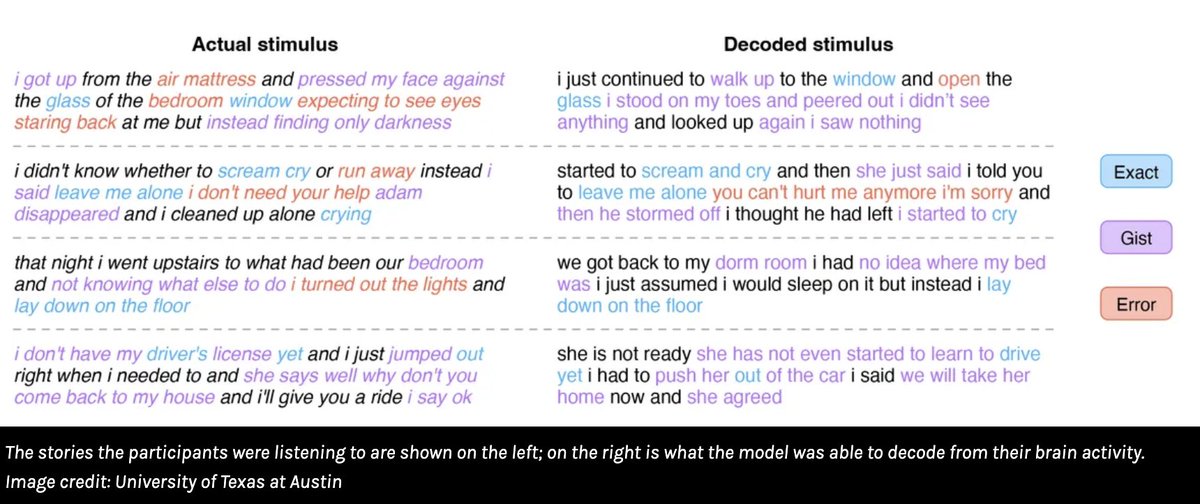
Researchers at the University of Texas have developed a GPT-based decoder that translates thoughts into text using non-invasive fMRI scans.

– Participants trained the decoder by listening to podcasts for 16 hours.

– The AI system generated a text as participants listened to or imagined a new story, capturing thoughts .

The exact words were not always the same, but the overall meaning was captured.

[This whole thread is interesting but I am putting it up because the kind of AI feedback described above will reveal in detail the underlying loose organization and chaos of the mind as we speak and listen (and do everything else). Being able to see this clearly will revolutionize our understanding of human psychology; how it actually functions in real-time. When tech like this is something we can access routinely at a business or school or even purchase and use at home, human communication and self-understanding will hit fabulous new levels, freeing us from the humdrum common associations we must now depend on for clear communication. FIML practice can show a great deal of this right now. I would highly recommend more smart people learn to do FIML because it shows us how we really think and act, thus preparing us for what is coming from this new tech. Subjectivity will become much more objective. This will shock and even traumatize many, but it need not because it is real and utterly fascinating. In my view, this will become one of the most impactful technologies stemming from AI. ABN]

Continue reading “AI makes mind-reading possible”

How FIML can improve your favorite relationship, your own mind, and your partner’s

FIML is a technique used to optimize communication and psychological well-being between two people in real-time, real-world communication. It is a form of analytical psychotherapy that aims to clear up mistaken psychological interpretations that may have been held for many years or that may have just arisen. No psychological training is necessary to do FIML.

By clearing up many small mistaken interpretations between partners, FIML gradually clears up the psychological bases of those misinterpretations, which leads to greatly improved communication and psychological well-being. FIML can be used in any interpersonal relationship, including romantic relationships, friendships, and professional relationships. FIML is ideal and should be considered mandatory for marriages and other long-term committed relationships based on love or mutual affection, especially when partners live together.

It is important that both partners care about each other and very helpful if they realize that the well-being of one is the well-being of the other, or at least greatly contributes to that. FIML practice enhances and supports honesty between partners and their understanding of what honesty entails and how to be deeply honest in a relationship without relinquishing subjective privacy and freedom of thought, which are essential for spiritual and psychological growth.

To do FIML, both partners need to have a previous agreement to do it and then follow their mutual understanding of how FIML is done. Partners should do FIML at a time and place where they can converse without interruption.

A FIML query begins when one partner notices they have begun to form an impression or an interpretation of something their partner said or did. To be sure they are not mistaken, they begin a neutral query that fundamentally asks their partner to describe the contents of their working memory at that moment in time.

Partners must agree on the basic data that initiated the query. “When you said, XYZ what was in your working memory?” Partners must be able to agree that one of them said XYZ. Or, “When you turned away and looked into the sink, what was in your mind [working memory]?” Partners must be able to agree that one of them turned and looked into the sink. Moments like these are chosen by the partner making the inquiry. These moments can be playful or they can be very serious, causing incipient strong emotions to begin forming. Before those emotions take hold, do the query and find out if you were right or wrong by listening carefully to your partner’s answer.

After you have listened to your partner’s description of the contents of their working memory, compare it with your own. Then share your insights with your partner. This part of FIML is where the greatest value is. Since the precipitating event was small—a word or gesture or tone of voice—it is quite easy to confess your mistaken interpretation and then listen to your partner’s probably befuddled response to your mistake. This part is fun and can be a huge relief if your query was psychologically charged with underlying traumatic memory.

It really helps if both partners have a rich understanding of how imprecise, messy, crude, and sloppy almost all spoken language is. ABN

‘We are at an impasse. I love you. I am committed to you’ — the Crowders

The exchange between Steven Crowder and his wife, Hilary, is not unusual. Rules, commitments, roles, I love you. I don’t love you.

The exchange is an example of a common form of communication that is normal throughout the world. It is based on a deep failure to understand how interpersonal language does not work. And how it can and should work.

It does not work through vows, declarations of loyalty or love, roles, or ‘respect’.

Interpersonal communication between couples only works when they have a consciously shared method that allows them to understand themselves in real-world, real-time situations.

If the Crowders had been doing FIML, which is precisely the method they need, none of this would have happened.

Consider how simple-minded their conversation is. How stupid it is. Two full-grown, intelligent, successful adults who at some point must have cared for each other talk themselves into box like a couple of babies.

Their voices creak with anger as they battle for peace and contentment while destroying any chance of getting it with every word they say. Neither is to blame because neither one knows any other way to speak.

FIML is described in the links above. It is easy to do if you start before you get to where the Crowders are.

The hardest part about FIML is observing and controlling the first split-second of the formation of any significant impression or interpretation of your partner. FIML can only be learned when partners are at peace with each other. Then, small impressions with only small importance can be explored. This lays the foundation for deeper impressions later on.

For Buddhists, FIML requires observing and controlling your reactions during the first skandhas, before consciousness has fully developed. The fourth skandha of mental activity should be engaged in doing a FIML query rather than consolidating what is probably a mistaken impression of your partner. ABN

Evolution of the smile and the inherent ambiguity of signs

Michael Graziano proposes a interesting, and quite convincing, hypothesis on the evolution of a good many human signals, including smiling, crying, laughing, and subtle versions of these.

His essay can be found here: The First Smile. I highly recommend it.

Evolutionary psychology is without question a real field capable of explaining a great deal about human beings. At the same time, it is often very difficult to separate what actually happened during thousands of years of evolution from what we think happened.

Graziano proposes that the human signals of smiling, crying, and laughing all evolved from a single more basic cringe reaction employed as defense against an object or person striking us or otherwise threatening us.

The evolutionary transformation from primitive reactions to subtle social cues is fascinating to contemplate. I am particularly struck by how ambiguous our present-day understanding of these social cues can be. As Graziano, the evolutionist, says, “So long as both sides of the exchange keep deriving benefits, the behaviour floats free of its violent origins.”

The violent origins of smiling and acting nice only sometimes play a direct role in why people do these behaviors today. Added to them is a plethora of cultural and idiosyncratic interpretations. And so, Graziano the social scientist also says, “We have stumbled on the defining ambiguity of human emotional life: we are always caught between authenticity and fakery, always floating in the grey area between involuntary outburst and expedient pretence.”

I would contend that this aspect of human emotional life is maddening, that it is literally driving people crazy. Because how can you really tell if an expression, a statement, a gesture is authentic or fake? And how can you be sure you know how to interpret it?

In most cases, you can’t be sure. Yes, we can make vows, proclaim fealty or allegiance, swear till death do us part, or repeat familiar, comforting routines for years, but none of these methods is certain. Indeed, our need for them only shows what thin ice we are on. All of them can be faked and all of them often are.

I do believe that many, if not most, of us do not want to be either fakers or the one faked to. Yet we seem all but trapped “between authenticity and fakery, always floating in the grey area between involuntary outburst and expedient pretense.”

This is why we all need FIML practice or something very much like it. With FIML, much greater communicative detail can be made available to both partners. Rather than wonder what words, smiles, tears, or a tone of voice means, FIML partners have the means to find out.

Evolutionarily, you might say that FIML allows the human neocortex to understand and control the human limbic system. FIML allows higher thought, reason, and reflection to control base reactions and base signs that inevitably cause serious misunderstandings even between people who are very well-disposed toward each other and who share a strong desire to interact honestly.

Humans are characterized by a delicate and intricate web of thought, language, and culture that has been grafted onto a base of animal behavior. I do not see how it is even remotely possible to fully realize the potential of that delicate and intricate web of thought, language, and culture without frequently analyzing how animal signs and signals interfere with it during even the most ordinary of interactions.

Graziano mentions the Duchenne smile, a supposedly authentic smile that includes the muscles around the eyes. But Duchenne smiles can easily be faked. They are a required social expression in most of East Asia and can be seen faked by actors on American TV all the time.

The distinction between a Duchenne smile and a super-fake one is valid and valuable to a point. But it is also a woefully simple distinction. We cannot as thinking beings expect to find satisfaction in noticing minor, and easily faked, distinctions like that. The same thing goes for tones of voice, gestures, word choices, behaviors, and everything else we use to communicate.

In public, in the world at large, we have to use best guesses about what is going on, but in private guessing about what your partner really means is a recipe for mutual disaster, if not complete destruction.

first posted AUGUST 18, 2014

Fourth wave cognitive behavior therapy

The third wave of cognitive behavior therapy is a general term for a group of psychotherapies that arose in the 1980s, inspired by acceptance and commitment therapy (ACT).

To me, third wave therapies seem more realistic than older therapies because they accept emotions as they are and pay close attention to how they function in the moment.

The link above is well-worth reading. The frames of these therapies are also well-worth considering.

FIML, which I am calling a “fourth wave cognitive behavior therapy,” differs from third wave therapies in that FIML does not use a professional therapist. Instead, partners become their own therapists.

Moreover, how FIML partners frame their psychologies or generalize their behaviors is entirely up to them. Similarly, their psychological goals and definitions are entirely in their own hands.

At its most basic, FIML “removes wrong interpretations of interpersonal signs and symbols from the brain’s semiotic networks.”

This process of removal, in turn, shows partners how their minds function in real-time real-world situations. And this in turn provides the tools and perspectives to reorganize their psychologies in whichever ways they like.

FIML is based on semiotics because semiotics are specific and with practice can be clearly identified and understood. They give partners “solid ground” to stand on. Words, tone of voice, gestures, and facial expressions are some of the major semiotics partners analyze.

Using real-world semiotics as an analytical basis frees FIML from predetermined frameworks about personality or what human psychology even is. With the FIML tool, partners are free to discover whatever they can about how their minds communicate interpersonally (and internally) and do whatever they like with that.

first posted DECEMBER 21, 2017

Today I would like to add that, most of all, FIML is a technique that optimizes communication between partners which in turn optimizes life itself. Everything improves with FIML. ABN

Communication at arm’s length

Most communication is done at arm’s length.

By this I mean our deepest levels of meaning, emotion, and intention are either implied or more often concealed from the person(s) we are speaking with.

In professional and formal settings (school, clubs, church, etc.) this is pretty much how it has to be since there is not enough time to delve more deeply and no good reason to do so in most cases.

Problems arise, however, when the arm’s length habits of formal settings are imported into intimate private settings such as close friendships, marriages, families.

Arm’s length communication is effective in formal settings, but its use of reduced messaging techniques in private settings invariably enters gray areas followed by conscious lying.

I think people do this in their private communications mainly because they don’t know how to communicate in any other way. Humans are basically somewhat smart apes who have a fairly complex (for us) communication/language system grafted onto the instincts of a wild animal.

When the inevitable ambiguities and lies of arm’s length communications build up within the intimate communications of couples or close friends, the result will be explosive emotions or alienation and apathy.

The simple arm’s length system is a primitive, basic system for communicating obvious things. To be honest, if you enjoy your communications at work or the clubhouse more than at home, you are basically showing how primitive you are.

In formal settings communication is entirely based on predetermined mutual agreement concerning values, beliefs, etc.

Private settings require much more nuance and thus a much more nuanced communication technique.

FIML is designed for private, intimate communication. It allows partners to open their minds to much richer and much healthier interactions.

You cannot achieve optimum psychological health if you engage only in arm’s length communication. You can only do so by using a technique like FIML that allows you and your partner to consciously share the profound world of interpersonal subjectivity.

You have to have a clearly-defined technique and an agreement to do this. FIML is not about sitting around drinking herb tea while doing “compassionate listening.” That is bullshit. That’s just another form of arm’s length communication.

FIML takes some time and practice but it is no harder than learning how to ski or cook  or play a musical instrument moderately well.

first posted JUNE 7, 2016

How ‘Generous Tit for Tat’ wins at life

And why the combo of strength+gentleness is unbeatable in the long run.


…With our newly acquired wisdom, let’s return to the original Tit for Tat strategy, and custom fit it with a mechanism for self-correction. We just need to add one rule:

Rule 1 – Be nice (technically meaning always co-operate on the first round).

Rule 2 – From then on just copy what the other player did in the previous round (meaning an eye for an eye and a hug for a hug).

Rule 3 – After you retaliate, always try to co-operate again in the next round.

link

OK advice for getting along in this world within arm’s-length relationships. Mathematical generalities of game theory are all but forced to produce simple and also unsatisfying outcomes like this. Compare this to FIML practice which removes Miscommunication, Miscalculation, Mistake, and Mishap (4Ms) thus enabling communication that is orders of magnitude closer than arm’s length. FIML provides near-perfect freedom between partners because the specifics of enough of their 4Ms can be worked out almost perfectly. This optimizes their communication which optimizes their cooperation and well-being. There may be rare occasions when FIML partners might do the eye-for-an-eye part of Rule 2, but this would be a weird glaring outlier that would have to be discussed and figured out at some point. FIML depends on a level of mathematical reasoning that requires also human quiddity and poetry. FIML can definitely be thought of as a game with general rules, but these rules include the rule that partners must appreciate the specific uniqueness of every moment. ABN

Why we need Functional Interpersonal Meta Linguistics (FIML)

We need Functional Interpersonal Meta Linguistics (FIML) because human communication is fraught with error. Communication errors are unavoidable. They happen very often.

At the most basic level, errors occur because the speaker misspoke or the listener misheard. Basic errors may involve words, expressions, gestures, or tone of voice.

More complex errors may involve misunderstandings concerning context, intention, or interpretation.

In normal communication, most people do not correct these sorts of errors. Instead, they react to them not as if they were errors but rather the real intention of the speaker. Sometimes, of course, people do attempt to understand and correct communication errors, but most do not do this often enough or with sufficient appreciation for the potential significance of even small errors. Even very basic communication errors can lead people into a mutual spiral of deep misunderstanding.

Functional Interpersonal Meta Linguistics (FIML) is a practice designed to help couples or close friends quickly understand and deal with the errors that inevitably occur in their communications with each other.

first posted AUGUST 30, 2011

This appears to be my first post on FIML. ABN

Robert Malone and Ryan Cole on the nuances of covid science

This is an interesting video if you want to get into the details of errors made during covid. In light of the discussion from earlier today on in-fighting among top covid scientists and the kinds of rhetoric that are appropriate for discussions of covid, the video above shows how two scientists talking about the science of covid does not make for gripping cinema and will not communicate with a wide audience. And this shows where and why Stew Peters and Alex Jones can and do play an important role in informing an audience much wider than Cole & Malone can hope to reach. Covid is a sciencey subject and also it affects everyone. Thus, strong voices, non-scientific voices, imperfect sensationalist voices also have a contribution to make. My brother watched Died Suddenly and was deeply affected by it. He will not have the patience for a video like the one above. ABN

Such an Easy Test of Veracity — Matthew Crawford

…you can test people on their commitment to principle. It should be an extremely low bar to want to file a FOIA. Most of the FOIAs filed during the pandemic have revealed valuable information. It would stand to reason that a FOIA filed about the military health database that was part of the CDC’s Vaccine Safety Technical (VaST) work group (and suffered an untimely glitch) would have a decent chance of returning positive value per time spent. As I’ve suggested the idea to people for over nearly a year, I believe every single person I talked with felt that way—until Steve Kirsch just the other day. I’m not sure when he changed his mind—he seemed strongly in favor in June of last year (below).

link

This contretemps strikes me as being catty, but I may be missing something. Crawford was nasty and evasive with Kirsch in an RTE video from a few weeks ago, which I am not going to bother looking for, but giving him the benefit of the doubt today, there may be something to this FOIA claim. Crawford would benefit immensely from a year of FIML practice. ABN

FIML and ‘sins of omission’

By “sin of omission” I mean refraining from doing a FIML query because you feel it will be too much trouble, seem contentious, take too long, expose a failing or weakness in yourself, hurt your partner’s feelings, and so on.

Some time ago we came up with the slogan: “It is always cheaper to do a FIML query than not do one.” This slogan is meant to help us guard against “sins of omission.”

If you refrain from saying something because you are afraid it will cause one of the problems mentioned above, you are right there causing a worse kind of problem in that you are assuming something about your partner that may not be (probably isn’t) true.

Even worse, you are refraining from informing your partner that you have concluded that some kinds of speech acts are not safe or pleasant to engage in with them.

It would be far, far cheaper for both you and your partner to deal with whatever you think the problem is the moment it arises.

This is so because small matters are much easier for us to understand and deal with than large matters. When we deal with small matters as they arise in normal conversation,we are doing at least two very important things: 1) we are dealing with the matter and its ramifications and 2) we are learning something very important about how we speak.

FIML changes the way we think not just what we think. If we fully understand that our understandings of each other can be very far off and if we fully understand how serious these misunderstandings can become, we no longer will see discussing minor mix-ups as a waste of time or something to be avoided.

I saw a post the other day by a beginning Buddhist who was confused about his mindfulness practice. He asked: “Every time I try to be mindful, my mind seems to fill with thoughts, words, and feelings. How do I stop that?”

Mindfulness is about being clear about what your mind is really doing. It’s not about pretending you have an ideal mind, or acting as if you do. If that Buddhist has a partner and if they both do FIML, they will experience the value of mindfulness in a very direct and beneficial way.

Human languages have evolved within violent hierarchical social systems that exploit our normally poor abilities to understand each other.

FIML practice allows us to be mindful of these limitations and go beyond them to achieve real understanding with our partner. The deep reward of FIML practice lies in that and in the profound feeling of resolution you will reach with your partner each and every time you carry a FIML discussion through to a mutually satisfying resolution.

first posted JUNE 15, 2012

Fabula and semiotics

Fabula are “the raw material of a story or narrative.”

I want to borrow this term to denote the raw material of a purposive conversation. For example, if I say to my partner that I want to have a salad for dinner, the notion or idea of that salad is a fabula that we can now discuss.

Our discussion of this as yet non-existent salad, this salad fabula, will include particular items, acts, and visualizations. For example, I may want sliced tomatoes in the salad, my partner may mention some olives in the refrigerator. We may both visualize our salad bowl and kitchen while we decide who does what.

Before the salad is made it is a fabula. The particular elements that go into getting the salad made while they are still only in our minds are semiotic elements.

In this sense, semiotics can be defined as the units or parts of a conversational fabula. We use these semiotics to discuss how to make what kind of salad.

We do the same thing with virtually all other conversational subjects. That is, we declare or grope toward determining what our fabula is and use semiotics to further clarify our vision of it. While doing this, ideally, we will remain open to real-time alterations and misunderstandings about both the fabula and the semiotics.

In these terms, most reasonable (and many unreasonable) conversations can be understood as two (or more) people negotiating* the “meanings” of their imperfectly shared fabula and semiotics. The fabula is a sort of context that defines the semiotics used in the discussion of it.

When the conversation is about salads, much of the process of going from a salad fabula to a real salad is straightforward and unproblematical.

When a conversation is about matters that are more ambiguous, subjective, emotional, or existential, there may be more problems because the fabula often will not be as clear as a salad to both parties. Or if it is, it may lead parties to quickly cleave to cliches or obvious explanations, thus limiting fresh responses or creative insights.

FIML practice can fix these problems by getting partners to clarify their fabula while also allowing them to alter it, or even change it entirely, as their discussion progresses.

The same is true at a different level for the semiotics they employ in their discussion. With FIML practice these semiotics often can be adjusted and clarified as soon as diverging understanding is noticed in either person’s mind.

Even if diverging understandings persist for some time, experienced FIML partners will be better prepared notice them when the opportunity arises.

A more complex example of this is an ongoing discussion my partner and I have had for several years. The basic discussion involves a strong reaction I sometimes have to cosmetic surgery. I admit that my reaction can be irrational and I can’t quite explain it. My partner frequently makes the point that I do like cosmetic surgery as long as I don’t notice it and/or like the results. We have gone back and forth on this quite a few times without ever getting a really good resolution, until a few days ago. The core problem had been that I do dislike the idea of cosmetic surgery, period. And also, I do recognize that it can be necessary and that if I like the results, I may be able to accept it even when it is not necessary.

We had never been involved in a simple dichotomy—like versus don’t like—but we both had been speaking as if we were. This was mostly my fault as I sometimes expressed revulsion at some forms of cosmetic surgery, but it was also not true that I actually liked the surgery if I liked the results or didn’t notice it.

________________________

*I mean the word negotiating not so much as making a deal but more as negotiating a narrow foot bride across a stream or negotiating a turn in an automobile. Negotiation in this sense is an effort between two or more people to make many small adjustments to arrive at a mutually satisfying result, the “meaning” of which is understood in roughly the same way by all parties.

first posted JANUARY 8, 2014

UPDATE 12/12/23: Wow, did I have a huge misunderstanding of a conversational fabula last night. I had trouble falling asleep over it and woke up ruminating on it. My partner is a genius and all I did was bring it up and describe exactly what I had thought and within minutes, everything was cleared up. I can’t go into it because it is too complex. But I can say that this kind of mistake is what causes neurosis, emotional agony, even mental illness. This is the kind of mistake FIML was designed to correct. Usually, FIML mistakes are small and involve semiotics but a huge fabula mistake is always possible, as I saw very clearly over the past 12 hours. I cannot thank my partner enough for having such deep understanding of me, herself, and what we had been talking about and how we generally talk. FIML is a profound training exercise. If you have ever gotten anything from this site (or not), please try FIML. It is by far the best unique thing I have to offer. ABN