A Florida megachurch is asking its congregation to sign a pledge denouncing homosexuality, warning them they will be kicked out of the church if they do not sign the document affirming their beliefs ‘in a sexually confused world.’
First Baptist Church in Jacksonville decided in October to make all of their 3,500-strong congregation sign the statement by March 19. If they refuse, they ‘will be considered by the church to have resigned their membership.’
The pledge states: ‘As a member of First Baptist Church, I believe that God creates people in his image as either male or female, and that this creation is a fixed matter of human biology, not individual choice.
‘I believe marriage is instituted by God, not government, is between one man and one woman, and is the only context for sexual desire and expression.’
President Trump transmitted a message to congress, warning them not to cut Social Security and Medicare {Direct Rumble Link}. Many politicians and pundits will look at Trump’s position from the perspective of it being good to campaign for older voters, but that’s not the core of his reasoning.
In 2016 CTH was the first place to evaluate the totality of President Trump’s economic policies; specifically, as those policies related to the entitlement programs around Social Security and Medicare. We outlined the approach Trump was putting forth and the way he was approaching the issue. In the years that followed, he was right. He was creating a U.S. economy that could sustain all of the elements the traditional political class were calling “unsustainable.”
Before getting to the details, here’s his video message and policy as delivered yesterday.
Fortunately, we do not have to guess if President Trump is correct. We have his actual economic policy results to look at and see how the expansion of the economy was creating the type of growth that would sustain Social Security and Medicare. This was/is MAGAnomics at work.
Although it is widely accepted that human beings have an ingrained ‘need to belong,’ there seem to be a substantial subset of young people who seclude themselves for most of the time at home and no longer engage in education or work, ultimately withdrawing from participation in society. In Japan, this phenomenon has been labeled as ‘hikikomori,’ but given its global presence it may be preferable to use the term ‘extreme social withdrawal’ (ESW). In this qualitative review, we provide a description and definition of ESW, provide figures on its prevalence, and discuss a number of associated concepts, including loneliness and “aloneliness,” school absenteeism and dropout, the ‘new’ developmental stage of adultolescence, and the labor force categories of freeter (‘freelance arbeiter’) and NEET (a young person not in employment, education, or training). The core of the paper is focused on the origins of ESW in young people and provides a narrative overview of relevant etiological factors, such as aberrant brain processes, unfavorable temperament, psychiatric conditions, adverse family processes including detrimental parenting, negative peer experiences, societal pressures, and excessive internet and digital media use, which are all placed within a comprehensive developmental psychopathology framework. We will close with a discussion of possible interventions for young people with ESW and formulate a guideline that describes (the temporal order of) various components that need to be included in such a treatment.
I have only read the abstract linked above but am posting this paper because it may be of interest to readers of this site. From a Buddhist point of view, there are many legitimate reasons to withdraw from society or reduce one’s participation in it. I am not encouraging that but am saying asceticism is a major form of Buddhist practice as are long silence retreats. This is not the same as what’s known as hikikomori and for the most part I do not think Buddhist asceticism is pathological in any way. Since I haven’t read the paper, I have no more to say than that. ABN
Symbolic Interaction Theory, also called symbolic interactionism, provides the best large-scale framework I have found so far for explaining FIML practice.
Three basic premises of symbolic interactionism are:
“Humans act toward things on the basis of the meanings they ascribe to those things.”
“The meaning of such things is derived from, or arises out of, the social interaction that one has with others and the society.”
“These meanings are handled in, and modified through, an interpretative process used by the person in dealing with the things he/she encounters.”
These basic premises have been taken from the Wikipedia article linked above. I tend to agree with most of the general framework, as I understand it, of symbolic interactionism and believe that FIML practice can reasonably be understood as a method that can fit fairly comfortably within that framework.
FIML differs from symbolic interactionism in that FIML is much more a form of interpersonal psychotherapy than a sociological theory. FIML is a communication technique that focuses on meaning as it arises and is apprehended during short periods of time. FIML’s focus on very small units of interpersonal communication is what allows partners to understand how their sense of meaning intertwines with their emotional responses.
From a FIML point of view, society does not appear very well structured in many of its contexts, especially interpersonal contexts involving emotions, friendship, and intimate bonding. From this point of view, a great deal of social structure appears to be a substitute for authentic interaction between individual minds.
FIML seems also to show that a great deal of human suffering arises from the paucity of meaning that can be exchanged between individuals in most social contexts. Indeed, even in intimate contexts, most individuals, if not all of them, have great difficulty in attaining profound mutual understanding. This happens because our perceptions of our selves and others—due to how we use language and semiotics—are too crude and vague to allow for communicative complexity equal to the complexity of our minds/brains.
FIML corrects this problem by focusing on the details of interpersonal communication. Incidentally, FIML theory/practice can be falsified by having many couples do FIML practice and measuring the results. A criticism of symbolic interactionism is that it is not falsifiable. FIML differs from symbolic interactionism in that it is a practical technique that uses objective data (agreed upon by both partners) to optimize communication and improve psychological well-being.
I am pretty sure I will have more to say about symbolic interactionism in the days to come. A friend just sent me the article linked above, so I put down a few thoughts after one reading. FIML partners may find that symbolic interactionism helps with a general understanding of FIML practice.
UPDATE 01/13/22: The Wikipedia page has been updated since the excerpt above. I found this update interesting:
[Symbolic interactionism] is a framework that helps understand how society is preserved and created through repeated interactions between individuals. The interpretation process that occurs between interactions helps create and recreate meaning. It is the shared understanding and interpretations of meaning that affect the interaction between individuals. Individuals act on the premise of a shared understanding of meaning within their social context. Thus, interaction and behavior is framed through the shared meaning that objects and concepts have attached to them. From this view, people live in both natural and symbolic environments.
I agree with this and would add that the the shared understanding and interpretations of meaning that affect the interaction between individuals occurs all-importantly and very profoundly on the level of intimate interpersonal relationships. What FIML does is discover, foster, and create a much more accurate shared understanding and interpretations of meaning between FIML partners. The benefit of this is enormous since it has an extremely profound effect on individual psychology and all other shared understanding and interpretations of meaning encountered in society everywhere. ABN
Since Canada legalized euthanasia in 2016, there has been a strange balancing act at the heart of its medical system. There is a national suicide prevention hotline you can call 24/7, where sympathetic operators will try to talk you out of killing yourself. But today there are also euthanasia hotlines, where operators will give you the resources you need to carry out your wish. Doctors and nurse practitioners are now in the business of saving the lives of some patients while providing death to others.
Canada calls it Medical Assistance in Dying, or MAID. The term encompasses both assisted suicide, which is when providers give patients the means to end their own lives, and euthanasia, which is when a medical practitioner directly administers a patient’s lethal injection. But virtually all such deaths — over 99 percent — are euthanasia.
Supporters insist that this is not state-sanctioned suicide. Rather, it’s a dignified solution for those who no longer wish to suffer from terminal or chronic illness. MAID allows “for compassionate action, while also protecting those who are particularly vulnerable,” claimed David Lametti, the attorney general and minister of justice, in 2021.
…Important people — prominent politicians, physicians, and judges — promised Canadians that their rights to autonomy would be expanded. But the picture that emerges is not a new flowering of autonomy but the hum of an efficient engine of death.
Once you make anything explicit, it changes it. Once you make something legal, it changes it. The moral compass moves all over due to complex factors that overwhelm the vastly simpler act of making something explicit or legal. As with all health care, providers are as much patients as the patients. ABN
There is something irresistibly attractive in Russia’s defense of traditional and religious values (what might be called Russian neo-conservatism if that label had not been usurped by American Jewish warmongers). But where does it really come from? We tend to assume that it is a reaction to Western post-modern decadence. But there is more depth to it.
What is Russia? How does Russia define herself, and how does she conceive of her relationship to Europe? Specifically, from what tradition do Russia’s current ruling elites draw their vision of Russian civilization? I wanted to learn about the Russian thinkers of the nineteenth and twentieth centuries that the Russians themselves have rediscovered since the fall of Communism, and who are said to have a strong influence on Vladimir Putin and his entourage. Here is what I found.
I wonder if some of these official deaths and others were not purged. Could be for political or criminal reasons or even euthanasia of the infirm and ‘undesirable’. This video ends with a traditional Chinese belief — that the deadly epidemic is a sign the ‘Mandate of Heaven’ has been withdrawn from ‘the Dynasty’ of Xi Jinping and the Chinese Communist Party. This is a powerful belief in China and will become a significant political force if the deaths are as numerous as they now appear to be. ABN
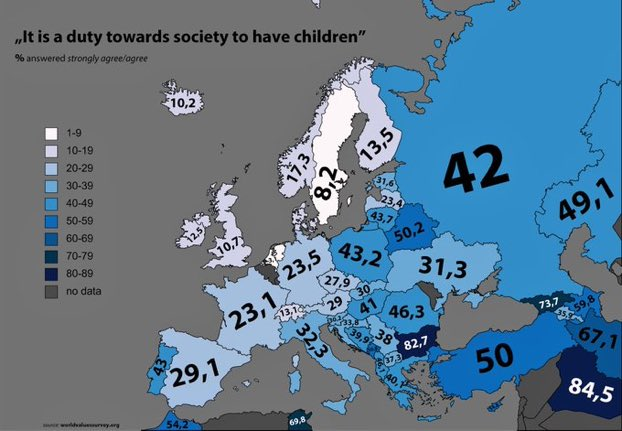
This is revealing of the weakened social bonds and self-esteem of the more woke regions of Western and Northern Europe, where there are also high levels of immigration. I wonder what the American figure is. For the record I strongly favor nationalism over globalism and individual rights over communal fantasies but I also do not believe it is anyone’s duty to have children. I do believe it is government’s duty to make life good enough and free enough that citizens are able to have children and able to want to have them. ABN
I am reasonably sure that no language in the world allows the kind of query that FIML practice is based on.
The reason for this probably lies in the origins of human language and culture, a developmental period during which languages were much simpler and were used mainly to indicate real things in the world or give commands.
At later stages of development, language became a tool of whatever hierarchy prevailed in the moment. To this day, Confucianism is still a rule book for hierarchies.
That said, languages are always potentially very supple, so there is no need for humans today to be restricted by archaic forms of speech and thought.
And that said, it is important to understand that your psychology has been deeply conditioned by the archaic and hierarchical cores of your language.
I bring this up because this side of human psychology makes it difficult for people to do FIML practice correctly.
To the speaker, the basic FIML query will instinctively feel like nagging, being petty, being whiny. To the hearer, this basic query will instinctively feel like a challenge, an insult, an affront.
These basic instincts must not be allowed to block FIML inquiries. Personally, I believe FIML has not been discovered before because no one ever went beyond these basic instinctive reactions.
So, expect to feel affronted and expect to feel like a petty nag, at least for a while. With practice, these feelings will go away. At the same time, the importance of the information gained through FIML queries will become increasingly obvious.
Once the hierarchical cultural and linguistic instincts that have developed in us, and upon which our psychologies depend, have been overcome, a new use of language will become possible.
This new language is capable of sufficient micro subtlety to allow us to objectively observe how our minds and psychologies actually function in real-time real-life situations.
No theory of psychology and no amount of introspection will take you to the actual data of how you function. Only FIML practice can do that.
UPDATE 12/24/22: All woke complaints about hierarchies, patriarchies, whiteness, or any group identity are deeply flawed because they are missing the deepest underlying point: All language and psychology is fundamentally hierarchical, even authoritarian. When woke or communists or others rail against one hierarchy only to replace it with another one, they are playing a destructive shell game with social organization, never escaping the foundations of their own identities. Rather than making things better, they only make them worse.
In Buddhism as in American and Western civilization, the individual has the unalienable right to be free as freedom is the essence of the True Mind or the soul created by God. At the same time, individuals also have the responsibility to conduct themselves ethically, honorably, wisely. When we focus on group identities or, worse, gender identities, we massively limit linguistic and psychological options to core instincts that are well-known to generate anger, lust, hatred, resentment, pride, ignorance, violence, doubt. The Buddha said, “Work out your own salvation. Do not depend on others.” And, “Do not look for a sanctuary in anyone except yourself.” And, “Nothing can harm you as much as your own thoughts unguarded.” And, “What we are today comes from our thoughts of yesterday, and our present thoughts build our life of tomorrow: Our life is the creation of our mind.” To be properly mindful in today’s world, you have to be mindful at the individual level of your own use and misuse of language in real-time. “We are what we think. All that we are arises with our thoughts. With our thoughts, we make the world.” ABN
An exploration of the perverse economic incentives in the practice of medicine and the obstacles faced in treating COVID vaccine injuries.
I have always been fascinated by the subject of free will, and continually saddened by observing individuals choosing to relinquish the spontaneity they inherited as living conscious beings. In turn, I’ve tried to touch upon how predictable psychological patterning, external influences, and predefined thought patterns help to explain many of the abhorrent behaviors we’ve observed from the medical profession, the scientific authorities, and the general public over the last three years.
•How the harsh medical training each doctor goes through leaves them with an existential need to believe their practice of medicine is safe and effective (retained emotional patterning, such as that resulting from traumatic experiences, exerts an enormous influence over most people’s lives).
•How the current academic system trains people to forfeit their critical thinking and instead follow rigidly defined cognitive algorithms, which prevents most of those it trains from arriving at inconvenient conclusions while simultaneously zealously believing in each defense they provide for the orthodoxy.
Simply stated, semiotic codes are the conventions used to communicate meaning.
Codes can be compared to puppet masters that control the words and semiotic bundles that people use when speaking and listening. For many people, semiotic codes are largely unconscious, functioning mainly as limits to communication or as givens.
Some examples of codes might be the ready-made formulas of politics or the ordinary assumptions of any culture anywhere.
Codes work well in most cases when we do ordinary or formal things, but they inhibit thought and communication when we want to go beyond ordinary or formal interactions and behaviors.
Unconscious, unexamined, or strongly-held codes can be a disaster in interpersonal relations if one or both (or all) parties are rigid in their definitions and understanding of the codes being used. These are the sorts of conditions that lead to absurd exchanges at the dinner table and are one of the main reason most of us learn never to talk about politics or religion at most gatherings.
Gathering for dinner itself is a code. On Thanksgiving we are expected to break bread without breaking the code of silence on politics or whatever else your family can’t or won’t talk about. There is not much the individual can do to change this because the harder you try—no matter how good your intentions—the more it will seem that you are breaking the code, being aggressive, or threatening the (probably fairly weak) bonds that hold your dining unit together.
Many years ago, Charles Berger and Richard Calabrese proposed a theory about communication known as the Uncertainty Reduction Theory. This theory deals with how people initially get to know each other. It proposes:
…that, when interacting, people need information about the other party in order to reduce their uncertainty. In gaining this information people are able to predict the other’s behavior and resulting actions, all of which according to the theory is crucial in the development of any relationship. (Source)
The basic idea is that we humans need to reduce uncertainty in order to understand each other well-enough to get along. If we succeed at reducing uncertainty sufficiently, it then becomes possible to continue to develop relations.
The theory works pretty well in my view, but the problem I see with it is reducing initial uncertainty is much the same as feeling out semiotic codes, discovering which ones both (or all) parties subscribe to. As mentioned, this works well-enough for ordinary and formal relations, but what happens next? For the most part, most people then become trapped in the codes they seem to share.
What happens next can even be seen as sort of comical as people over the weeks or months continue to reduce uncertainty while confining themselves even more. Very often, if you try to go a bit deeper, you will be seen as breaking the code, disrupting convention, even threatening the group.
This is the region in which intimate relationships can be destroyed. Destruction happens because the parties involved are trapped in their codes and do not have the means to stand outside them and analyze them. Obviously, this leads to either reduced or turbulent speech.
I think the Uncertainty Reduction Theory might be extended and amended to include a stage two theory of uncertainty reduction. FIML practice would constitute a very reasonable stage two as FIML is designed to remove uncertainty and ambiguity between close partners.
Notice that FIML itself is not a semiotic code. It is a tool, a method, a procedure that allows partners to communicate without using any code at all save ones they consciously choose or create for themselves.
It seems clear to me that all established interpersonal codes are ultimately limiting and that people must find a way to analyze whatever codes they hold or have been inculcated with if they want to have truthful or authentic communication with their closest partners.
Most codes are public in the sense that they are roughly known by many people. But all of us have idiosyncratic ways of understanding these public codes and all of us also have private codes, idiosyncratic codes that are known only to us.
Sometimes our understanding of our idiosyncratic codes and/or idiosyncratic interpretations of public codes is not all that clear to us. One reason is we do not have good ways to access them. Another reason is a good many idiosyncrasies are sort of born in the dark. We muddle into them privately, inside our own minds with little or no opportunity to share them with others. Indeed, as seen above, to try to share them all too often leads to disruption of the shallow “certainty” that adherence to the shared code has provided.
What a mess. We need codes to learn, grow, and communicate with strangers. But we have to go beyond them if we want to learn, grow, and communicate with the people who are most important to us.
FIML is a sort of stage two Uncertainty Reduction Practice that allows partners to observe and analyze all of their codes—both public and private—in real-time.
Why is real-time analysis important? It is important because codes can only be richly and accurately analyzed when we see clearly how they are functioning in the moment. The “psychological morphemes” that appear only during brief moments of communication must be seen and analyzed if deep understanding is to be accomplished.

 American Buddhist Net