Fourth wave cognitive behavior therapy

The third wave of cognitive behavior therapy is a general term for a group of psychotherapies that arose in the 1980s, inspired by acceptance and commitment therapy (ACT).

To me, third wave therapies seem more realistic than older therapies because they accept emotions as they are and pay close attention to how they function in the moment.

The link above is well-worth reading. The frames of these therapies are also well-worth considering.

FIML, which I am calling a “fourth wave cognitive behavior therapy,” differs from third wave therapies in that FIML does not use a professional therapist. Instead, partners become their own therapists.

Moreover, how FIML partners frame their psychologies or generalize their behaviors is entirely up to them. Similarly, their psychological goals and definitions are entirely in their own hands.

At its most basic, FIML “removes wrong interpretations of interpersonal signs and symbols from the brain’s semiotic networks.”

This process of removal, in turn, shows partners how their minds function in real-time real-world situations. And this in turn provides the tools and perspectives to reorganize their psychologies in whichever ways they like.

FIML is based on semiotics because semiotics are specific and with practice can be clearly identified and understood. They give partners “solid ground” to stand on. Words, tone of voice, gestures, and facial expressions are some of the major semiotics partners analyze.

Using real-world semiotics as an analytical basis frees FIML from predetermined frameworks about personality or what human psychology even is. With the FIML tool, partners are free to discover whatever they can about how their minds communicate interpersonally (and internally) and do whatever they like with that.

first posted DECEMBER 21, 2017

Chekhov’s “The Party” as a Study in Non-FIML

“He was probably thinking, as he looked at her, of his farm, of solitude, and — who knows? — perhaps he was even thinking how snug and cosy life would be at the farm if his wife had been this girl – young, pure, fresh, not corrupted by higher education, not with child. . . .”

“Listening to her husband, Olga Mihalovna, for some reason, thought of her dowry. ‘And the time will come, I suppose,’ she thought, ‘when he will not forgive me for being richer than he.'”

“Saying this, Pyotr Dmitritch picked up his pillow and walked out of the bedroom. Olga Mihalovna had not foreseen this. For some minutes she remained silent with her mouth open, trembling all over and looking at the door by which her husband had gone out, and trying to understand what it meant. Was this one of the devices to which deceitful people have recourse when they are in the wrong, or was it a deliberate insult aimed at her pride? How was she to take it?”

This short story by Anton Chekhov (linked below) seems almost tailor-made for a FIML analysis. We can watch Olga’s neurotic interpretations as they arise, and it is tantalizing to imagine what kind of stew is brewing in Pyotr’s mind. Readers with any grasp on the basics of FIML practice will likely feel a sense of frustration as they watch these two characters flail through the evening with no effective way to check their interpretations.

The Party

first posted  ~ KHIPU

Uncertainty in human social interactions

All human interactions entail some uncertainty and most entail a lot.

To deal with uncertainty, humans use heuristics (“rules of thumb”) that generally are based on what they perceive to be normal or required in the situation at hand. These heuristics come from experience, from role models, from organizational structures, beliefs and so on.

A recent study—Uncertainty about social interactions leads to the evolution of social heuristics—explores:

…an evolutionary simulation model, showing that even intermediate uncertainty leads to the evolution of simple cooperation strategies that disregard information about the social interaction (‘social heuristics’).

This study uses simulations to tease out how social heuristics and social cooperation evolve in very simple game scenarios.

If social games have rules, we can change how much uncertainty they contain and how best to cooperate within them.

This is essentially what FIML practice does. FIML greatly reduces interpersonal uncertainty between partners while increasing cooperation by having a few fairly simple rules.

When uncertainty is lowered and cooperation increased between partners, psychological well-being and understanding is proportionally enhanced. This happens because social interaction and communication are basic to human psychology.

The study linked above employs simulations to show a sort mathematically forced evolutionary outcome arising from initial settings. I believe FIML is similar in this respect, though the FIML game involves complex humans rather than simple sims.

I often wonder why no one has discovered the rules of FIML before. So many great thinkers, but not one found these key rules for optimal communication and psychological understanding. I believe there are two basics reasons for this: 1) FIML requires developing dynamic metacognition during real-time real-life communication events and this takes practice; and 2) most great thinkers that we know about today and hence could learn from also had great status, and this prevented them from noticing the deep flaws in interpersonal communication that FIML corrects.

first posted JUNE 1, 2018

Advanced FIML

FIML is a method for generating crystal clear communication between participating partners. Once this has been achieved partners will notice a profound reduction in neurotic feelings–anxiety, worry, fear, suspicion, depression, boredom, anomie, etc.

Following this, many FIML practitioners will also notice that the practice has given them insights into cultural semiotics that parallel changes in art and literature. In designing FIML, we were not originally looking for this outcome, but it is there. Let me explain.

The “semiotics” or vocabulary of all art forms have changed throughout history, but especially since the 19th century. For example, in music the notion of what is dissonant or harmonic has changed from simpler classical forms, which demanded greater conformity between scales and chords, to jazz and modern music that allow for much greater freedom. Similarly, in the visual arts, the modern sense of color, balance, and perspective has changed to allow for much greater freedom of expression than in the past. The same kinds of changes can be seen in literature, chess, math, architecture, design, and many other areas.

We even see these changes in society as many more concepts and ways of living are now allowed than in the past–a more open sense of gender and sexual orientation, for example, are generally considered normal or acceptable in many parts of the world when just a few decades ago they were not. We also have a much broader and deeper understanding of race, culture, history, religion, ethnicity, and so on.

All of this relates to FIML in this way: FIML gives partners the means to understand and reorganize any and all levels of cultural semiotics they can become aware of. By semiotics I mean all signs, symbols, mores, taboos, beliefs, roles, impressions, memories, feelings, etc. that are connected to language and that thereby influence our use of language. That basically means everything in your mind, including language. Semiotics is the water the fish of language and communication swim in. Your mind is filled with a multifaceted semiotics that affects everything you do, say, and hear. Normally, we are only sort of aware of this.

FIML practice will lead many partners to realize that the semiotics–whatever they may be–in which their lives are immersed are as fully open to interpretation and reorganization as the artistic and cultural traditions described above. How partners decide to interpret their shared semiotics is up to them. FIML says nothing about that. What FIML will do is show you in a most intimate and convincing way that your capacity to fully understand your partner can also free you from traditional strictures in how you think about psychology, society, politics, history, art, and so on. If you want to play classical tunes with that knowledge, that is fine. If you want to play jazz or something you make up, that is also fine.

FIML will free you to do whatever you like with the semiotics you share with your partner.

In this way, I think that FIML practice can greatly enhance traditional Buddhist practice. At the same time, FIML may make traditional Buddhist practice more accessible or relevant to people today. FIML shows partners the emptiness of their semiotics in a way that may be more engaging than traditional techniques.

(As a side note, one great concern I have about FIML is ethics. I am quite convinced the ethics required to successfully practice FIML will convince partners that high ethical standards are essential for good living, but I cannot prove that. It does not follow logically and we do not have enough examples of successful FIML practitioners to claim that based on the numbers. No social or intellectual system, not even a strict legal system, can ensure that all members will behave ethically. I hope that FIML will be so powerful and transformational to those who do it, though, that high ethical standards will be a nearly inevitable byproduct of the practice. Time will tell.)

first posted DECEMBER 24, 2011

UPDATE 09/18/22: I have long been convinced since first posting the above that honesty and good ethics all but “fall out” of FIML practice. Surely there will be some individuals who will misuse the practice but the majority will not. Within just a few weeks it will become evident to partners that lying or withholding are completely counterproductive and defeat everything good about FIML. Remember, FIML is not a tell-all game. Partners always have the option to decline to say. FIML is not about discovering personal secrets or using psychological techniques. It is all about becoming very clear about what you and your partner mean when you speak or act. It is an extremely wonderful, refreshing practice. ABN

How (intimate) interpersonal language functions

Parentheses around the word (intimate) indicate a spectrum from less to more intimate, less to more psychologically important.

1) If we study how (intimate) interpersonal language functions, we will discover that it is significantly both defined and impeded by errors in listening and speaking.

2) The more intimate interpersonal communication is the more idiosyncratic it is.

Since (intimate) interpersonal communication is psychologically more significant the more intimate it is, it follows that it is very important to analyze and understand this kind of communication. It also follows that (intimate) interpersonal communication is harder to analyze from the outside the more intimate it is.

It is essentially impossible for an expert to tell two lovers what their words mean or how to understand their acts of communication.

Therefore, the lovers must do it themselves. The expert can only show them how to do it themselves.

3) This is a fundamental truth that rests in the nexus between language and psychology: the more intimate the communication the more important it is psychologically and also the more important it is that the communicators be able to analyze their communication satisfactorily and correct errors that inevitably occur.

4) How to do that can be taught. This is a good job for psychologists. Doing the analyzing and correcting is the job of the intimate communicators.

5) If (intimate) interpersonal communications are not analyzed and corrected; if errors are not discovered and removed from the system, the psychologies of both communicators will be harmed.

6) Conversely, if (intimate) interpersonal communications are analyzed and corrected; if errors are discovered and removed from the system, the psychologies of both communicators will be benefited.

7) Indeed, removing error from an (intimate) interpersonal communication system will result in gradual optimization of both the system and the psychologies of the analyzers.


8) In sum:

  • communication error is inevitable in (intimate) interpersonal communication systems
  • it is very important to correct these errors
  • and to analyze them and the communication system itself in the light of these corrections
  • this optimizes both the communication system and the psychologies of both communicators

There is no other way to accomplish such sweeping improvement in both communication and individual psychology. There is no outside way for intimate communications to be analyzed and no one else to do it but the intimate communicators themselves.

This is a fundamental truth that applies both to intimate communication and psychology. And this makes perfect sense because psychology is determined by intimate communication and vice versa.

first posted JANUARY 6, 2019

UPDATE 09/17/22: FIML is by far the best way I know to accomplish this. In fact, I know of no other way. TBH, I know I am giving away something extremely wonderful for free. All you have to do is take it and use it. That’s all I want. ABN

What is FIML? Part 1

FIML is different from anything you’ve done before. Our society, as well as probably every other society that has ever existed, offers no real encouragement or training in this type of communication. Consequently, when you first read about FIML you may struggle to fit it into some familiar category. Well, here are some:

Science – FIML can be conceived as a sort of interpersonal scientific method.

Like science, the process is rational and can be explained to, and practiced by, anyone. It is not the exclusive property of some esoteric priestly class.

FIML is based on data. In this case, the data is the contents of your mind and that of your partner. You and your partner will attempt to be objective about these data and check your interpretations against each other.

FIML does not ask the practitioner to banish his/her emotions, just as “science” makes no such request of the scientist. Rather, the point is to “hold your emotions in abeyance” while data is gathered, i.e., while you ask your partner what they meant.

It is considered good science to test a hypothesis and find out that it’s wrong. Likewise in FIML, you will find that your interpretations about what the other person said/meant will many times be proved wrong, or at least partially wrong, when you “test” them, i.e. query your partner.

FIML inquiries are not scientific experiments that can be replicated by others. We are dealing with the unique dynamics between unique individuals. However, the general results of increased interpersonal understanding and decreased neuroticism should be replicable by anyone, if FIML is practiced correctly.

Romance – This may be hard to see at first, but FIML is indeed deeply romantic. By querying your partner, you will gain insights that are simply impossible under the constraints of ordinary communication. You will come to know him/her better.

But at the same time, you will become more aware of how little you know.

You will find over and over again that your neurotic interpretations – about what the other person meant when they said this or what they were thinking when they did that – are wrong. The self-centered tales you’ve woven will unravel as neurotic “certainty” is replaced by doubt. You will be filled with a most pleasant sense of disorientation.

You will begin to see your partner as a continually unfolding, tantalizing mystery. And that’s exactly what they are. What could be more romantic?

Entertainment – Humans spend lots of time and money to be entertained. Movies, TV shows, concerts, art galleries, sporting events, strip clubs, restaurant meals, vacations… Friends, couples and family members commonly engage in these kinds of activities together, activities that almost seem designed to supplant real communication between people.

I would love to better understand why we’re like this but that’s a topic for another post.

What I want to say here is that FIML is not just to be thought of as some serious endeavor. It is also a lot of fun. The little dramas you uncover/create with your partner will be much more interesting than anything on TV or in the movies. Don’t be surprised if those dramas start to appear cartoonishly simplistic by comparison.

You will gradually acquire a more appropriate sense of your own ridiculousness.

Perhaps most significantly: Insofar as FIML is a form of entertainment, it is one that you and your partner actively engage in. You will not just be sitting there, passively absorbing someone else’s ideas.

first posted  ~ KHIPU

Whole brain transformation through micro accumulations

Can we achieve whole brain transformation through an accumulation of micro inputs?

In other words, can we achieve deep transformation by gathering many small bits of information? Or by many small insights?

To ask is to answer. Most deep transformation happens this way.

We see something, see it from another angle, see it again and again, and eventually a transformation happens. It takes time.

We don’t usually make deep changes in a single moment with no prior accumulation of bits of knowledge or insight. What happens is the bits accumulate into a large enough mass of information and we “suddenly” change.

Changes of this type can occur within skill sets, within thought and emotional patterns, and within our general psychology.

An example of this kind of change happened to me recently.

For years, my partner had been telling me that I have a “positive neurosis” about some friends of ours. (A positive neurosis is an “overly-optimistic mistaken interpretation of something.”)

And for years, she tried to convince me that I was making a mistake. My mistake persisted for a long time because we rarely saw those friends.

Persisting for a long time was sort of good because it showed me how deep-seated this mistake was and that I have made it in many areas of my life.

My positive neurosis was that I thought these friends were extremely open to freewheeling discussions where almost anything can be said.

“No, they are not like that. You just think they are like that,” my partner said.

It came to pass that I found out she was right. Those friends do not like that sort of discussion. They do not even understand what the point of it could be.

So I changed. I made a deep transformation in how I see them, how I see myself, and how I see other people in general.

I now know that I have to be more careful in how I speak and in what I assume about others. Some people are discomfited by freewheeling talk and suffer from it. Not my intent! A positive neurosis to think otherwise!

This realization came about slowly—first through a long accumulation of bits of information coming from my partner and then by a more rapid understanding that what she had been saying was right when we had a chance to spend some serious time with the friends in question (who are still friends, I think).

My partner got me to see that through an accumulation of many FIML queries and follow-up discussions about those friends. Even though I never agreed with her, I did store her views away in my mind.

When circumstances were right, I saw she was right and I was wrong and changed.

I do not feel ashamed or sad or humiliated. I simply realize that I was wrong.

An accumulation of many micro bits of information caused a deep transformation in my mind as soon as conditions were right.

FIML shows us that finding out we are wrong about stuff like that is great, wonderful, the best thing.

I am going to suffer less and our old friends, and others, will too. A mistake I have been making and that was a fairly large part of my mind is gone and now I am free to fill that space with better stuff.

Most FIML queries are about the two partners who are doing FIML. What happened above is a type of FIML that involves our understanding of other people.

The one above bore good fruit because the long time duration forced me to see how deep my mistake was.

first posted MAY 8, 2016

Free energy principle & interpersonal psychology

To be very brief, Karl Friston’s “free energy principle” says that the brain is an “inference machine” or “prediction machine” that uses Bayesian probability reasoning and is motivated to act by an inference seeming not true or “surprising” to it.

More can be found here and here.

The free energy principle is a straightforward way to explain what FIML (note: this link will lead to recent posts and reposts, including this one, but just scroll down a bit for more)  practice does, how it does it, and why it works differently than any other form of psychotherapy and in many significant ways why it works better.

A psychological “complex,” “neurosis,” “personality disorder,” or “persistent thought,” call it what you will, affects human behavior by being or having become a nexus of thoughts, ideas, perceptions, feelings, interconnected neurons and chemistry.

The same is true for any personality trait or skill, including very positive ones.

In Friston’s free energy terms, the psychological elements described above are surrounded by Markov blankets.

That means they are isolated or protected systems with their own variables. These protected systems (protected by Markov blankets) are hard to change because they have their own sets of rules and habitual inputs and outputs.

And that makes them stubborn candidates for most forms of psychotherapy, especially psychotherapy that requires a therapist. One reason for this is time & expense. A second reason is it is difficult for the patient to change without therapeutically experiencing for themself the complex or trait in real-world situations.

The key here is therapeutic experience in the real-world of the unwanted trait or complex that requires change.

The third reason most psychotherapies are ineffective is very subtle incisiveness in real-time is needed to penetrate psychological Markov blankets.

What FIML does is penetrate the Markov blanket enshrouding a complex with a series of small pricks. Each prick in the blanket is small, but each prick also allows some of the valence (gas) inside the blanket to escape.

FIML slowly punctures the Markov blanket with many small pricks, eventually causing it to collapse.

Once it has collapsed, the energies that were trapped inside it can be used for other things. In this way FIML optimizes even non-neurotic psychology by removing pockets of inefficiency held within psychological Markov blankets.

By using only small pricks to penetrate Markov blankets, FIML allows people to gradually and painlessly see what needs to be changed, why, and how to do it. Since FIML works in real-time real-world situations, even very small insights can bring about large changes.

first posted NOVEMBER 23, 2019

How to observe the semiotics that form the basis of your consciousness

A few days ago, I posted the essay, How semiotics can help us understand ourselves.

Today I want to discuss how you can grasp the semiotics that form the basis of your consciousness.

I am sure you already understand a good deal about yourself, but my guess is your understanding is probably in the form of a group of abstractions, such as—“my personality is thus-and-so”; “since I had this sort of childhood/education/etc., I am now outgoing/fearful/frugal/etc.”; “I believe in personal responsibility/behavior/etc.”; “my mom was a religious nut so I am an atheist, etc.”

In the post cited above, we used the terms signaling system and semiotics more or less interchangeably. A signaling system emphasizes what the message is and how it is sent, while semiotics emphasizes how the message is interpreted.

If we think of our minds as being signaling systems that are constantly referring to whatever semiotics we interpret as “true” or “real,” we can get a very good idea of how they function in the moment by observing what they are referring to in “the moment” (1-10 seconds, or so). By observing our minds closely, we can learn what semiotics cause us to have emotional responses or to interpret things in the ways we do. We can see how our mental/emotional signaling system builds up within us the appearance of a self with a biography, a personality, needs, fears, desires, goals, and so on.

If, for example, at some point in your life you learned and accepted as real a semiotic that you are stupid, you can spend hours, even decades, analyzing your feelings without getting any results. But if you can actually watch your mind as it signals to itself the semiotic “I am stupid,” and if you can see while that is happening that the signal is a mistake, then your mind will tend to stop sending you that signal.

If you can repeat that experience a few times—that is, catch that same mistake a few times—your mind will almost certainly stop wasting its resources thinking you are stupid. It will do this almost effortlessly because the mind is efficient and won’t waste time doing something it knows is a mistake.

So how do you do that, how do you catch the mistakes? You probably have already tried to catch them through introspection, reading, or discussing them with friends with less than satisfying results.

And what’s even harder to do is catch mistakes that you are not even aware of. How do you catch them?

I don’t think you can do it all by yourself. And I don’t think you can make satisfying progress by discussing these matters even with very wise friends. You can’t do it yourself because you can’t see yourself, and you can’t do it through long discussions because the signalling system works too quickly for that.

If you don’t cut in quickly and observe what it is doing, you won’t be able to change it easily.

Here is a way to look at that. Have you ever had a clock or mirror on the wall that was removed; maybe the mirror fell or the clock broke. At some point, the object that you had been used to seeing for years was gone. For some time after that, you probably turned unconsciously more than a few times to look at the now absent mirror or clock. That gives a strange feeling because at moments like that we see how deeply unconscious signs (the clock or mirror) affect our sense of who we are.

After a while we get used to the bare wall, but the lesson in how deeply signs operate within us should be clear. The other lesson of how we can indeed change our reference or expectation from a wall with a clock or mirror to a wall without either should also be clear.

At first, the mind is surprised, but after a while, it accepts that there is no clock on the wall with little fuss.

When two people do FIML (note: this link will lead to recent posts and reposts, including this one, but just scroll down a bit for more) practice, they help each other remove broken clocks and mirrors from the walls of their minds. FIML strongly emphasizes catching the signal and the semiotic it is referring to as quickly as you can. If partners can isolate their signals quickly, they will find that they are dealing with very small and discrete signs that very, very often are not true.

Normal people live in vague worlds where they grope toward each other like ghosts in the fog. How can we understand each other or ourselves if we do not pay attention to the small signals that are, arguably, the most important units of interpersonal communication?

And how can you pay attention to them if you don’t catch them quickly in the moment? If you try to understand yourself through long explanations and stories, you will only be understanding the underlying semiotic library that your moment-by-moment signals are referring to. If you catch those small signals as they happen in the moment, though, you will come to understand how and why that library is being accessed and how that affects you.

When your partner shows you that one of your signals was wrong and that it was referring to a part of the library that had no proper bearing on that moment, and when they show you that again, and again, that particular signal will stop firing. And there is a very good chance your library will change as well. It will change you deeply to see that.

first posted SEPTEMBER 14, 2012

More thoughts on “Empathy”

It seems that many individuals who self-describe as “empathetic” think of empathy as a talent they have for “reading people”, or knowing what others are thinking without having to ask. I think this is a huge mistake that can actually lead such people to have less empathy over time. To me it seems much more appropriate to think of empathy not as a talent one possesses but as a desire to understand other people. If we think of it this way then the ever-problematic “I know” becomes “I want to know.”

If empathy is conceived as an interest or desire, it is more likely to be developed and pursued. If, however, it is conceived as a static quality or talent, it will be taken for granted, misapplied, and probably warped into just another form of hubris.

I wonder what a self-described “empathetic” might learn from FIML. I have a feeling many of them would find that they’re not so good at “reading” others after all. Perhaps they are just adept at getting along in some sort of professional capacity and have generalized their confidence about that to other social realms.

As FIML has shown me and my partner over and over again, we are comically substandard at knowing what the other is thinking. But I hope the fact that we want to know means we have empathy for one another.

Be sure to read or re-read our previous post entitled “Theory of Mind and FIML” for a much more comprehensive treatment of this subject.

first posted  

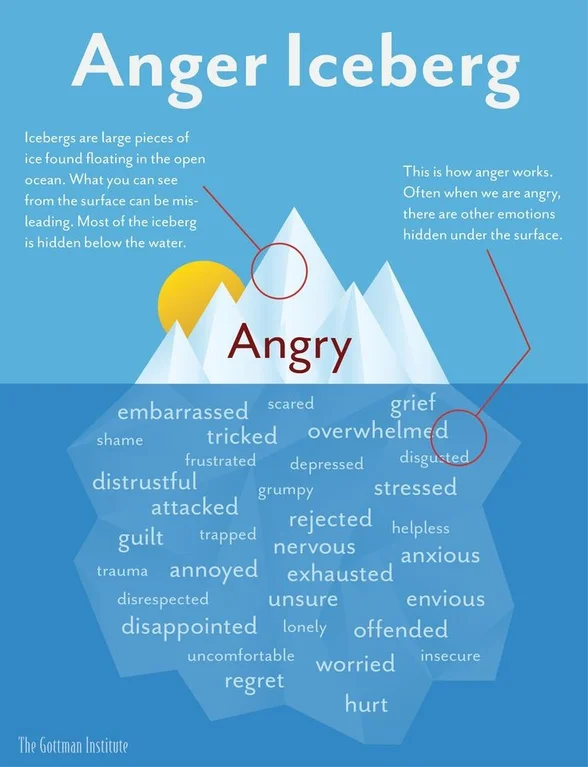
This image is profoundly misleading because it leaves out a major factor

A major cause of anger and all other emotional reactions during interpersonal communications is mistaken interpretations, either wrong or distorted. This can also include positive interpretations.

For Buddhists, the second skandha (sensation) is the proximate cause of how we perceive (third skandha) forms (first skandha). The fourth and fifth skandhas (mental activity and consciousness) are how we consolidate or more often reconsolidate the original mistaken or distorted sensation. For more on this see: The Five Skandhas.

For non-Buddhists, if you watch your mind closely you will notice there is a short delay between receiving an impression and reacting to it, interpreting it.

For everyone, if you can be mindful of the second skandha (sensation) as it occurs and then interrupt the habitual firing of the next three skandhas by doing a FIML query, you will begin to truly observe how your mind (and your partner’s mind) really works. Each interruption of this type improves your mental and emotional functioning because you will observe an objective bit of reality and correct toward it. For more information see: Disruption of neurotic response in FIML practice and How the brain processes new information. ABN

A perfect moral, dramatic, pragmatic, linguistic, psychological, spiritual, and emotional act…

…is a proper FIML query.

It is perfect (in no special order) morally because it seeks truth and goodness between two people; dramatically because it uses our innate dramatic instinct to question our own deep sense of live drama in the moment; pragmatically because it is eminently practical; linguistically because it is an extremely good use of language, possibly the best use; psychologically because it benefits both the self and other in profound ways while also revealing deep behavioral patterns painlessly; spiritually because it stimulates the spirit and spiritual metacognition, bringing both partners closer to their ideals; and emotionally because it forestalls false negative and destructive emotional responses, replacing them with joyful understanding. FIML is a pursuit of truth shared by two people. It is a technique, a method, that can be used in any religion, philosophy, world-view, or lifestyle. In the beginning, FIML does not even depend on scrupulous truthfulness because the practice itself will reveal the value of truthfulness, which ultimately will require almost no effort. Truthfulness is an instinct or inkling of deepest consciousness. Once seen, it calls forth itself.

ABN

first posted NOVEMBER 5, 2021

Personality as persona

The word persona comes from Latin, where it originally meant a “theatrical mask.” In everyday usage today, we normally mean it to indicate a “social role” that, to some extent, most of us play consciously.

Carl Jung used the concept of persona to indicate the deep sense in which a person employs conscious and subconscious methods to present a social face, or mask, to the world.

Jung said of his use of the word persona that it is “a kind of mask, designed on the one hand to make a definite impression upon others, and on the other to conceal the true nature of the individual.” (C. G. Jung, Two Essays on Analytical Psychology London 1953 p. 190)

My understanding of Jung’s psychology is that he took the persona to be something more substantial—more real—than it need be. In my view, when we take our persona(s) too seriously, we reify them, even fetishize them.

Once fetishized or reified, the persona in Jungian psychology takes on almost supernatural qualities, eventually requiring “disintegration” followed after some time by “restoration” as a more conscious and reasonable thing that can serve both personal and social needs without painful contradictions.

I believe this Jungian sense of the term persona has had a considerable influence on our ordinary sense of what a personality is.

In this light, I would contend that what we commonly refer to as personality is a ghostly generalization that obscures both inner-private and outer-social reality.

Belief in “personality” removes analysis of interpersonal-being-in-this-world from actual specifics to nebulous generalities.

If you have a conflict or misunderstanding with a friend and either of you believes it is due to “personality differences,” you will tend to avoid the problem rather than fix it. You will avoid it because it is all but impossible to fix anything with such a vague notion as personalty.

Assuming the two friends just mentioned are close friends, they would do much better to identify the specific moment their misunderstanding occurred and work with that.

People today do not normally do this for two reasons: 1) almost everyone believes in something like “personality” and in so believing makes it impossible to fix even small moments of discord, and 2) very few people know how to fix those sorts of problems even if they do realize that more is going on than two ghostly persona clashing in a mystical realm.

I agree that people need personas to negotiate many social and professional environments. And I agree that most people have a few traits that often remain sort of constant over time and in similar contexts.

What I do not agree with is everything else we normally attribute to personalities. In place of all that, I would substitute the idea that humans are semiotic entities and that we communicate with each other and within ourselves by using semiotics and semiotic networks.

Our interests and training lead us to emphasize some parts of these networks over others, but this does not constitute a “personality” as the word is normally used.

Suffering arises when we experience bad communication. Belief in personalities masks (ironically) the true nature of communication problems. Belief in personalities causes us to generalize when we should be looking very closely at the specific moment during communication that the semiotic networks of the two (or more) communicators began to diverge.

That is the point at which their interpretations began to differ and nothing will explain why they began to differ except close analysis of that precise moment.

People do not analyze the precise moment their interpretations of each other began to differ because they do not know how. In place of analysis, people almost always generate strong emotions and within seconds make it impossible to analyze anything.

It is not your personality or theirs that does this. It is, rather, our lousy abilities to communicate, a problem everyone in the world has. We are like monkeys in a high-powered automobile all but doomed to crash, or go nowhere.

How to drive that car? How can we catch the specific moment interpersonal interpretations diverge? And how can we analyze that moment? Only FIML practice or something very much like it will allow us to do that.

Wasting time analyzing your personality or constructing an even better one will get you nothing more than a theatrical mask, a persona, that will be useful in some social situations but a disaster in all close interpersonal relationships.

first posted APRIL 17, 2014

What Really Happened During the Yellowstone Park Flood?

I found the narrator’s delivery quite interesting. For the length of the video he maintains a public face with a few conspicuous emotional expressions, also stock public semiotics. He comes across as an intelligent, kindly, nice-guy type. This may well be his persona in real life. What I want to point out is the burden of carrying a persona like this wherever you are, especially into your own home, your own world. In your private spaces, you can greatly improve your communication by doing FIML practice. Clearly, there is a more complex person behind the persona we see in the video. This is the part of us—our authentic being—that FIML works with. There are two difficulties in doing FIML: 1) you must have the ability to be trustworthy and you need to have a trustworthy partner that you care about and that cares about you; 2) you both have to learn how to overcome the universal taboo of stopping real-time speech to query the speaker directly about what they just said; you have to be able to do this and accept this when your partner does it to you. Point #1, sadly, can be the more difficult. Point #2 is difficult because it goes against what seems to be an instinct. It can be overcome fairly easily if we know there is a reason to do that. It is like overcoming a tendency to flinch where it is not needed. ABN

To readers of ABN

ABN has gained many more readers since coverage of covid and other matters became of more pressing importance. They still are more pressing since our very existence as a free society is at stake.

That said, please do your best to understand and practice FIML with your spouse or best friend. FIML is a life-changing practice that will reveal the building blocks of both of your makeups in a most wonderful way.

Positive change through FIML is easy in the sense that each building block is small. Being small, they are easy to analyze and not difficult to accept if we see we are in the wrong. This promotes rapid incremental transformation for the better.

A little change here, a little change there, patterns are recognized and rather easily transformed into something much more adaptive, real, appropriate for your lives. No theory or concept of personality is necessary. No training in psychotherapy is necessary.

The simple dynamic of FIML done honestly and in friendship will help both of you feel much better and be much more authentic to yourselves. FIML is a process, a dynamic method. It has no other content save what you bring to it. ABN