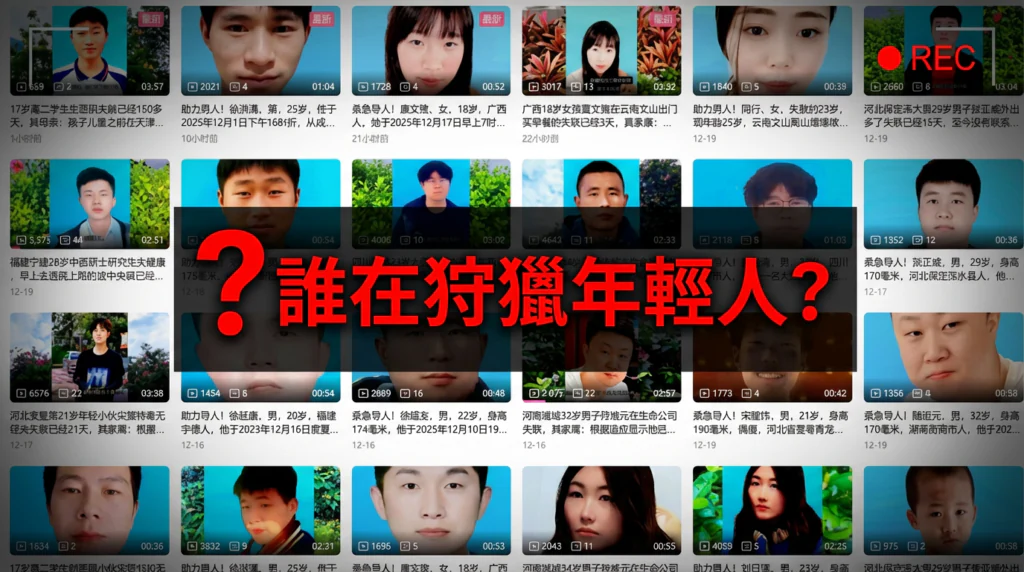
【view the truth within the wall 】 Recently, a phenomenon has emerged on Chinese social media platforms that has attracted widespread attention and discussion. On the well-known audio and video platform Bilibili, an account has uploaded nearly 300 missing person search videos since August this year, claiming that the whereabouts of young people across the country are unknown. The videos quickly spread on the Internet, causing public panic and spawning various speculations, with some netizens speculating that they had become “parts (organ harvesting)”.
According to the account’s release, the so-called disappearances cover most provinces in China, including Guizhou, Shaanxi, Hubei, Yunnan, Henan, Hebei, Shandong, Shanxi, Jilin, Anhui, Chongqing, Sichuan, Inner Mongolia, Gansu, Qinghai, Fujian, Jiangsu, Zhejiang, Hunan, Guangxi Zhuang Autonomous Region, Hainan and other places. This cross-provincial and cross-regional distribution model does visually create the impression of ” national problem ”.
From these collaborative search videos, it can be observed that the persons reported missing are mainly concentrated in the group of teenagers in their 10s and young adults in their 20s and 30s. In contrast, there are relatively few cases of children and the elderly. The age distribution characteristics of this year are indeed different from traditional lost or trafficked cases, which has attracted special attention and speculation from netizens.
Thailand is not the aggressor. We’ve always chosen diplomacy. Until Cambodian soldiers planted landmines, causing Thai troops to lose limbs. Then fired BM-21 rockets directly at civil areas, killing many Thai civilians, including children. Thank you for your love and support for Thailand. This time we need it more than ever.
__________
This video was provided by the Thai military. The back story appears to be China encouraged Thailand to destroy Cambodia’s Scam Compounds, or Scam Parks as they are sometimes called. More info can be found at the link beneath the video above. ABN
“Don’t come to the Diet anymore!” What’s going on? Because Katsuya Okada went to meet with the International Department of the CCP. What is the International Department? Kazuhiro Haraguchi laid it bare directly: “Do you even know what the International Department is? It’s above the CCP’s Foreign Ministry—it’s the CCP’s party affairs organ!” “It’s an organization specifically for foreign work and infiltration!” “Why would you meet with an organization like that?” What’s even more outrageous? Katsuya Okada also questioned Sanae Takaichi in the Diet, demanding she provide specific evidence for “a Taiwan contingency.” Haraguchi exploded right there: “That’s enough from you! Which side are you even on?” “For diplomacy and national security, even with political rivals, we must speak with one voice externally!” “You’re actually asking for specifics on a ‘Taiwan contingency’? And asking which ‘closely related country’ we’re operating in which ‘region’ with?” “That country is obviously the United States! What are you playing dumb for!” “Japan’s national security absolutely cannot take a single step back—any further, and Japan is done for!” “At a time like this, meeting with the CCP’s united front organization—what the hell are you trying to do?” Haraguchi finally laid down the harsh words: “I’m really pissed off—parliamentarians like you, just stay away!” “The Japanese political world has already been infiltrated like a sieve!”
Do you know how the CCP takes down foreign politicians? It’s not through money, not through power. But through a kind of… ancient culture. A former Japanese high-ranking official, who once served as the secretary-general of the “Japan-China Friendship Delegation.” He personally recounted his own experience. It was during a visit to Beijing, with the welcome ceremony held at the Great Hall of the People. A long table, with the Japanese delegation seated on one side and CCP officials on the other. But strangely, Next to each Japanese representative stood a beautiful woman. Before departure, he had been warned: “These women are specially tailored for each of you, Selected entirely according to your preferences, You absolutely, absolutely must not touch them!” He was half-believing, half-doubting, but when he arrived at the scene and took a look, “Bingo!” The woman standing next to him was completely his type. And this was just the beginning. In the evening, the delegation checked into the Diaoyutai State Guesthouse. He was warned again: “Listen up, cadres, they will definitely come knocking at night, You absolutely cannot let them in! The rooms are full of cameras; once they enter, you’re done for!” Sure enough, they came. They knocked on the door and asked: “Are you thirsty? Would you like a drink?” He refused. Think it was over? Not at all. A little while later, another knock: “Do you need a massage service?” In short, they tried every possible means, just to get into your room. In Japan, many members of parliament started out as secretaries. Today’s foreign minister is the secretary of one of his former colleagues. What does it mean if these people get caught with leverage? This isn’t an isolated case; it’s the CCP’s systematic infiltration over decades. The Japanese political arena has long been their hunting ground.
The latest report from Amnesty International, “I Was Someone Else’s Property,” reveals a harrowing reality: at least 53 scam compounds across Cambodia have become hubs of modern slavery, human trafficking, torture, and forced labor. These compounds, often disguised as legitimate tech parks or business centers, are operated by transnational criminal networks with apparent impunity. Victims – lured by fake job ads – are imprisoned, abused, and coerced into defrauding people worldwide through online scams. The report documents how these operations are enabled by systemic corruption, weak law enforcement, and a lack of political will to dismantle the criminal infrastructure.
Drone footage of a scamming compound in Cambodia with high perimeter walls, security cameras and security guards
While Taiwanese citizens are not the largest group affected, they face unique and severe risks due to their international status. In recent raids, dozens of Taiwanese nationals were arrested, and many were wrongly identified as perpetrators rather than victims of trafficking. Without proper screening procedures, these individuals are often treated as criminals and, in some cases, forcibly extradited to China, where they face prosecution and detention under Beijing’s jurisdiction. Taiwan’s lack of formal diplomatic ties with Cambodia further complicates rescue efforts, leaving victims vulnerable and without recourse.
The situation is further exacerbated by the demographics of the victims. Many are extremely young, including minors, who are deceived by fraudulent job advertisements on social media platforms. These ads promise glamorous lifestyles and high-paying, easy work in Southeast Asia. Upon arrival, however, these individuals are stripped of their documents, confined under armed guard, and subjected to physical and psychological abuse. Surveillance systems, armed guards, and barbed wire fences make escape nearly impossible. The betrayal of their aspirations and the trauma of captivity leave lasting scars that are often overlooked in public discourse.
Amnesty International’s findings underscore the Cambodian government’s failure – and in some cases, complicity – in addressing these crimes. The lack of enforcement and accountability has emboldened criminal syndicates, allowing a billion-dollar shadow economy to flourish. Victims are often denied access to justice, and the absence of transparent investigations perpetuates a cycle of impunity.
Cambodian scam parks are a significant factor in the Thai-Cambodia conflict, serving as both a source of economic tension and a strategic target in the ongoing military clashes. The conflict, which reignited in December 2025 after a brief ceasefire brokered by the Trump administration, has seen Thailand conduct air strikes on at least five Cambodian casinos and resorts, which are widely believed to house scam operations These strikes are viewed by Thai officials and the public as a response to the perception that these facilities are hubs for cross-border online scams, which have generated billions of dollars annually and involved widespread human trafficking, forced labor, and torture of victims from Asia, Africa, and Latin America The Thai military’s targeting of these sites is seen as both a security measure and a political signal to the Thai public, demonstrating action against a major perceived threat
The economic stakes are high, as these scam centers are believed to be linked to powerful Cambodian political elites, including the Hun family, and are a major source of illicit revenue Thailand’s proposed legalization of casinos near the border threatens to undermine this lucrative system by reducing the need for money laundering through Cambodian casinos and cutting into their earnings This economic competition, combined with the political fallout from a leaked phone call between Thailand’s acting Prime Minister Paetongtarn Shinawatra and Cambodia’s former Prime Minister Hun Sen, has further inflamed tensions The conflict has also been exacerbated by nationalist sentiments on both sides, with the Thai government using the issue to rally public support and Cambodia’s leadership potentially leveraging the conflict to distract from domestic socio-economic challenges
The speaker in the video is Cao Changqing (曹長青), a prominent Chinese dissident, writer, and commentator known for his outspoken criticism of the Chinese Communist Party (CCP).This clip features a common argument in anti-CCP dissident circles, comparing the CCP’s historical concessions on territories like Outer Mongolia (citing Guo Moruo’s article) to its fixation on Taiwan—not for territorial reasons, but because Taiwan’s democratic system exposes the authoritarian nature of the CCP regime.Cao frequently appears in exile media and online videos discussing similar themes.
The Taiwan issue actually has nothing to do with the question of unification or independence. Because after the Communist Party seized power, it gave up territory exceeding more than 50 Taiwans. Just Outer Mongolia alone is already roughly 50 Taiwans. At the time when the Communist Party abandoned Outer Mongolia, Guo Moruo was the president of the Chinese Academy of Sciences and Mao Zedong’s personal literati. He even wrote an article in the People’s Daily titled “Why We Should Cheer for the Independence of Outer Mongolia.” You can still find that article online. So, if you add in things like the Northeast, it might exceed 100 Taiwans—no exaggeration. Yes, and territories disputed with Kazakhstan, Myanmar, and Vietnam—all of them were completely abandoned by the Communist Party. Therefore, the Taiwan issue is not a territorial problem, nor is it about unification or independence, and it’s not about economics or technology either. The only reason the Communist Party wants to take Taiwan is because Taiwan’s very existence highlights the evil of the Communist Party’s dictatorship.
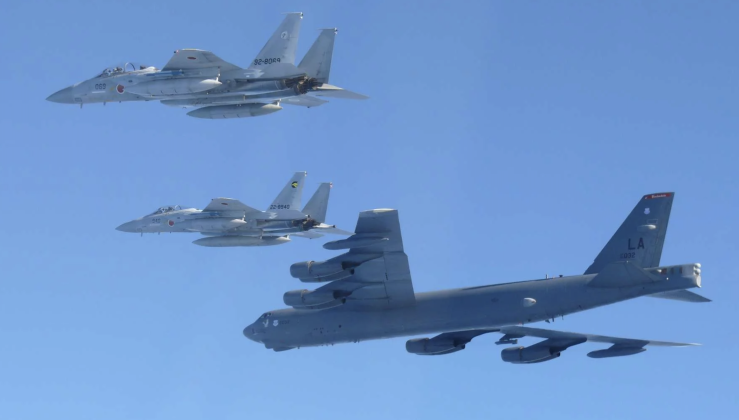
The U.S. Air Force has deployed two B-52H Stratofortress nuclear capable bombers for operations alongside Japan Air Self-Defense Force fighters, with the aircraft staging a joint show of force on December 11.
Japanese government sources Tokyo described the show of force as a signal of alliance cohesion, while U.S. defense officials familiar with regional operations have confirmed the choice to deploy the B-52 was specifically intended to demonstrate combined long-range strike readiness.
B-52H Bomber with Japanese F-15J Fighter Escort
This follows rising tensions between Tokyo and Beijing, after Japan’s new prime minister, Sanae Takaichi, threatened to intervene militarily in the ongoing conflict between the People’s Republic of China on the Chinese mainland, and the Republic of China based on Taiwan, which have for decades remained in a state of civil war.
China responded to the Japanese prime minister’s threat by deploying the aircraft carrier Liaoning to conduct exercises near Japanese waters, with J-15B fighters operating from the carrier on December 6 locking onto two Japanese F-15J fighters and demonstrating the significant superiority of their sensors.
Japan responded by deploying F-2 fighters armed with anti-ship missiles to simulate strikes on the Chinese carrier group.
The rapid modernisation of the Chinese People’s Liberation Army has left Japan in a significantly weakened position, with the F-15J fighters that form the backbone of the fleet being long since obsolete, while even the newer F-2s are over a quarter century old and lack sufficiently long range weaponry.
…According to a letter from experts in this field to the Lancet, studies of other wars – most of them far less destructive than Israel’s on the tiny enclave – indicate that between three and 15 times more people are killed by indirect, rather than direct, methods of warfare.
The authors conservatively estimate an indirect death toll four times greater than the direct death toll. That would mean, at a minimum, 350,000 Palestinians have been killed in Gaza through Israel’s actions.
The reality is likely to be even worse. That is without even mentioning the hundreds of thousands of Palestinians who have been left with horrific injuries and psychological trauma.
Israel’s war planners know exactly how this direct-to-indirect ratio works. Which is why they chose to destroy nearly every home in Gaza, to bomb the power, sanitation and water facilities, to level the hospitals, and to block aid month after month.
They knew this would be the way Israel could carry out a genocide while offering its allies – western governments and its army of lobbyists – a “get out of jail card” for their active complicity.
Donald Trump’s so-called “ceasefire” is just another layer of deception in this endless game of smoke and mirrors. The UN’s child protection agency, Unicef, reports that less than a quarter of aid trucks are getting into Gaza, past Israel’s continuing starvation blockade, despite Israeli commitments agreed as part of the “ceasefire”. Apparently, this doesn’t register as a gross ceasefire violation. It goes unnoticed.
Unicef reports further that in October alone, at the start of the “ceasefire”, nearly 18,000 new mothers and babies had to be hospitalised in Gaza from acute malnutrition.
The genocide isn’t over. Israel may have slowed the rate of direct killings it is committing by bombing Gaza, but the indirect killings continue unabated. And so does the Israeli-engineered “debate” in the West, one designed to obscure and excuse the mass murder of Gaza’s population.
China Vanke Co., the last big survivor of the country’s yearslong property crunch, sent investors an innocuous-looking announcement about a $3.1 billion loan agreement with a state-owned shareholder. But the Nov. 2 statement contained a twist: Shenzhen Metro Group Co., which had given unwavering support to the developer for nearly two years, now set a cap on any further financing. It also demanded that Vanke stump up collateral for its loans — including for the $2.8 billion already drawn down.
The move, which sent a signal that state officials were finally losing patience with Vanke, set off a chain reaction that ultimately pushed the company to ask for more time to pay back some of its debt. Its dollar bonds have lost more than two-thirds of their value, tumbling to as low as 20 cents on the dollar. State-owned banks have scrambled to limit their exposure. Regulators, unwilling to rescue the company, have started making plans to contain the fallout, according to people familiar with the matter.
Bankers and fund managers are now rushing to weigh the damage of what could become one of the biggest corporate restructurings in China’s history, involving over $50 billion of outstanding debt — including more than $7 billion held by lenders and bond investors overseas. They warn that Vanke’s worsening problems will send ripples throughout China’s economy and its financial system, threatening losses for banks and ramping up pressure on the long-struggling property sector.
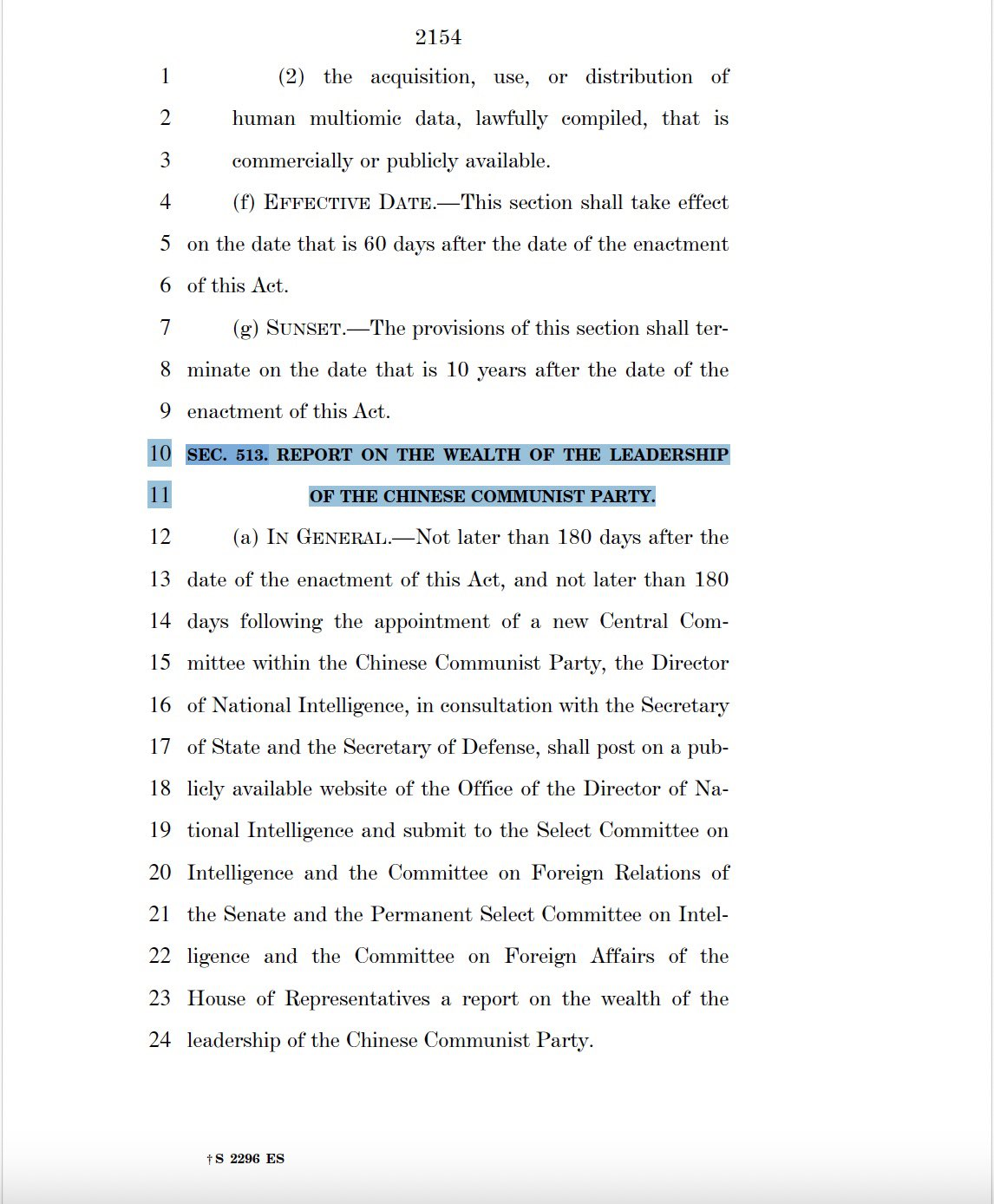
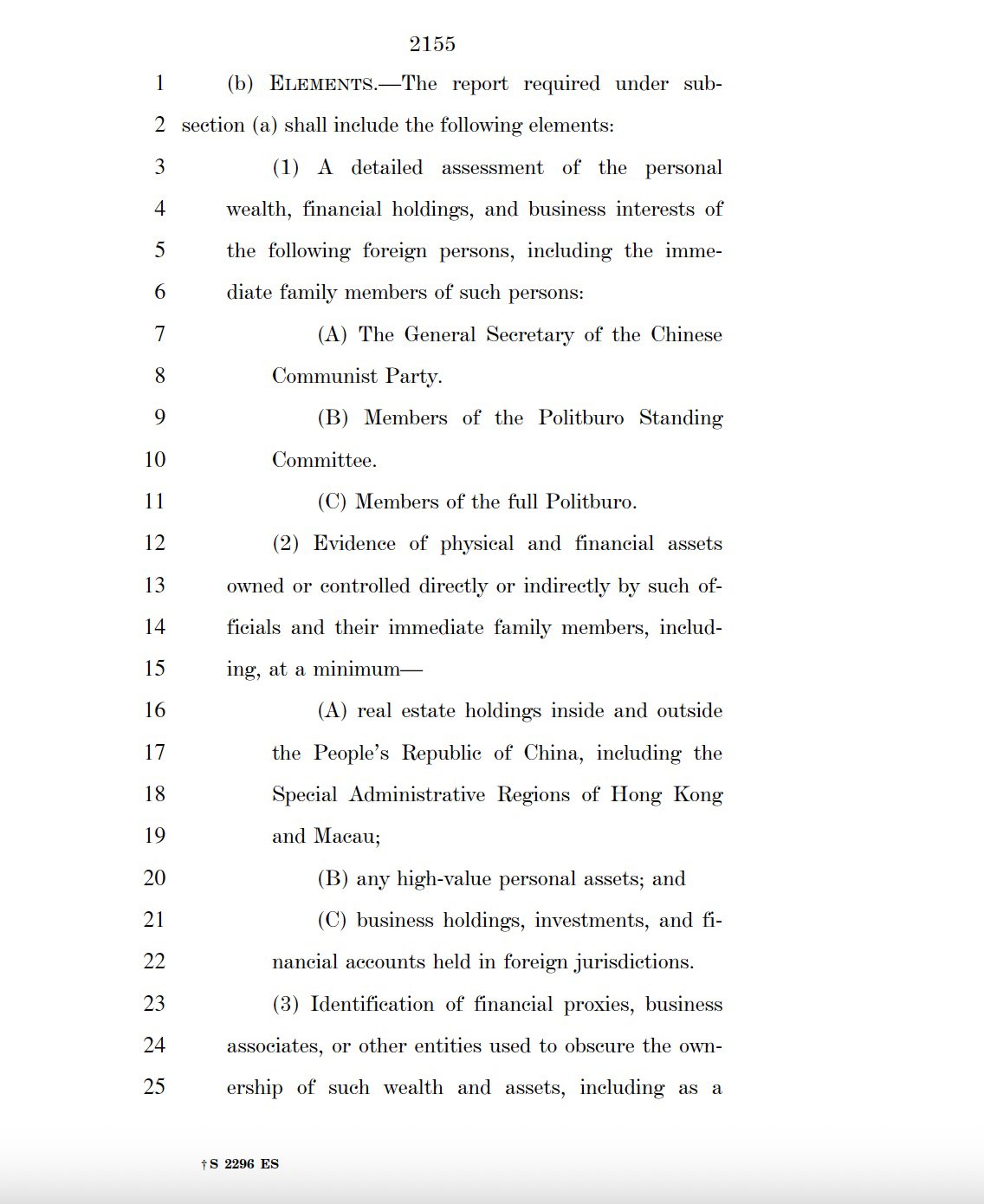
The 2026 National Defense Authorization Act passed by the U.S. Congress requires that within 180 days of its effective date, the Director of National Intelligence must publish an open report online, comprehensively exposing the financial status of the CCP General Secretary, Politburo Standing Committee members, Politburo members, and their immediate relatives.
The content will include:
• Domestic and foreign real estate
• Overseas bank accounts, investments, and business interests
• High-value personal assets
• Asset chains hidden through proxies, shell companies, and business partners
• Non-public information held by intelligence agencies (to be submitted to Congress as a classified annex)
The bill explicitly states: The scope of relatives is extremely broad, covering spouses, parents, children, siblings, in-laws, grandparents to grandchildren.
This will be the first time the United States systematically and comprehensively publicly discloses the wealth of the CCP’s top leadership and their families.
The U.S. intelligence community should monitor global supply chains as part of a sweeping goal to decouple the nation’s economy from foreign adversaries and advance American economic interests, according to the Trump administration’s newly published National Security Strategy.
Published late on Thursday, the 33-page strategy document adds to Trump administration direction to federal agencies to treat economic policy as a national-security matter.
U.S. spy agencies “will monitor key supply chains and technological advances around the world to ensure we understand and mitigate vulnerabilities and threats to American security and prosperity,” the strategy reads.
Security and defense agencies have long monitored or sought to bring awareness to supply-chain issues to ensure operational security and the protection of U.S. forces; more comprehensive monitoring would require vaster efforts to discover and track where American companies and foreign rivals ship, produce and stockpile their goods and services around the world.
While the publicly released NSS calls for the end of a “perpetually expanding NATO,” the full version goes more into the details of how the Trump administration would like to—quote—“Make Europe Great Again,” even as it calls on European NATO members to wean themselves from American military support.
Working from the premise that Europe is facing “civilizational erasure” because of its immigration policies and “censorship of free speech,” the NSS proposes to focus U.S. relationships with European countries on a few nations with like-minded—right-wing, presumably—current administrations and movements.
Austria, Hungary, Italy, and Poland are listed as countries the U.S. should “work more with…with the goal of pulling them away from the [European Union].”
“And we should support parties, movements, and intellectual and cultural figures who seek sovereignty and preservation/restoration of traditional European ways of life…while remaining pro-American,” the document says.
The C5
Over the summer, President Trump made headlines when he lamented the expulsion of Russia from the Group of Eight—now the Group of Seven—as a “very big mistake.” He even suggested that he’d like to see China added to form a “G9.”
His national security strategy proposes taking this a step further, creating a new body of major powers, one that isn’t hemmed in by the G7’s requirements that the countries be both wealthy and democratically governed.
The strategy proposes a “Core 5,” or C5, made up of the U.S., China, Russia, India and Japan—which are several of the countries with more than 100 million people. It would meet regularly, as the G7 does, for summits with specific themes.
First on the C5’s proposed agenda: Middle East security—specifically, normalizing relations between Israel and Saudi Arabia.
“Hegemony wasn’t achievable”
The full NSS also spends some time discussing the “failure” of American hegemony, a term that isn’t mentioned in the publicly released version.
“Hegemony is the wrong thing to want and it wasn’t achievable,” according to the document.
In this context, hegemony refers to the leadership by one country of the world, using soft power to encourage other countries to consent to being led.
“After the end of the Cold War, American foreign policy elites convinced themselves that permanent American domination of the entire world was in the best interests of our country,” the NSS states. “Yet the affairs of other countries are our concern only if their activities directly threaten our interests.”
The White House has denied this document, claiming: ‘No alternative, private, or classified version exists’ of the publicized National Security Strategy.
If it looks like a rose and smells like a rose, it probably is a rose. I hope this is US policy, declared or otherwise. ABN
The New Apostolic Reformation, aka NAR, is a movement in evangelical churches started by C. Peter Wagner in the late 90s.
NAR is not a denomination and it does not have any set or elected leaders or *official* ideology that defines it.
Rather NAR is a hodgepodge of beliefs, rituals and practices pulled from various traditions within mainstream charismatic and Pentecostal churches.
The core belief posited by Wagner was the Christians must engage in spiritual warfare to bring about Christian dominion over all aspects of society.
When this is accomplished, the road will be paved for Christ to return.
NAR is led by apostles believed to have been appointed by God. These apostles are delegated spiritual authority that grants them authority over the entire Church- which is one of the most controversial aspects of NAR.
NAR churches do not advertise that they are NAR. And just because a church adopts one or two NAR ideas, doesn’t mean they adopt them all.
Decentralization has been key to NAR’s rapid growth.
NAR rejects many traditional church teachings around the role of women in the church. Women can become apostles and pastors in NAR churches. The most famous one being Trump’s spiritual advisor, Paula White-Cain.
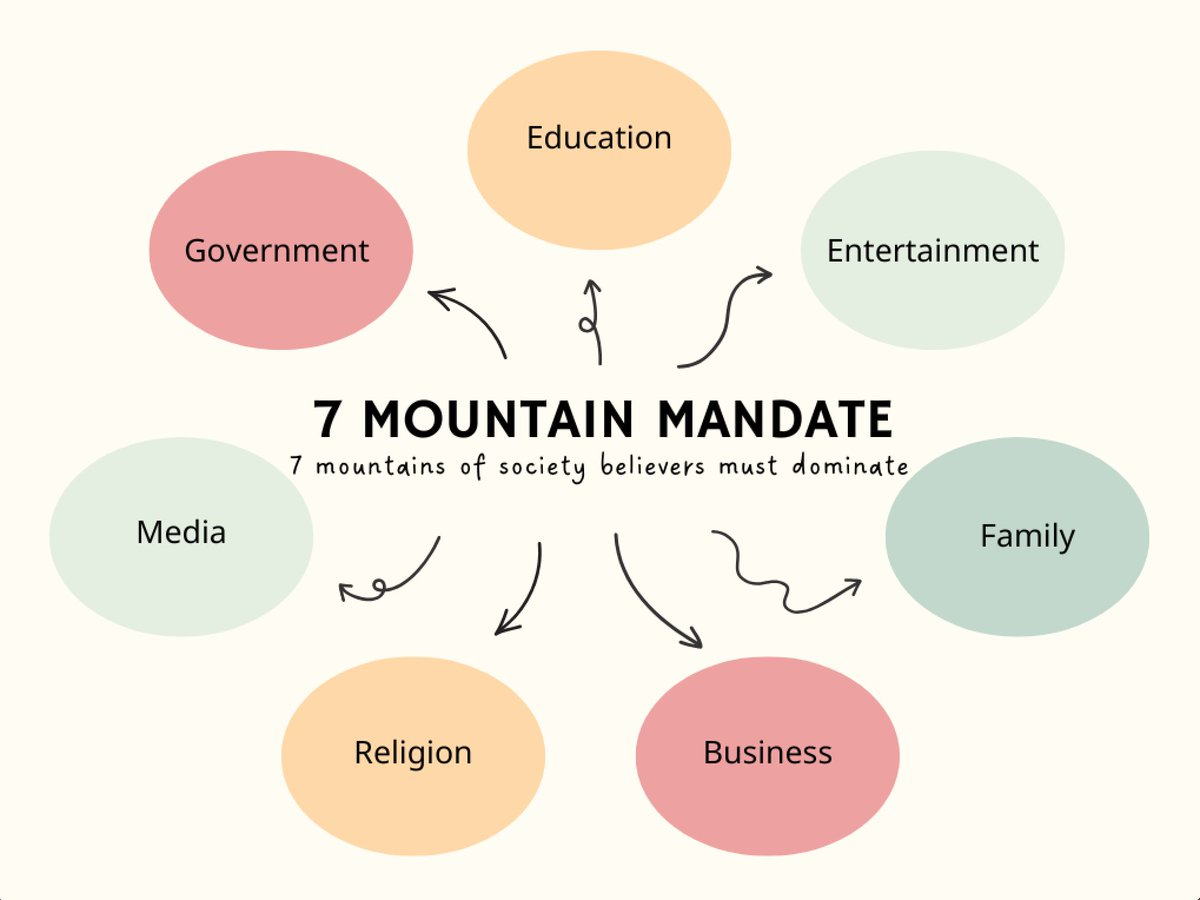
The 7 Mountain Mandate has become the most important idea with the NAR movement and the one to gain the most traction.
The 7MM dictates that Christians must engage in spiritual warfare to dominate the 7 most important aspects of society:
This idea was conceived in the 1970s but revived and refined in the 2013 book “Invading Babylon: The 7 Mountain Mandate” by Lance Wallnou a televangelist and Bill Johnson, senior pastor of Bethel Church, a megachurch in Northern California.
As far as Charlie goes, these are the NAR names you need to know, in addition to those already listed above:
Rob McCoy: pastor of Godspeak Calvary Chapel in Thousand Oaks California
Sean Feucht: former worship leader at Bethel church and 2020 Congressional candidate
Jack Hibbs: senior pastor of megachurch Calvary Chapel Chino Hills
David Lane: longtime Republican consultant and activist, member of Rob McCoy’s Godspeak Calvary Chapel
For the purposes of my threads, I think that’s enough intro. If you want to go down the NAP rabbit hole, and trust me, it’s DEEP, here are a few intro links with lots of additional links of their own:



 American Buddhist Net