I remember similar figures from even earlier in 2020, I believe from a WHO analysis. These were the odds then and afterward. It was lethal hospital protocols, normal human stress responses to the panic, the banning of all treatments except in hospital, and then the mRNA vaxxes which caused the large ‘covid’ death and injury toll. Even if the vaxxes had worked, you can see that almost no one needed them, and definitely no one in the younger age groups. The entire plandemic was a totalitarian psyop to seize power and probably to kill, harm or render impotent large numbers of people. Historically, elites have frequently controlled their populations by limiting their access to healthy foods, by spying on them and killing those who might threaten them. It has ever been thus. ABN
The ongoing debate surrounding the relationship between Christianity and Jewish scripture has grown increasingly complex over recent decades, with critics like Laurent Guyénot arguing that Christianity did not merely absorb Jewish texts but was, in its very essence, molded by them. This perspective suggests that the core tenets of Christianity—such as notions of divine election and messianic expectation—reflect a deeper Jewish influence that has shaped Western civilization. Guyénot posits that Christianity became the primary conduit through which Jewish metaphysical concepts were disseminated to Gentile cultures. This appropriation, he argues, led to a civilization that, while claiming to worship a universal God of love, effectively organized itself around Jewish messianic aspirations. Such claims, while provocative, warrant careful scrutiny, particularly in the context of differing interpretations within the Christian tradition itself.
Guyénot’s analysis operates on two levels: one historical and one theological. He outlines a historical trajectory wherein the Latin Church gradually compromised its original theological foundations, becoming increasingly intertwined with the Jewish tradition it initially sought to transcend. However, he also asserts that Christianity inherently bore the Jewish imprint from its inception. Critics argue that this latter claim lacks sufficient evidence, suggesting instead that the issues Guyénot raises are symptomatic of a divergence within Christianity itself, particularly between Western and Orthodox traditions. The Orthodox Church, they argue, has consistently maintained a distinct theological identity that diverges from Western Christianity’s post-Filioque developments, and it has preserved the apostolic inheritance against various historical assaults.
The crux of the disagreement lies in the differing interpretations of salvation and grace between Orthodoxy and Western Christianity. While Orthodoxy emphasizes the transformative aspect of salvation as theosis—union with God through divine grace—Western traditions, particularly post-Filioque, have tended to frame salvation in more legalistic terms, akin to a change in legal status before God. This theological divergence has far-reaching implications, leading to fundamentally different understandings of the relationship between God and humanity. The Orthodox perspective maintains that the ultimate aim of Christian life is the restoration of communion with God, contrasting sharply with Western thought, which has often conceived salvation as a transactional relationship governed by legal categories.
Ultimately, the historical and theological complexities surrounding Christianity’s relationship with Judaism raise important questions about the nature of religious identity and the interpretation of scripture. While Guyénot’s thesis regarding the “Judaization” of Christianity has garnered attention, it is essential to recognize the diversity within Christian thought itself. The Orthodox tradition, with its emphasis on theosis and the uncreated divine life, offers a counter-narrative to the claims of inherent corruption within Christianity. The ongoing dialogue between these perspectives highlights not only the historical intersections between Christianity and Judaism but also the broader implications for understanding the evolution of religious thought in Western civilization. This discourse challenges adherents to critically engage with their theological foundations, ensuring that they are rooted in a coherent understanding of their faith that honors both tradition and scripture.
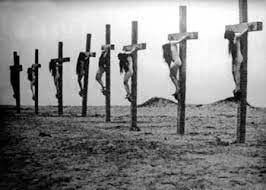
Jews were behind the Armenian Genocide in 1915-1923. (Pictured – Armenian film reenactment of young Christian girls crucified alive in Malatia, as a mockery of Christ)
1.2 million Christian Armenians were sent on death marches to the Syrian Desert in 1915 and 1916. Driven forward by paramilitary escorts of the Ottoman Empire, Under the direction a Judaic/Masonic sect named ‘The Young Turks’. After a successful coup in Turkey, driven by Jewish revolutionaries, ‘The Young Turks’ celebrated their victory by committing Christian genocide and did so as barbarically and as demoralizingly possible.
The ‘Armenian genocide was decided between August, 1910 and October 1911, by a Young Turk committee composed entirely of displaced Balkan Jëws in the form of a syncretist Jèwish-Masonic sect which included Talaat, Enver, Behaeddin Shakir, Jemal, and Nizam posing as Muslims. It met in the Rothschild-funded Grand Orient Lodge/Hotel of Salonika, where the plan of a coup and genocide was planned, a plan that is well documented.
“Every Jew who spills the blood of the godless, is doing the same as making a sacrifice to God.” (Talmud: Bammidber Raba c21 & Jalkut 772)
__________
UPDATE: I forgot to link to the original when I posted this yesterday. The probable link is here. The words are the same, but I am not certain this was the original link I had used. The poster at the link provided clarifies that the execution scene in the photo is a reenactment from an Armenian film of a purported genuine event. ABN
According to the latest 2026 reports from the National Cancer Institute (SEER) and the@AmericanCancer Society, since 2021, there has been a documented acceleration in #turbocancers, specifically colorectal, breast, and brain tumors, in adults under 50.
Millions believe this is proof positive of the the long-term immunological impact of mass mRNA #covidvaccination, yet the medical community refuses to do a proper investigation and/or end this disastrous campaign.
The timing of this surge is a massive red flag. We need transparency, independent safety data, and a relentless search for the truth.
Three Signs, or Trilakṣaṇa: All dharmas are anitya ‘impermanent’…. All dharmas are duḥkha ‘unsatisfactory, imperfect, unstable’…. All dharmas are anātman ‘without an innate self-identity. (dharmas means ‘things’)
By basing meditation practice on the Three Signs, we can achieve nirvana.
This is the simplest or shortest way to describe Buddhism. It appears to also be the most ancient way to describe Buddhism. This basic description is historically attested to within approximately 100 years of the Buddha’s passing.
The Noble Eightfold Path is also an excellent way to describe and understand Buddhist practice. It is not historically attested until several centuries after the Buddha’s passing.
Buddhism is a living tradition which develops and responds to new information and societal differences. Something that is true and helpful, like the Noble Eightfold Path, is good Buddhism. Buddhism is not based on sacred texts but on mind-to-mind teaching and insight, both philosophical (the Three Signs) and experiential (samadhi/ nirvana).
The Three Signs include duhkha, which is often misleadingly translated as ‘suffering’, or worse, ‘lifelong suffering’. The much better translation of duhkha is ‘badly standing’ or ‘unstable’. With this in mind, the Four Noble Truths may be considered slightly misleading since the First Noble Truth is often called the Truth of Suffering. The Four Noble Truths are not attested historically until several centuries after the Buddha’s passing.
Nirvana and deep meditative states are something we experience.. There is no substitute for this experience. All of Buddhist practice is aimed at experiencing nirvana. Nirvana can be attained in this life. ABN
Bayesian belief or perspective in some respects possibly co-relates with FIML as both are able to update expectation based on accumulating data insight, particularly as a kind of Thomas Kuhnian or Zen insight. The more reductive method of scientific expectation cognizes realization, reality, as statistical summaries across repeated events. These two types correlate, in degrees, to Kantian Noumenon and phenomenon, and to his notion of categorical decisions.
Beginning with Cantor’s Uncountability and Power Set Theorems, then Godel’s two Incompleteness Theorems, and Tarski’s Undefinability of Truth Theorem, it is presently accepted proof in logic-mathematics circles that there is no earth-touching mudra Truth gesture within “Human, All too Human” ratiocination. Cf Wittgenstein’s “Whereof one cannot speak, thereof one must be silent.” Both Gautama’s mudra and Jesus’ comparable “mudra” of Silence standing in the “What is truth?” Biblical scene witness to a Truth-claim of Mind re which human inquiry thereat Cantor, Godel, Tarski, et al. have satisfactorily shown to be coincidentally incomplete and therefore indefinite.
__________
I completely agree with paragraph one above. That is precisely what FIML does and it is in line with both ancient and modern philosophy and modern mathematics and science. As for paragraph two, I also agree with it but want to add that Buddhist practice provides a fundamental experience, which is typically lacking in Western philosophy. That experience is the experience of the samadhi states, including nirvana which is the purest of the samadhi states. If we use words to describe nirvana, we might say it is the experience of pure awareness of pure consciousness. It is the knowable and observable ‘going out’ of delusion, leaving the experiencer with nothing but pure awareness. This is an attainable state in this life, achievable through meditation. ABN
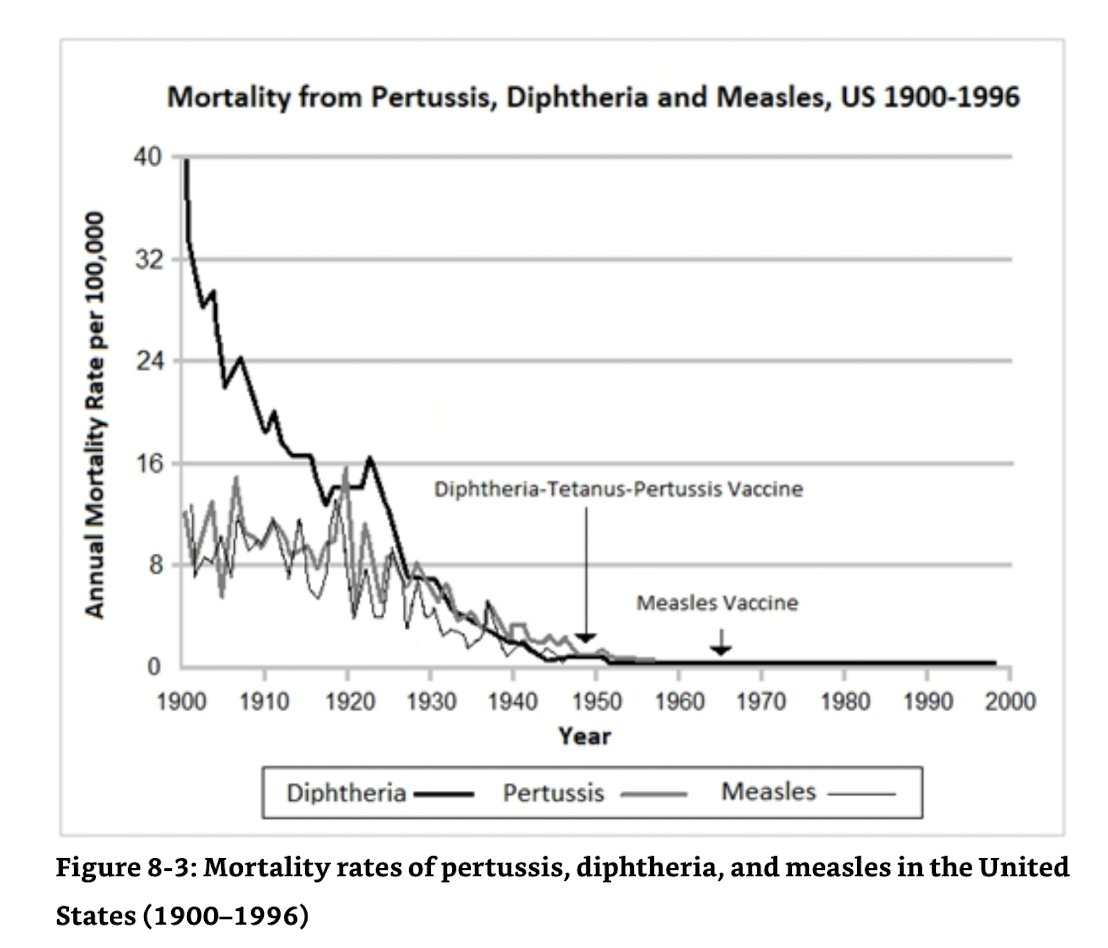
You need to see this chart. The keys to public/private health and better lives are clean water, sanitation, fresh food, and good hygiene. Vaccines have historically played a minor/tiny role at best. The reason we keep talking about them constantly pertains almost entirely to industrial interests.
He is leaving out covert violent attacks against rivals, especially when they are young. Attacks range from low dose poisoning to lobotomies to murder. I am not sure if Dan is aware of the scale of these attacks, but am confident he is smart enough to figure it out. Covert attacks by an army of infiltrators are extremely difficult to prove or even notice. This is especially true when attacks are directed against young people before their careers begin. Trump right now is showing conspicuous signs of possibly having been cognitively damaged or discombobulated by a targeted energy weapon or some other means. Keep this in mind the next time you see a more or less normal friend go bonkers. Our normal reaction is to assume they are losing it, started drinking or using drugs or are simply going crazy. Rarely does anyone suspect a covert attack designed to disable or control the victim. I am not saying this is definitely the case with Trump. I am saying he is an example of what you might see happening to a loved one, relative, friend or colleague. The person becomes a weird deranged version of what they were because that is how the mind is affected. From that information, most of us wrongly assume the person is simply devolving into some core state that we may or may not have thought was there. Our minds seize on simple reasons for the victim’s demise and rarely wonder if something sinister is being done to them. Consider how almost everyone is viewing Trump right now. How many suspect he may be a victim of covert violence? ABN
It has been shown conclusively that in the earliest sutras Buddha is shown as having attained nirvana in this lifetime, and did not lose it during the decades before his death. Hundreds of years later, in Normative Buddhism, the early picture of Buddha’s enlightenment as nirvana had become increasingly modified, to the point that many came to consider it impossible to attain nirvana in one lifetime. Nevertheless, this must not mislead us into thinking that such was the view of the Buddha’s followers in his lifetime, or soon after his death. It is logically necessary for the Buddha to have achieved nirvana and for his followers to have believed that they could do the same thing if they imitated him, in order for such later ideas to have developed in reaction to it. If the Buddha had not achieved his remarkable, heroic breakthrough, there would have been no Buddhism.
Beckwith, Christopher I.. Greek Buddha: Pyrrho’s Encounter with Early Buddhism in Central Asia (pp. 42-43). Princeton University Press. Kindle Edition.
__________
In early Buddhism, it is also true that no one thought of the Buddha as a god. The Buddha himself, even in ‘Normative Buddhist’ texts, claims that he is ‘just a man’ and that anyone can achieve nirvana if they do the work (karma). It would probably be a good thing for Buddhists today to emphasize these points; and by so doing, remind Buddhism of its deepest roots — Nirvana is a real state that anyone can achieve if they do the work; and all dharmas (things) are characterized by the Three Signs, or Trilakṣaṇa: “All dharmas are anitya ‘impermanent’…. All dharmas are duḥkha ‘unsatisfactory, imperfect, unstable’…. All dharmas are anātman ‘without an innate self-identity’.” ABN
The conclusion to be drawn from the evidence about Pyrrho’s thought and practice is that he adopted a form of Early Buddhism during his years in Bactria and Gandhāra, including its philosophical-religious and pragmatic elements, but he stripped it of its alien garb and reconstituted it as a new ‘Greek Buddhism’ for the Hellenistic world, which he presented in his own words to Timon and his other students.
Beckwith, Christopher I.. Greek Buddha: Pyrrho’s Encounter with Early Buddhism in Central Asia (pp. 54-55). Princeton University Press. Kindle Edition.
The earliest attested philosophical-religious system that is both historically datable and clearly recognizable as a form of Buddhism is Early Pyrrhonism, the teachings and practices of Pyrrho of Elis and Timon of Phlius, as shown in Chapter One. Its central features correspond exactly to some of the central features of the traditional putatively “early” form of Buddhism presented in Pali canonical texts.
However, the latter tradition of Buddhism also contains many elements—beliefs, institutions, devotional practices, and so on—which developed at the earliest in the Saka-Kushan period, three centuries after Pyrrho. They spread throughout the ancestors of the attested forms of Buddhism, creating Normative Buddhism. The elements that are attested only from approximately the Saka-Kushan period on—the exact time remains to be established—are far from trivial. They include the Saṃgha, the community of monks; the idea of the bhikṣu ‘monk’ per se, as well as of the bhikṣunī ‘nun’; the vihāra or monastery; the Vinaya, or Buddhist monastic code; worship of the Buddha;4 development of the idea of reincarnations of the Buddha, both human and godlike; abhidharma or “Buddhist scholasticism”; and many others. They are now considered to be essential elements of traditional Buddhism, yet there is no historically sound evidence that they existed at all5 (and some evidence that they did not yet exist) until long after the visit of Pyrrho in 330–325 BC and that of Megasthenes in 305–304 BC. The lateness of the development of devotion for the Buddha and Buddha incarnations, as well as reverence for the Buddha’s teachings (the Dharma) and the community of monks (the Saṃgha), means that the invention of the Triratna (‘Three Jewels’) formula is even later (perhaps as a “popular” substitute for the difficult Trilakṣaṇa1 ‘Three Characteristics’ formula, which is phonetically similar.
Beckwith, Christopher I.. Greek Buddha: Pyrrho’s Encounter with Early Buddhism in Central Asia (pp. 61-62). Princeton University Press. Kindle Edition.
The Buddha says, “All dharmas are anitya ‘impermanent’…. All dharmas are duḥkha ‘unsatisfactory, imperfect, unstable’…. All dharmas are anātman ‘without an innate self-identity’.” ↩︎
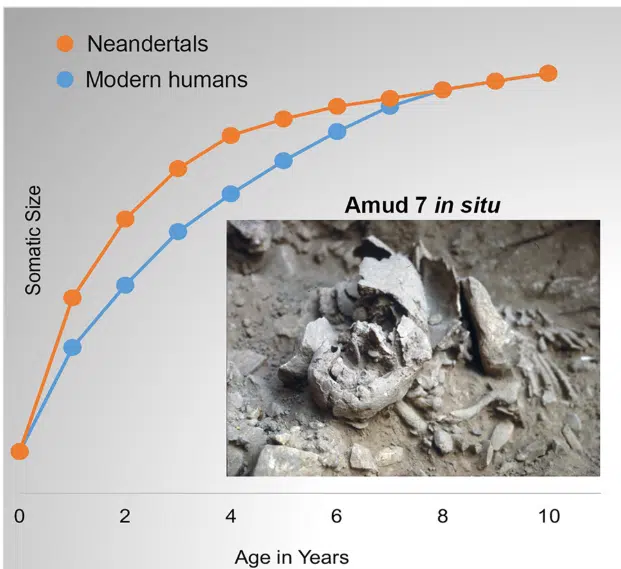
A six-month old Neanderthal infant who lived more than 50,000 years ago reached the physical size of a modern one-year old toddler in just six months. The discovery, based on a highly complete skeleton, points to a rapid growth pattern in early life.
The fossil, called Amud 7, was found in a cave near the Sea of Galilee and dates back between 51,000 and 56,000 years. Reconstructed from 111 bone fragments, gave to scientists a detailed look at Neanderthal infancy, a stage rarely preserved in the archaeological record.
Growth rates influence energy needs, parental care, and adaptation to climate. In this situation, the findings suggest a faster start to life in a demanding environment.
To understand why CO₂ levels rise and fall over millennia, look at a glass of sparkling water.
When it’s cold, it stays fizzy. When it warms up, it goes flat as the CO₂ escapes into the air. The Earth’s oceans work exactly the same way. This is the principle of a solubility pump.
Cold water is a carbon sponge; warm water is a carbon chimney. Because the oceans hold 50 times more carbon than the atmosphere, even a tiny change in sea temperature causes a massive shift in atmospheric CO₂. This explains the time lag seen in ice core data.
Historically, temperature rises first, and CO₂ follows centuries later. Why? Because it takes a long time for the deep, cold thermal flywheel of the ocean to warm up enough to start releasing its stored carbon.
When the oceans finally warm—driven by those million-year Milankovitch cycles—they exhale CO₂. This natural outgassing is a primary driver of the atmospheric shifts we see in the geological record.
It is a biological and physical response to a warming world, not a trigger for a crisis.
The planet is essentially recycling carbon from its massive oceanic reservoir to its parched terrestrial landscapes. It’s a self-regulating system of incredible complexity and beauty.




 American Buddhist Net