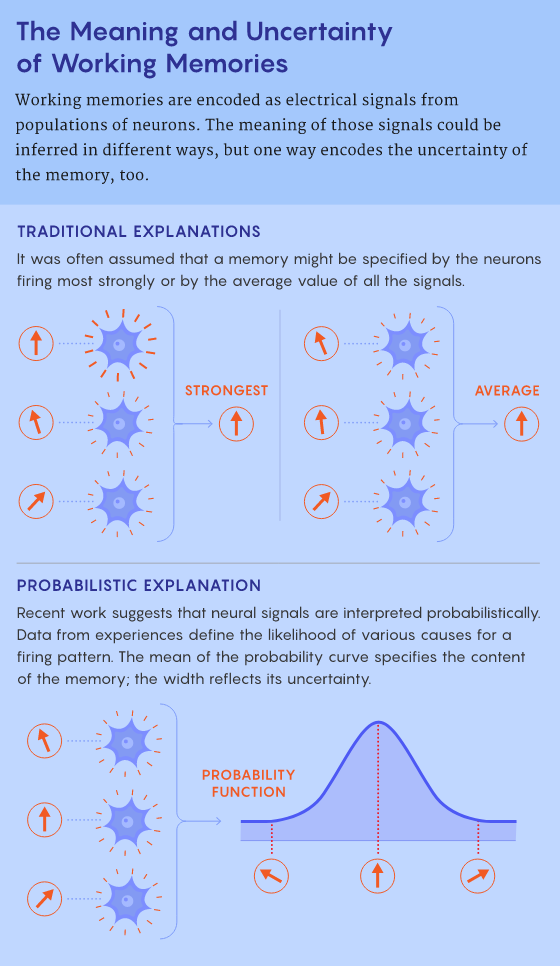
Neural noise indicates our working memory may encode Bayesian probabilities of its contents

The uncertainty in working memory may be linked to a surprising way that the brain monitors and uses ambiguity, according to a recent paper in Neuron from neuroscience researchers at New York University. Using machine learning to analyze brain scans of people engaged in a memory task, they found that signals encoded an estimate of what people thought they saw — and the statistical distribution of the noise in the signals encoded the uncertainty of the memory. The uncertainty of your perceptions may be part of what your brain is representing in its recollections. And this sense of the uncertainties may help the brain make better decisions about how to use its memories.

…the idea that we are walking around with probability distributions in our heads all the time has a certain beauty to it. And it is probably not just vision and working memory that are structured like this, according to Pouget. “This Bayesian theory is extremely general,” he said. “There’s a general computational factor that’s at work here,” whether the brain is making a decision, assessing whether you’re hungry or navigating a route.

link

How the brain processes new information

A new paper provides fascinating insight into how our brains amass information and organize and assess it in real-time.

The paper—Cliques of Neurons Bound into Cavities Provide a Missing Link between Structure and Function—proposes that “the brain processes stimuli by forming increasingly complex functional cliques and cavities.”

The full intro to the paper:

The lack of a formal link between neural network structure and its emergent function has hampered our understanding of how the brain processes information. We have now come closer to describing such a link by taking the direction of synaptic transmission into account, constructing graphs of a network that reflect the direction of information flow, and analyzing these directed graphs using algebraic topology. Applying this approach to a local network of neurons in the neocortex revealed a remarkably intricate and previously unseen topology of synaptic connectivity. The synaptic network contains an abundance of cliques of neurons bound into cavities that guide the emergence of correlated activity. In response to stimuli, correlated activity binds synaptically connected neurons into functional cliques and cavities that evolve in a stereotypical sequence toward peak complexity. We propose that the brain processes stimuli by forming increasingly complex functional cliques and cavities.

The cliques of neurons that grow and connect in real-time make up the transient “architecture” of awareness as it changes and responds to stimuli.

You can observe a process that seems to fit this description by simply turning your head and looking around. As your eye settles on something to consider in more detail, neuronic cliques will grow in your brain based on that stimulus.

Depending on the significance to you of what you are looking at, further associations drawn from memory and emotion will aggregate around it.

Interestingly, the concept of transient neuronal cliques that grow into larger structures fits very well with the Buddha’s Five Skandhas explanation of the path between perception and consciousness.

This paper also seems to explain why FIML practice works. FIML interrupts the (re)formation of mistaken neuronal cliques in real-time, thus preventing the (re)association of (mistaken) established mental states with new perceptions. If there was no mistake FIML affirms that truth.

By consciously interfering with habitual neuronal cliques, FIML eliminates the false and unwanted psychological structures that give rise to them.

FIML works because large (mistaken) psychological brain structures rely on reconsolidation through the continual processing of “new” information that falsely reconfirms them.

As such, human psychology to a large extent is an ongoing self-fulfilling prophesy.

Here is an article about the paper: Brain Architecture: Scientists Discover 11 Dimensional Structures That Could Help Us Understand How the Brain Works.

How working memory works and doesn’t work

A new study on working memory has some intriguing insights into how working memory works and how it doesn’t work.

It’s widely known that when working memory is overtaxed, confusion results, skills decline, while feelings of frustration and anger may arise. The reason for this seems to be:

Feedback (top-down) coupling broke down when the number of objects exceeded cognitive capacity. Thus, impaired behavioral performance coincided with a break-down of Prediction signals. This provides new insights into the neuronal underpinnings of cognitive capacity and how coupling in a distributed working memory network is affected by memory load. (Working Memory Load Modulates Neuronal Coupling)

A well-written article about this study contains the following diagram and explanation:

This article—Overtaxed Working Memory Knocks the Brain Out of Sync—also contains the following passages and quote from one of the study’s authors:

Miller thinks the brain is juggling the items being held in working memory one at a time, in alternation. “That means all the information has to fit into one brain wave,” he said. “When you exceed the capacity of that one brain wave, you’ve reached the limit on working memory.”

The prefrontal cortex seems to help construct an internal model of the world, sending so-called “top-down,” or feedback, signals that convey this model to lower-level brain areas. Meanwhile, the superficial frontal eye fields and lateral intraparietal area send raw sensory input to the deeper areas in the prefrontal cortex, in the form of bottom-up or feedforward signals. Differences between the top-down model and the bottom-up sensory information allow the brain to figure out what it’s experiencing, and to tweak its internal models accordingly. (Emphasis added)

Working memory works via connections between three brain regions that together form a coherent brain wave.

Notice that “an internal model of the world,” which is a “top-down signal” within the brain wave feedback loop, predicts or interprets “bottom-up” sensory input as it arrives in the brain.

I believe this “top-down signal” within working memory is the reason FIML practice has such enormous psychological value.

By analyzing minute emotional reactions in real-time during normal conversation, FIML practice disrupts the consolidation, or more often the reconsolidation, of “neurotic” responses. (Disruption of neurotic response in FIML practice)

FIML optimizes human psychology by helping partners intervene directly into their working memories to access real-world top-down signals as they are happening in real-time. Doing this repeatedly reliably alters the brain’s repository of top-down interpretations, making them much more accurate and up-to-date.

The model of working memory proposed in this study also explains why FIML can be a bit difficult to do. Partners must learn to allow a FIML meta-perspective or “super top-down” signal to quickly commandeer their working memories so that analysis of whatever just happened can proceed rationally and objectively. It does take some time to learn this skill, but it is no harder than many other “automated” skills such bicycling, typing, or playing a musical instrument.

first posted JUNE 7, 2018

Why motorcyclists weave

Psychophysics gains a new law of sensory perception that also sheds light on subjective perception

Weber’s law, also called Weber-Fechner law, historically important psychological law quantifying the perception of change in a given stimulus. The law states that the change in a stimulus that will be just noticeable is a constant ratio of the original stimulus. It has been shown not to hold for extremes of stimulation. (Weber’s Law)

About 200 years ago, the German physician Ernst Heinrich Weber made a seemingly innocuous observation which led to the birth of the discipline of Psychophysics – the science relating physical stimuli in the world and the sensations they evoke in the mind of a subject. Weber asked subjects to say which of two slightly different weights was heavier. From these experiments , he discovered that the probability that a subject will make the right choice only depends on the ratio between the weights.

For instance, if a subject is correct 75% of the time when comparing a weight of 1 Kg and a weight of 1.1 Kg, then she will also be correct 75% of the time when comparing two weights of 2 and 2.2 Kg – or, in general, any pair of weights where one is 10% heavier than the other. This simple but precise rule opened the door to the quantification of behavior in terms of mathematical ‘laws’. (NEUROSCIENTISTS MAKE MAJOR BREAKTHROUGH IN 200-YEAR-OLD PUZZLE)

We investigated Weber’s law by training rats to discriminate the relative intensity of sounds at the two ears at various absolute levels. These experiments revealed the existence of a psychophysical regularity, which we term time–intensity equivalence in discrimination (TIED), describing how reaction times change as a function of absolute level. (The mechanistic foundation of Weber’s law)

Memory reconsolidation as key to psychological transformation

I’ll probably have more to say on this subject, but for now let me just say I am delighted to have found a psychotherapy that is highly compatible with FIML practice.

Indeed this psychotherapy is based on the same principles as FIML, though the approach is different.

In FIML unwanted psychological reactions are discovered in real-world, real-time situations with a partner.

In Coherence Therapy—the psychotherapy I just discovered—unwanted psychological reactions are called schemas. Schemas are transformed through memory reconsolidation in a way that is theoretically very similar to FIML practice.

Here is a video that explains the process of memory reconsolidation that is achieved through Coherence Therapy:

Coherence Therapy (CT) requires a therapist, while FIML does not.

In a nutshell, CT uses three steps (as described in the video) to achieve results. I will list them below in bold font and explain briefly how FIML differs and is also very similar.

1) CT: Reactivate the target schema as a conscious emotional experience. This is done with the help of a therapist.

FIML: In FIML, harmful or unwanted schemas are encountered in real-life with a participating partner. No therapist is needed, though prior training in the technique is helpful.

2) CT: Guide a contradictory experience. This juxtaposition unlocks (de-consolidates) the target schema’s memory circuits. (“Mismatch”/”prediction error” experience)

FIML: The “contradictory experience” is discovered in real-life through the FIML query. The partner’s answer to the FIML query provides the “juxtaposition” that unlocks or de-consolidates the encountered schema. In FIML, we have been calling this process the discovery and correction of a contretemps or mix-up.

3) CT: Repeat contradictory experience in juxtaposition with target schema. This rewrites and erases target schema.

FIML: Repetition of the contradictory experience happens in real-life whenever it next happens if it happens again. Generally, most schema or unwanted reactions are corrected within 5-10 recurrences. Serious unwanted schemas may take more repetitions.

Since CT uses a therapist as a guide, it is better than FIML for very serious problems and for people who are unable to find a partner to do FIML with.

Since FIML does not use a therapist, it is better for dealing with a very broad range of many unwanted schemas, not just the most serious or ones discovered by a therapist.

I am quite sure that CT will be very effective for many kinds of psychological agony. If a problem is acute, I would recommend CT based on my experience with FIML.

A shortcoming of FIML is it requires a caring partner and the transformations it induces are generally all induced in the presence of that partner. Much good comes of that and most transformations can be extrapolated to other people and other situations, but for serious problems like panic or deep anxiety, a CT therapist may be more helpful.

FIML is best for two people who want to optimize their psychologies. Partners will discover and correct many unwanted schemas and many bad communication habits.

If you can understand CT, you should be able to do FIML. If you have already done CT and had good results and now you want to go further and optimize your psychology, FIML will help you do that.

I believe the core theory of CT is sound. If that is so, it should be clear that bad schemas arise constantly in life. We start new ones all the time. Bad schemas are like trash that inevitable accumulates and must be cleaned away. FIML does this job very well.

Here is more on memory reconsolidation, which underlies CT: A Primer on Memory Reconsolidation and its psychotherapeutic use as a core process of profound change.

More on FIML can be found at the top of this page and in most posts on this site.

first posted FEBRUARY 26, 2019

Buddhism and modern psychology

I put up a post last year about the ‘erasure’ of dysfunctional psychological schema and how to achieve that. The article that post is based on, How the Science of Memory Reconsolidation Advances the Effectiveness and Unification of Psychotherapy is good and well-worth reading.

Today, I want to explain how that take on modern psychology fits very well with Buddhist practice.

Buddhist practice is best understood by understanding the Noble Eightfold Path:

Right View, Right Intention, Right Speech, Right Action, Right Livelihood, Right Effort, Right Mindfulness, and Right Samadhi.

If the Noble Eightfold Path is followed diligently, it will erase all dysfunctional schema from the mind. The complete erasure occurs in the eighth element of the path, Right Samadhi.

Right Samadhi is an elixir of the mind. It bathes and cleanses the mind like nothing else. Right Samadhi erases all delusion, all suffering, all dysfunctional schema. Right Samadhi is one part of the Noble Eightfold Path and also it can be understood as a culmination of the Path, the ultimate or penultimate reward of Buddhist practice.

On this site, I add something to the Noble Eightfold Path that, in my opinion, makes it even better. What I have added is FIML practice. FIML can be understood to be an addition to Right Speech and Right Mindfulness. FIML works by getting us to pay close attention to what we hear as well as what we say. When we do that using the tools FIML provides we also greatly improve our Right Mindfulness.

I deeply hope readers of this site will improve their understanding of Buddhism and learn how to do FIML.

The hardest thing about FIML practice is finding a Right Partner, someone who is able to understand the practice and willing to do it with you. The second hardest thing is overcoming a very deep-seated, instinctive human speech prohibition which prevents us from quickly shifting from talking to talking calmly and wisely about the minutia of the talking and listening that just occurred.

If you have a suitable partner, learning how to do FIML is much easier and more fun than finding a suitable therapist. Like Buddhism itself, FIML works directly with the unique reality of the lives of you and your partner. ABN

first posted March 21, 2024

The existential beauty (and chemistry) of updating beliefs

A new study shows that updating beliefs about the world requires and stimulates dopamine release in the brain.

Lead author of the study, Matthew Nour, from University College London and Kings College London has this to say about the findings:

“We found that two key brain areas of the dopamine system (the midbrain and striatum) appear to be more active when a person updates their beliefs about the world, and this activity is related to measures of dopamine function in these regions.” (Source)

Healthy people update beliefs when new evidence is presented. The study may also show that abnormal dopamine functionality is implicated in schizophrenia and paranoid ideation by interfering with normal updating.

The study can be found here: Dopaminergic basis for signaling belief updates, but not surprise, and the link to paranoia.

I like this study because participants were measured while changing minor, short-term beliefs.

Small changes in beliefs manifested in short-term memory lies at the heart of FIML practice.

FIML relies heavily on changing inaccuracies in the short-term memory bank because this data can be isolated and objectively agreed upon by both partners and because this data is by definition fairly small and thus easily changed.

A year of FIML practice may entail a thousand or more small updates in perception, belief, and self-knowledge. Each individual update is typically small, but the aggregate of many updates over longer periods of time creates the basis for very large psychological transformations.

And since these transformations are based on more accurate data, they lead to a more realistic view of the world and the self.

Moreover, by regularly making many small updates in their perceptions of each other and themselves, FIML partners are constantly exercising their dopamine “updating system,” thus strengthening their abilities to function well in any environment.

FIML changes can come quickly, but it is long-term practice that brings the best results.

The above study shows that something very real happens when we update our perceptions. I would maintain that making this happen often with meaningful psychological information through FIML practice leads to very significant and beneficial changes in psychological functioning across many domains.

first posted October 16, 2018

Perceptual distortions inevitably accrue and distort our psychologies

Keep your eyes focused on the cross between the flashing images. The faces will appear grossly distorted in your peripheral field of vision. Now, consider that just as our eyes can distort faces as in the gif above, so our minds can and frequently do distort all of our perceptions, especially ones with psychological relevance. This is how our minds do not work well psychologically and emotionally. To compensate for psychological distortions most people in all cultures in the world are forced to cleave to whatever the default assumptions of their cultures are. This leaves us with plastic faces and conformist mannerisms, while inside our minds are filled with emotional distortions. As we carry these distortions through the years, our psychological misperceptions of ourselves and others can become deeply misshapen, leading to neurotic confusion on many levels. No general theory or general method can fix this problem, which at its core is an accumulation of idiosyncratic perceptual distortions held in memory (and the responses that arise from them). FIML practice is a specific activity designed to find and remove perceptual and psychological distortions. FIML will always be unique to the partners using it. It will always deal with their idiosyncratic distortions as they arise in real time. In this sense, FIML has no content except what you put into it. FIML is a tool that helps us see ourselves as we are really functioning in real-time. ABN

Intelligent men exhibit stronger commitment and lower hostility in romantic relationships

Men’s general intelligence is associated with better relationship investment and lower aversive behaviors, according to a study published in Personality and Individual Differences.

Past research shows that higher general intelligence (g) is associated with numerous positive life outcomes, such as academic success, better socioeconomic status, and lower likelihood of criminality. These studies also suggest that intelligence may play a role in romantic relationships. General intelligence has been linked to lower rates of divorce and higher chances of being married in mid-life, but the effects of intelligence on more nuanced relationship behaviors have not been as widely explored.

In their new study, Gavin S. Vance and colleagues examined how men’s intelligence related to behaviors such as partner-directed insults, sexual coercion, and relationship investment.

Their research builds on existing theories that intelligence could influence romantic relationship behaviors. Some past studies suggested that specific cognitive abilities, such as problem-solving and memory, can contribute to better conflict resolution between partners. For instance, people with strong working memory skills tend to recall their partner’s perspective during conflicts, helping to reduce the severity of relationship issues.

link

Working memory can be cultivated and improved. Memory is important in Buddhist mindfulness practice as well as in Buddhist ethical practices. Memory skills greatly enhance FIML practice. Some people are fundamentally more talented mnemonically, but most people can very effectively improve interpersonal skills when working with a compatible partner. Mindfulness when applied to interpersonal communication improves not only memory and communication skills, but also our understanding of how we actually are operating in the world. In a nutshell, morality boils down to internal subjective integrity — active use of our working memories, Buddhist mindfulness, and FIML all contribute to a wise understanding of what we are and why good ethics are of fundamental importance to that. ABN

Metacognition improves memory retrieval

In this post I am going to argue that strong metacognitive awareness of one’s own intentionality in real-time translates into better and more accurate memory retrieval.

More specifically, I mean that the strong metacognitive awareness of one’s own intentionality that results from FIML practice is a skill that transfers to memory retrieval.

FIML partners spend a good deal of time asking and answering questions about each others’ intentionality in real-time.

The metacognitive skills that develop out of that practice streamline communication between partners, while also streamlining communication within the brains of each partner.

Each partner benefits psychologically as a standalone individual from the practice of FIML because FIML skills can also be applied to individual, subjective brain functions.

One of the psychological benefits of FIML practice is greatly enhanced awareness of the difference between truth and lies during interpersonal communication with the FIML partner.

This awareness beneficially affects memory retrieval.

It does so by increasing the individual’s capacity to better know when memories are reliable and when they are dubious if not outright false.

Advanced FIML practitioners will have less need for egotistical interpretations of their pasts (or anything else), and thus have minds and memories that are more streamlined and efficient.

This happens because FIML practice gradually shifts brain organization away from the heuristics of a static ego to operations that can be described as “metacognitive.”

Metacognitive operations of this caliber are a great improvement on static beliefs in a self or an egocentric narrative.

Additionally, since psychology is based on memory, fine metacognitive awareness of memory retrieval will also improve psychological functioning in other areas.

For example, emotions based on memory (all of them really) will be less likely to negatively influence intentionality if fine metacognitive awareness of memory retrieval is functioning in the individual.

The same can be said of psychological schemas, framing, values, beliefs, instinct and its interpretations, and so on. All aspects of human psychology can enjoy improvements (more truthful, less stupid) through the metacognitive skills that result from FIML practice.

first posted AUGUST 14, 2016

How Scents Can improve Memory, Autism and Depression | Dr. Michael Leon

UPDATE: This video shows the value of novel experiences. What is most interesting to me is these novel experiences are fairly mundane, ordinary, simple and small — just new odors or fragrances. I believe novelty can also be found in many other simple and small things or experiences. And, it seems to me, many human moral and existential mistakes can be understood as excessive novelty-seeking. Taking strong drugs, overmuch or weird sex, committing crimes, riding motorcycles too fast (my own worst failing in this arena), etc. We can find deeply rewarding novelty through pursuing philosophy on our own; in meditation; in exploring psycholinguistics through FIML practice; taking a walk in the woods and allowing ourselves to get lost; just looking in a different direction or an unexpected direction right now. It is generally wiser to seek and find novelty in ways that are not excessive, meaning harmful to ourselves or others, or immoral. A lot can be learned about ourselves by analyzing how and why we seek novel experiences. A good deal of what you do may be novelty-seeking known to you by another name. Powerfully novel experiences than harm no one are the best. ABN

Study supports FIML practice

This study—Neural Correlates of People’s Hypercorrection of Their False Beliefs—supports the contention that FIML practice can produce deep, wide-ranging, and enduring changes within the brain/mind of practitioners.

The basic finding of the study is:

Despite the intuition that strongly held beliefs are particularly difficult to change, the data on error correction indicate that general information errors that people commit with a high degree of belief are especially easy to correct. (Emphasis added.)

According to the study, this happens due to:

…enhanced attention and encoding that results from a metacognitive mismatch between the person’s confidence in their responses and the true answer.

This is exactly what happens when a FIML query shows the questioner that his/her assumptions about what their partner’s thoughts or intentions were wrong.

Initially, FIML partners may experience some embarrassment or disbelief at being wrong. But since FIML queries are generally based on negative impressions, after some practice being shown to be wrong will typically produce feelings of relief and even delight.

A FIML query will generally arise out of a state of “enhanced attention” and usually further increase it by being spoken about. Incidentally, this is probably the most difficult aspect of FIML practice—controlling the emotions that accompany enhanced attention, especially when that attention concerns our own emotional reactions.

With continued practice of FIML, however, even strongly held erroneous interpersonal beliefs will be fairly easily corrected whenever they are discovered during a FIML discussion. Correcting core false beliefs (mistaken interpretations) has a wide-ranging, beneficial effect on all aspects of a person’s life.

Since the hypercorrection effect discussed in the linked study only occurs during moments of enhanced attention, the FIML technique of focusing quickly on good data agreed upon by both partners can be seen as a way of inducing states of enhanced attention that will lead to deep changes in both partners. This technique (using good data) also turns the discussion from one about feelings to one about “information,” which the study finds makes errors “especially easy to correct.”

Furthermore, since FIML practice tends to deal with very small incidents, the enhanced attention FIML induces works like a laser that quickly and painlessly excises erroneous thoughts and feelings while they are still small and have not been allowed to grow into full-blown emotional reactions.

first posted OCTOBER 31, 2015

How the Science of Memory Reconsolidation Advances the Effectiveness and Unification of Psychotherapy

Abstract

Memory reconsolidation research by neuroscientists has demonstrated the erasure of emotional learnings. This article reviews these historic findings and how they translate directly into therapeutic application to provide the clinical field with an empirically confirmed process of transformational change. Psychotherapists’ early use of this new, transtheoretical knowledge indicates a strong potential for significant advances in both the effectiveness of psychotherapy and the unification of its many diverse systems. The erasure process consists of the creation of certain critical experiences required by the brain, and it neither dictates nor limits the experiential methods that therapists can use to facilitate the needed experiences. This article explains memory reconsolidation, delineates the empirically confirmed process, illustrates it in a case example of long-term depression, indicates the evidence supporting the hypothesis that this process is responsible for transformational change in any therapy sessions, describes the differing mechanisms underlying transformational change versus incremental change, and reports extensive clinical evidence that the basis and cause of most of the problems and symptoms presented by therapy clients are emotional learnings, that is, emotionally laden mental models, or schemas, in semantic memory.

link

FIML practice works most of all because it focuses directly on memory formation and reconsolidation, thus allowing beneficial changes to be made quickly in real-time. Discussions of how this is done can be found here: Memory reconsolidation as key to psychological transformation and here: Disruption of neurotic response in FIML practice.

Below is an excerpt that explains how memory reconsolidation works. FIML does precisely what is described below in real-time, real-world situations as they arise between partners or when they are together and something else arises. ABN

The Erasure of an Emotional Learning

MR research by neuroscientists has demonstrated that an emotional learning is nullified by the following set of three experiences, which have therefore been termed the empirically confirmed process of erasure (ECPE) (Ecker 2018). Hundreds of MR research studies have used a vast range of different procedures and protocols to produce these experiences (reviewed by Ecker 20152018), which means that what the brain requires for erasure of an emotional learning is not any particular external procedure, but rather the internal occurrence of these three subjective experiences, whatever may be the external procedures that create them. Therefore the ECPE does not dictate or favor the use of any particular therapeutic techniques, and psychotherapists are free to facilitate these critical experiences using any of the therapy field’s vast array of experiential methods.

  1. 1.Reactivated, Symptom-Generating Target Learning Experienced in AwarenessThis is the deliberate use of salient cues or contexts that reactivate the target emotional learning or schema underlying the client’s presenting symptom or problem. For example, a woman in therapy for depression and absence of motivation was cued into reactivation of her lifelong schema that had newly come into awareness and was verbalized as, “Mom sees and knows everything I ever care about or do, and then takes over and takes away everything I ever care about or do, which feels devastating for me, and my only way to be safe from her pillaging is for me to care about nothing and do nothing.” To assure that the schema is being directly accessed at its roots in the emotional learning and memory system and is not merely a cognitive insight, it is critically important that the emotions accompanying the reactivated schema are fully felt affectively and somatically while the schema also is cognized verbally and conceptually. Note that the schema is at core a mental model, from which are generated particular emotions, which in the example above would include helplessness, hopelessness, fear, desperation, despair, aloneness, and the deep pain of feeling used, pillaged and eclipsed in this way by her own mother. How that schema was found, brought into awareness, and then disconfirmed and unlearned is described in the case vignette in the next section.
  2. 2.Experience of Mismatch/Prediction Error Destabilizes the Target Learning’s Neural EncodingWhile the target schema is reactivated in awareness as described above, this is an additional, concurrent experience or knowing that contradicts what the client knows and expects according to the schema. This is termed a memory mismatch or prediction error experience by memory researchers. In response to this experience of the world differing from the target learning’s expectations, the client’s brain rapidly transforms the neural encoding of the target learning from its stable, consolidated state in long-term memory into a destabilized, de-consolidated, labile state, which is susceptible to being updated and re-encoded by any relevant new learning that may occur next. This destabilization, which requires and is triggered by the mismatch/prediction error experience, begins the reconsolidation process.Footnote2 The labile, destabilized condition persists for about 5 h, widely termed the reconsolidation window, after which the neural encoding automatically reconsolidates, that is, it returns to a stable state in long-term memory. The case vignette below describes how a contradictory knowing was found for the schema of the depressed woman, creating the needed mismatch experience.
  3. 3.Experience of Counter-Learning Drives Unlearning, Nullification, Re-encoding and Replacement of Target LearningThis experience consists of just a few repetitions, during the rest of the therapy session, of the same mismatch experience created in the previous step. Each mismatch is a juxtaposition experience, in the sense that the client experiences both reality according to the target learning and a contradictory perception or knowing, with both in the same single field of awareness. Two or three repetitions of that juxtaposition experience serve as counter-learning that functions as an experiential disconfirmation of the target learning. Because the counter-learning is occurring while the encoding of the target learning is labile, the counter-learning rewrites and replaces the encoding of the target schema in memory. As a result, the target learning no longer exists in memory, so it cannot be reactivated and cause a relapse. The target learning is a model of the world in semantic memory, not an episodic memory of specific events and experiences; the latter is not erased. The unlearning of the target learning’s version of reality is the profound resolution of a core emotional issue in the client’s life, as noted earlier.Footnote3 Successful erasure of the target learning is then verified by observing the markers of transformational change beginning to appear immediately: the symptom(s) driven by the target learning cease to occur; the target learning itself, which previously was felt as a potent and horrible truth of the world, no longer feels true or real and is not reactivated by situations that formerly did so, eliminating a problematic, distressed ego state; and those changes persist effortlessly and permanently. If the same counter-learning occurs without first finding, reactivating and destabilizing the target learning (steps 1 and 2 above), the counter-learning only creates its own encoding separate from that of the target learning. In that case, the two learnings compete for control of behavior and state of mind, producing at best only incremental change that is prone to relapse when the emotionally more intense target learning becomes newly retriggered by current circumstances.
ibid

An advantage of FIML as therapy for unwholesome or unwanted schema is FIML is mostly done in real-time, real-world situations so the schema is right there in front of you clear as a bell in your own mind. You can see it and see very clearly how it is distorting reality.

Therapies that work by recalling unwholesome schema in a professional settings have the advantage of: 1) relying on a professional; 2) avoiding doing this work with your spouse or best friend; and 3) aiming for wholesale erasure of the schema once and for all.

FIML practitioners could use a schema method to do this but generally FIML works by focusing on the unwholesome schema the moment it arises and whenever it arises in the real-world (conditions permitting). This method erases or extirpates the unwholesome schema by observing its maladaptive dysfunction as many times as needed.

FIML is also able to deal with more than one maladaptive schema, and in real-life there are many, without causing confusion because when unwholesome schemas are encounter in real-world, real-time, their structure and origins are generally easily seen for what they are.

Many unwanted schema can be extirpated with just a few FIML exchanges. Some are more stubborn and may require more time and multiple occurrences.

Another advantage FIML has is it prevents new schemas from arising and taking hold. Unwholesome schemas do not all come from the deep past or from childhood. Schemas also arise later in life and often are based on serious misinterpretations. FIML is very effective at stopping schemas of this sort immediately, before they can consolidate and cause harm.

I would add that unwholesome schemas exist in virtually everyone and often we are dealing not with our own schemas but those of others. FIML partners can eliminate problem schemas between themselves, but often do no more than recognize them in others. However, understanding ourselves through FIML practice does help us understand others much better, and how deal with them more compassionately due to that understanding. ABN